Prefer audio over written content? Listen to the article here:
I love shopping for cars, and I love shopping for guns. For two very different types of machines made of metal and plastic, they’re strangely similar experiences. I “ooo” and “ahh” as I walk past exotic pistols and rifles the same way as I do going past a Ferrari dealer on my way to a lot full of F-150’s. Ferraris are fun to look at, but I know my place.
In guns, it’s pretty easy to identify the 9mm as one of the Fords. The best selling truck and the best selling pistol caliber, and it isn’t really close with either. But which caliber gets to play the Ferrari in this scenario? Well in my book it’s the 5.7x28mm.
Until recently, there hasn’t been much of a practical comparison between the 5.7×28 and the 9mm. However, a renewed interest in the 5.7, both from consumers and manufacturers, has made it a more viable caliber to have stock in than in the past.
That glass case with a 5.7 caliber pistol in it isn’t just for window shopping. It would be a tall task to unseat the 9mm from its throne, but how does the 5.7 stack up, and where can it match or exceed the current pistol caliber king?
The Rise of 9mm & the Niche Reality of 5.7x28mm
If there were a championship belt in the world of pistol calibers, it would certainly belong to the 9mm right now. That title has obviously changed hands throughout the history of firearms, but the 9mm is on an impressive run with a trajectory that still points up.
Just browse our in-stock ammo and you’ll see that the 9mm fills up 11 pages of search results, more than twice that of any other rimmed handgun cartridge.
The 5.7×28, on the other hand, is a relative new-comer to a market that doesn’t have a lot of elbow room. It was developed by FN in the late 1980s after a call from NATO for new armor-piercing ammunition, then introduced in 1990.
It was a new design without a gun to even fire it until FN released the PS90 carbine in 1990 and the Five-Seven pistol in 1998. They were later introduced to the civilian market in 2005 and 2004 respectively.
The genesis of the 5.7 has served as its limiting factor, however, and the armor piercing nature of the 5.7 meant that it had to be tamed to go on the civilian market. It’s like actually buying the Ferrari I mentioned earlier, but with a governor put on it.
Civilian Ballistics: 9mm vs. 5.7x28mm
Cutting to the chase, there really isn’t much comparison between the 9mm and the 5.7×28, at least not with what’s currently available to the general public. The 5.7×28 just doesn’t measure up in the civilian configuration if your focus is on penetration and terminal ballistics.
Let’s take Hornady’s Critical Defense round in 5.7×28, for example. With a 40 grain projectile and 1810 fps muzzle velocity, it generates 291 ft lbs of muzzle energy, which puts it somewhere between the same load in 38 special and 9mm.
Not too bad, from a velocity and energy standpoint.
The problem is, when that light round hits a target and expands or tumbles, it’s going to lose its energy quickly and probably won’t penetrate very far. That’s not to say it won’t do its job as a defensive round, but the 9mm just performs better.
Bullet weight is a big deal for ballistic performance, if you really want to see the math, check out this article: How Does Bullet Weight Actually Affect Performance?
I prefer a heavy 9mm defensive load, something like the Speer Gold Dot 147gr that will have some thump downrange but won’t have the snap of a +P load.
Being over 100 grains heavier, this round puts out 326 ft lbs of muzzle energy, expands well, and consistently hits the 12-18” ideal penetration depth.
What surprises me with the 5.7x28mm, though, is how close the numbers are to the 9mm.
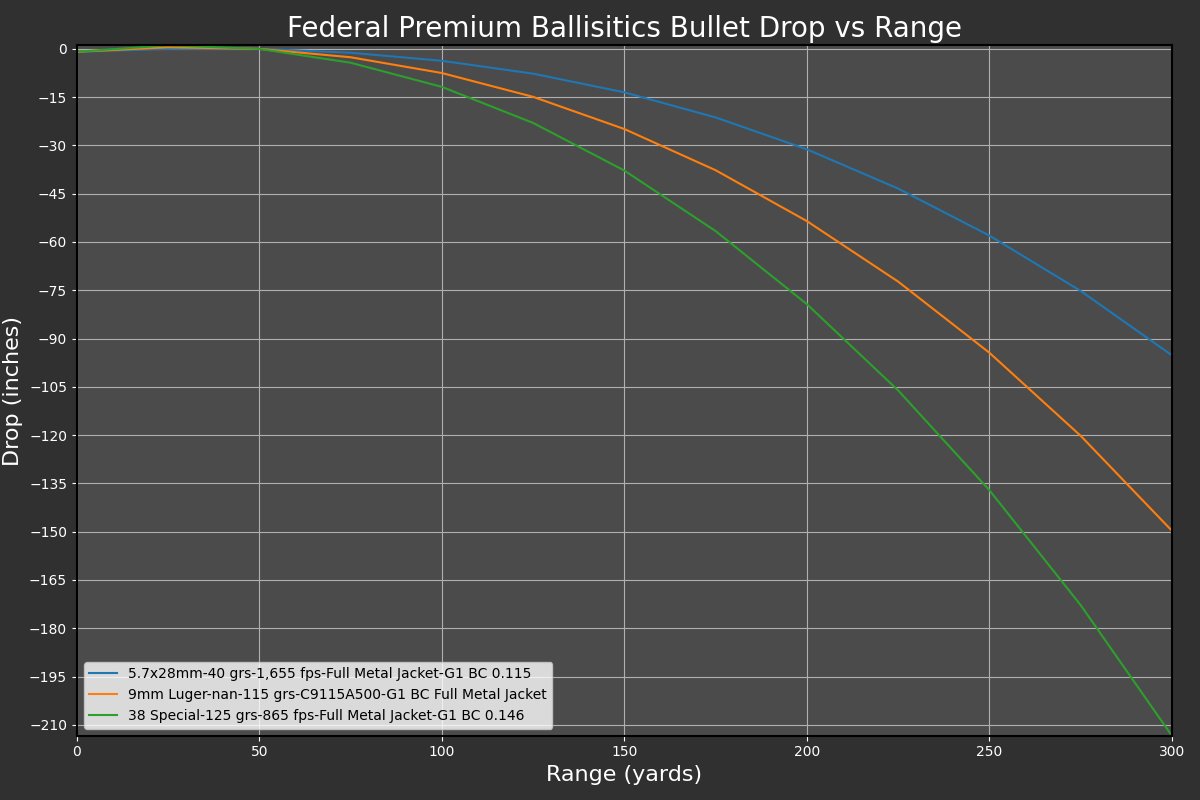
I wouldn’t have thought the energy would have been higher than a 38 Special, so it makes me wonder; if given the same market and design focus that the 9mm has gotten over the last 15-20 years, would the 5.7 not be a more reliable defensive round?
The 5.7x28mm Design & High-Capacity Advantage
When you’re comparing one caliber against another, the ballistics and performance of a particular round are critical, but they aren’t the only factors to consider.
One of the most noticeable things about the 5.7 is how it looks. Look out a picture online with nothing else for scale and the cartridge looks like a rifle round with its bottlenecked case and smaller projectile. It’s quite unique in the world of pistol calibers.
The case on the 5.7x28mm, however, has much smaller dimensions than a rifle cartridge as it was designed to run in a pistol or small carbine. It’s this size that gives the 5.7 one of its key benefits over other rounds, and that is capacity.
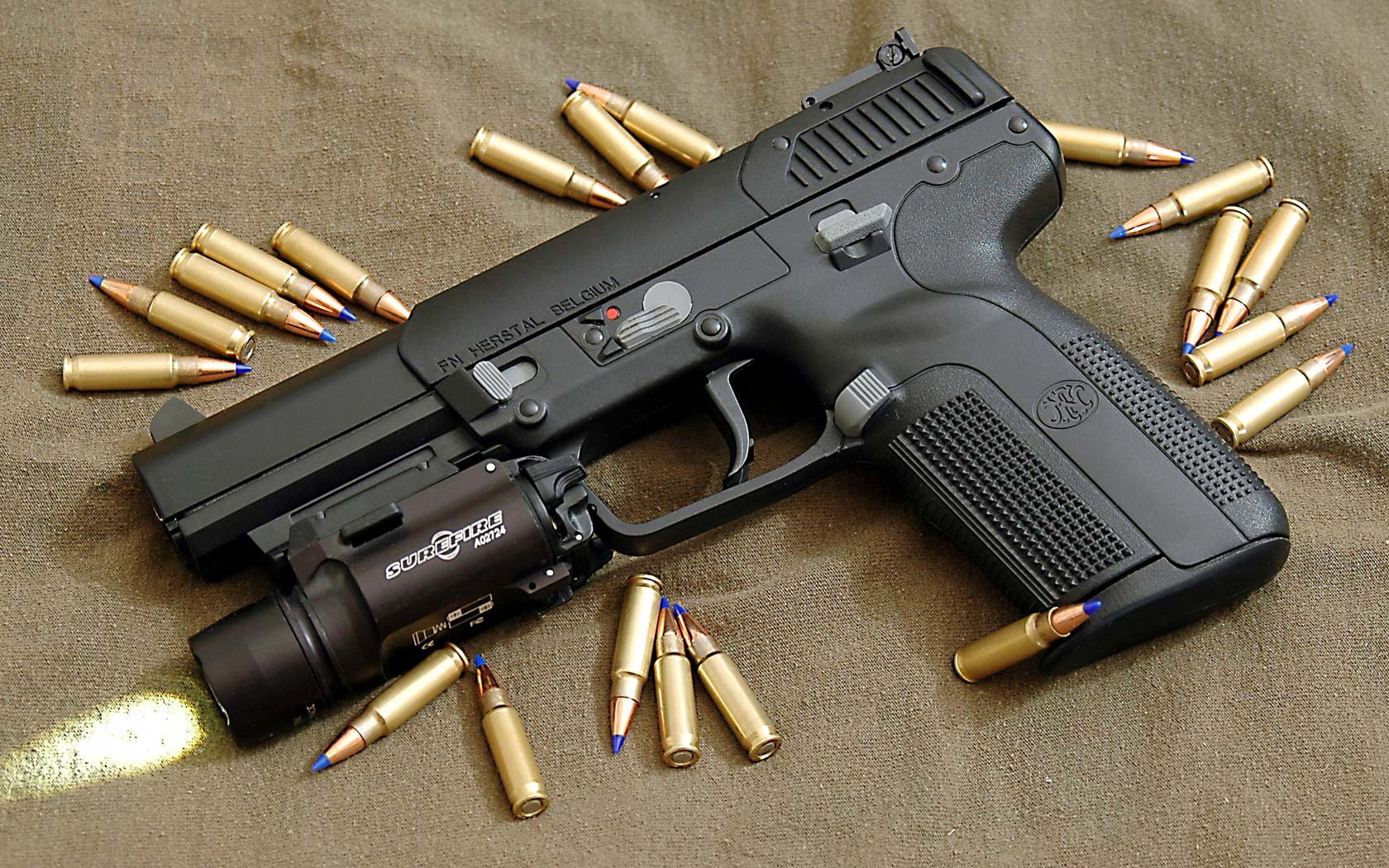
The original FN Five-Seven pistol has a capacity of 20+1, giving it an advantage over even the largest 9mm pistols, which usually will carry 15 or 17+1. Ruger’s 5.7 pistol also carries 20+1, while the PSA Rock 5.7 and 5.7 compact hold 23+1 and 21+1, respectively.
Getting 20 or more rounds in a pistol that’s chambered in a viable defense caliber is outstanding. Those pistols are still a pretty large package, but they can be carried openly or concealed, and capacity in a defensive situation has a lot of value.
Why the 5.7×28 Has Less Recoil Than 9mm
Another place where the 5.7×28 edges past the 9mm is in felt recoil.
While the 9mm is a very comfortable round for most shooters, the 5.7 shoots even softer. The designers goal in creating the 5.7 was to make a round that allows for high capacity and low recoil.
The 5.7×28 accomplishes that in spades.
Couple the light recoil with higher capacity, and you have a combination that allows the user to put more rounds out with a higher level of accuracy, and with faster follow up shots. It’s no wonder that the 5.7×28 has found a following in security and armed forces around the world.
Another advantage of the low recoil is for new and recoil sensitive shooters. Getting some work behind a robust gun with a soft feel is a great way to learn good shooting habits, and if you can train out the instinct to punch a trigger early, you’ll have a better experience on higher recoil calibers later.
Like I said earlier, shooting a 9mm pistol is not a harsh experience, even with hotter +P ammunition. The 9mm is extremely shootable, and with a subsonic round like the Hornady Subsonic 147 Grain XTP the experience gets even better.
Still, the 5.7 does have verifiably less recoil than the 9mm, but if the subsonics sound attractive, read this article: Best 9mm Subsonic Ammo: Top Picks & Uses
Why the 9mm Owns the Conceal Carry Market
The firearm industry has spent a lot of resources over the last 15 years on concealed carry as consumers have taken more of an interest in self-preservation.
First came small single stack guns like the Glock 43, then the Sig P365 changed the game with an even smaller, narrower double stack pistol that could ride in a pocket or conceal neatly under a T-shirt. All this while packing 10+1 rounds.
The market raced to catch up, and now there’s a wide selection of carry guns to choose from.
Of all the numerous compact and micro-compact pistols out there, the vast majority are chambered in 9mm.
The size and length of the round have always made it easy to cram in a magazine at decent quantities, but new projectile technologies and higher magazine capacity has given the 9mm an even higher leg up.
One of the challenges of the shorter, smaller guns is generating enough velocity in a short barrel to get reliable expansion and penetration on target while keeping the 9mm comfortable enough to shoot.
That’s where more advanced projectiles came through and helped make the 9mm not only viable, but preferable as a defensive caliber.
If you want to see a few examples or are planning to carry 9mm, this article is a must: What is the Best 9mm Self Defense Cartridge for EDC?
All of that is to say that the 9mm is lightyears ahead of other calibers in the concealment category, but especially the 5.7×28. While the 5.7 offers a very high capacity, the length of the round and the size of the current pistol offerings make it very difficult to conceal.
The 5.7 pistols I mentioned earlier are big, full sized guns that are more likely to be carried on a hip than in your waistband. Now, open carry culture has certainly grown, but the majority of pistols are carried concealed, and being stuck with a large format gun is a big negative for the 5.7.
The Cost Gap Isn’t Even Close
Finally, let’s talk about money. The 9mm walks away with this category and it’s not close. The 9mm is cheaper to get into from a firearm perspective, cheaper to shoot, and easier to find accessories for.
Outside of some demand related shortages, the 9mm is easy to find and affordable to train with.
In such a competitive market that’s centered around one caliber like the pistol market is right now, it’s easy to see why the cost for 9mm firearms and ammunition is so low. Anyone that’s overpriced is going to be looking for ways to make their products cheaper and easier to access, or they’ll be looking for new work.
Let’s look at the cost of Fiocchi’s Range Dynamics in both 9mm and 5.7×28 as an apples to apples comparison. As of this moment, the 9mm is running $0.26/round while the 5.7 is at $0.78/round, right at triple the cost.
At that price, shooting a full magazine out of your FN Five-Seven is going to run you over $16. Ouch.
In addition to the cost of the ammunition, the cost of a gun chambered in 5.7×28 has, until recently, been on the high side. FN’s own Five-Seven pistol and PS90 carbine were the only mainstream options and currently run around $1,100 and $1,600, respectively.
However, the recent influx of lower priced firearms from Kel-Tec, Ruger, Smith & Wesson, and others for less than $600 give some hope to the 5.7’s future.
What the 5.7 Can Learn From the 9mm
The 5.7×28 remains a fringe round for the time being with some potential applications, but facing a stiff uphill climb to snag market share away from the 9mm. But it’s in the 9mm’s history that the 5.7 could find its blueprint to success.
The 5.7, having already been accepted into the global military, police, and security arsenal has taken the first step in gaining credibility as a viable round. It’s the step down that the round takes in the civilian market that has stopped its forward progress.
Who knows what developments will come in the industry that allow the civilian version of the 5.7×28 to take some leaps forward in performance, the size of the guns, and help manufacturers cut costs?
That’s the beauty of this industry: there’s always someone pushing the envelope somewhere, be it a corporation trying to corner a part of the market, or a wildcatter in their garage, counting grains of powder trying to perfect a new cartridge.
It is said that the only real constant in life is change, and the 9mm has constantly changed, or been a part of the change that the firearm industry has demanded.
From the Browning Hi-Power of the 1930’s to the development of the P365 in the late 2010’s the 9mm has been a conduit for change for nearly a century, and for now it remains the reigning king of the pistol calibers, for now…
5.7x28mm vs 9mm FAQs
Q: Is 5.7 Deadlier Than 9MM?
“Deadlier” isn’t the right framing. 9mm typically delivers more mass and energy with proven terminal performance, while 5.7×28mm emphasizes speed, low recoil, and penetration characteristics that depend heavily on the specific load used.
Q: Why Isn’t 5.7 More Popular?
Cost, limited firearm options, and mixed perceptions about real-world stopping power have slowed adoption. 9mm benefits from decades of widespread use, cheaper ammo, broader support, and a much larger ecosystem of guns and loads.
Q: Will 5.7 X28 Stop a Bear?
No. 5.7×28mm is not suitable for bear defense. Large predators require deep penetration and heavy bullets, which are better provided by magnum handgun cartridges or large-caliber rifles specifically intended for dangerous game.
Q: Will 5.7 Penetrate Body Armor?
Some military-specific 5.7 loads were designed for armor penetration, but civilian-available ammunition generally does not defeat modern rifle-rated armor and may not reliably penetrate higher-level soft armor either.
Q: Should You Conceal Carry 5.7x28mm?
It can be concealed in certain pistols, but most are larger than typical concealed-carry handguns. While recoil is low and capacity is high, ammo cost, availability, and terminal performance make 9mm a more practical choice for most people.