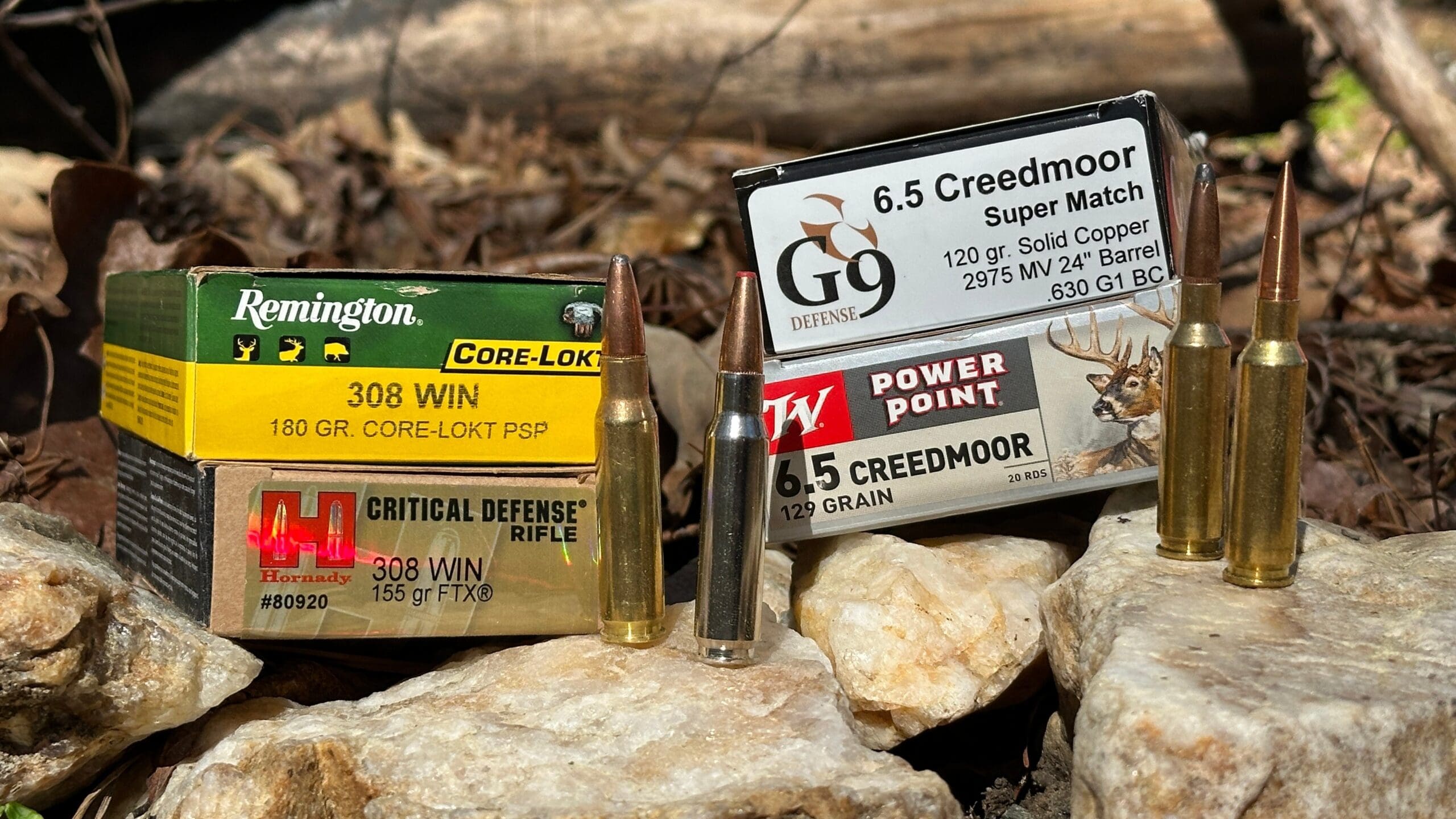
Prefer audio over written content? Listen to the article here:
Trying to determine the best cartridge to use for hunting or target shooting is tough because when it comes to caliber selection, there are so many options that it’s hard to say one is always better than another.
It often comes down to the shooter’s preferences and the specific scenario of the hunt.
The .308 Winchester and the 6.5 Creedmoor are fantastic cartridges for hunters and target shooters alike. They are capable of extreme accuracy, and if the shot distance is within a reasonable range, they will knock down all commonly hunted big game animals in the lower 48 with ease.
While both cartridges will do the job in most situations, that’s not really what most people are looking for. Most hunters and shooters are looking for an edge in the field.
They want to know which caliber will help them harvest an animal, while another may fall short, or which one will help them get a higher score during a competition.
Below, I discuss the pros and cons of the .308 Winchester and the 6.5 Creedmoor. However, there isn’t technically one that is better than the other; it’s going to come down to your specific situation and what you expect out of a gun.
.308 Winchester Vs. 6.5 Creedmoor | Ballistics Showdown
These cartridges are two of the most popular today, especially for hunters who want to purchase a gun chambered in a versatile cartridge with good ballistics, and doesn’t kick like the larger magnum cartridges.
If you’re a ballistics nerd like me and you want to see how these concepts apply to other cartridges, you got to check out this article here: Internal External & Terminal Ballistics [What Truly Matters]
However, there are still some big differences in these two cartridges. Let’s dive in below.
Bullet Trajectory Differences, Is It Big Enough to Matter?
For our purposes, trajectory is the bullet’s arc between leaving the barrel and impacting the target. As a bullet leaves the barrel of a rifle, it slightly arcs up, reaches its maximum ordinate (or peak), and then starts to drop back down again.
Since we lose to gravity every time, your bullet trajectory is a big factor if you’re shooting over a couple hundred yards.
How much that bullet drops or how exaggerated your arc is heavily depends on the cartridge. Ideally you want a cartridge with as flat an arc as possible; that way you don’t have to account for as much bullet drop when you start shooting serious distances.
With today’s dialable scopes and precise reticles, bullet drop isn’t as big a deal as it used to be. That said, for hunting, it’s nice to keep things simple and limit bullet drop as much as possible.
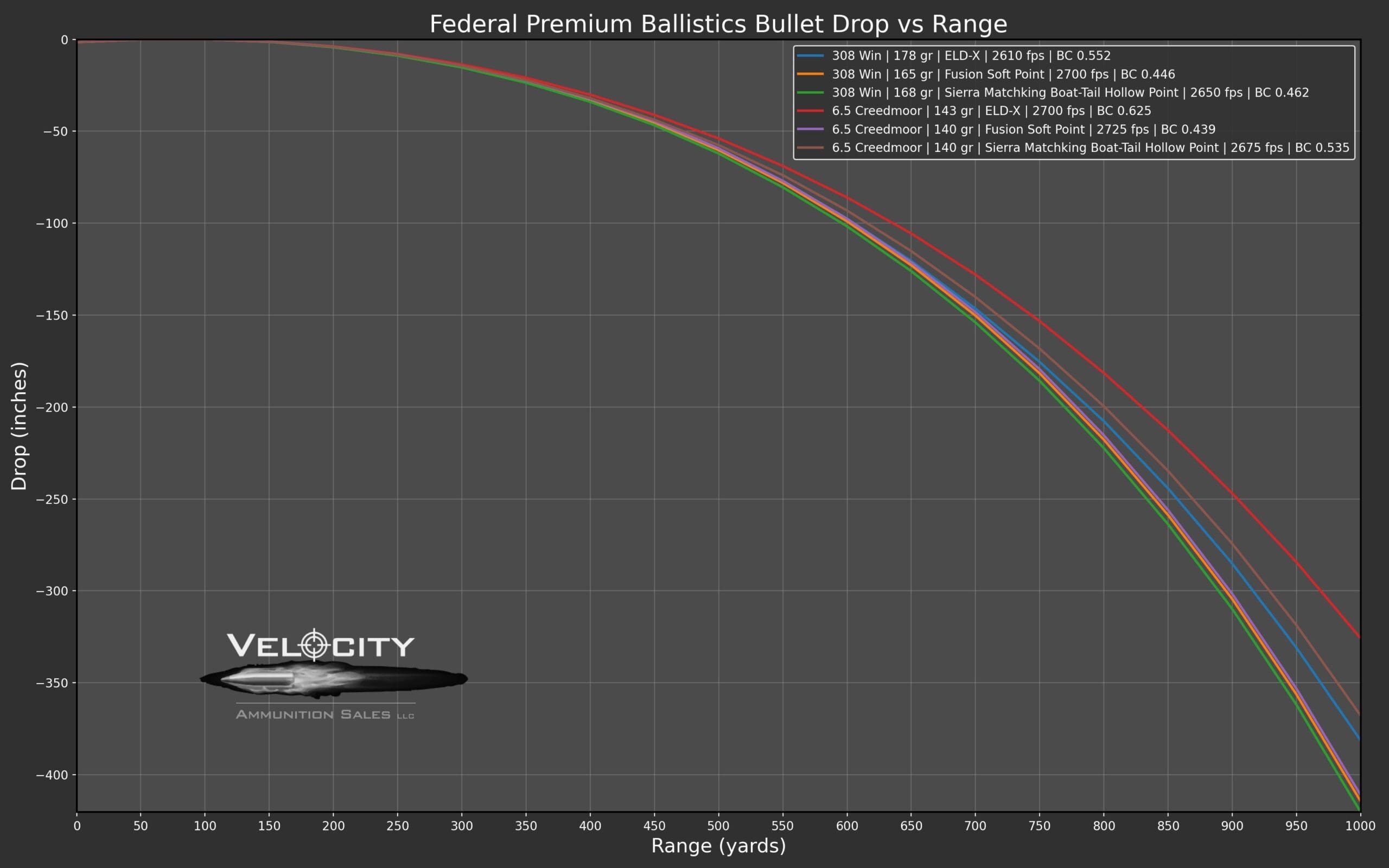
The long and short of it is, the 6.5 Creedmoor has less bullet drop than the .308 Winchester, but this really doesn’t show itself until you’re shooting farther than 300 or so yards.
This is due to the 6.5’s superior ballistic coefficient, which we will discuss later on.
At 400 yards, a 6.5 Creedmoor shooting Hornady 143 grain ELD-X will drop 30.1 inches, while the .308 Winchester shooting a Hornady 178 grain ELD-X will drop 33.6 inches.
At 600 yards, the 308 Winchester shooting the same bullet will drop 97.6 inches, while the 6.5 Creedmoor only drops 86 inches. The 6.5 Creedmoor is quite a bit flatter shooting and better suited to taking longer-range shots than the .308 Winchester.
If you were only considering these two cartridges, I would say this difference in drop is more important for long-range target shooters than it is for hunters.
Unless you’re taking 400-yard shots out west somewhere, most hunters aren’t going to notice that difference. If you are one of the hunters that take shots that far, you’re probably not using either of these cartridges to do it.
Wind Drift Resistance Between the .308 Winchester & 6.5 Creedmoor
Another difference between these two cartridges is wind drift. When comparing similar bullets, the 6.5 Creedmoor will drift less than the .308 Winchester.
Relatively minor differences in bullet drop tend to not bother me much because I use a dialable scope, and what’s one more click on the turret?
However, I typically hold over in the reticle for wind, and wind is much harder to judge than drop. Differences in ballistics between the 6.5 Creedmoor and .308 Winchester start to become clearer with wind drift.
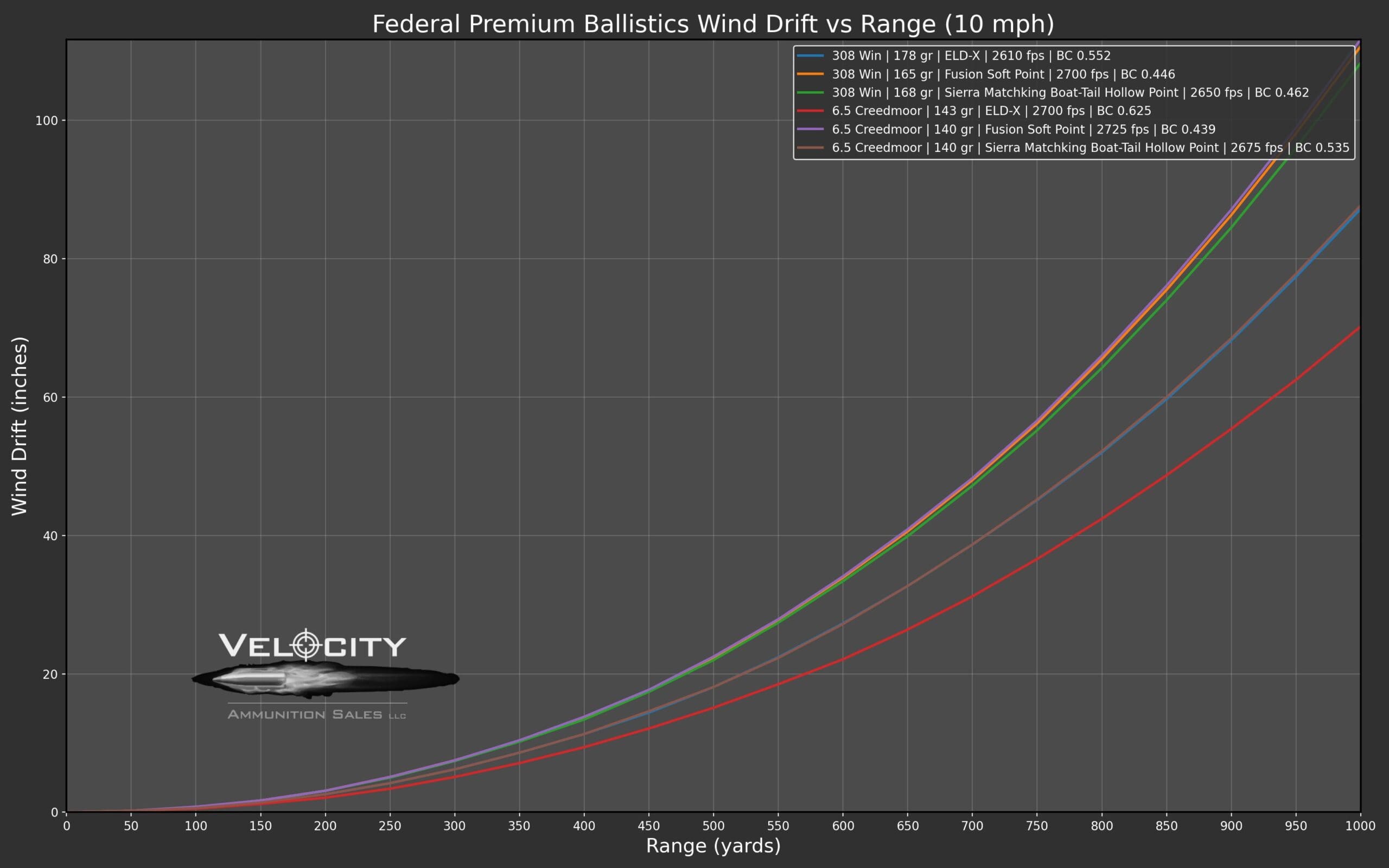
When comparing wind drift in a 10mph crosswind with a 168 grain Hornady ELD-X in .308 Winchester and a 143 grain ELD-X in a 6.5 Creedmoor, there are 11.3” and 9.4” wind drift, respectively. The 6.5 Creedmoor , even at 400 yards, has less drift than the .308 Winchester.
At 1000 yards, the gap becomes even wider. The .308 Winchester drifts 87.2 inches while the 6.5 Creedmoor drifts 70.2 inches.
If you hunt in windy places, the 6.5 Creedmoor will give you an edge. Even at 400 yards, a 3-inch difference in wind drift can be the difference between a wounded animal and a clean kill.
Ballistic Coefficients | A One-Sided Contest for the 6.5 Creedmoor
The ballistic coefficient is essentially a measure of how slippery a bullet is through the air and how well it maintains velocity and energy in flight.
The higher the ballistic coefficient, the better. The longer, narrower bullets pierce through the air more easily and don’t experience as much drag; therefore they will have higher ballistic coefficients.
Notably, bullets on the heavier side typically have higher ballistic coefficients than lighter bullets of a similar design.
The smaller caliber size of the 6.5 Creedmoor is going to give it an edge over the .308. Its diameter is 6.5 mm or .264 caliber so out of the gate, you can expect it to have a higher ballistic coefficient than the wider .308 Winchester.
This makes sense because the more surface area, the greater the force of friction on the bullet as it flies through the air, aka drag.
All of this is to say, if you’re selecting heavy-for-caliber bullets for a 6.5 Creedmoor, they will likely have a better ballistic coefficient than similar bullets for the .308 Winchester.
Energy Transfer | Where the Classic .308 Shines
Energy transfer is measured in foot-pounds and is a measure of how much energy is transferred from a bullet to a target. It is a good measure of how well the bullet will perform on game. The higher the energy transfer for hunting, the better, and heavier bullets produce more energy.
Bullet weight is a big deal in ballistics and if you want to dive more into it, we’ve got an entire article on why this is important: How Does Bullet Weight Actually Affect Performance?
However, higher energy transfer comes at a cost. The more energy a gun produces, the more recoil the rifle will have.
When comparing similar gun weights, the larger .308 Winchester will produce more recoil and hit harder because it uses more powder and heavier grain bullets. Although I don’t think that the recoil difference is too extreme between these two cartridges.
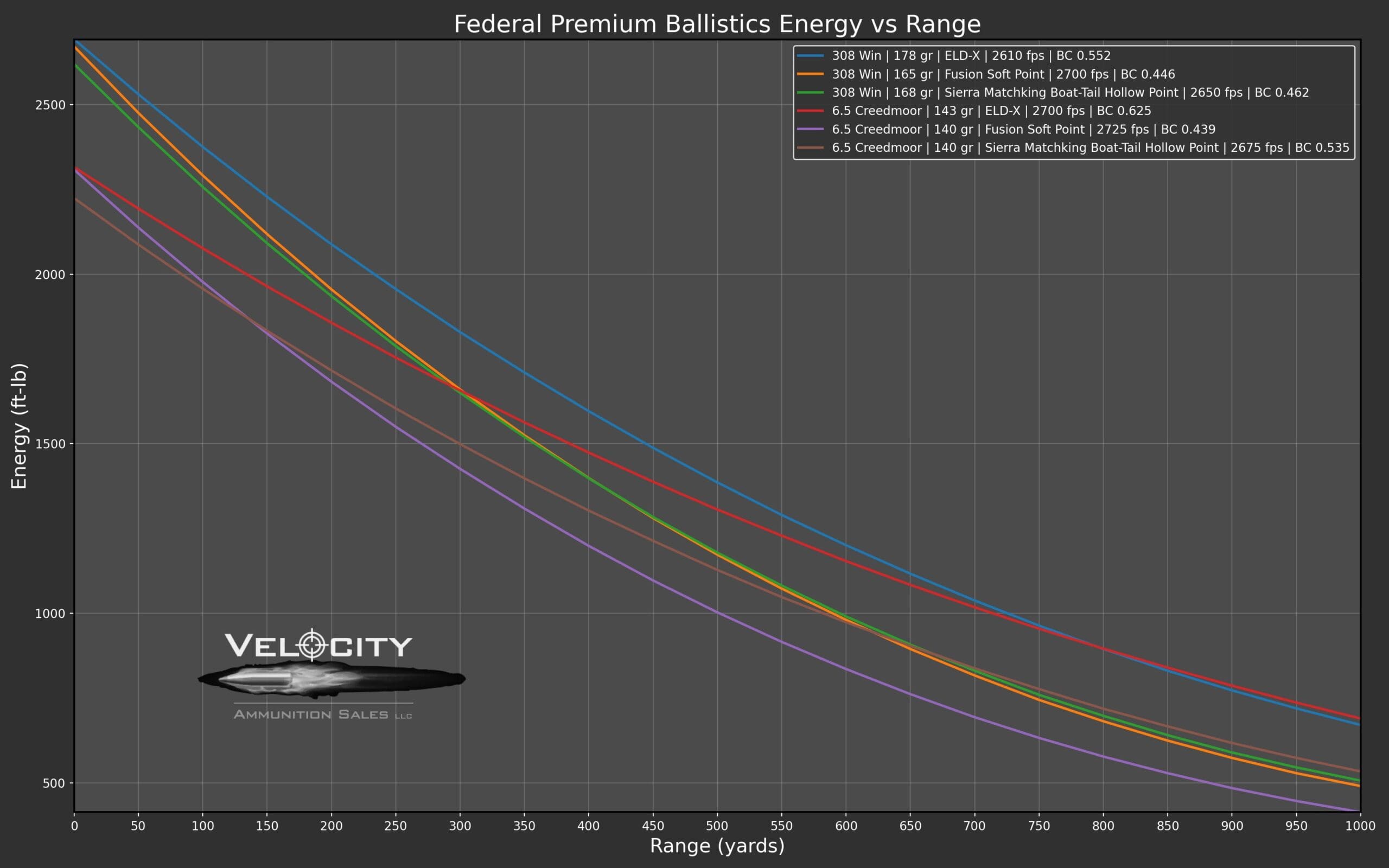
At typical ranges for hunting, say 400 yards and in, the additional energy produced by the .308 Winchester might give it an edge on big game like deer or elk. Even stretching out to 800 yards, you’ll see that the 308 Winchester consistently beats out the 6.5 Creedmoor in pure energy.
So if you want a cartridge that hits hard, whenever it hits, the 308 Winchester is your obvious choice here.
A Plethora of Bullet Choices
Excellent bullet options for the 6.5 Creedmoor and .308 Winchester are the Hornady ELD-X and ELD-M. The ELD-X is a better hunting bullet that won’t fragment as rapidly as the ELD-M and was designed for hunting.
This year, I tried a 147-grain Hornady ELD-M with my 6.5 Creedmoor and shot a whitetail at 200 yards. The shot entered about 1 inch behind the front shoulder and exited at the back of the ribcage.
I had bloodshot meat in the shank and lost part of the shoulder. For some people, they want maximum internal damage, and the bullet certainly did that.
For me, I don’t like wasting meat and losing part of a shoulder I didn’t directly hit isn’t acceptable.
In the future, I’ll save the ELD-Ms for target shooting, which is what they were designed for and excel at, and stick with the 143-grain ELD-X for hunting. Another fantastic option that admittedly has worse ballistics at longer range than the ELD-Xs is the Barnes monolithic copper LRX bullet.
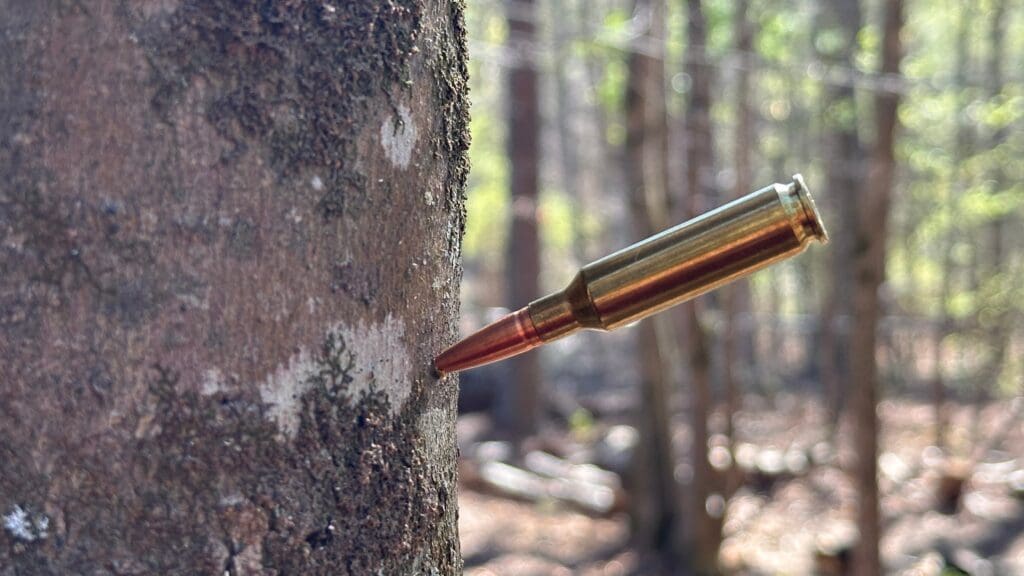
I’ve shot a pile of animals with these, including a handful of bears and a bunch of deer, and they’ve always done their job.The pure copper monoliths do some damage, and are pretty sharp as you can see… If you like 6.5 but have trouble punching through a shoulder every now and then, try the monolith.
On the 308 side there’s nothing quite like a Remington Core-Lokt. I usually use the soft point Core-Lokts but the ballistic tipped ones are fairly popular in stores.
I hunted with a Remington 700 chambered in 308 for many years and have killed no fewer than 30 deer with a Remington Core-Lokt out of it. I can’t say I’ve ever had any complaints!
Recoil Differences Between the .308 Winchester & 6.5 Creedmoor
Recoil is often overlooked by new hunters and shooters who want the latest and greatest rifle chambered in the hardest-hitting cartridge they can get their hands on.
However, new hunters and shooters are often not capable of properly handling heavy recoiling rifles and can develop bad shooting habits.
Additionally, in my opinion most new hunters can’t and shouldn’t be taking long-range shots at game in the field, which negates the need for a heavy recoiling rifle.
Fortunately, the .308 Winchester and 6.5 Creedmoor aren’t heavy recoiling rifles.
The 6.5 Creedmoor can produce up to 15lbs of recoil in a standard hunting rifle, and the .308 Winchester will produce around 19 lbs of recoil in a similar setup.
The 6.5 Creedmoor will be easier to handle and shoot for most new shooters. It’s often a great choice for children and women but it works just as well in the mountain man’s hands.
In fact, I frequently shoot a 6.5 Creedmoor and thoroughly enjoy it, and I’ve been shooting my entire life. The lighter recoil is easier to mitigate, and I tend to shoot lighter recoiling guns more accurately.
Further, a lighter recoiling gun is almost always more enjoyable to shoot. If you enjoy shooting your gun, you’re more likely to shoot more often and therefore are going to be more accurate for it!
The 308 Winchester Has Killed More Deer Than CWD!
The 6.5 Creedmoor and .308 Winchester are both sufficient for commonly hunted game animals in the lower 48 out to 400 yards and further in the right hands.
Still, the 308 has been around for many decades and it has killed literally millions of deer. It’s tried and true and battle tested. If you need a cartridge that you don’t need to worry about, the 308 is the one for you.
The .308 Winchester will produce more energy than the 6.5 Creedmoor in the range of 200 to 300 ft pounds out to around 400 yards.
However, at further ranges, around 500 yards and out, the 6.5 Creedmoor’s superior ballistics will take over as it’s better bullet drop and when drift resistance starts to shine.
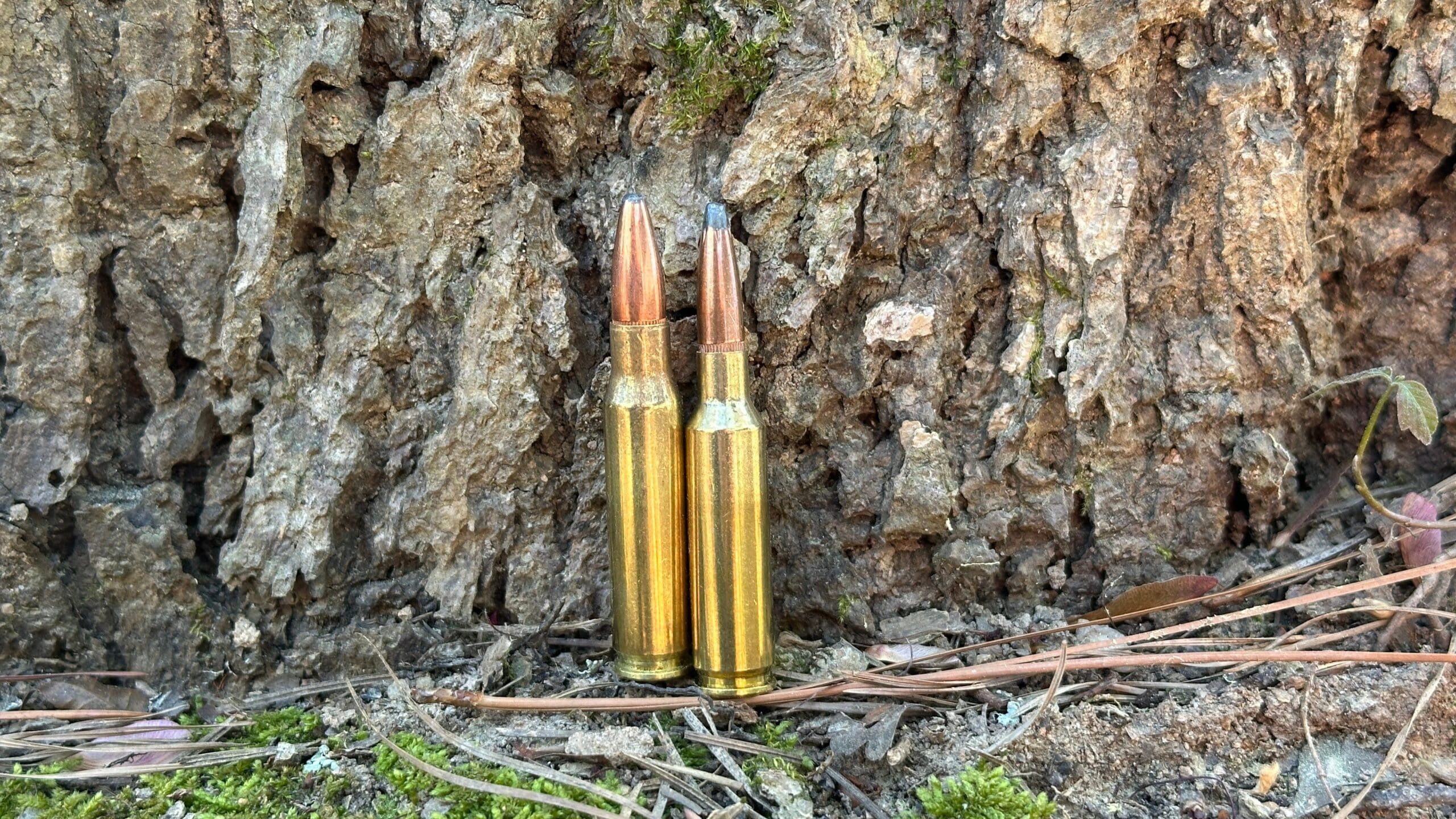
All this to suffice, when hunting big game animals at regular ranges (within 400 yards), the .308 Winchester is the better choice.
The one caveat is that it will produce a tad more recoil than the 6.5 Creedmoor, so if you’re smaller-framed or recoil sensitive, the 6.5 Creedmoor is a better choice.
At longer ranges or in high wind environments, hunters should choose the 6.5 Creedmoor and select a high BC heavy for caliber bullet.
When shooting longer ranges, it’s important to keep in mind the minimum expansion velocity for your selected bullet and make sure to stay above it for reliable performance on game.
Target Shooting | the 6.5 Creedmoor’s Wheelhouse
Factors are weighted differently for target shooting than hunting. For target shooting, the most important factors are recoil, wind drift, bullet drop, and, if you shoot often, barrel life and ammunition costs.
For target shooting, shooters often prefer low-recoil guns with the best ballistics they can get. However, energy on target isn’t a big concern.
This is where the 6.5 Creedmoor shines. The 6.5 Creedmoor will have 20% to 30% less wind drift than a .308 Winchester in a 10mph wind at 1000 yards. Not to mention the significant reduction in bullet drop at that distance.
Additionally, the reduced recoil allows shooters to be more accurate and comfortable during long sessions at the range.
Barrel Life for Frequent Shooters
For target shooters, barrel life is often much more of an important consideration than for hunters. While the 6.5 Creedmoor wins in the recoil and ballistics category for target shooting, it falls short on barrel life.
Shooters can expect a barrel life of around 3000 rounds from 6.5 Creedmoors and 10,000 rounds from the .308 Winchester.
It comes down to heat and throat pressure. 6.5 Creedmoor produces hotter, higher-pressure gas flow right at the throat because it propels long, sleek bullets at relatively high velocity with more powder than is ideal for the diameter of the bore.
That increases the rate of erosion which means accuracy often starts to fade around 2,000–3,000 rounds with precision shooting.
The. 308 Winchester is kinder to barrels because it operates a touch slower and is more balanced in terms of caliber to bore size. Less intense heat/erosion per round means you’ll commonly see barrels lasting 5,000–10,000+ rounds.
In short, the 6.5 Creedmoor sacrifices barrel life for performance, while .308 sacrifices some performance for durability.
The .308 Winchester wins here; however, it’s possible to get a gun rebarreled, and if you’re shooting that much, you may not be worried about rebarreling costs anyway.
Rebarreling a rifle will cost anywhere from $600 to well over $1000, depending on whether it’s a pre-fit or a blank and the quality of the barrel and gunsmith.
At over $2/round for Hornady ELD-M ammunition for both 6.5 Creedmoor and .308 Winchester, shooters will be spending $6,000 on ammo to burn out a 6.5 Creedmoor and $20,000 for the .308 Winchester. Of course, if you reload, your costs will be less but still significant.
Ammunition Costs & Availability
Ammunition costs for 6.5 Creedmoor and .308 Winchester are generally fairly close, and for hunters, there’s not much difference.
However, costs do add up for target shooters. In general, 6.5 Creedmoor ammo costs slightly more per round than .308 Winchester ammo.
However, there are cases where this is reversed, so if you are planning to shoot a lot and cost is an important factor, keep this in mind and do a little research on the ammunition you want to shoot before buying the gun.
Self Defense in the Hill Country
For most, the first guns that come to mind for self-defense are handguns, maybe followed by shotguns and then rifles.
However, for certain scenarios, like on rural properties or when you may need maximum stopping power, like for bears, rifles may be the best choice.
The .308 Winchester wins hands down compared to the 6.5 Creedmoor in this scenario for one reason. It provides more stopping power at short ranges.
Additionally, ammo is typically cheaper and readily available.
When using a rifle for self-defense, you’ll need to be extremely careful regarding overpenetration. To help mitigate this risk, you can select bullets specifically designed for self-defense. One of the best bullets to reduce overpenetration is the Hornady Critical Defense round.
This round was developed to specifically mitigate overpenetration. It rapidly expands on impact and dumps energy into the target. If you’ve got a long gun with a magazine and these loaded into it, there’s not much that can get in your way.
6.5 Creedmoor Vs .308 Winchester | Who Is the Real Winner?
If you made it this far, I hope you learned a lot about the similarities and differences between the 6.5 Creedmoor and .308 Winchester cartridges.
Both cartridges are suitable for hunting and target shooting. However, there are specific situations where one will pull away from the other.
For hunting most game animals 500 yards and in, it probably doesn’t make much of a difference which cartridge you pick.
If hunting bigger game like elk or large black bears, the heavier bullets from the .308 Winchester might give it a bit of an edge. That said, over 500 yards, the 6.5 Creedmoor’s superior ballistics will help you place the bullet where you want.
If you’re selecting a cartridge for target shooting, you need to weigh the pros and cons of barrel life, ballistics, and recoil.
If you prefer a light recoiling rifle with better ballistics and are ok with reduced barrel life, then the 6.5 Creedmoor may be for you.
If barrel life is more important and you’re ok with increased recoil, then the .308 Winchester is a better choice.
If you can’t decide which cartridge is best, maybe get both and try them out yourself!
6.5 Creedmoor Vs .308 Winchester FAQs
Q: Which Cartridge Is Better for Long-Range Shooting?
The 6.5 Creedmoor generally outperforms at long range due to its flatter trajectory and lower wind drift. Its higher ballistic coefficient helps maintain velocity, making it easier to place accurate shots beyond 400 yards compared to the .308 Winchester.
Q: Is .308 Winchester More Powerful Than 6.5 Creedmoor?
Yes, the .308 Winchester typically delivers more energy on impact, especially within 400 yards. Its heavier bullets transfer more force to the target, making it a strong choice for larger game, though this added power comes with slightly increased recoil.
Q: How Do Recoil Levels Compare Between These Cartridges?
The 6.5 Creedmoor produces noticeably less recoil than the .308 Winchester, making it more comfortable to shoot over long sessions. This reduced recoil can also help shooters maintain better control and improve accuracy, especially for beginners or recoil-sensitive users.
Q: Which Cartridge Has Better Barrel Life?
The .308 Winchester has a clear advantage in barrel life, often lasting up to 10,000 rounds. In contrast, 6.5 Creedmoor barrels may show noticeable wear around 2,000 to 3,000 rounds due to higher heat and pressure at the throat.
Q: Which Option Is Better for Hunting Big Game?
For big game hunting within typical ranges, the .308 Winchester has a slight edge because of its higher energy and heavier bullets. However, both cartridges are highly effective, and proper shot placement remains the most critical factor for ethical and successful hunts.