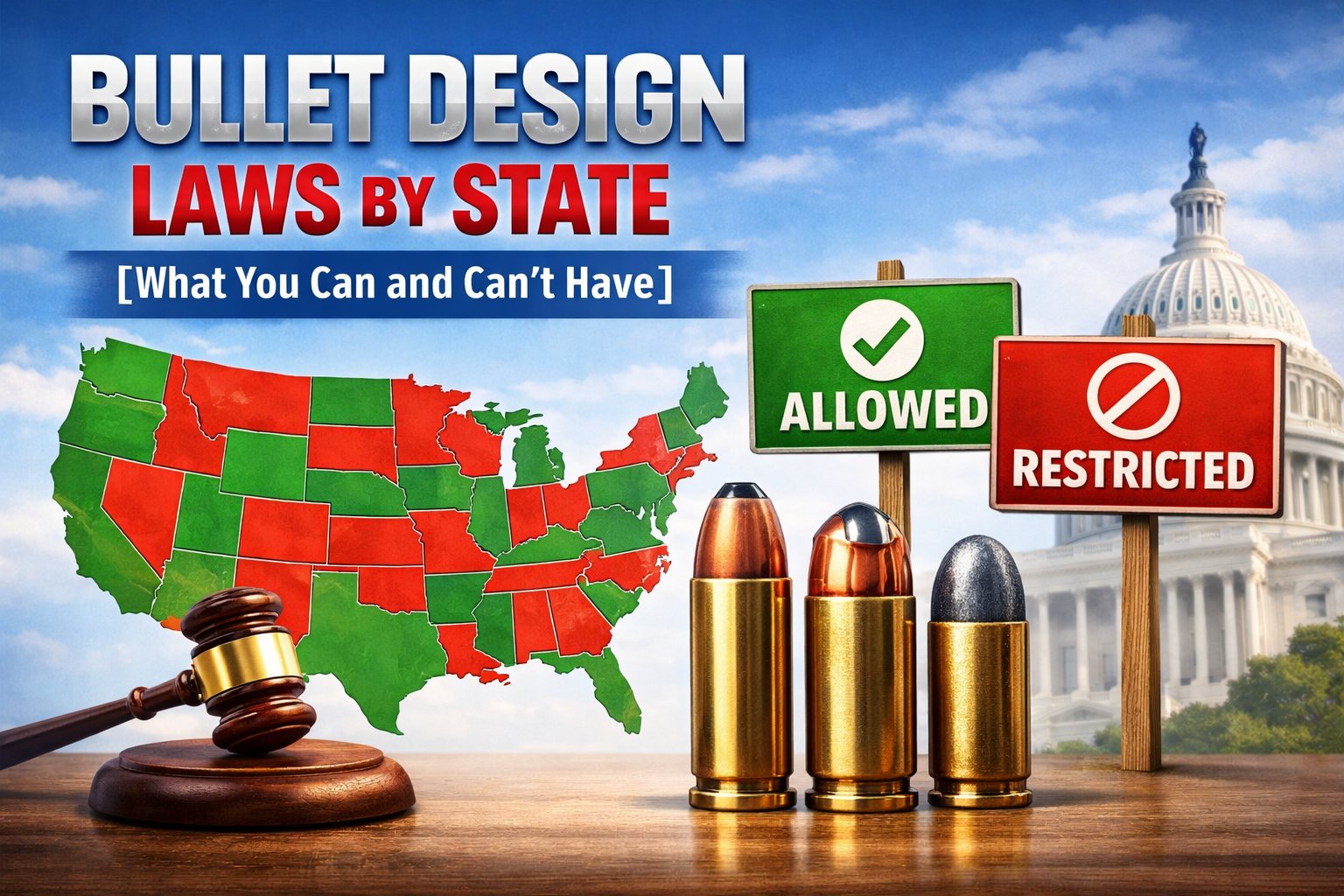
Firearms and ammunition restrictions are crucial to understand at both the federal and state levels, as they have significant legal implications. Federal laws and restrictions apply to all states, while individual states can have statutes that outline exemptions or inclusions for different types of ammunition and bullet designs. Keep in mind that restrictions on the type of ammunition you can own are different from the types of ammunition that you can use during certain activities (like hunting).
This is where things can get tricky; each state is different. Some are more restrictive than others, while some have more laxity in their statutes about exactly what you can and can’t own in terms of ammunition. While this article uses the most current information available as of its publication date, laws can change from year to year, and it’s important to be familiar with your state’s laws whenever new legislation is passed.
Now that the formalities are out of the way let’s dive in to see what each state’s bullet design laws are and what you can and can’t own as a firearm aficionado.
Federal Ammunition Restrictions
Federal laws and regulations are relevant if the states choose to apply them to their constituents. Some states adopt state-level regulations that mirror federal law; others don’t. Some states even provide exceptions to law enforcement personnel or certain military personnel.
In cases where states don’t adopt federal law, it’s essential to remember that federal laws apply whenever you cross state lines (i.e., transporting ammunition).
The largest Federal restriction on ammunition is for armor-piercing (AP) cartridges. Their use is generally restricted to law enforcement, military, or for exportation. The statute is as follows: The manufacture, importation, sale, or delivery of armor-piercing (AP) or metal-piercing ammunition (18 U.S.C. § 921, 18 U.S.C. § 922 and 27 CFR § 478.37), unless you hold a Federal Firearms License.
Alabama
Alabama state law (Ala. Code § 13A-11-60) prohibits the possession or sale of brass or steel Teflon-coated handgun ammunition, and the possession or sale of “ammunition or any ammunition of like kind designed to penetrate bullet-proof vests.”
The exception to this law applies to state and local law enforcement officers. An additional exception is clarified, allowing the sale of Teflon-coated lead or brass ammunition that’s designed to expand upon contact.
Alaska
Alaska does not have a state legislature that restricts ammunition. However, Federal ammunition restrictions apply and prohibit the possession or sale of armor-piercing ammo. This means that on a state level, ammunition is not regulated (which translates to you can own and sell whatever kind of bullets you want).
However, you have to be aware that nuanced situations like transportation across state lines are where the Federal law applies. Essentially, no transporting armor-piercing ammunition across state lines, or you could be prosecuted at the federal level.
Arizona
Arizona is another state that has few firearm-related regulations. Even more interestingly, its state law has language that specifically outlines that firearms, firearm accessories, and ammunition that are manufactured commercially or privately in the state are not subject to federal law or regulation.
This means any bullet design goes as long as it’s made in-state and used in-state. Any ammunition that crosses state lines is subject to federal laws and regulations.
Arkansas
There are no restrictions on ammunition manufacturing, possession, or sale in Arkansas. In fact, there’s not even an age limit or licensure requirement to own, sell, or buy ammunition in this state. Remember, federal law applies in this case when transporting ammo over state lines.
California
California is the first state on our list that has some more intensive restrictions on ammunition. If you pay attention, you’ll notice a consistent theme of these restrictions that stems from California’s high fire risk.
California prohibits the possession, sale, or manufacturing of:
- Armor-piercing ammunition
- Tracer rounds for handguns
- Incendiary ammunition
- Flechette darts and bullets containing or carrying an explosive agent
Tracer round: tracer rounds have a small pyrotechnic charge in their base that burns brightly upon discharge. This allows the shooter to visibly track the projectile’s path and make ballistics corrections for long-distance shots.
There are some brands of non-incendiary tracer rounds, like Ammo, Inc.’s “streak” line, that uses a luminescent coating instead of a pyrotechnic charge. If you have your heart set on owning a tracer round in California, I highly recommend asking a local law official about the law’s application in this situation before purchasing any.
Incendiary ammunition: Incendiary ammunition uses chemical substances to ignite fires and cause burning upon impact. Common compounds include magnesium and white phosphorus. High-explosive incendiary (HEI) rounds would fall under this category.
Flechette darts and bullets: Under California’s penal code, Flechette darts and bullets themselves aren’t prohibited, but if they contain or carry an incendiary or explosive agent, they are.
Colorado
Colorado defers much of its ammunition regulation to its local governments. While there isn’t a state-level restriction on certain types of bullet designs, there may be municipal restrictions, depending on the area you are in. Even with this exception, many areas have more extensive regulations on the types of firearms and accessories rather than the type of ammunition itself.
For example, the City of Aurora specifically prohibits the sale or possession of ammo coated or treated with Teflon (like KTW bullets). Remember that Federal restrictions against AP ammo still apply.
Connecticut
Connecticut adopts federal restrictions as state law regarding AP ammo. They additionally ban incendiary .50 caliber bullets. This state further defines bullet design restrictions in CGS § 53-202l to include specific internal materials like tungsten alloys, steel, iron, brass, bronze, beryllium copper or depleted uranium in more detail than some other state legislation.
Delaware
Delaware doesn’t have specific state ammunition restrictions and abides by federal restrictions on AP ammunition when crossing state lines. However, the City of Wilmington does have a specific prohibition on possessing, selling, buying, or manufacturing AP ammunition within its boundaries.
Florida
Florida bans AP ammunition at the state level, as well as “exploding bullets.” Exploding bullets are not hollowpoint ammunition, and they do designate the difference in this statute (§790.31). Florida also includes further restrictions on types of shotgun shells, outlawing dragon’s breath, bolo shells, and flechette shells.
Georgia
Georgia doesn’t significantly regulate ammunition sales, possession, manufacturing, transfer, or purchases, with the exception of cases that fall under federal law applications (like transporting AP across state lines).
Hawaii
Hawaii is a generally permissive state when it comes to the type of ammunition you can have. It does ban the possession, sale, and manufacturing of AP ammunition and explosive ammunition.
Idaho
There are no state-level restrictions on the sale of ammunition for civilian use in Idaho, but federal restrictions on armor piercing ammunition still apply.
Illinois
Illinois prohibits the possession, sale, or manufacturing of AP ammunition, explosive bullets, and .50 BMG ammunition at a state level. Individual cities in the state of Illinois further restrict other types of ammunition, but this varies.
Indiana
In the state of Indiana, the only restriction is that of AP ammunition, similar to the federal restrictions. Law enforcement officers and agents are exempt from this statute.
Iowa
Iowa explicitly prohibits AP ammunition and exploding bullets at a state level. They also outlaw shotgun shells containing exothermic pyrophoric misch metal that are intended to project flames or fireballs like the popular “Dragons Breath”.
Kansas
Kansas has a few unique laws around ammunition. In Kansas, it is illegal to possess, manufacture, sell, lend, or transfer plastic‑coated handgun cartridges whose bullet cores are less than 60% lead by weight (Kan. Stat. Ann. § 21-6301(a)(6)). This law is designed to further restrict access to armor piercing ammunition, which is commonly polymer coated. Federal ammunition restrictions still apply in Kansas.
Kentucky
Kentucky’s state laws for ammunition are in the “less restrictive” category, banning the manufacturing, sale, delivery, transfer, or import of AP ammunition, but it does not restrict licensed gun dealers from possessing this ammunition to receive and transfer it to members of the military or law enforcement (KY Title XIX, Chapter 237, Section 237.080).
Louisiana
Louisiana prohibits the sale, manufacture, and possession of armor-piercing ammunition at the state level, aligning with federal regulations.
Maine
Maine prohibits armor-piercing ammunition at a state level as well, but further explains that this law does not include charges used for industrial purposes (like oil and gas well perforating devices). This restriction does not apply to members of the military, the reserves, the National Guard, or law enforcement officers and their agencies.
Maryland
Maryland prohibits the sale, or transfer of explosive or incendiary ammunition and AP ammunition at a state level. It is also illegal for anyone under 21 to possess or buy ammunition made for handguns or assault rifles.
Massachusetts
Massachusetts has some of the strictest regul;ations around ammunition in the country. If you are to possess ammunition, or components of ammunition, you must hold a valid Firearm Identification (FID) card or License to Carry (LTC) for handgun ammunition. There is also an outright ban on AP, tracer, incendiary, explosive, or highly frangable bullets.
Michigan
Michigan prohibits the sale, possession, transfer, or manufacture of armor-piercing ammunition at a state level, following the federal regulations.
Minnesota
The Minnesota legislature outlines a restriction on the use or possession of “metal penetrating bullets with hardened cores that prevent expansion on impact”. Possessing or using these bullets in a crime is a felony.
Mississippi
There are no major ammunition bans or restrictions in Mississippi. Federal ammunition restrictions apply, such as transporting ammunition across state lines.
Missouri
Missouri is another state where federal ammo restrictions apply by default (but are not defined at the state level). Additionally, Missouri prohibits the possession, manufacture, transportation, repair, or sale, of exploding or detonating ammunition. Additionally, it is illegal to sell ammunition to someone known to be intoxicated.
Montana
There are no state-level restrictions on the purchase, sale, or possession of ammunition in Montana. However, using AP ammunition during a crime adds 5 to 25 years to your sentence.
Nebraska
Nekraska does not impose any state-wide ammunition bans or regulations, other than allowing federal ammunition regulations to apply.
Nevada
The manufacture or sale of any “metal-penetrating bullets” designed for a handgun whose core is at least as hard as the hardest red metal alloys and that reduces normal bullet expansion upon impact is illegal in the state of Nevada.
New Hampshire
New Hampshire does not impose any strict ammunition bans, but using armor-piercing or Teflon-coated bullets during a crime adds a class B felony to your charges.
New Jersey
New Jersey has state-level restrictions that are circumstance-specific. For example, you cannot conceal carry hollow point ammunition, but it’s legal to own it for home defense, target practice, and hunting (if applicable). AP ammo is restricted at a state level, with exceptions for law enforcement.
New Mexico
New Mexico doesn’t regulate ammunition at the state level; however, municipalities may have restrictions that apply to their specific areas. New Mexico still allows federal regulations to apply.
New York
New York also restricts possession of AP ammunition (defined as a bullet whose core is entirely tungsten alloys, steel, iron, brass, bronze, beryllium copper, or uranium) and exploding ammunition at the state level. Federal regulations also apply.
North Carolina
North Carolina prohibits the import, manufacture, possession, storage, transport, sale, or transfer of Teflon-coated bullets at a state level. Federal regulations also apply.
North Dakota
North Dakota doesn’t have state-level ammunition restrictions, but does follow federal ammunition regulations.
Ohio
There are no state-level restrictions on ammunition in the state of Ohio beyond AP ammunition outlawed by federal regulations.
Oklahoma
Oklahoma prohibits explosive ammunition and AP ammunition at the state level. Oklahoma explicitly bans “restricted bullets”, defined as having less than 60% lead in the core, and being coated with a fluorocarbon (like Teflon), designed for high velocity, and capable of penetrating body armor.
Oregon
Oregon does not have explicit bans on types of ammunition at the state level, but it is one of the highly restrictive states in terms of firearm-related activities.
Pennsylvania
Pennsylvania is another state that has a specific restriction against AP ammunition at a state level only if it’s being used in the setting of a crime.
Rhode Island
Rhode Island prohibits AP ammunition on a state level, and it requires a valid handgun safety certificate or hunter education card to purchase ammunition.
South Carolina
It is prohibited at the state level to use, transport, manufacture, possess, distribute, sell, or purchase Teflon-coated ammunition in South Carolina.
South Dakota
South Dakota does not restrict any type of ammunition at a state level, though federal laws still apply.
Tennessee
Tennessee bans the manufacture, sale, display, or use of exploding bullets. You will also get additional charges for using rounds coated with plastic over non‑lead cores, jacketed bullets with non‑lead cores, or bullets wholly composed of non‑lead metals or alloys in a crime.
Texas
Texas specifically prohibits AP ammunition at the state level, following federal regulations.
Utah
Utah restricts AP ammunition and tracer/incendiary ammunition at a state level, with a few exceptions (like permission from the Director of the Division of Forestry, Fire, and State Lands).
Vermont
There are no state-level restrictions on ammunition in Vermont, but federal regulations are still enforced.
Virginia
Virginia specifies in their state law (§ 18.2-308.3) that it’s unlawful to use or possess “restricted ammunition” in the setting of a crime but does not ban specific types of ammunition for civilian possession.
Washington
The state of Washington does not have state-level restrictions against certain types of ammunition, but federal regulations still apply.
West Virginia
West Virginia does not have restrictions on types of ammunition at the state level, but federal regulations still apply.
Wisconsin
Wisconsin prohibits Teflon-coated bullets and AP ammunition, specifically their use in a crime. These bullets are not illegal to purchase or possess.
Wyoming
Wyoming does not regulate or prohibit ammunition at the state level, as long as you are legally able to purchase a firearm, you are legally able to purchase the ammunition.
Remember to Check Your Local Ordinances
Remember that there are different levels to the legislature. Just because a state might not define a restriction on a type of ammunition, doesn’t mean that your local municipality doesn’t have a restriction of its own. It’s always best to double-check your local ordinances if you have any questions. Just be a little careful walking up to the county sheriff asking about what type of armor piercing ammo you are allowed to own…