Prefer audio over written content? Listen to the article here:
One of the most longstanding debates in shooting circles is the comparison between 1911s and modern polymer-framed pistols.
For the sake of narrowing down the different aspects to debate, we’ll be referring to the historic .45 ACP 1911 setup, but there are other variants like the 9mm and 10mm (my favorite).
Both types of firearm construction have distinct advantages, but when we look more closely, we need to consider factors such as ergonomics, intended use, maintenance requirements, and overall cost.
This article will explore key aspects to provide clarity on the strengths and limitations of each of these frames.
The Legacy of the .45 ACP 1911
Originally designed by John Browning in the early 20th century, the 1911 became the standard-issue firearm of the U.S. Military from 1911 to 1985.
For the time, this frame was exceptionally ergonomic and allowed people to carry “cocked and locked” with a reliable safety mechanism within thumb’s reach.
.45 ACP was the preferred round at the time, and as the 1911 branched out into the civilian world, other firearm brands released their own 1911 series.
Kimber, Rock Island Armory, Sig Sauer, Springfield, Wilson Combat, Colt, and other smaller manufacturers all have various 1911 models, which is a testament to their historic popularity. The focal points of the 1911 that make it such a standout model are:
- Crisp and light single-action trigger pull
- Reliable thumb safety that allows you to carry safely with the hammer back
- A steel frame with ergonomic grips that let your hand find a comfortable, secure placement
- Straightforward locked-breech design
The Rise of Polymer-Framed Pistols
In the late 20th century, lighter and more moldable materials were developed that cut down on firearm weight while still being durable enough to withstand the ballistics of the firearm.
High-strength plastics offered an alternative to the heavier steel frames, and they became quite popular for a number of different reasons.
The corrosion-resistant high-strength plastics required less oiling and maintenance than a 1911, and could be more easily molded into different grip shapes to fit a wider range of hands. It also cut costs for manufacturers as steel became increasingly expensive.
Pistol Design & Mechanics
Each of these firearms’ designs influences their performance and leads us to why someone might opt for one or the other.
Frame Materials
The .45 ACP 1911 is traditionally made from steel, but you can find some with aluminum alloys. It has an overall solid feel, and that extra weight helps absorb recoil, especially with cartridges like the .45 ACP.
Its weight can also be a downside, and, despite its ergonomics, carrying a larger steel-framed pistol for hours at a time can cause discomfort, depending on your carry position.
Engineered polymer pistols aren’t entirely metal-free. You still need the steel components for critical areas like the barrel, slide, and internal mechanisms.
Despite this, the polymer material significantly reduces weight, making it very comfortable to carry for long periods and even cut down on your suitcase weight if you’re flying with a firearm and ammo, but it can also make it feel top-heavy in your hand.
If you plan on flying with your firearm or ammunition. Need to make sure to check out our article on that here: Flying With Ammo [TSA Tips & Tricks]
Different Operating Systems
The 1911 is a single-action, recoil-operated firearm, which is why Browning included a thumb safety so it could be carried with the hammer cocked back. This helped reduce response time for military users and law enforcement.
Polymer pistols are usually striker-fired or double-action. The trigger is heavier in a double-action firearm, which can lead to reduced accuracy if you’re not careful.
A striker-fired pistol has two stages of engagement: a partial engagement by the slide and the rest of it from the trigger pull.
Many people find striker-fired pistols to be more consistent from shot to shot, where 1911s are often known for having issues with failure to feed jams (1911-itis).
Common Jams or Failures
Something to consider with common firearm jams between these two setups is that there’s often a user error component. One of the most overlooked causes of failures and jams is, by far, improper ammunition storage. I get it, buying ammunition in bulk has its advantages, but it has to be stored properly.
If you want the best chance at having reliable ammo, you need to read our article here: Buying & Storing Ammo Effectively [A Step-By-Step Guide]
1911s are notorious for failure to feed jams or stovepiping. A lot of failure to feed jams are because people underestimate the amount of lubrication a 1911’s slide needs compared to a polymer pistol.
She’s thirsty, she has tight tolerances, and she needs a little extra love to perform how you need her to. A 1911 is also a gun that isn’t tolerant of running dirty for long.
Carbon buildup is not your friend with any firearm, but sometimes you can get away with a little less cleaning with a polymer pistol.
The most common cause of stovepiping is limp-wristing, which can happen with inexperienced or fatigued shooters.
The frame absorbs too much energy, and the spent cartridge ends up being ejected at a slower rate than the slide is operating.
Steel frames are more efficient at absorbing recoil to begin with, so tight tolerances (like with a newer gun) can contribute to this issue as well, at least until you cycle through a few hundred rounds.
While each gun can have its cartridge preferences, you may find that a heavier grain will fix this issue if everything else checks out.
How They Handle Different Ammunition
The 1911 is designed with tight tolerances that take a while to break in and even longer to break down and fail, with good reason.
However, this characteristic has given the 1911 a reputation for being a little finicky about which ammunition it “likes”.
Lighter .45 ACP cartridges may lead to jams, while heavier cartridges may cause other issues or significant carbon buildup after a short round of shooting.
Polymer pistols give a little extra grace with ammunition, and can often run steel and brass cased .45 ACP with little issues.
It’s important to remember that high-strength plastics do wear down faster than steel components, and even though the mechanisms of a polymer pistol are steel, changes in the plastics can shift these components over time.
It’s true that both frames are designed to handle 230gr .45 ACP with reliability, but with so many kinds of modern ammunition, it can be hard to decide which you want to keep on hand.
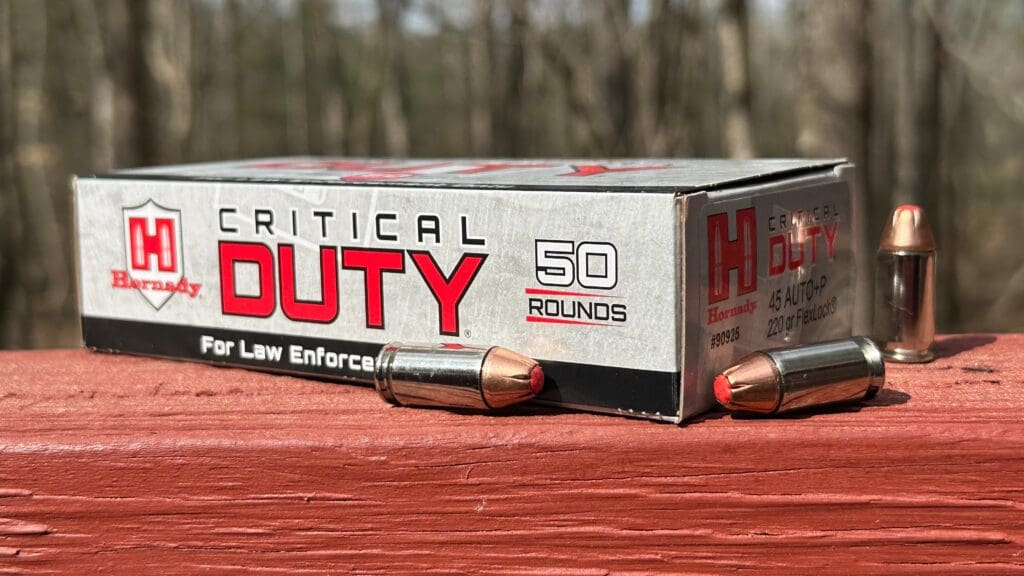
Take, for example, the .45 ACP Hornady Critical Duty cartridge. It’s a 220gr +P cartridge, which means it has a decent chance to fit the tolerance of your 1911 and run through your polymer without too much stress. At the end of the day, though, it sometimes takes a little sample-testing to see what feels right for your pistol.
I don’t always recommend running +P or +P+ ammunition excessively, unless you really need the power. A lot of shooters stick with standard loads for the range and training and step up to +P or +P+ for carry.
If you were thinking about +P ammo for EDC you should read this article first: Should You Everyday Carry +P or +P+ Ammo? [A Break Down]
How They Feel in The Hand
1911s were among the most ergonomic firearms at the time of their inception, but I can speak from experience that I prefer a Springfield-built 1911 over a Colt-built one any day because of how it feels in my hands.
The straight-back grip angle of a 1911 is intuitive for pointing and is designed to fit a larger hand (i.e., most men’s hands), which works fine most of the time.
However, if you’re one who appreciates a firearm that can be more modular, a steel frame isn’t what you’re looking for.
Polymer pistols have the advantage of being more modular. They often offer interchangeable backstraps, textured grip panels, and other modifications that fit a wider range of hand sizes, which is also why they’re a bit more popular with women shooters.
How Much Do You Want to Pay?
Firearm costs can vary widely between brands, regardless of the materials that make up the gun. In terms of initial price, the 1911s are going to sit at a higher price point overall.
Steel costs more to produce, the machining is a little more complex, and there’s a historical cachet that gets thrown in there.
Polymer pistols are typically less expensive and are considered an entry-level-friendly firearm because they’re more affordable. They’re more widely produced, less complex overall, and have a simpler manufacturing process.
There are premium polymer pistols with hefty price tags, but on average these pistols are going to be cheaper than steel-framed 1911s.
Now let’s actually get into some real prices and what you can expect to pay for a 1911 or polymer pistol depending on how nice of a firearm you want.
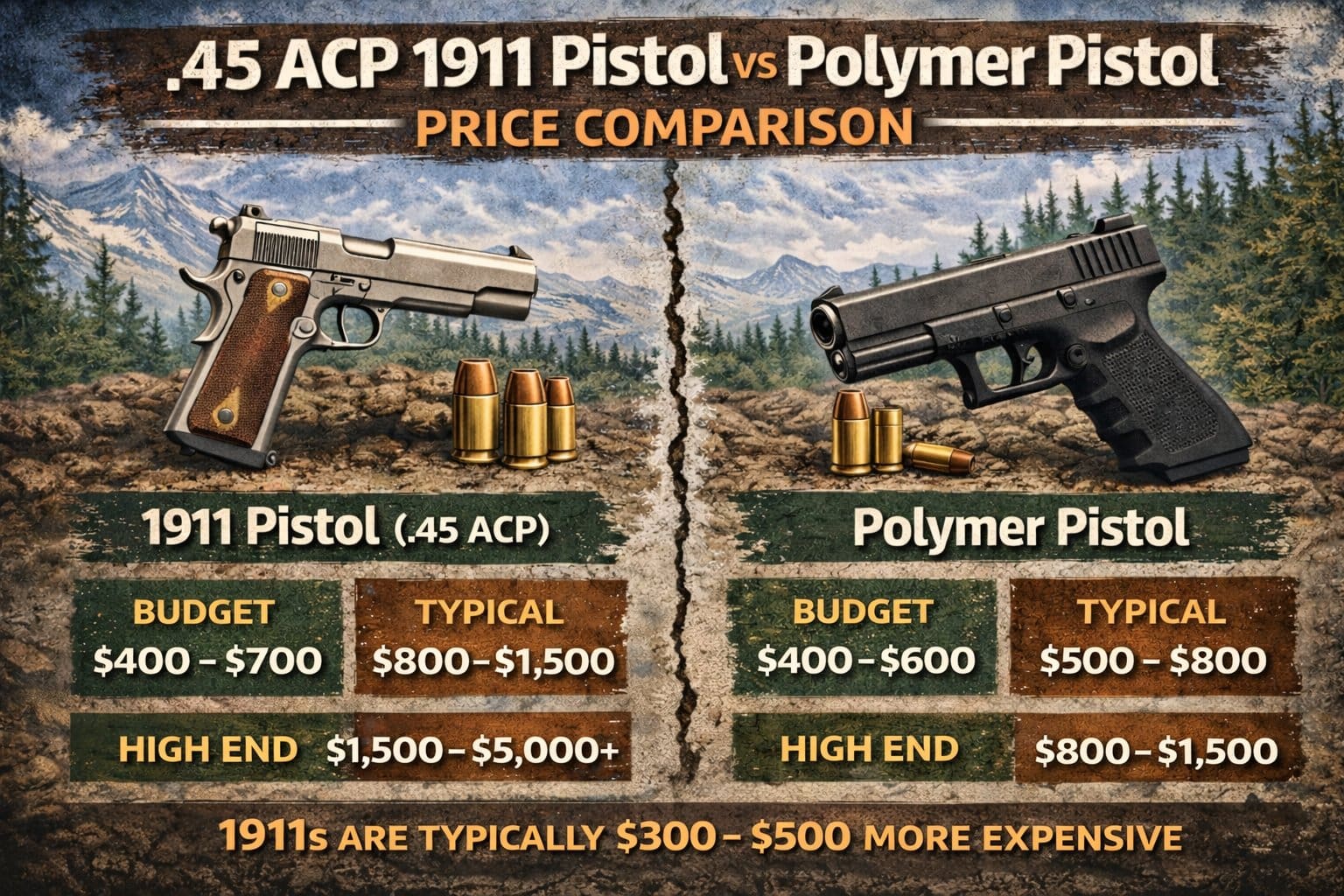
Even at the same price point the quality between a 1911 and a polymer pistol can be night and day but it really does depend on the brands that you buy. You can definitely find a cheap polymer pistol that works better than a cheap 1911 but in the mid-range and up you’re probably going to be happier with the 1911.
You also need to clean a steel-framed pistol more often, but a polymer pistol may wear out faster than a 1911 of the same caliber. So you can also count on the 1911 to stick around longer if you plan to shoot it quite a bit.
Are You Choosing the Polymer or the 1911?
Overall, I’m a fan of the 1911s despite the extra weight and tendency to be particular about certain ammunition and cleaning routines. I like the feel and the history, but that doesn’t mean I dislike a polymer pistol.
It’s a great way to spend less money if you’re new to buying a firearm, or cut down on weight if you’re just learning how to build up your shooting muscles. Polymers are a little more approachable in that sense.
Both firearms are great options for an avid shooter who wants to have fun, and both types of firearms demand the same respect as any other. With that, be safe, store your ammo properly, and have a great time shooting.
1911 Vs Polymer Pistols FAQs
What Are the Main Differences Between a 1911 and a Polymer Pistol?
A traditional 1911 typically uses a steel frame, single-action trigger, and thumb safety, while most polymer pistols use lightweight synthetic frames and striker-fired or double-action systems. These design differences affect weight, trigger feel, maintenance needs, and how each pistol performs during extended shooting.
Why Are 1911 Pistols Prone to Feeding Issues?
1911 pistols often have tighter mechanical tolerances and require proper lubrication and regular cleaning to run smoothly. Failure-to-feed problems can occur if the slide is under-lubricated, the gun is dirty, or the ammunition doesn’t match the pistol’s preferred load characteristics.
Are Polymer Pistols Usually Cheaper Than 1911s?
Polymer pistols are generally more affordable because their frames are easier and cheaper to manufacture than machined steel. The simpler production process and high-volume manufacturing often result in lower retail prices, making polymer pistols a common entry-level option for new firearm buyers.
How Do the Ergonomics of 1911 and Polymer Pistols Compare?
The 1911 is known for its straight-back grip angle and solid steel frame that many shooters find naturally comfortable. Polymer pistols, however, often offer modular features like interchangeable backstraps and textured grips, allowing shooters to customize the fit for different hand sizes.
What Type of Ammunition Works Best in 1911 and Polymer Pistols?
Both pistol types commonly run standard 230‑grain .45 ACP ammunition reliably, but 1911 pistols may be more selective about loads because of tighter tolerances. Polymer pistols usually handle a wider range of ammunition types with fewer issues, though excessive high-pressure loads can increase wear.