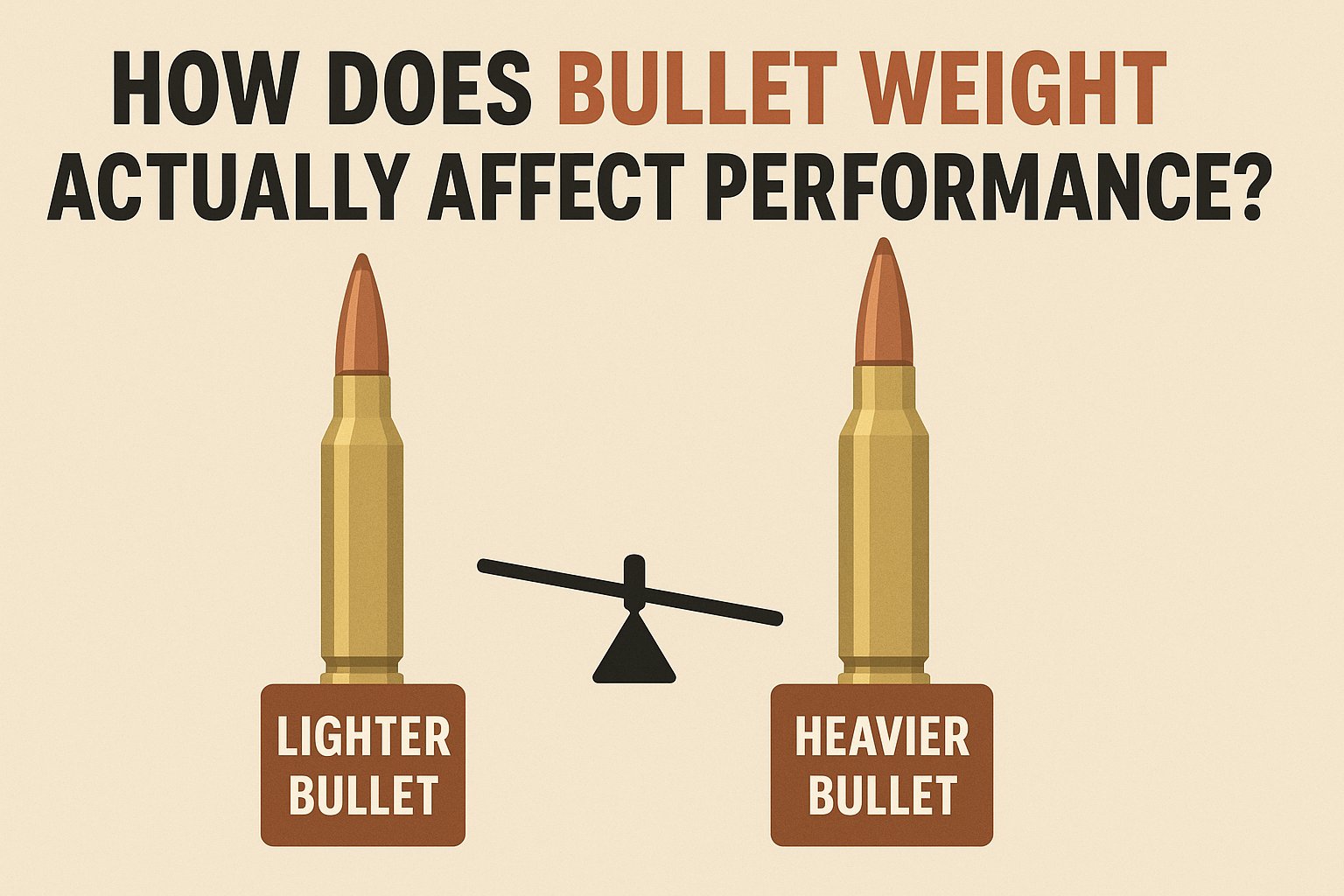
When it comes to shooting, there are endless characteristics that we obsess over, including caliber, brand, or scope, yet some treat bullet weight like an afterthought. But in reality, grains do matter. They affect speed, arc, recoil, and what a round actually does when it hits. Pick the right weight for your gun and goal and your shots (and results) will improve.
Bullet weight directly affects velocity, trajectory, recoil, penetration, energy, and terminal performance. Lighter bullets fly faster and flatter while heavier bullets retain momentum, penetrate deeper, and can be more stable in wind over longer distances.
If you’ve ever stood at the counter endlessly debating your choice of weight on your favorite ammo, then this piece is for you. It’s time to break down the correlation between performance and weight in language we can all actually understand.
Prepare to go pro in factors like velocity, trajectory, energy, recoil, and stability as we pair them with real-world examples so you can pick the best-performing bullet weight for every application.
Let’s Talk Grains: Understanding Bullet Weight the Right Way
So, when we talk about a bullet’s weight, we’re talking grains (gr). There are 7,000 grains in a pound. You’ll commonly see 9mm rounds in 115gr, 124gr, and 147gr; though those small differences matter a lot for how they perform. Just to be clear, the grain here is just about the bullet’s mass,and no other part of the cartridge.
What the weight of a bullet really represents is how much mass is getting pushed out of the gun. That mass has everything to do with how fast it goes, how much it slows down in the air, and what kind of resistance it faces.
So, picture this: a light bullet zips out super fast. But a heavier bullet? It might not be quite as speedy at first, but it keeps its momentum and cuts through wind better. I think it’s safe to say that it’s a bit of a trade-off.
Here’s another way you can think of this, picture a baseball being a lighter load and a heavier load being a bowling ball. An MLB pitcher is going to put much more initial velocity behind a pitch than a PBA bowler could with a bowling ball. Although that extra mass in the bowling ball does a much better job at maintaining momentum.
Velocity: Speed Vs. Weight
Velocity is one of the first topics that comes to mind when shooters are comparing bullet weights. The rule of thumb is that lighter bullets leave the muzzle at a higher velocity, and heavier loads start at a lower velocity when fired; which is true if we keep the powder constant.
| Cartridge | Bullet Weight (grains) | Observations | |
|---|---|---|---|
| .223 Remington | 55 | ≈ 3,200 | Flat-shooting at short–mid range; less stable at extreme distances |
| .223 Remington | 77 | ≈ 2,700 | Slower off the muzzle; arcs sooner but more stable and wind-resistant downrange |
| 9mm | 115 | ≈ 1,150–1,200 | Faster, snappier recoil; common for range practice and quick follow-ups |
| 9mm | 147 | ≈ 950–1,000 | Slower, more momentum and penetration; common choice for self-defense |
To make matters even more technical, there’s also the way that velocity translates into kinetic energy. Kinetic energy is the energy that an object possesses while in motion. When calculating kinetic energy, the velocity of a bullet is squared (Kinetic energy = 1/2mv2, where m stands for mass and v stands for velocity). Bear with us because we are about to tie it all together!
Since velocity is squared when calculating kinetic energy, lighter bullets can still look extremely powerful on paper. Although, this calculation of raw energy doesn’t really tell the whole story about bullet performance downrange. Momentum is key.
This is one of the reasons you’ll hear varmint hunters favor flat-shooting rounds, lightweight bullets for small game like groundhogs and coyotes. On the other end of the spectrum, long-range competitive shooters and big game hunters prefer shooting slower and heavier options that are more consistent and carry more momentum.
Neither group of shooters is right or wrong. One group prefers speed and a straight shot, while the other wants consistency and reliable penetration at distance.
From Muzzle to Target: What Bullet Weight Does to Accuracy & Trajectory
When we bring up a bullet’s trajectory, we’re talking about how much the bullet drops as it travels through its flight path from point A to B. Accuracy in relation to trajectory refers to how close the bullet’s actual trajectory matches the theoretical path as it leaves the muzzle.
| Bullet Type | Trajectory at Short Range | Performance at Long Range | Example |
|---|---|---|---|
| Lighter Bullet (e.g., 55-grain .223) | Flatter trajectory under 200 yards; minimal bullet drop; easier for new shooters and varmint hunting. | Sheds velocity quickly beyond 200 yards; drag causes increased drop; less stable in wind. | A 55-grain bullet zeroed at 100 yards drops nearly 8 inches at 300 yards. |
| Heavier Bullet (e.g., 77-grain .223) | More initial drop compared to lighter bullets; requires more sight adjustment at short range. | Maintains velocity and stability better at longer ranges; resists wind drift more effectively. | A 77-grain bullet starts slower but carries energy and stays accurate further downrange. |
The biggest factor when it comes to long-range accuracy? Wind, and this is where bullet weight really flexes and shows its value. A crosswind capable of moving a lightweight bullet several inches off target will have a fraction of this effect on a heavier load. That small difference can be the deciding factor between a clean kill, a miss, and a gutshot animal.
Your choice of bullet weight should come down to the distance you plan on shooting. If you keep a hunting journal and notice that you haven’t taken a buck outside of 150 yards in the past decade, a lighter bullet should be the first thought in your head for next deer season.
If you’re used to chasing elk through the mountains or competing at 500 yards and beyond, a heavier bullet with higher ballistic coefficients is usually going to be your best answer.
How Bullet Weight Affects Penetration
If you ever overhear shooters talking about the power of a cartridge, they are most likely referring to target penetration. The momentum that your shot carries is going to determine how well it penetrates your target, whether that be a piece of paper at the range or a trophy whitetail that is in your sights.
Penetration is the difference between a botched shot and a clean kill on that whitetail deer you’ve been stalking. Momentum is what punches through bone, hides, or barriers in the real world.
For example, A 55-grain .223 cartridge packs plenty of punch to drop any prairie dog or coyote that you come across. Using the same load against a deer is debatable.
An experienced hunter at a short enough distance can definitely get the job done. In the hands of a new hunter or a long-distance scenario, you run the risk of the bullet fragmenting before it hits any of the deer’s vitals.
Now a 180-grain .308 on that same deer may not leave the muzzle with as much speed, but it definitely carries more than enough momentum to break through everything surrounding the sweet spot you are aiming for. This raises the chances of an ethical kill, even at a longer distance.
Ballistics charts only paint part of the picture when considering different loads to hunt with. On paper, a light round may look devastating based on its speed, but that doesn’t necessarily correlate to how well it will hit your target where it matters.
Bullet Weight & Felt Recoil
Recoil is a tough one to describe. You will find contradicting info all over the internet. Why? There are many variables that affect recoil. The other problem with this is that different shooters can perceive recoil differently, and there are many terms that get mixed up.
When talking recoil, there is recoil energy, recoil momentum, power factor, and the felt (perceived) recoil that the shooter actually feels.We are focusing on felt recoil because it helps describe the shootability of a firearm much better than a bunch of equations on a piece of paper.
The recoil that you actually feel when you fire does depend on bullet weight, along with many other factors. Variables like gun weight, grip size/style, shape of the stock, muzzle rise, and the duration of the feeling all account for why there is so much conflicting data out there.
Heavier bullets usually produce a stronger and longer pushing feeling, but these factors we just mentioned can make a lighter bullet feel more like a heavy round. A good rule of thumb to keep in mind is that a lighter bullet will produce a quicker, harsher feeling, and snappier recoil.
Firearm accessories and aftermarket upgrades will most definitely affect how the recoil of your shot feels. With handguns, a shorter, light slide usually means the felt recoil impulse is a sharp, noticeable bite.
Rifles equipped with a sturdy stock, recoil pad, or muzzle brake feel more like a longer, more consistent push when shot.
The Twist Factor: How Bullet Weight Pairs With Barrel Design
Rifling and the advancements in barrel design over the past few centuries are to thank for stable shots at long distances. This is where the relationship between barrel twist rate and bullet weight comes into the picture.
Barrel twist rate is a ratio related to the lands and grooves inside the bore that represents how fast your round spins as it leaves the barrel (rotations per inch).
Both longer and heavier bullets need to spin faster to maintain stability. Using ammo that is the wrong weight for a firearm’s ratio will lead to keyholing and poor grouping at the range.
| Barrel Twist Rate Ratio | Typical Stabilized Bullet Weights | Typical Use |
|---|---|---|
| 1:7 | 68–77 gr .223 | Match / heavy-for-caliber, longer-range shots |
| 1:9–1:12 | 40–55 gr .223 | Varmint hunting/ light for caliber, short-to-mid range shots |
Accuracy always matters, so check your barrel’s twist and test a few different bullet weights at the range before opening day is upon us. This way, you’ll know which bullet weight to use with your favorite rifle when it really matters, in the field.
Finding The Balance To Maximize Performance
Does bullet weight affect performance? Unquestionably, and in more ways than the average shooter knows. There’s no such thing as the best bullet weight for every application. Some choices are clearly better than others, but it all depends on your mission.
Lighter loads afford you flatter trajectories and lethal speed for hitting the range. Heavier bullets should be your first choice for delivering power, stability in inclement weather, and reliable performance hunting at long distances.
Just like everything else worth doing, trial and error is part of the process. The best way to find the weight you’re looking for is to experiment and test several different weights in the caliber you plan to use. Don’t break the bank, but from time to time, be sure to practice with the exact rounds you intend to use in the field.
If you want the best performance out of your next ammo purchase, match it to the target, the distance, and your purpose so you can learn to shoot it like a pro.
FAQ: Bullet Weight in Real World Shooting
We can only cover so much in a single article, so here are some answers to common questions around bullet weight before we close out.
Q: How Much Does Bullet Weight Affect Accuracy?
Bullet weight can affect accuracy, but not in any hard-and-fast way. It’s often the case that heavier bullets shoot flatter and more reliably in longer barrels with slower twist rates, while lighter bullets may produce better groupings out of faster-twist barrels. The best way to find the most accurate load for your setup is to try several bullet weights and test them at the range.
Q: Does a Heavier Bullet Mean More Stopping Power?
No, not necessarily. “Stopping power” is related to how efficiently the bullet transfers energy to the target and penetrates vital areas, not simply its weight. Heavier bullets will usually penetrate deeper, while lighter bullets expand more quickly and dump energy earlier. For self-defense or hunting applications, shot placement and bullet design are more important than the bullet’s weight.
Q: Do Heavier Bullets Kick Harder?
Yes, as a general rule. Since a heavier bullet requires more energy to push down the barrel, the energy converts to recoil. Recoil, of course, is also affected by powder charge, firearm weight and design, among other factors. Loads of different bullet weights can end up feeling quite similar depending on how they’re loaded and the specific gun they’re fired from.
Q: Do Heavier Bullets Fall Faster?
Yes: heavier bullets will have a steeper trajectory, or a bullet path that drops more over distance. Because they typically have slower velocities, gravity has more time to act on the heavier bullet in flight. However, wind drift has less of an effect on heavy bullets, which makes them easier to predict at long range when zeroed properly.
Q: Do Lighter Bullets Do More Damage?
In some ways, yes. Lighter bullets usually expand more rapidly on impact, which can produce more surface-level or “immediate” damage. However, they also may not penetrate as deeply, which is not ideal for hunting or defensive purposes if vital organs aren’t hit. Heavier bullets, by contrast, will often retain their shape and momentum for deeper penetration.