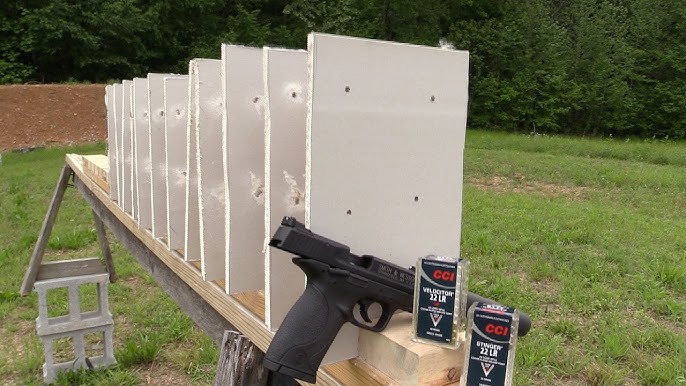
Broken glass. The crack and thud of a door being kicked open. The screech of your house alarm. Those dreaded bumps in the night at 2 o’clock in the morning that jolt you out of bed and into a rush of adrenaline. In a worst-case scenario, you’ve found yourself in a home defense situation, and if your first move is to grab a firearm, hopefully you’ve put some thought into it before this moment.
Besides getting you and your family out of the situation safely, what any rounds you fire penetrate should be priority number one. You can avoid the risk of over-penetration in a home-defense scenario through proper planning, training, and firearm selection.
Now, none of this should be considered legal advice, nor do I know the ins and outs of everyone’s home and firearm setup. We don’t all live in the same square boxes with the same room layouts, and we don’t all prefer the same gun. This isn’t a copy and paste home defense plan, there are just too many variables involved.
We can, however, agree that the safety of our neighbors and loved ones is important, and that is not suspended when a wolf comes knocking at our door. With that in mind, let’s dive into how you can protect yourself and your home while avoiding over-penetration.
Build Your Plan
Maybe you’ll get lucky like I did: a door sensor fell off in the middle of the night, setting off my house alarm. Of course, I didn’t realize that’s what happened right away. First, I clumsily tried to gather a flashlight, my phone, and my pistol before realizing I don’t have three hands to hold all of that stuff. Once I sorted that out, I set about clearing my home in the worst possible fashion before finding the fallen door sensor. I swear it was laughing at me.
It was a literal and figurative wake-up call: your barely-existent plan sucks. The next day I fastened all my door sensors with screws in lieu of the supplied double sided tape, then reworked my home defense plan. I have no business clearing rooms, so I centered my plan around efficiency and safety. One key aspect of that was “where are my rounds going to end up if I do have to send them?”
Back to Basics
In any conversation about safety and guns, you would be remiss not to bring up the Four Primary Rules of Firearm Safety. It’s always a good refresher, and number four is particularly relevant in our current conversation. You can find different versions of the four rules all in the same spirit, but the National Shooting Sports Foundation (NSSF) is my go-to:
1 | Always keep firearms pointed in a safe direction
2 | Treat all guns as though they are loaded
3 | Keep your finger off the trigger until you are ready to shoot
4 | Always be sure of your target and what’s beyond it
At the range, you should have some kind of backstop on the other side of your target to eat the rounds that fly through (hopefully not past) your paper. In your home, what lies beyond your target is a lot harder to tell. If you fire at an intruder, where does that round go once it goes into your target?
As we’ll discuss later, a modern 2×4 wall sandwiched between half-inch drywall is not a suitable backstop. In a pressure-packed situation with less than ideal conditions, the odds of connecting on all of your shots are slim to none, so you need to make sure your plan accounts for what lies beyond your target. That goes for what’s on the inside, as well as the outside of your home.
I’ve lived in seven different places since falling into the world of guns, so I’ve had to make home defense plans for seven different residences. Apartments, duplexes, and houses all have different things to consider when you think about the risk of over-penetration. Add to that the various styles of home and the evolving nature of architecture and you have an endless number of variables that can alter a home defense plan.
Are your children’s rooms next to yours? Are you in an apartment with a mere 2×4 wall separating you and your neighbor, or are they half a mile away? Even if your kids sleep across the house, is it an open-concept home without many walls to separate you from them? Even the exterior cladding of your home is a factor.
There are a lot of questions to think through, but the point here IS to think instead of just relying on the shotgun leaning in the corner to sort it out. If guns are your tools, then act like a home builder and plan your work instead of just diving into that project with no blueprints.
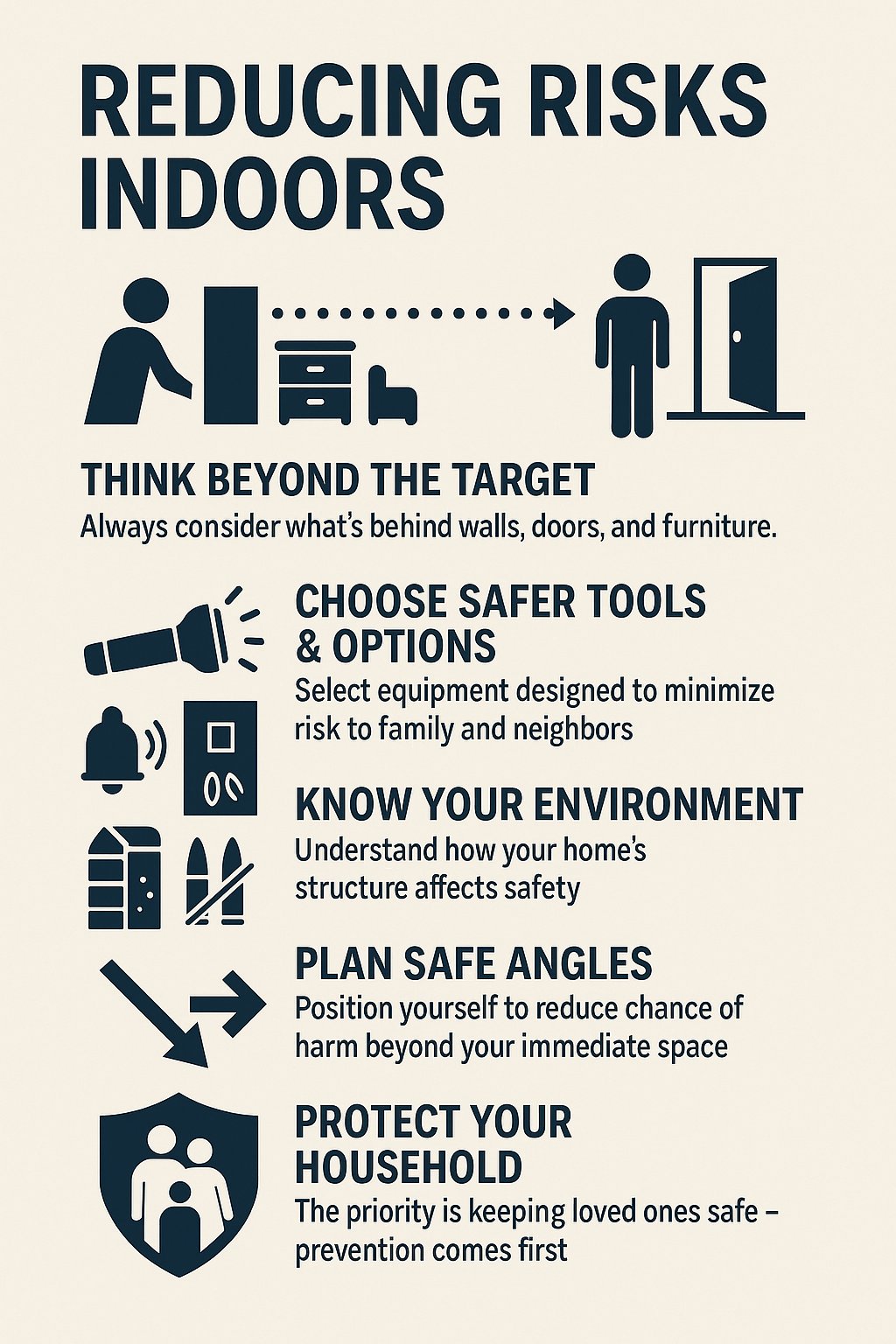
Plans Are Final*
*Unless otherwise noted. Sticking with the construction analogy, your home defense plan should be like a set of blueprints. Version 1.1 may be a rough draft, Version 1.2 might have some edits, and Version 1.3 is currently active but subject to change. You may not know what Version 1.4 looks like yet, but you know there will be one.
My version of a home defense plan, after my failed room clearing experience, changed to more of a safe room type scenario. Our bedroom door is always locked, so we would retreat to a far closet with a staged firearm, extra rounds (in case the invaders were actually zombies or something), even ear protection, and basically let a home intruder have the house unless they crossed a certain threshold.
This change let me do a couple of things. First, I was able to be more efficient in getting my family to safety and not expose myself to whomever was in my house. Second, it allowed me to focus my fire on one specific area and know where those rounds would go. If a bad guy was going to need rounds, I knew exactly where that would be, and what was beyond that target.
Throughout several different life changes, including moves and having children, my home defense plan has centered around a safe room or area theory. There’s an area behind me that stays safe, and a threshold in front of me that is my target area. Of course there are tweaks that get made, maybe with a different gun or accessory, but the basic strategy stays the same.
Train Your Plan
Plans, even ones that are well thought out, can burn up in the heat of the moment. You may have thought through all of the details, drawn out a house plan, and even discussed it with your family, but that house alarm going off at 2AM has a way of throwing all of that out of the window. As Mike Tyson famously said, “Everybody has a plan until they get punched in the face.” You may not be able to dodge that punch, but you can train your response.
Recreating the full stress of a home invasion is next to impossible, but you can put in some practice reps to make it more manageable. First, train yourself: dial in your movements while you’re awake and alert (safely, with cleared or even dummy guns) and get your process smoothed out. If there are other occupants in your home, involve them and get them up to speed on the plan by rehearsing where they need to be.
Another important aspect of training is actual live fire and weapons handling. Range time with your buddies can be fun, but taking a focused, instructor lead course will take your shooting and weapons handling game to another level. If the goal is to avoid over-penetration (it is), then being able to put rounds on target solves a lot of problems.
First of all, get your trigger press down cold, especially if your in-home weapon of choice is a pistol. It doesn’t matter what kind of gun you use, what rounds you buy, or what optic you throw on your weapon. If you slap your trigger and jerk the gun in anticipation, you’re going to miss more than you hit, and that puts the other people in and around your home in serious danger.
Once you have a good trigger press and your weapons handling is settled, introduce some stress into your training. Stress will shine a spotlight on your inefficiencies and turn a smooth reload into a dropped magazine, or a tight group into a scatter shot mess. Stress can be manufactured by taking a jog before you do a shooting exercise to increase your heart rate, or adding a timed element to your training.
I understand that not all ranges are created equal, and your local indoor range may not want you running a lap around the building before you go handle a gun on a busy day. If your options are limited, visualize a stressful situation during your shooting and you can bump up your heart rate. Make sure to include malfunction clearing and reloads, because Murphy’s Law is always waiting to show up when you least expect it.
Tools for the Job
Planning and training for a home defense situation are the best ways to avoid over-penetration, but the weapon you choose plays a big part in that as well. I’ll preface this by saying that I have my own bias, but this is not just going to be based on my opinion. You can find plenty of those on forums and in comment sections, so I’m going to keep this as fact-based as possible.
I’ll skip to the end real quick and say this: based on the tests I’ve seen, the best gun you can use in a defense situation is the one you shoot well and can make hits with. Your goal in that scenario is to stop the threat, and in doing so, you want to keep the people around you safe. The best way to avoid overpenetration is to hit what you’re aiming at, end of story…almost.
Pistols | The Default Firearm For Home Defense
My bedside gun is a pistol. Why? Because I carry it every day so I know the weapon well. I’m a much better shot with a rifle, but my AR doesn’t fit in a drawer safe where my kids or guests can’t get to it, so the pistol is the first thing I go to. It’s the first stage of my home defense plan, but not the last.
Pistols have a lot of draw (pun intended) for home defense scenarios because they’re small, so they’re easy to store and access, the same reasons I keep one in my nightstand. There’s a variety of defense loads that perform well according to the FBI standard, and you can see those results at Lucky Gunner Labs, or various YouTube channels like ShootingTheBull410. They’re reliable and offer various accessories to make your gun fit your needs.
For all of their pros, pistols have some drawbacks as well, including the risk of over-penetration. Pistols can be hard to master, and they’re the most dependent on good shooting form to be accurate. In a stressful, low-light situation, your grip, sight alignment, and trigger press can fall apart quickly, making the odds of a clean miss very high.
What does that mean on the target side? Well, pistol rounds made for defense perform very well when they hit a soft target. They’re meant to expand and dump all of their energy into the target so that, even if you get a pass through, they’re often caught in clothes on the other side or stopped by the nearest wall. A clean miss, however, doesn’t give the round a chance to do its job, and it can burrow through multiple walls and out of your house.
Shotguns | A Quick Answer to Over Penetration
Shotguns are the de facto firearm when people first consider a gun for home defense. I’d say that the initial conclusion is widely based on anecdotes, movies, and myth. They CAN be effective for home defense, but it’s not as straightforward as it’s made out to be.
If you’ve ever been shopping for shotgun ammo, you know the options for loads are nearly endless. Shotguns are fantastic because they’re so versatile; one gun can be used for sport shooting, hunting, and home defense without making any modifications. Unfortunately, there’s only one or two of those infinite number of loads that I would use as home defense ammunition. Yes, all of them will stop a threat (eventually), but not all of them are created equal.
Birdshot, for instance, makes up the majority of the shotgun loads you see. As a home defense ammo, it can be effective, but you’re unlikely to get the amount of penetration you need to stop a determined threat. You can make a real mess of someone, and a petty thief probably won’t tolerate it well, but a determined, armed intruder won’t be pushed aside with your dove hunting or clay shooting ammo.
On the flip side, 00 buck or slugs, which people commonly consider good home defense loads, can put serious holes in your target, but they also have the mass and energy needed to keep on going. Even if you hit your target with those loads there’s a good chance they continue on through interior and exterior walls.
The only shotgun load generally recommended to reduce penetration but maintain effectiveness is a 2 ¾” #4 buckshot, which has enough energy for sufficient penetration on target, but stopped at the next interior wall. It can be tough to reliably find #4 buckshot online, but we have plenty of it here.
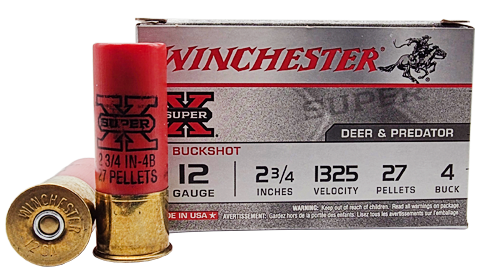
Our best #4 buckshot in 12 gauge is the Winchester 2-3/4″ Super X #4 Buck Shot
Your favorite shotgun loaded down with #4 buckshot is likely your best bet if you are concerned about over penetration. It has the best balance of power and design that is going to make it extremely deadly to an intruder, but it isn’t so large and fast that it is going to go through every wall you have.
Rifles | The Big Surprise For Penetration Performance
Up until the proliferation of AR’s, the rifle had little feasibility as a home defense weapon. They are loud, heavy, have low capacity and high recoil, and their rounds are typically high-powered. None of that makes for a great home defense option. The AR-15 changed almost every aspect of that narrative, however, and has been gaining acceptance as a viable, possibly superior option for home defense.
AR’s have many different chamberings, but the most popular and widely tested in these scenarios is the 5.56 NATO/.223 Remington. Just like the pistol and shotgun, a rifle’s safety and effectiveness in a home defense scenario is limited to your ability to hit your target, but an AR style gun goes a long way in helping you do that.
How does an AR do with over-penetration? Better than most people think. The high muzzle velocity would lead you to believe they’ll burn through almost anything, but even a missed shot with a .223, especially a defense round, can be safer than other types of firearms. Due to their light weight, the rounds bleed energy quickly and can be destabilized by a layer or two of drywall, making them a better option if you’re going to miss.
This 2009 experiment and write-up titled .223 Drywall Penetration by C. Kaukl and B. Toombs shows how different firearms and loads perform in a clean miss situation with 2×4 and drywall. Based on their testing and analysis of different loads, a heavier soft point .223 round offers a good balance of target penetration while minimizing the risk of over-penetration, even if you miss your target entirely.
One of our favorite defense rounds for .223 Remington is the Federal Premium 55 Grain Nosler Ballistic Tip
An AR, or AR pistol, could be a very effective home defense weapon. Surprisingly, they penetrate drywall much less than traditional pistol cartridges. Since AR’s are easier to handle, easier to be accurate with, and are generally much more effective weapons, choosing one as a home defense weapon over a pistol is a great idea.
Home Defense Over-Penetration FAQs
Home defense is a complex topic, and there are a million different scenarios to cover; so, to help as much as we can, here are some quick answers to the most common over penetration questions.
How Many Sheets of Drywall Will a 9MM Penetrate?
A 9mm Full Metal Jacket (FMJ) can penetrate up to 24 half inch sheets of drywall. A hollow-point or self defense 9mm cartridge will penetrate up to 6 half inch sheets of drywall.
Does 9MM or 5.56 NATO Penetrate More?
A 5.56 NATO FMJ will penetrate much more than a 9mm FMJ; however, a 5.56 NATO designed to expand will lose energy more quickly and penetrate less than a 9mm designed to expand.
Can Bullets Go Through Apartment Walls?
Bullets can absolutely go through apartment walls. Most apartment walls are made of two layers of drywall with insulation in between; in this configuration, bullets can go through multiple apartment walls.
Will Hollow Points Go Through Walls?
Yes, hollow points will go through walls. They penetrate less than a Full Metal Jacket (FMJ) cartridge, but they can still penetrate and be deadly on the other side of multiple walls.
Does Buckshot Over Penetrate During Home Defense?
Yes, larger buckshot penetrates through drywall quite excessively. Multiple tests show that buckshot can pass through multiple walls and still be deadly. Smaller buckshot like #4 buckshot has been shown to reduce over penetration and stop within the first wall.