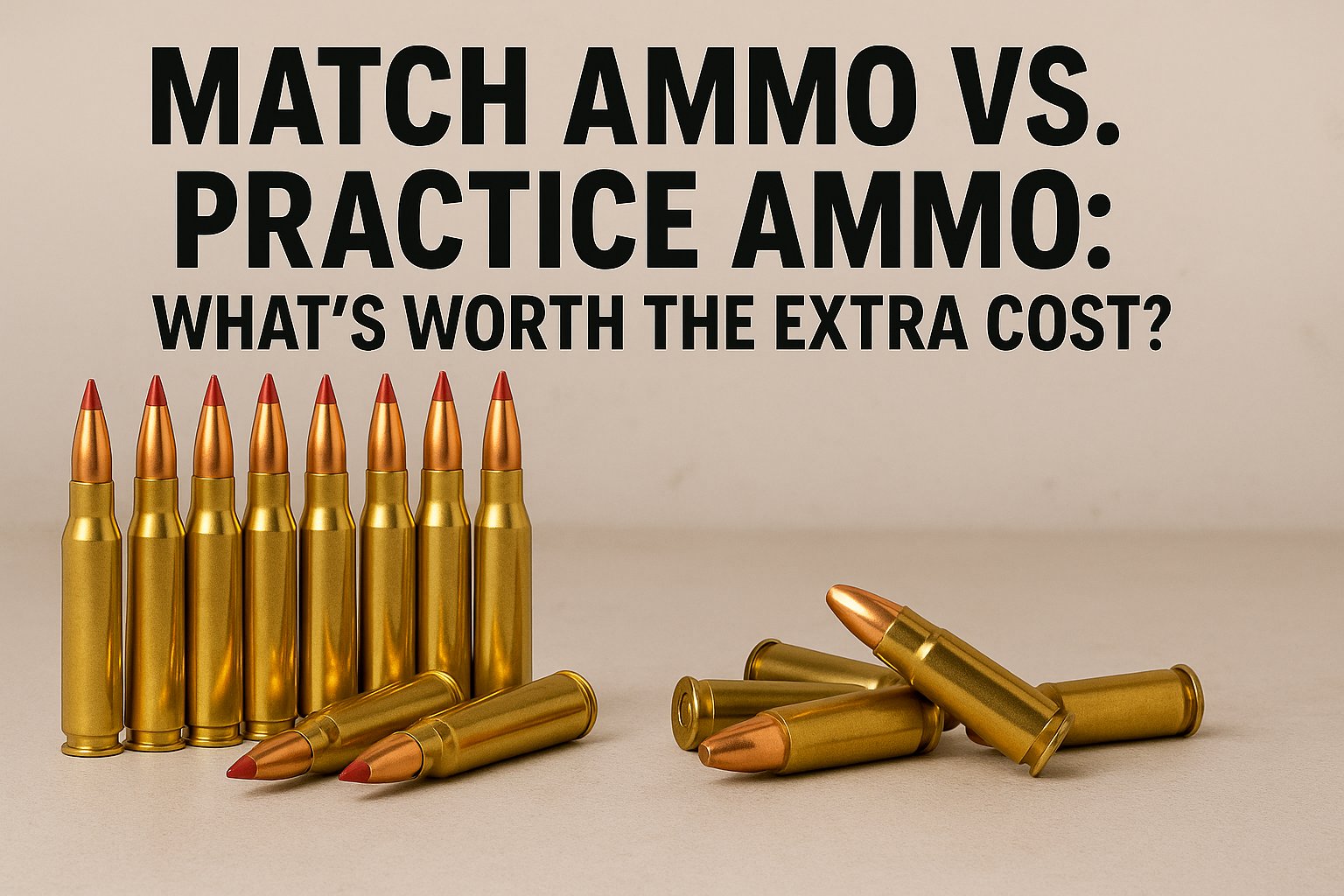
If you’ve spent any time at a shooting range or shopping for ammunition, you’ve seen both match and practice ammo labels on different cartridges. Match ammo carries a premium, while practice ammo is generally the lower-cost option.
As the names imply, match ammo is crafted with a focus on consistent and high-level performance, and practice (or range) ammo to not break the bank every time you want to punch some holes in a target and work on your form.
Which one should you buy? When is the extra cost of match ammunition justified, and when should you save a few bucks? This article breaks down the differences, explains the technical reasons behind the inevitable performance gaps, and gives some practical advice so you can budget your range costs wisely.
Terminology Breakdown
Terminology matters because the firearms industry doesn’t have one single legal definition for “match” ammo. Here’s a practical way to think about these two kinds of cartridges.
Match ammunition is manufactured to tighter tolerances. Components are selected and loaded to give a higher shot consistency. This ammunition is marketed toward competition shooters, precision-oriented hunters, and any other shooter chasing the smallest possible groups, and has a lot at stake.
Practice ammunition is mass-produced and value-oriented. These rounds are intended for training, drills, and casual range use. Their performance is acceptable for everyday practice, but not optimized for ultimate precision.
Key Construction and Manufacturing Differences
It’s important to remember that if you’re looking at match ammo in terms of competition ammunition, each competition is going to have certain ammunition requirements, from power factor to other features. Practice ammo can have a variety of features as well, but it is usually pretty straightforward.
Match Grade Ammunition
Producing match ammunition requires more stringent quality controls than practice ammo. It’s also produced in smaller batches to help keep production variances to a minimum.
With match ammunition, there’s a focus on tighter concentricity and weight tolerances, which means the bullet’s centerline is more likely to line up with the case and the bore when fired. This results in better accuracy and fewer malfunctions.
A low standard deviation for velocity consistency is crucial for precision loads. Match rounds have carefully measured charges and are often hand-sorted to control powder fill rates tightly, rather than relying on a machine.
The type of primer is also an important feature in match ammo production. Match loads use primers with a higher degree of consistent ignition and seat depth compared to target rounds. This reinforces first-shot reliability and shot-to-shot consistency.
In terms of brass, match casings have less variances than practice ammo. Consistent neck tension and case dimensions, even within a fraction of a millimeter, help bullets launch more uniformly. Many match rounds can also vary in bullet design and feature boat tails and open tips to help retain velocity.
Practice Ammunition
Ammunition that’s designed to be cost-effective and relatively safe has to make some sacrifices somewhere. For what I like to call “plinking” ammo, there are looser manufacturing tolerances, and components are selected more for economy than peak performance.
Production speed is also a lot faster than what you see with match ammo. When you prioritize speed of production, bullet seating can be less precise, leading to reduced accuracy. Bullet and casing designs are also more standardized than those of match ammo, and the aerodynamics are significantly simpler.
That being said, you can save 30-50% per round or more going with practice ammo over match rounds.
How These Differences Translate Into Real Performance
The advantages of match ammo when compared to practice ammo usually show up in these ways:
- Tighter groups
- Lower velocity standard deviation
- Better long-range performance
Match ammo has a higher consistency in bullet flight, reducing group size. Consistent velocities in match ammo reduce vertical dispersion and can improve performance predictability, and uniform bullets let you call wind and drop more accurately.
The magnitude of these advantages depends on several things that are beyond the bullet’s scope. Namely, the firearm’s inherent accuracy, your skill as a shooter, environmental conditions, and shooting distance.
For example, if you and the gun are only capable of 2-3 MOA, switching from good practice ammo to match ammo may produce groups that appear to show no improvement.
When to Spend the Extra Money on Match Ammo
Competition shooting with precision rifles, pistols, and the like is an event where every fraction of an inch counts. If you’re already investing in top-of-the-line competition equipment, match ammo is worth the price. As a competition shooter, you need the reliability and accuracy that match loads offer.
Haven’t tried competition shooting yet? Check out this article to know what to expect: Your First Shooting Match: What to Expect at IDPA, USPSA, or 3-Gun
Long-range shooting at extended ranges (300 yards +) creates more room for error with any bullet. Match ammo’s lower sectional density, consistent bullet seating, and more specialized features help improve ballistic predictability, especially when you have to account for long-distance factors like wind and drop.
Match ammo is also a good investment if you have a gun that’s a picky eater. If you’re having the same failure to fire or failure to load issues, consider investing in a box of match ammo to see if your firearm shoots them a little better.
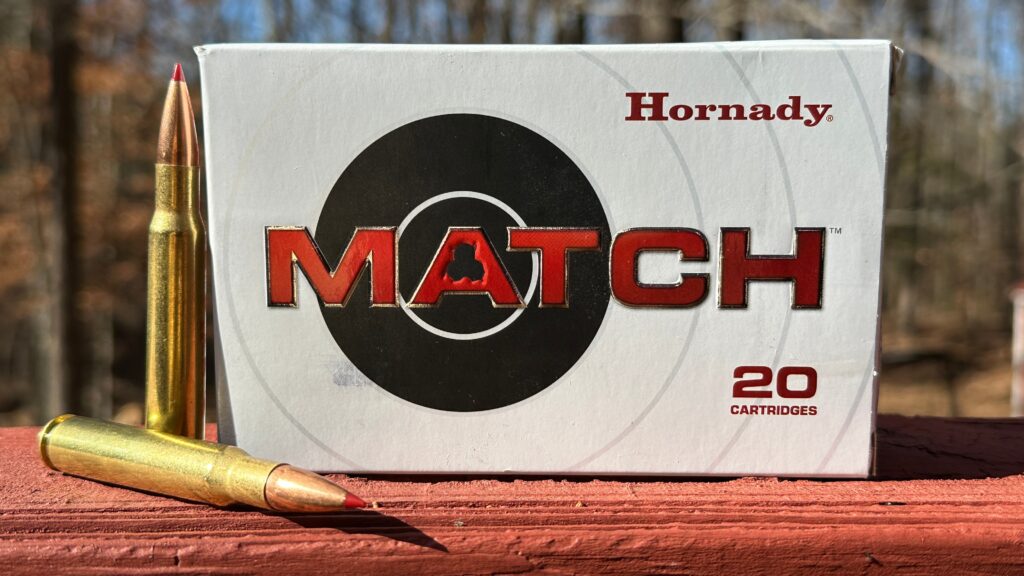
When Practice Ammo is the Smarter Choice
Basic training and fundamental work focuses on your skills as a shooter. This takes time and thousands of repetitions, especially if you’re working on trigger control, sight alignment, target acquisition during movements, or volume training.
Spending $0.40-$0.70 per round instead of $1.00-$3.00 or more lets you get more reps without draining your wallet dry. This builds skills much faster than shooting a handful of perfect rounds, especially if you’re just starting out as a shooter.
Defensive training relies on realistic drills and volume training. Quality practice ammo that feeds and functions reliably in your gun is a more economical option to get the time and reps in to better these skills and make you more confident when you carry for self-defense.
There are plenty of premium self-defense loads that would be considered target loads and won’t break the bank as badly as match ammo.
Overall, practice ammo is best when you have champagne taste but a beer budget, and you aren’t actively competing or worried about shooting targets half a mile away.
There are premium practice loads that can help you find some middle ground between price points. Typically, they have slightly better bullets and brass, which can provide improved consistency at a moderate premium.
Ammo Reliability Considerations
Match ammo isn’t always the most reliable in a wide variety of firearms. Some match loads use softer bullets or different bullet profiles that feed less smoothly in certain platforms, particularly in semi-autos and carbines.
In contrast, practice ammunition brands prioritize reliable feeding and consistent extraction in these types of platforms, especially under harsh conditions, which matters more for everyday use.
Some Real World Math
At the end of the day, numbers don’t lie, and many of us, like myself, are at the mercy of our paychecks to invest in high-dollar ammunition. While the exact prices of each type of ammo can fluctuate, generally, practice ammo falls within the low to mid-range, while match ammo is 2-5 times the cost of practice rounds.
To truly determine if the match ammo you’re using is worth the money you’re spending, conduct a controlled test. Use the same firearm and rest each time, fire groups at the same distance, and shoot multiple groups with each kind of ammo.
After you record the group sizes, see if the groups show a consistent performance difference. If you’re extra nerdy and happen to have a chronograph, you can even measure the standard deviation of velocity. Numbers don’t lie.
Spend Your Money Wisely
Match ammunition brings real and measurable benefits to the field. Those benefits are well worth the extra cost if you need precision, like in competition or high-stakes hunting scenarios.
For everyday training, defensive drills, and learning fundamentals, practice ammunition is almost always the better investment, as the skills gained from firing more rounds are more valuable than the small accuracy gains from match ammo.
That’s not to say you can’t have both. I typically reserve match-grade ammo for zeros, competition, and long-distance shooting. I also try to watch what I spend on my hobbies, so I stock up on my cheaper “plinking” rounds to run drills or just have fun at the range.