Prefer audio over written content? Listen to the article here:
Decisions, decisions. If there’s one thing that can be said about the current state of the gun and ammunition industry, it’s that there’s no shortage of choices. Buying decisions can be fun, exciting, and exhausting all at the same time.
Thankfully, we’re here to help.
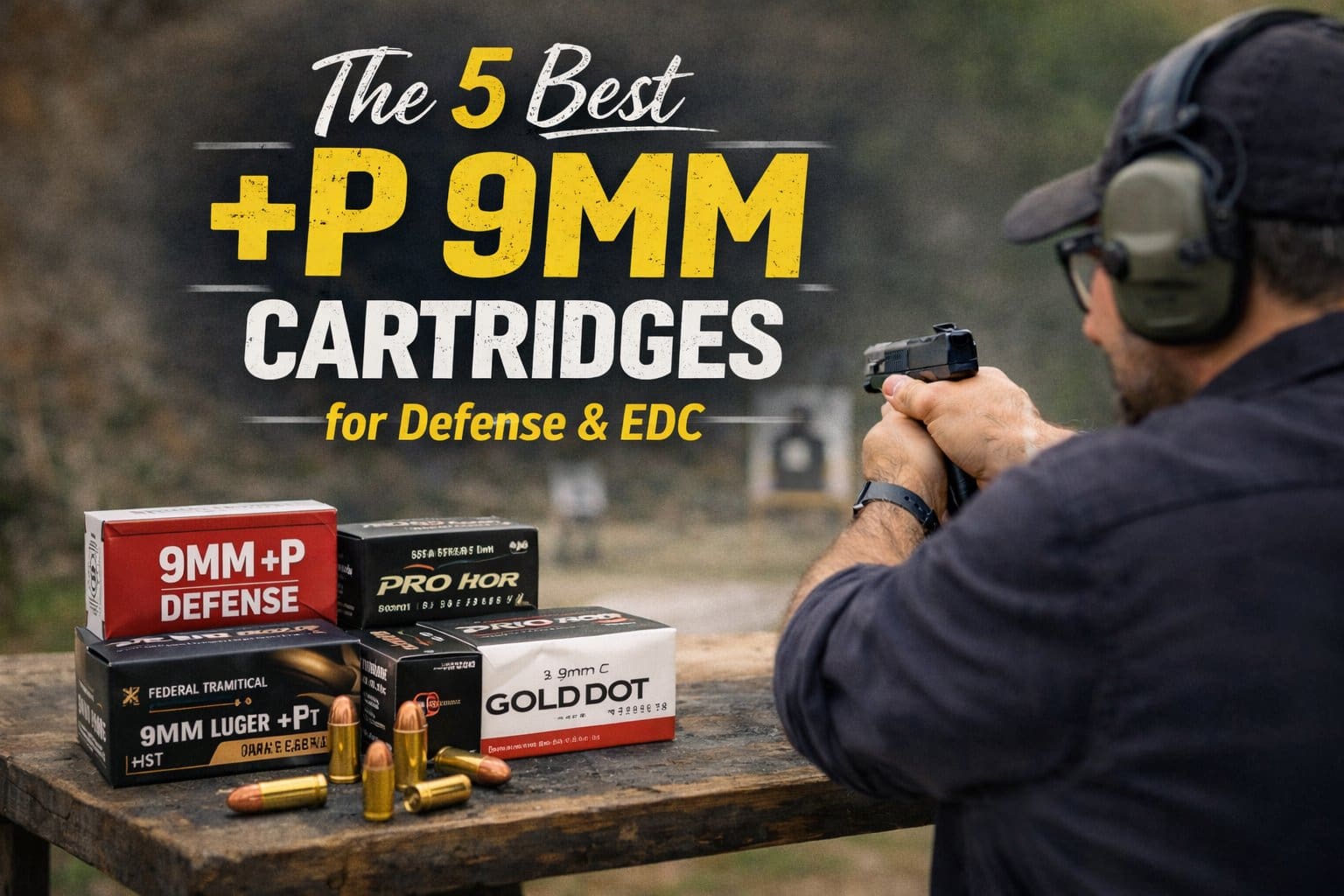
Today, we’ll be looking at 9mm ammunition, specifically the best +P defense cartridges, to help you decide what to put in your EDC and home defense guns.
If you’re not sure about whether or not you want to fill your magazines with +P loads, or even what +P means, don’t worry. After we go over the cartridges, I will break down what sets +P loads apart from a standard cartridge.
Top +P 9mm Ammo Picks for Defense & EDC
Proven high-performance cartridges for carry, home defense, and short-barrel effectiveness
-
Best for Overall Performance
-
Best for Trusted Duty Use
-
Best for Barrier-Blind Performance
-
Best for Consistent Expansion
-
Best for Maximum Velocity
Best for Overall Performance | Federal LE 124 Grain +P JHP
One of my favorite +P rounds overall, is the Federal 124 Grain +P.
The 124 grain HST bullet paired with a +P loading generates 1,200 fps of muzzle velocity and 396 ft/lbs of kinetic energy. In a vacuum, those numbers don’t mean much, so let’s dig a little deeper.
For reference, 1,000 feet per second is considered the minimum speed for an expanding round to do its job, whether that’s a hunting round out of a rifle or a defensive round out of a handgun.
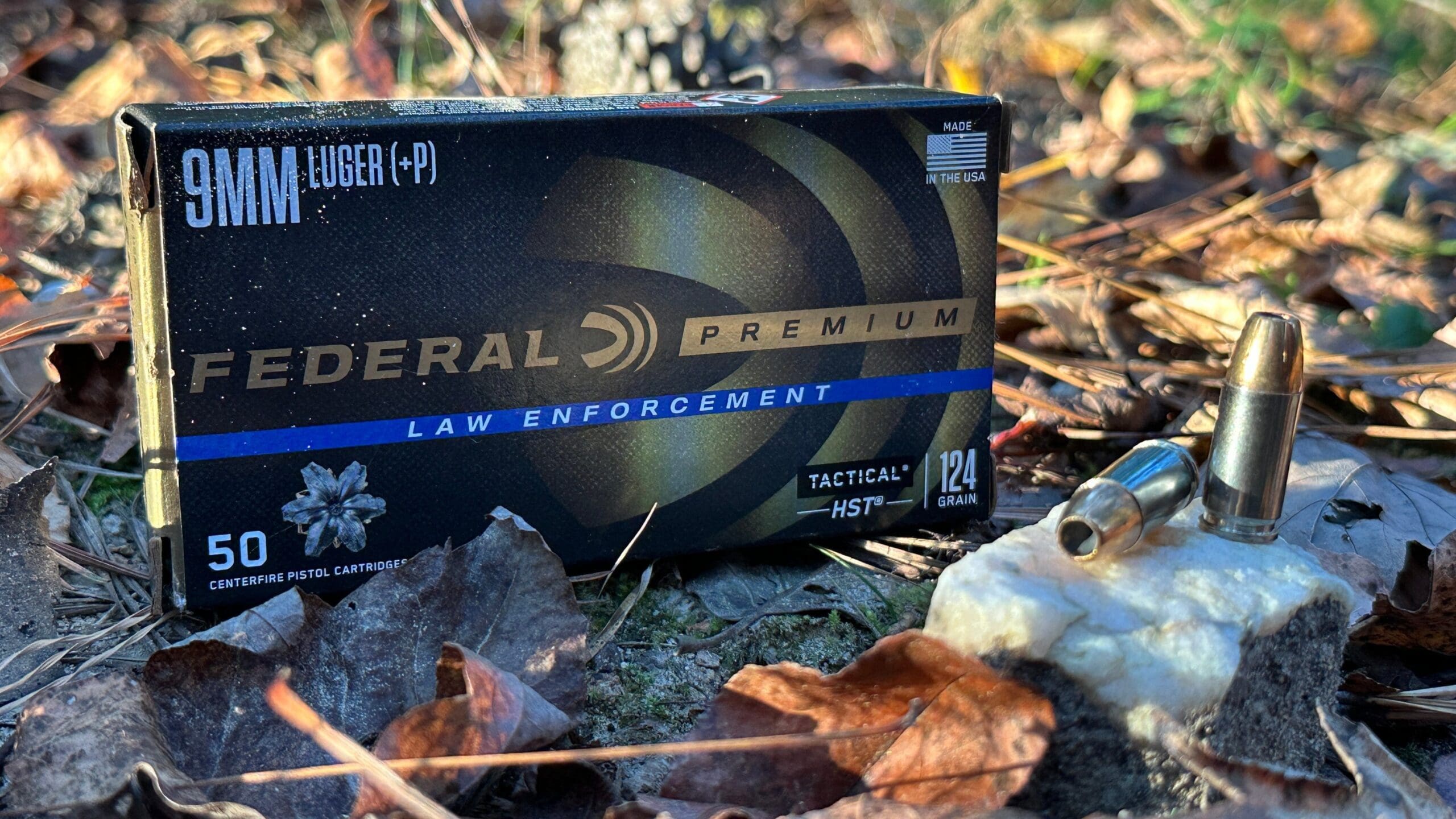
What the higher weight bullet does is allow this round to project that muzzle velocity at longer ranges. According to Federal’s ballistic chart, this round holds its velocity above 1,000 fps out to 100 yards (1,002 fps to be exact).
That ought to give you some confidence in the round’s ability to perform at under 10 yards, a much closer distance where a defensive encounter typically happens.
Another thing I like about this round is the HST bullet, which is a tested, proven performer.
In the ballistics testing that I’ve seen, the HST jacketed hollow point expands reliably and consistently to the same shape without any separation. This means your bullet stays in one piece and works as it’s designed to.
Overall, this round strikes a nice balance between weight, speed, and energy.
It just doesn’t feel like you have to compromise anywhere in the metrics, and Federal paired it with the HST projectile that just plain works. To me, this one is a ten out of ten.
If you are considering a +P round for everyday carry, read this article first: Should You Everyday Carry +P or +P+ Ammo? [A Break Down]
Best for Trusted Duty Use | Speer Gold Dot 124 Grain +P JHP
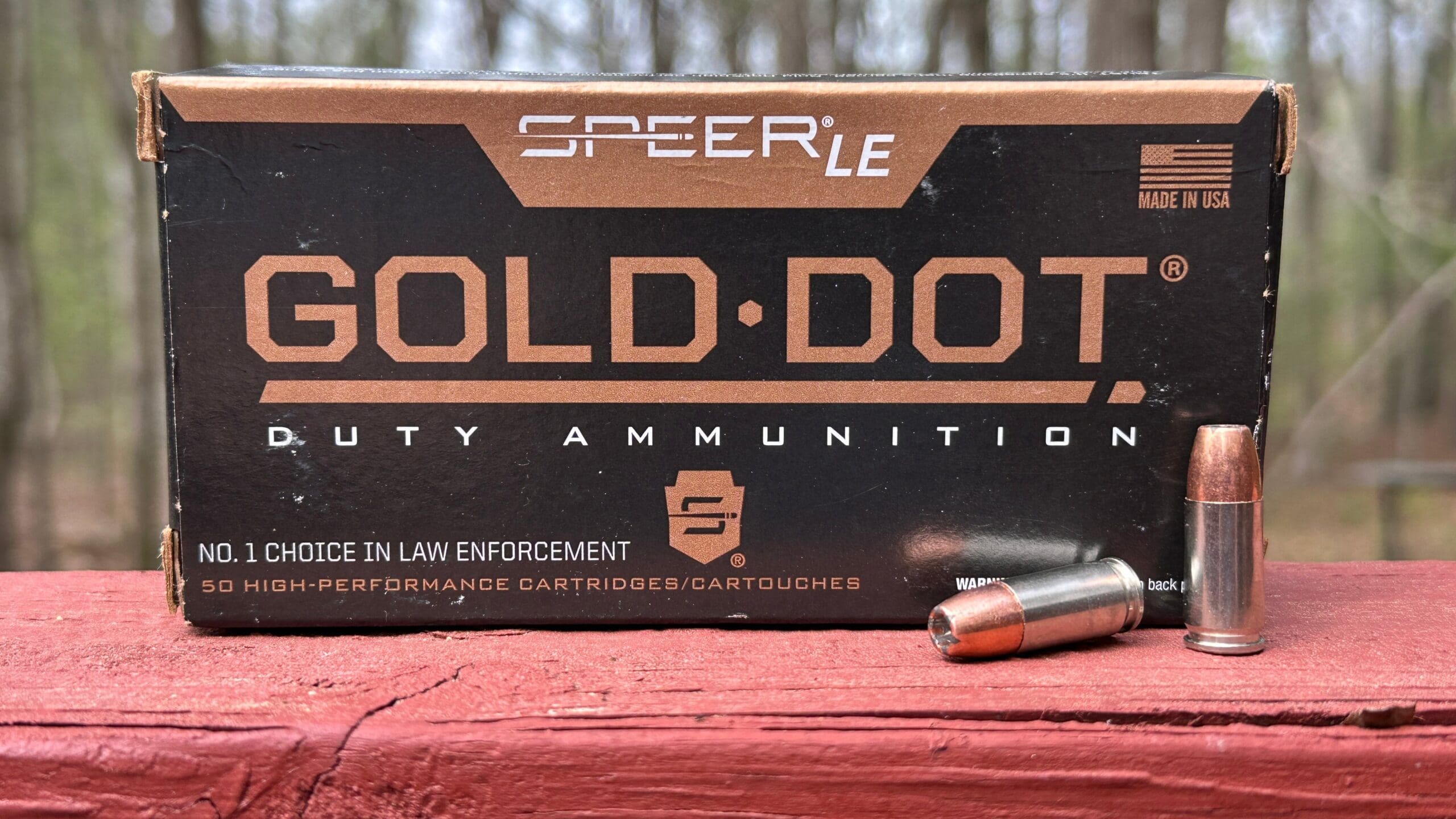
The Speer Gold Dot 124 grain +P is another round that hits what I consider to be the sweet spot in weight and velocity.
Coming out at an advertised 1,220 feet per second, it boasts a little more energy than the Federal at 410 foot pounds.
You can probably find a magazine or two in my safe loaded with some 124gr +P Gold Dots, and I can vouch for their reliability on the range.
Ballistics gel testing shows a round that reliably expands and stops within the FBI’s 12-18” penetration depth range, so it performs well in the lab as well.
In that testing, you’ll also see that the lead core and copper jacket don’t separate and the bullet retains a good portion of its mass as it passes through the gel.
The overall diameter of the expanded bullets was a little less than the Federal rounds, but again, they all did what they were supposed to.
This cartridge is extremely popular for EDC, and it even topped our list here: What is the Best 9mm Self Defense Cartridge for EDC?
Best for Barrier-Blind Performance | Barnes Tac-X PD 115 Grain +P HP
The Barnes Tac-X PD 115gr +P breaks the mold in multiple ways, both in this group and in the ammunition world.
On this list, it’s the first 115 grain round I’ve chosen, and the specs, which I’ll get to, aren’t as eye-catching as the previous two we’ve looked at.
Barnes lists the muzzle velocity at 1,125 feet per second, which is slower than I expected for a lower weight +P round. As a result, their advertised kinetic energy is on the low side at 323 foot pounds. On paper, those stats don’t make me bust out my wallet to hit the “Buy Now” button.
But there is a method behind all of this: the Tac-X uses an all copper projectile.
Traditionally, bullets have been made of either all lead or a combination of lead and copper where a copper jacket is wrapped around a lead core to reduce fouling of the barrel.
All-copper bullets are built differently, though.
Because they don’t use a lead core, the bullets themselves have to be long for the caliber in order to reach a certain weight. Because of this, the case can hold less powder, which drives down velocity and kinetic energy.
What sound like disadvantages, though, are outweighed by the performance of the bullet itself. The Tac-X has a deep hollow point cavity, and without a lead core in the way, is able to expand to an impressive width in the target.
The lack of a lead core also means there’s no concern about jacket separation, so the bullets hold together well and expand exactly as designed.
This design creates an almost unmatched consistency in both expansion and penetration depth.
These are great for home defense, but make sure to check out this guide first: How to Avoid Over-Penetration in Home Defense Scenarios
Best for Consistent Expansion | Corbon 115 Grain +P JHP
The CorBon 115 Grain +P is another of the lighter-variety +P rounds. Unlike the Barnes, however, this round uses a bullet with a lead core and relies on that core for penetration and expansion.
According to CorBon, it comes out the muzzle smoking at 1,350 feet per second and delivers a whopping 465 ft/lbs of energy. Those are incredibly high, and frankly hard to believe.
I’m not here to cast doubts, but I’d suggest you look at some independent testing before making a buying decision just based on the advertised speed and energy.
Manufacturer’s information can be presented as a best-case scenario, which doesn’t exactly exist in the real world.
In looking at that independent testing, you can also find some gel tests that show the CorBon expands and penetrates reliably and consistently. Ammo box statistics aside, this round performs and does what a defensive round should.
Best For Maximum Velocity | Hornady Critical Duty 135 Grain +P
The last round on our list is the Hornady Critical Duty 135 grain +P. It comes in as the heaviest round selected, but also packs some other features unique to Hornady bullets that help it perform well.
Spec wise, the heavier round acts as you’d expect with a lower advertised muzzle velocity at 1,070 feet per second, generating 343 foot pounds of energy.
Oddly though, some tests show that Hornady undersells their muzzle velocity by 40-50 feet per second, which would put this round’s energy north of 370 foot pounds.
In gel, this round is another consistent performer that expands well and penetrates uniformly in a group.
Hornady uses their FlexLock bullet, which incorporates a locking band that helps the core and jacket stay together with their Flex Tip hollow point design.
Hornady uses Flex Tip bullets for many applications, from hunting to defense, and I can attest to their efficacy on deer.
The design is meant to keep the bullet from getting clogged as it passes through a barrier, such as hide or clothing, while allowing expansion when it enters a target.
Hollow points like these are the default for defensive rounds, but have you ever wondered: Do Hollow Points Actually Make a Difference in Self Defense?
9mm +P: Not Your Daddy’s Ammo
Maybe you’re new to the firearms game and have seen +P ammunition, but aren’t sure what it is.
Or maybe you’ve been shooting for years, but you know what ammunition works for you and that’s what you look for every time you browse the pistol ammo.
Either way, +P ammunition has enough share of the 9mm market to warrant your attention, or at least for you to be aware of its benefits.
Let’s briefly discuss the background and details of +P ammo before talking about which ones you ought to be looking for on the shelves.
Basics of +P Ammo
First of all, what does +P even mean?
It’s not that complicated, really: the +P designator lets you know that those rounds were intentionally overpressured by the manufacturer to increase velocity. The additional pressure is done in a controlled, consistent way that conforms to SAAMI specs to ensure safety.
Speaking of safety, we’re not talking about an accidental double charge of powder here.
+P ammo, depending on the projectile and powder type, only has about 15% more powder than a standard load. In a modern pistol rated for +P ammo, you’ll feel the additional recoil, but the gun will handle it just fine.
That little bit of extra juice in the cartridge means a little extra oomph on the receiving end.
By boosting the muzzle velocity, +P ammo has more energy on target, which means more thump and better penetration. +P ammo is, afterall, mostly reserved for hollow point ammunition, so the goal is to improve the performance of a defensive round.
Living in a +P World
+P ammunition isn’t a new concept, and it certainly isn’t confined to one caliber, but 9mm has by far the most options for +P ammunition.
The fact is, if you’re packing around a 9mm these days, there’s a good chance you could benefit from the extra juice that +P ammo has to offer.
This is especially true if you’ve chosen one of the compact or subcompact pistols that have been dominating the market in recent years.
Those shorter barrels cut down on muzzle velocity since the projectile has less time to build up speed.
And no, sub-4 inch barrels on a pistol aren’t new, but the market for those guns has broken wide open in the last decade as the interest in self defense has increased and manufacturers have met that new demand.
It would be a shame to buy a gun for self defense, only to have the round you’re using underperform in a critical moment.
And that’s where +P ammo comes into play. With a little extra powder in the charge, your subcompact 9mm can spit out rounds that are just as effective on target as a full-sized gun.
If you want to know more about +P ammunition and if it’s right for you, check out our article titled Should You Everyday Carry +P or +P+ Ammo [A Break Down]
What to Consider Before Selecting a +P Cartridge
Before loading a cartridge into your mag, there are a few things to consider as you look at each of the cartridges I listed previously.
I’ll be referencing these points for each of the options listed, but here’s a quick rundown of what you should be looking for.
Projectile Weight
This is pretty self explanatory, but I always want to be aware of how much the bullet I’m shooting weighs.
Projectile weight feeds directly into the next two key metrics I look for, and depending on your use case or preference, can narrow your shopping down dramatically and help in your decision making.
If you’re not familiar, bullets and other projectiles such as broadheads and arrows are commonly measured in grains (gr) as opposed to ounces or grams.
When you’re reading a box of 9mm ammo and you see 115gr or 115 grains, that’s telling you the weight of the bullet itself, not including the case, powder, or primer.
While there are some outliers, commercial 9mm ammunition typically falls into either 115, 124, or 147 grain weights.
Most of your full metal jacket (FMJ) practice ammunition is 115 grains, while hollow point or other defense ammo cover a wider spectrum, even going as low as double-digit weights for some offerings.
For +P rounds, I typically go with a higher projectile weight, such as a 124 grain bullet. This combination of a heavier round with the higher velocity of a +P load boosts our next critical metric, kinetic energy.
If you really want to know where this matters and where it doesn’t, check out this article: How Does Bullet Weight Actually Affect Performance?
Kinetic Energy
Kinetic Energy, or KE as it’s commonly abbreviated, is calculated using a given mass and velocity.
There are a few different formulas depending on the units you’re using, but for our case using grains for mass and feet per second for velocity, we use the formula Foot Pounds of Energy (FPE) = (m x v2)/450,240.
Why do I bother telling you this?
Because kinetic energy is a measurement of the force your round puts on the target, and is a way of comparing one round with another, even though their projectile weight and speed are different.
Some manufacturers will actually put their KE calculation on the ammo box, while others don’t.
The nice thing about the equation is that it’s simple enough to keep in the notes on your phone, so if you’re standing in the store and you want to figure out a round’s kinetic energy quickly, you can.
You could also look it up, but where’s the fun in that?
Use your knowledge, do a little math. Kinetic energy also ties directly to our final metric, and with self defense rounds that rely on expansion to do their job, making sure the kinetic energy is right is crucial to making a good buying decision.
Penetration Depth
When we’re talking about rounds for defense and every day carry, ultimately the conversation revolves around picking ammunition that will work if you have to stop a threat.
By work, I don’t mean just go bang or poke a hole.
Will it do what it’s designed to do and put enough hurt on a bad guy to make them stop what they’re doing?
That’s the question we’re really asking here, and there’s one metric that encapsulates all the others: penetration depth.
How is penetration measured?
The industry standard is the FBI test on ballistics gelatin, where a round is shot into a block of gel and the depth at which the round stops is measured.
Typically a 5 round group is shot into the gel and the minimum, maximum, and average depths are recorded.
If all of the shots are within 12-18”, it’s considered a good, consistent performer.
Below that range it’s possible the rounds wouldn’t penetrate far enough into a body to do enough damage to immediately stop a threat. Over-penetrate that range and the rounds would exit the body too soon.
To my knowledge, manufacturers aren’t putting penetration depths on their ammo boxes, so you’ll have to do some research on your own.
I won’t quote any specific stats because each testing scenario is different and not necessarily done in a standard fashion, but the information that’s out there is valuable.
The end-all, be-all measurement of efficacy is a real life defense scenario, but that’s not something that can be created and tested.
The ballistic gelatin test is the standard we have, and it’s the main thing I’ll check before spending money on a defensive round.
The Bottom Line on +P 9mm Ammo
If there’s one big takeaway I have from putting this list together, it’s that there are a lot of different ways to skin the +P cat.
You’ll find an even wider variety out there of weights and bullet types, but for my money, I’d rely on any of these five in a defensive situation.
I’ll always suggest doing your own research to find the round that’s right for you, but hopefully I’ve been able to distill the wide array of offerings into a helpful grouping that cuts down on your decision making time.
+P 9mm Cartridges FAQs
What Does +P Mean in 9mm Ammunition?
+P indicates that the cartridge is loaded to a higher internal pressure than standard 9MM rounds, increasing velocity and energy. These loads are manufactured within safety standards and are designed to deliver stronger terminal performance, especially in defensive situations.
Is +P 9mm Ammo Safe to Use in All Pistols?
Not all firearms are rated for +P ammunition, so it is important to check your pistol manufacturer’s guidelines before use. Most modern handguns can handle it, but increased pressure can accelerate wear, especially with frequent use.
What Are the Benefits of +P 9mm for Self-Defense?
+P 9MM cartridges offer higher velocity and increased kinetic energy, which can improve bullet expansion and penetration. This is especially useful in compact or subcompact pistols where shorter barrels typically reduce standard ammunition performance.
How Do Bullet Weight and Velocity Affect +P Performance?
Heavier bullets like 124 or 135 grains paired with +P pressure often provide a strong balance of penetration and energy. Lighter bullets may travel faster, but overall effectiveness depends on how well velocity, expansion, and penetration work together.
What Makes a Good +P 9mm Defensive Round?
A reliable +P defensive round should consistently expand, maintain structural integrity, and penetrate within the FBI-recommended 12 to 18 inches. Factors like bullet design, weight, and real-world testing results are more important than raw velocity numbers alone.