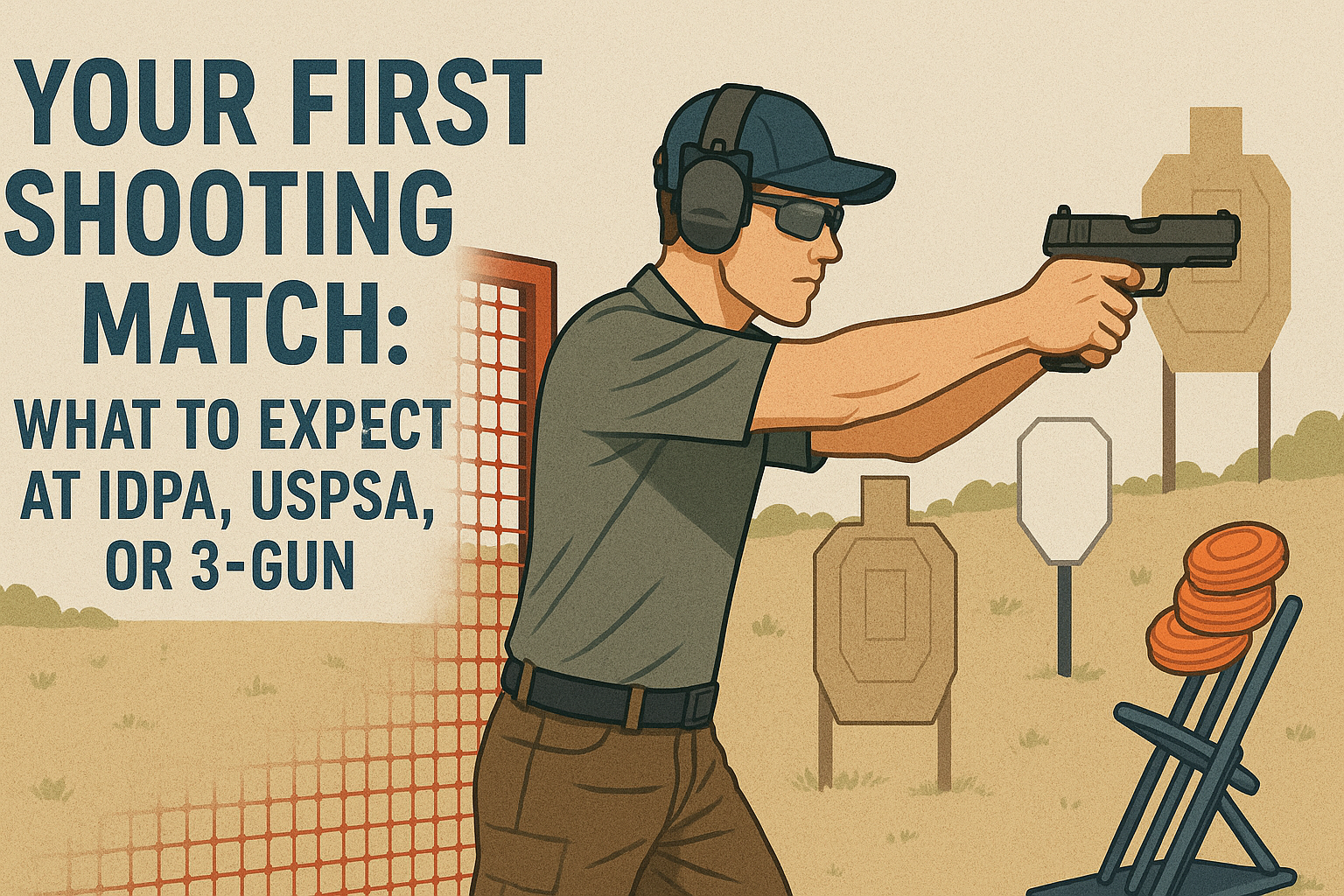
Stepping onto the range for your first competition is going to feel both thrilling and nerve-wracking. Expect sweaty palms, your mind spinning through a dozen “what-ifs,” and it’s a guarantee you’ve checked your mags and gear bag ten times already. Take a breath, every great shooter started right where you are.
Your first match is all about learning the ropes, staying safe, and soaking it all in. Whether it’s IDPA’s defensive drills, USPSA’s run-and-gun stages, or the controlled chaos of 3-Gun, every type of match offers the same reward: challenge, confidence, community, and most importantly, fun.
We are here to break it down so you know what to expect on match day. Meaning, how to prepare, what to bring, and how to handle those first-stage jitters. By the end, you’ll know what really happens and how to enjoy every second of it.
First Match Jitters Are Completely Normal
It’s perfectly okay to feel butterflies before the buzzer goes off. In fact, it’d be kind of odd if you weren’t at least a little anxious. You’re stepping out of your comfortable routine of shooting at your leisure at the range and throwing yourself into an environment with timers, scoring, and other people watching.
Lucky for you, we have a secret to share with you. Everyone, and we mean EVERYONE, from veteran shooters to rangemasters remembers exactly how that feeling felt on their first go round. The good news? Most matches are set up to cater to ease in newcomers.
Don’t be surprised if there is a new shooter briefing where safety, rules, and basic procedures are explained to you.
I like to think of it like when I was learning to drive a stick shift at 15. At first you’re grinding gears and dropping the clutch (or in this case, probably fumbling magazine changes) all while your heart is pounding out of your chest.
After a bit, you will notice something…you find your rhythm. You most likely won’t knock down every target or remember every rule on day one, and that’s fine. Your mission today is to be a sponge and soak up the experience for your future matches.
The Difference Between IDPA, USPSA, and 3-Gun Matches
Each match has its own flavor, rules, quirks, and “personality.” Knowing what sets IDPA, USPSA, and 3-Gun apart will help you prepare mentally (and gear-wise) for what’s coming.
IDPA – When Self-Defense Meets Competition
IDPA stands for International Defensive Pistol Association. Think of IDPA as the more tactical cousin in the competition world. The stages are designed to mimic self-defense scenarios; we’re talking home invasions, parking lot muggings, that sort of vibe.
What does this mean for your first match? Expect to wear a cover garment (like a vest or jacket) to conceal your pistol, because that’s what you’d do in real life carrying concealed. You’ll be shooting around barriers and from cover, sometimes while moving, and you’ll often have to reload behind that cover.
IDPA has rules intended to keep things “realistic”, so you won’t be hauling 30-round mags or racing with a tricked-out $5,000 pistol. Most folks use pretty standard handguns (your everyday Glock, SIG, M&P, etc.) with maybe two or three spare magazines on the belt.
The pace in IDPA is a bit more measured compared to USPSA. There’s a balance between speed and not picking up “procedural” penalties for slicing the pie incorrectly or leaving cover too soon. Don’t worry; as a newbie, the safety officers and seasoned shooters will guide you through it.
The vibe at IDPA tends to be friendly and focused on safe gun handling. You won’t feel like the spotlight’s on you; everyone’s too busy figuring out how not to “get shot” by the pretend bad guys in the scenario.
In short, IDPA is a great first-match option if you like a dash of real-world strategy with your shooting.
USPSA – Speed, Steel, and Adrenaline
If IDPA is tactical chess, USPSA (United States Practical Shooting Association) is full-on Formula 1 racing with a handgun. USPSA matches are known for being fast, furious, and flexible. Instead of “defensive” scenarios, you get stages that are more like obstacle courses for your shooting skills.
You might start standing in a faux doorway, sprint to one side and engage a plate rack, then drop to a knee and take out a few paper targets – all while the timer is ticking. It’s an absolute rush.
Unlike IDPA’s stricter rules, USPSA lets you solve the stage your own way: any order, any stance, just get hits and get them quick. That freedom is addictive, but for a first-timer it can also feel like drinking from a fire hose.
What should you expect at your first USPSA match? Well, no concealment garment needed here; you can wear that loud Hawaiian shirt proudly. You’ll see shooters with all sorts of gear, from bone-stock pistols to elaborate “race guns” with compensators and red dot sights.
Don’t let the gear race intimidate you. New shooters usually start out in the Production or Carry Optics division, meaning you can run a pretty standard pistol (again, something like a Glock 17 or a CZ or whatever you already own) with iron sights or a basic optic.
Magazines can be loaded fuller than in IDPA (in many cases up to 10 rounds in certain divisions, or more in others), and you’ll want at least 3-5 mags on you because a single USPSA stage could require 20+ rounds. Running dry because you only brought two mags? That’s a “duh!” moment you can avoid by packing spares.
USPSA scoring is a bit of a game; it’s all about balancing speed with accuracy (hits on target are scored as A, C, D zones). But guess what: you do not need to figure out the math on day one. My advice is to ignore the finer points of power factors and hit factors for now.
Just shoot safely and have fun blasting targets.
The range officers will handle the scoring tablets and make sure you understand the course. A local USPSA match usually runs maybe 4 to 6 stages, and you might fire 120-150 rounds total. Again, bring more ammo than you think you’ll need – 200 rounds isn’t overkill.
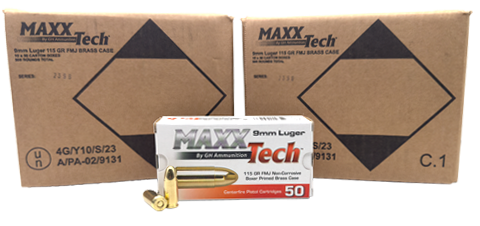
Bulk ammo is your friend here too; snagging a 500-round brick of 9mm from ahead of time means you won’t sweat each trigger pull thinking, “At $0.50 a round, that miss just cost me a dollar!”. The MaxxTech 115 Grain FMJ is some of our most popular bulk 9mm.
One thing you’ll notice in USPSA is the energy. People will be sprinting between firing positions, magazines will be flying during reloads, and steel targets will be ringing. It might look like pure chaos, but underneath is a well-oiled safety structure.
There’s always a range officer right next to the shooter to ensure everything’s done by the book. And when it’s your turn, they’ll guide you through the start position and range command
3-Gun – Triple the Guns, Triple the Fun (and Chaos)
Feeling extra adventurous? 3-Gun might be calling your name. As the name blatantly suggests, 3-Gun matches involve three firearms: a pistol, a rifle (usually an AR-15 type), and a shotgun. If USPSA is an obstacle course with one gun, 3-Gun is a triathlon where you transition between all three.
One minute you’re engaging paper targets with your AR at 100 yards, the next you’re dropping it safely and pulling out your handgun for some up-close shots, and then you’re running over to blast a set of flying clay targets with a shotgun.
It’s a wild ride, and yes, it can be overwhelming for a first-time competitor, but it’s also ridiculously fun.
Logistically, you have more gear to manage. You’ll need a rifle with a sling or some way to safely abandon it during stages (many matches have barrels or tables where you “dump” cleared rifles or shotguns when it’s time to switch guns).
Your pistol setup can be similar to USPSA or IDPA (holster, mag pouches, etc.), and your shotgun is typically a 12 gauge semi-automatic or pump with a capacity of at least 8 shells in the tube. (Some divisions allow more; don’t worry about those details just yet.)
You’ll also need a way to carry shotgun shells; many new shooters start with a simple belt-mounted shell caddy or even just their jacket pockets. It’s true that some 3-gunners have specialized shell holders, chest rigs, and $3k shotguns with extended magazine tubes. Ignore all that at your first match.
Bring what you have, and if you’re missing something (say you only own a 5-shot hunting shotgun), reach out to the match organizer or fellow shooters – chances are someone will loan you gear for the day. Competitive shooters love an excuse to help get a newcomer hooked on 3-Gun.
A 3-Gun stage is usually longer than an IDPA or USPSA stage, since you’re juggling multiple weapons. Round counts can add up across the guns, for example, a single stage might require 20 rifle rounds, 10 pistol rounds, and 8 shotgun shells. Multiply that by a few stages and yes, you’ll be burning through ammo fast.
It’s not a bad idea to stock up on ammo beforehand: think bulk .223/5.56 for your AR, a few boxes of quality 12ga shells (birdshot is most common for the clay and steel targets in 3-Gun, though sometimes slugs are needed), and of course plenty of your usual pistol ammo.
A lot of 3-gun competitors choose reliable, off-the-shelf ammo that they know will run in their guns; this isn’t the time to test some wild new handloads. If you want match-grade .223 for those precise long shots, or just want to buy in bulk so you don’t run dry, we have you covered on all fronts.
You’ll appreciate having a stash of ammo to practice with each gun before the match, because handling three different firearms under pressure is a skill in itself.
Perhaps the best part of your first 3-Gun experience will be the sense of camaraderie. Since it’s a bit more of a circus to coordinate (more gear, more things to remember), 3-Gun shooters tend to be super supportive of newcomers.
They’ll help you figure out stage strategies, like which gun to use first or where to reload, and they’ll definitely remind you to “Make sure that safety’s on!” when you dump a gun. Let the squad know it’s your first time. You might even get a coach trailing behind (at a safe distance) during your run, calling out helpful reminders like “Don’t forget that last target!” It’s all part of the 3-Gun culture.
Yes, you might get really nervous before your first stage, that’s normal times three. Once you finish a course of fire with all three guns, you’ll have a grin plastered on your face. Many folks say after their first 3-Gun match: “I was hooked and already planning what I need to upgrade or practice next.”
Gear Up: What You Need (and Don’t Need) for Day One
By now you’re probably wondering what exact gear is required for a first match. The good news is you don’t need a space-age arsenal to get started. Here’s a quick rundown of essentials that apply to IDPA, USPSA, or 3-Gun:
Eye and Ear Protection: Non-negotiable at any range. Pack a comfortable set of ear plugs or muffs and shatterproof shooting glasses. You’ll be wearing them all day.
Your Firearm(s): Obviously, bring the gun(s) for your chosen match. For IDPA/USPSA, a 9mm pistol is the prevalent choice and ideal for beginners. For 3-Gun, add your rifle and shotgun. Make sure they’re all in safe working order. No need for modifications – a stock gun that you handle safely beats a tricked-out gun you’re not used to.
Holster and Belt: If you’re shooting a pistol match, you need a sturdy belt and a holster that completely covers the trigger guard. In IDPA, the holster rides on your hip and a concealing cover garment is usually required. In USPSA and 3-Gun, you have more freedom (drop holsters, race holsters, etc., depending on the division), but just use something secure that you’ve practiced drawing from. Avoid flimsy fabric holsters or any setup that points the gun at your own leg; range officials will make you change unsafe gear.
Magazines and Pouches: Bring more mags than you think you’ll need. For a pistol, having at least 3 magazines (5 is better) ensures you can complete any stage even if you miss a lot. Magazine pouches on your belt help with quick reloads, but if you don’t have fancy mag carriers, don’t sweat it – stick a spare mag in your back pocket as a last resort. In 3-Gun, extend this logic to rifle mags (a couple of 30-round AR mags should do).
Ammo: It’s worth repeating: bring ample ammunition. If you think you’ll shoot 4 shotgun shells, load your vest with 8. Any ammo left over can be used for your next practice session. Buying in bulk is smart here. Not only is it more cost-effective, it means you can practice more beforehand.
And a few things you don’t need on day one:
- a fancy shooting jersey with your name on it (earn that after you decide this sport is for you)
- custom-tuned handloads (factory ammo is perfectly fine and one less thing to worry about)
- expensive gun upgrades. Keep it simple.
Use gear you’re comfortable with from your practice at the range. The point is to get through your first match safely and figure out what, if anything, you might want to improve for next time.
What Are You Waiting For?
Now it’s time to take a moment to appreciate what you just did. You showed up, you faced the nerves, and you completed your first shooting match. That’s huge. Plenty of gun owners never step beyond casual plinking, so you’ve already opened a new chapter in your shooting journey.
Whether you shot IDPA and learned the art of using cover, blazed through a USPSA stage with a big grin, or juggled three guns in 3-Gun madness, you’re coming away a better shooter than you were in the morning.
So, are you hooked yet? If one sport didn’t quite float your boat, try another. Perhaps IDPA’s tactical vibe was cool, but you crave more speed; give USPSA a shot. Or you loved USPSA but want to spice it up, 3-Gun is sitting there with a new challenge.
Competitive shooting will push you in many ways, and you’ll likely make some lifelong friends along the way.