

Prefer audio over written content? Listen to the article here:
9mm ammunition is one of the longest-standing rounds in the history of firearms. It’s one of the most popular for self-defense. Because of its popularity, many manufacturers play around with specs to get better performance. The more you get into the nitty gritty of these rounds, the more particular your preferences often become.
115, 124, and 147 grain 9mm ammunition are common loads to find on the shelves. The difference between these loads is the weight of the bullet. The more grains in a bullet (like the 147 grain) the harder it will hit. Lighter bullets like the 115 grain will fly faster and have a flatter trajectory.
Generally, the lighter the bullet the faster it flies, the faster it loses its energy and the less stopping power you have. Heavier weight (higher grain) means a slower-moving bullet, but this also hits harder and can theoretically be a little more accurate.
We’ll discuss some more details below about the difference between these types of 9mm and which you might reach for in particular situations.
If you want to know the science of how bullet weight affects your shot, this article is a must: How Does Bullet Weight Actually Affect Performance?
What Does “Grain” Mean?
What do we mean when we talk about “grains”? When looking at a box of ammunition, there will likely be a number indicating the grain of the bullet. This is the unit of measurement that specifies how heavy that bullet is. The larger the number, the heavier the bullet, and this can vary between cartridges.
This is not to be confused with the amount of powder that is loaded in the casing. The grains listed on the box will be the weight of the bullet. Different boxes of ammo that are the same cartridge (like 9mm) will have different designs, and that often includes different bullet weights. Any 9mm firearm will fire any grain 9mm cartridge, but there are slight differences in performance between the different weights no matter what cartridge you are shooting.
115 Grain 9mm
115 grain 9mm ammo is likely the most popular 9mm round. These bullets fly fast but deliver the least amount of energy to a target in comparison to our other rounds in this discussion. Because less energy is delivered, due to the lower mass of the bullet, an experienced shooter may notice the recoil to be snappier, depending on how the firearm normally performs.
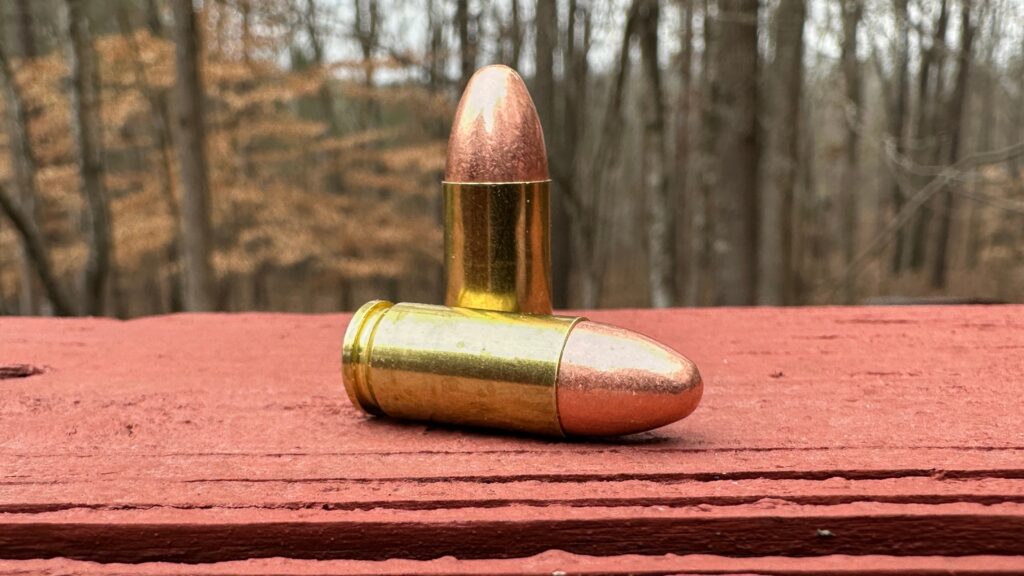
These cartridges are usually better for shooting at the range. They tend to be fairly cheap and easy to find, plus the majority of 115 grain 9mm cartridges are Full Metal Jackets (FMJs) which are not ideal for defense or other uses.
The ballistics of a 115 grain 9mm round can vary depending on what kind of bullet design you’re looking at. We’ll look at the plain-jane full metal jacket round for simplicity’s sake. Browning’s 115 grain FMJ rounds are common at most gun shops when supply chains aren’t an issue. This particular manufacturer’s specs note this cartridge has 362 ft.-lbs of muzzle energy and a muzzle velocity of 1,190 fps. This is a pretty fast moving pistol round.
Of course, different manufacturers have different specs. For example, Remington’s 115 grain 9mm rounds have 329 ft-lbs of muzzle energy and a muzzle velocity of 1,135 fps. Fiocchi’s has a muzzle velocity of 1200 fps and 368 ft-lbs of muzzle energy. IMI has a muzzle energy of 335 ft.-lbs and a muzzle velocity of 1,150 fps.
Choosing between a lighter and heavier round for practicing really does come down to preference. The change in recoil from a 115 grain to a 147 grain bullet is around 5% this change will only be noticeable by a select few who are very used to a different round and are very in tune with how it normally feels.
If you are looking for the ideal grain for self defense, you’ll find the answer in this article: What is the Best 9mm Self Defense Cartridge for EDC?
124 Grain 9mm
124 grain 9mm ammunition is in this cartridge’s mid-range bullet weight. The distance it covers is shorter, and the penetration is going to be deeper than lighter bullets when shot from the same distance and same firearm.
Interestingly, some people comment about how the recoil of a 124 grain 9mm is actually more comfortable versus the 115 grain. Although recoil is highly subjective; if we think through this, we’d think that the heavier the projectile, the more energy it takes to propel it, meaning the more energy is blown back in response resulting in more recoil.
Evenstill, the difference is minimal among the same cartridge.
124 grain bullets can be a little more accurate than 115 grain bullets at closer ranges because of the greater mass, but at longer distances, slower bullets fall quicker and farther, resulting in less long-range capability. This is why you often see small powder charges in small long-range rifles and larger amounts of powder with large calibers pushing heavier bullets.
Compared to 115 grain rounds, 124 grain 9mm transfers more energy to a target. You’ll hear a louder “plink,” and you’ll have more stopping power, momentum, and damage on impact.
MaxxTech’s 9mm 124 grain FMJ has a muzzle velocity of 1,150 fps and a muzzle energy of 323 ft-lbs In comparison, Remington’s same-weight round has a muzzle velocity of 1,110 fps and muzzle energy of 339 ft-lbs Fiocchi’s round has a muzzle velocity of 1,150 fps and muzzle energy of 383 ft-lbs IMI’s round has a muzzle velocity of 1,110 fps and muzzle energy of 333 ft-lbs.
You’ll notice that the muzzle velocities are slightly slower, but the muzzle energy is greater than that of a 115 grain 9mm. Remember, bullet energy is how hard the bullet will hit the target, whereas velocity is how fast the bullet travels on its way to the target.
If you want to dive deeper into the ballistics, you need to check out this article: Internal External & Terminal Ballistics [What Truly Matters]
147 Grain 9mm
147 grain is the heavier version of the 9mm rounds. These are the slowest of the three we’ve been discussing, averaging anywhere from 1,000 to 1,050 fps, depending on the load you’re dealing with.
These heavier grain bullets are technically sub-sonic rounds, which makes them a good partner to use with suppressors. Most people don’t need suppressors for everyday use, but some like a few special toys to play with. Even heavier rounds are marketed specifically for this (158 grain and up), but these can be hard to find.
We wrote an entire article on subsonic 9mm and suppressor use, if that’s up your alley, check it out: Best 9mm Subsonic Ammo: Top Picks & Uses
Historically, the 147 grain 9mm round was developed for US Navy SEALS to use in suppressed 9mm submachine guns. The FBI carries 147 grain 9mm today as a standard issue because they can fit more rounds in the magazine compared to using a .40 or .45 caliber. The lower recoil of the 9mm allows skilled shooters to be even more accurate and quick with shot placement.
Now, in comparison to 115 grain and 124 grain, this heavy beast isn’t necessarily better for some tasks. 147 grain is particularly slow. When examined in JHP (jacketed hollow point) ballistics from handguns, terminal performance is noticeably different from the lighter rounds. Because these rounds are often subsonic, this means bullet expansion on impact is often lacking, even with hollow point designs.
For some, this doesn’t matter, and the 147 grain bullet can be incredibly accurate aside from being slow. The slower speed of the bullet may lend itself to a more subtle recoil, but physics is still physics, and the change will once again be unnoticeable to most.

One great choice for 147 grains is the Speer Gold Dot 147 Grain JHP. This was a law enforcement round and is known for its performance and reliability.
Why Do I Care?
These differences may not matter to weekend shooters but can make all the difference in how the round performs when you squeeze the trigger. Some weights will shoot better than others in some handguns, but may not shoot as well out of another.
Some guns have clearances that are so tight that you’ll find your piece may “prefer” a particular brand or weight of ammunition.
A gun that prefers a round may have less incidence of failure or jams when using that round. If you find a good bullet for your gun it may lead to less maintenance in the future. Additionally, the bullet will fly better and be more accurate.
Even looking at just the 9mm FMJ in varying grains, you’ll find that specifications vary according to manufacturers. You’ll often get what you pay for. Fiocchi has specs that might fit the best for what you want to do; just make sure your wallet has enough cushion.
Winchester and Remington are friendly enough for entry-level shooters or plinking cartridges and won’t completely break the bank with one range visit.
Other Considerations
Ballistics are affected by many variables. The gun build, metals, slight differences in round casings between manufacturers, and even smaller differences can change the energy and travel of a projectile. The type of bullet (FMJ, HP, JHP) and powder load affects performance as well.
Jacketed hollow points act differently than solid bullets because they’re built to expand on impact and cause a greater radius of damage to a target. This means hollow point rounds penetrate shallowly compared to solid bullets.
By the same token, solid bullets travel farther but might create a “cleaner” hole and cause less damage.
This basic premise is usually why hollow points are preferred for self-defense but not target practice or competition shooting. When you delve further into ammunition there’s a whole other set of ballistic charts to dissect–at the end of the day.
The nonstandard +P and +P+ rounds will fly hotter and with more energy but that’s another topic, if you want to learn about that, check out this article: What Is +P Ammunition?
Closing Thoughts
If you’re looking for a particular grain for self-defense, any of these are going to work. That’s a given with any projectile that can travel quickly and penetrate soft material.
If you want something that has extra stopping power, look for one with a higher grain. If you’re looking for something to plink around and are on a budget the 115 grain may be the best option.
Between the three bullet weights for a 9mm, there’s not one that reigns supreme. Each has a place and a reason why you would gravitate toward one more than another.
The basic premise is that the lighter the bullet, the faster and farther it goes; the heavier the bullet, the slower and shorter it goes. Find what your gun likes and what feels the best, and you’ll be a happy shooter.
115 vs 124 vs 147 Grain 9mm Ammo FAQs
Q: Is 147 Grain or 115 Grain Better?
Neither 147 or 115 is better; they are just different. 115 grain 9 mm loads are going to weigh less than 147 grain loads. Meaning the 115 grain ammo is going to be faster, but larger 147 grain bullets will typically penetrate deeper. For this reason many shooters feel more comfortable with the heavier bullet for defensive purposes, but the lighter bullet for time at the range.
Q: Is It Better to Have Higher or Lower Grain Ammo?
A lower grain bullet is going to fly faster than a higher grain bullet will. When shooting, you will typically notice that low grain ammo feels lighter than higher grain ammunition. A higher grain ammunition will have more momentum and therefore penetration. Really it all boils down to what you’re looking to use your ammunition for and what you’re comfortable with recoil-wise.
Q: Which Has More Recoil, 115 Grain or 124 Grain 9MM?
9 grains does not make much of a difference, but 124 grain ammunition will have just a hair more recoil than 115 grain because there is more bullet weight to move. Different handguns will feel different based on the overall mass of the slide, barrel length/rear sight placement, and even what powder charge the ammunition manufacturer used more so than a 9 grain difference in bullet weight.
Q: Why Use 147 Grain 9MM Ammo?
Typical 147 grain 9 mm ammunition gives the shooter a very smooth recoil impulse. Another benefit is most defensive ammo terminates quickly while still penetrating deep enough to be effective. Also, 147 grain 9 mm ammo tends to remain subsonic. This makes it great for suppressed setups.
Q: Is a Heavier Grain Bullet Better for Self-Defense?
Bullet design is the most important factor for self defense cartridges. Just because the bullet is heavier doesn’t mean it will penetrate better than all other lighter bullets. A 147 grain bullet will typically penetrate deeper than a 115 grain will. But a well designed 115 grain bullet will perform just as good (if not better) than a 147 grain bullet.







Is the powder load generally the same across the grain spectrum?
Thank you for your question. Powder load can vary greatly due to a combination of powder types and manufacturers. Here is a great resource that shows lots of published load data for a variety of 9mm loads.
I use 147grain +p+ in my duty handgun only. My handgun of choice are 2. First the sig Sauer P226 Legion. As it’s a full railed handgun. It’s heavier than most handguns allowing felt recoil to be negligible. I as well use Federal 115 grain +p+
The second handgun I favor is the H&K VP9, that I own 2 of. One has an RMR on it. The second is a stock VP9. I have to qualify monthly to carry these handguns. I have become very proficient with both. I can put bullet hole through bullet hole at 15 yards, the accepted range for an encounter of multiple targets. Sadly today it’s necessary to engage multiple targets in a defensive scenario. I do use 124grain Winchester ranger T ammunition in one of the VP9s
Geogrose
I’m looking into switching from 124 to 147. You mentioned that 147 would be less level trajectory at longer distances, but didn’t say what distances we’re talking about. What I’m looking to use these for is up to, say, 15 or 20 yards max. Would you consider that to be “long” in the context of this article? I realize there would be some increased drop at any distance, technically, but at my distances would it be negligable?
Interesting to read the “Why do I care” section of this article. This is something I’ve been asking myself for some time. Since different shells may not be what your gun prefers to “eat”, how do you find your guns match? As an ammo supplier, I would think providing new shooters a kind of “sampler pack” would be a great idea. Let the shooter decide on 10 shells from 5 different manufacturers.
50 rounds total in a shipment. They could be labeled by manufacturer and 10 in a baggie or something. This would give you a starting point to make your decision with. A true side-by-side comparison without the necessity of buying 5 boxes boxes at 50 rounds each.
Just a thought?