
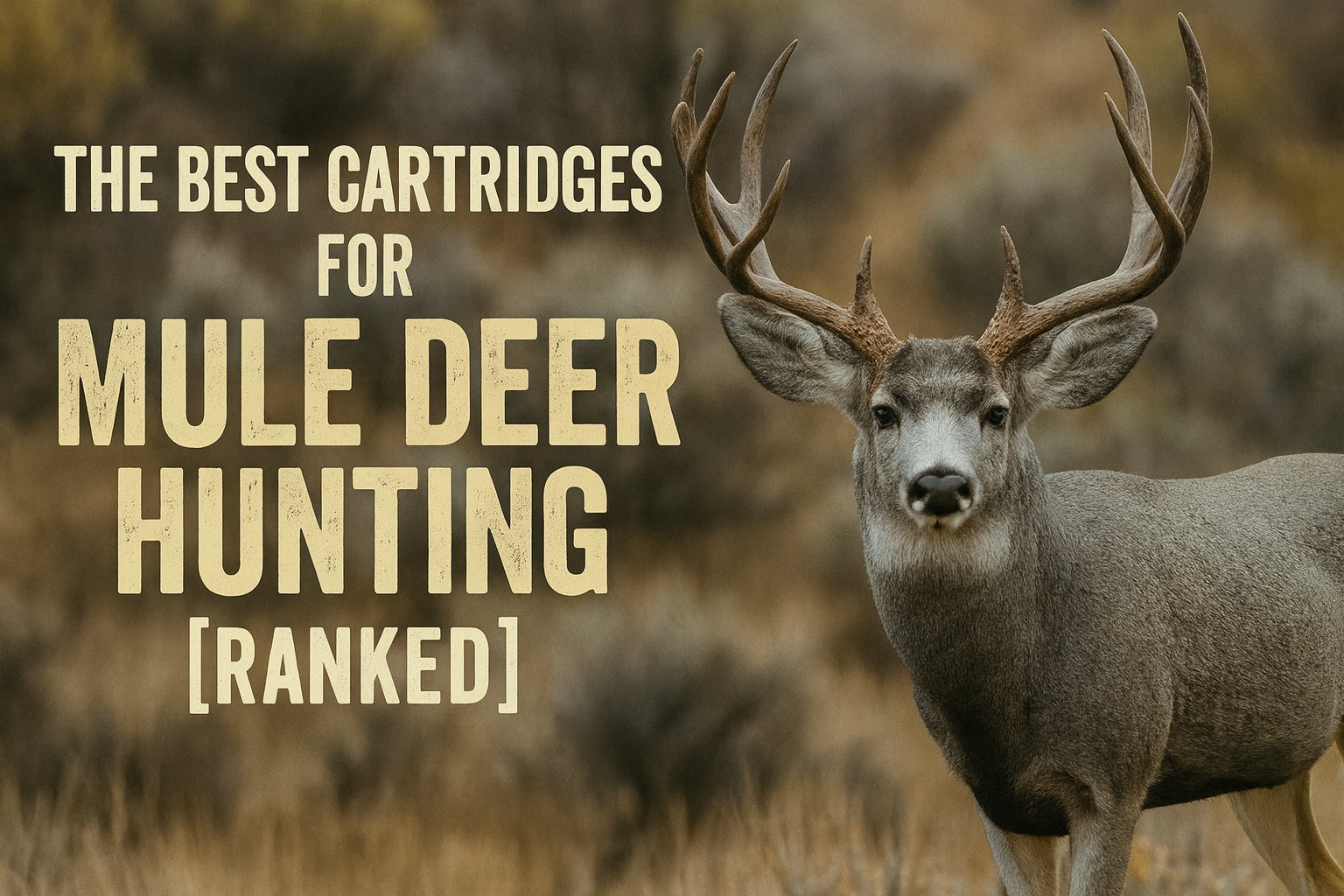
Mule deer hunting has grown in popularity, with many heading out to the western United States for a chance at getting a big mule deer buck in their crosshairs. While there is a ton that a hunter has to consider when going on a planned hunt like this, the cartridge they choose to use while in the field can be one of the most important decisions they make. You want a cartridge you can trust to be reliable, and we are here to rank the best of the best cartridges to use for mule deer hunting.
While there are many different cartridges to choose from, we rank the top ten based on a variety of criteria. The always versatile .308 Win leads the way for all-terrain reliability, while the 6.5 Creedmoor has quickly become popular for long-range precision for Western mule deer hunts.
So let’s dive into our top 10 best cartridges for mule deer hunting. But before we do, let’s talk a little bit about how we developed our list based on mule deer hunting itself and the criteria we considered for each cartridge.
Choosing A Cartridge For Mule Deer Hunting
Compared to hunting whitetail deer, mule deer are rough and tumble creatures that stick to the sagebrush deserts and steep mountain sides of the Western United States. Also known as “Mulies” or the Gray Ghosts, mule deer have the innate ability to appear and disappear out of nowhere. They are masters at blending into their surroundings, making it extremely difficult to get close to them.
Mule Deer are built to evade predators in open deserts as well as on the sides of some of the steepest mountains, which means your cartridge better be ready for any type of terrain and environment. That means your cartridge needs a flat arc trajectory to fight wind and gravity while packing enough punch for a vital hit on a 200-pound buck, and recoil you can handle after a long stalk and possibly for a follow-up shot should things go sideways.
That being said, in the backcountry of the Western United States, long-range shots are the norm rather than the exception. The need for an efficient, ethical, 1-shot kill between 200 and 500 yards is at the forefront of choosing an effective cartridge for taking down a mule deer.
For this, we looked into the ballistic performance of each cartridge, the historical success of the cartridge, and real-world reports of each as it pertains to mule deer hunting. We also took into consideration recoil, cartridge availability, suitability for 200-500 yard shots, and the reliability of ethical kills at those ranges.
If this is your first time venturing out on a mule deer hunt and you are starting at the very beginning, you came to the right spot. Deciding which cartridge you want to shoot will help you choose the right firearm to fire it from. Start there and work your way backwards. There are plenty of options to choose from.
If you are interested in bullet design, check out our other article The Best Bullet Design for Whitetail Hunting, all the same science is relevant to mule deer.
.308 Winchester: The Do-It-All Cartridge
The .308 Winchester has long been the choice of many hunters, especially out West, for mule deer hunting. Hitting the scene in 1952 as the civilian version of the 7.62×51 NATO round, it was a proven cartridge that was necked down slightly for better accuracy. By the 1960s, the .308 had become the go-to for American big-game hunts. Today, it is chambered in over 50 different rifle models.
A standard 150-grain soft point clocks 2,820 fps of muzzle velocity, delivering 2,654 ft-lbs of energy. At 300 yards, velocity dips to 2,000 fps with 1,332 ft-lbs of energy. This is plenty for a vital shot on any mule deer. Bullet drop is about 10 inches from a 200-yard zero, and wind drift stays under 10 inches in 10 mph crosswinds.
Heavier 180-grain loads will trade a lower speed for more penetration and knockdown power. So, the lower grain will allow for better distance while sacrificing some knockdown energy, but a heavier grain .308 will do the opposite. This makes the heavier grain bullets better for areas with a little more brush or forested mountain sides.
The .308 Winchester has about 18 ft-lbs of recoil, putting it in the mid-range of recoil for shooters. Most hunters will not have a problem getting used to it.
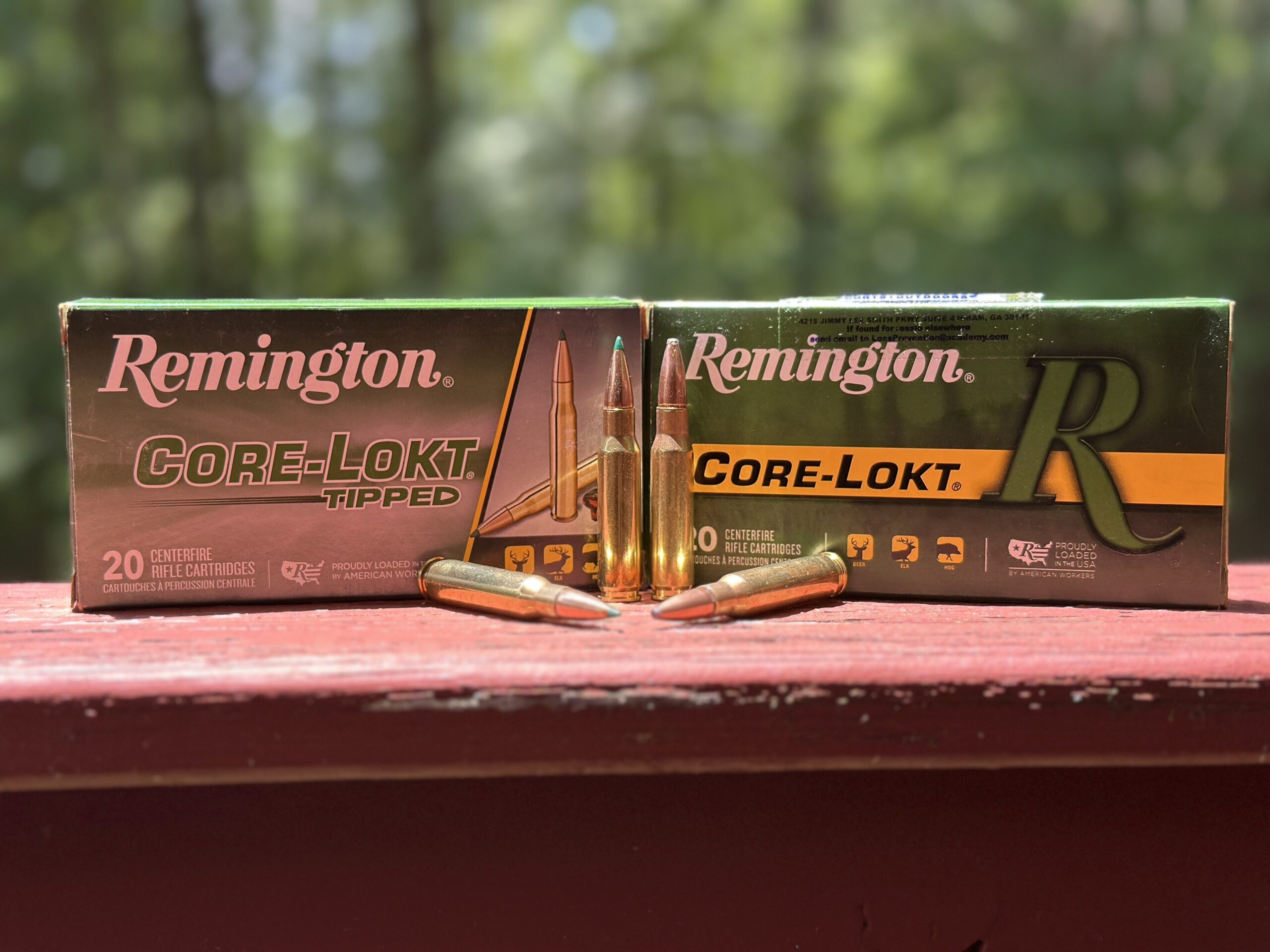
Core-Lokts are my favorite type of cartridge for deer sized game, you can’t go wrong with them.
Shop in-stock 308 Winchester Here
Pros:
- – Abundant and flexible with thousands of factory loads and rifle choices.
- – Mild recoil (15–20 ft-lbs) for easy confidence and accuracy.
- – Great brush-busting performance and consistent accuracy in rough country
Cons:
- – Limited choice at 400+ yards because of steeper trajectory and greater wind drift.
- – Has potential to over-penetrate smaller deer or does, especially with heavier bullets.
Tips for Best Performance:
- – Use a 1:10” twist barrel for optimal stability.
- – Zero at 250 yards for maximum effective range.
- – Use 150–165 grain bullets for a balance of expansion and penetration.
6.5 Creedmoor: Long-Range Precision
As the newest cartridge on the scene, the 6.5 Creedmoor has burst into popularity since its introduction in 2007. It took less than a decade for the 6.5 Creedmoor to overtake the .308 in sales, thanks to its superior long-range ballistics and ease of shooting.
Ballistically, the 6.5 Creedmoor is a dream. With a 140-grain, it has a 2,710 fps at the muzzle paired with 1,910 ft-lbs of energy. At 400 yards, it holds 1,800 fps and 1,000 ft-lbs of knockdown energy. It only has 15 inches of drop from a 200-yard zero on a 400-yard shot. It also only has about a 7-inch drift in a 10 mph crosswind.
The 6.5 Creedmoor is known for its extremely flat trajectory and retaining energy for ethical kills beyond 500 yards, which makes it a long-range hunter’s dream cartridge, especially in open territory.
The 6.5 Creedmoor is also easy on the shoulder, with only 12 ft-lbs of recoil. This is great for follow-up shots, younger hunters, or even hunters who just want a smoother shot.
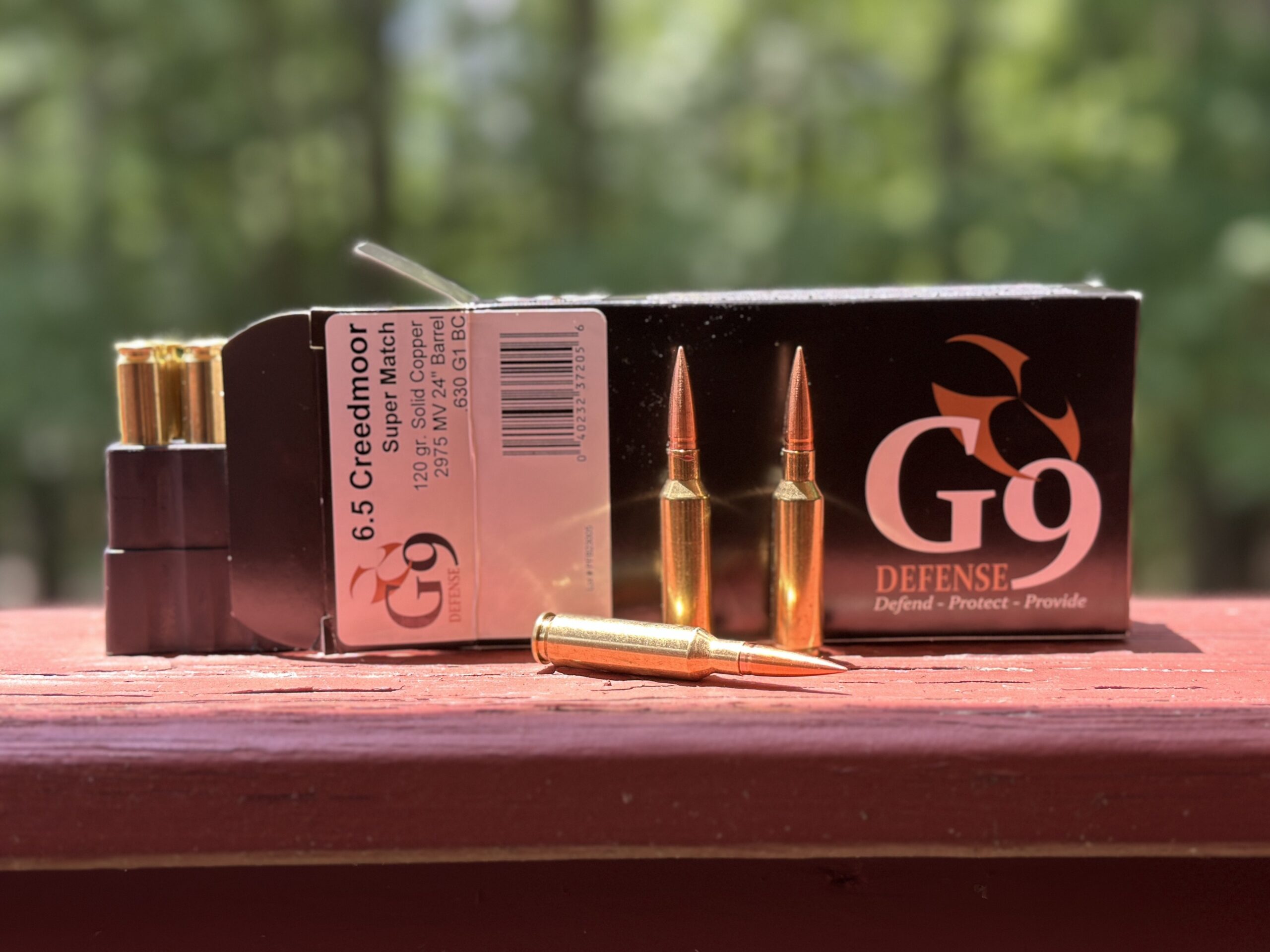
If you like monolithic bullets, you need to check out the G9 Defense Super Match
Shop in-stock 6.5 Creedmoor Here
Pros:
- – Laser-flat trajectory and outstanding ballistic efficiency make it highly accurate at long ranges.
- – Low recoil enhances shooter comfort, accuracy, and follow-up speed.
- – High-BC bullets offer predictable downrange performance and great wind resistance.
Cons:
- – Lighter bullet weights may offer reduced penetration on heavy bone or larger-bodied bucks.
- – Not suited for close shots through heavy brush where larger, heavier rounds perform better.
Tips for Best Performance:
- – Match with a 1:8” twist barrel to stabilize longer, heavier bullets.
- – Zero at 250 yards to allow for effective shot placement in most western hunting situations.
- – Train at realistic hunting ranges; just because it can hit 500+ yards doesn’t mean you should without the skill and confidence to do so accurately.
.270 Winchester: Flat & Fast
The .270 Winchester was introduced in 1925 as a necked down version of the .30-06 Springfield that could provide flatter trajectory and higher velocity while maintaining big game versatility. The cartridge rapidly gained a cult following among hunters, with popular outdoorsmen such as Jack O’Connor calling it one of the best all-around, most useful hunting cartridges ever devised.
Its “baby brother” status to the .30-06 gives it similar case capacity and retained power but less bullet weight and diameter, which translates into faster velocity, a flatter trajectory, and reduced recoil. All this combines to make it especially popular among accuracy-focused hunters who love long-range capability and easy recoil, but don’t want to sacrifice terminal performance.
A typical 130-grain soft point factory load clocks in at 3,060 fps muzzle velocity and about 2,700 ft-lbs of muzzle energy. It retains 2,200 fps and 1,400 ft-lbs of energy even at 300 yards, plenty to handle deer-sized game with authority. Its flat trajectory, with around 9 inches of drop at 300 yards, and relatively light 17 ft-lbs of recoil make it easy to shoot accurately all day at the range or on a long-distance hunt.
Shop in-Stock .270 Winchester Here
Pros:
- – Flat-shooting trajectory and higher velocity are great for the open country.
- – The recoil is mild enough to shoot both accurately and rapidly.
- – Lots of history and field-proven performance with decades of success stories.
Cons:
- – Limited selection of bullet weights above 150 grains.
Tips for Best Performance:
- – If you’re likely to take longer shots or encounter heavier-bodied animals, consider a 150-grain bullet. It’ll cut through wind better and provide additional knockdown power.
- – A 1: 10 twist rate will stabilize just about any bullet weight you’ll throw in the .270.
.280 Remington: The Classic That Never Got Its Due
Developed by necking the legendary .30-06 Springfield to .284 caliber, the .280 Remington offered the best of both worlds, providing a flatter trajectory than the flat-shooting .270 Winchester but with heavier, more potent bullet performance than the classic hunting favorite. Unfortunately, its arrival was a few years too late to make much of a splash. By the time gunmakers started producing it in any serious numbers, the reputation of the .270 and .30-06 were already well established.
For mule deer hunters, there’s a reason the .280 Rem is such a staple in many western states: it’s perfect. Powerful enough to put any big buck down cleanly, but mild enough to shoot accurately and with confidence, the .280 offers a sweet spot that’s hard to beat. The result is a remarkably flat-shooting, hard-hitting, and versatile round that can tackle just about any deer hunt you can throw at it.
On a typical load (a 150-grain bullet), you can expect muzzle velocity to be around 2,890 fps, and muzzle energy to be about 2,780 ft-lbs. At 300 yards, you still have an ample 2,450 fps and 2,007 ft-lbs to work with; that’s more than enough to ethically harvest a mule deer or even an elk if need be. The bullet will also drop a manageable 9–10 inches at that distance, and recoil is mild compared to magnums, typically around 18 ft-lbs, so it’s a pleasure to shoot and easy to use.
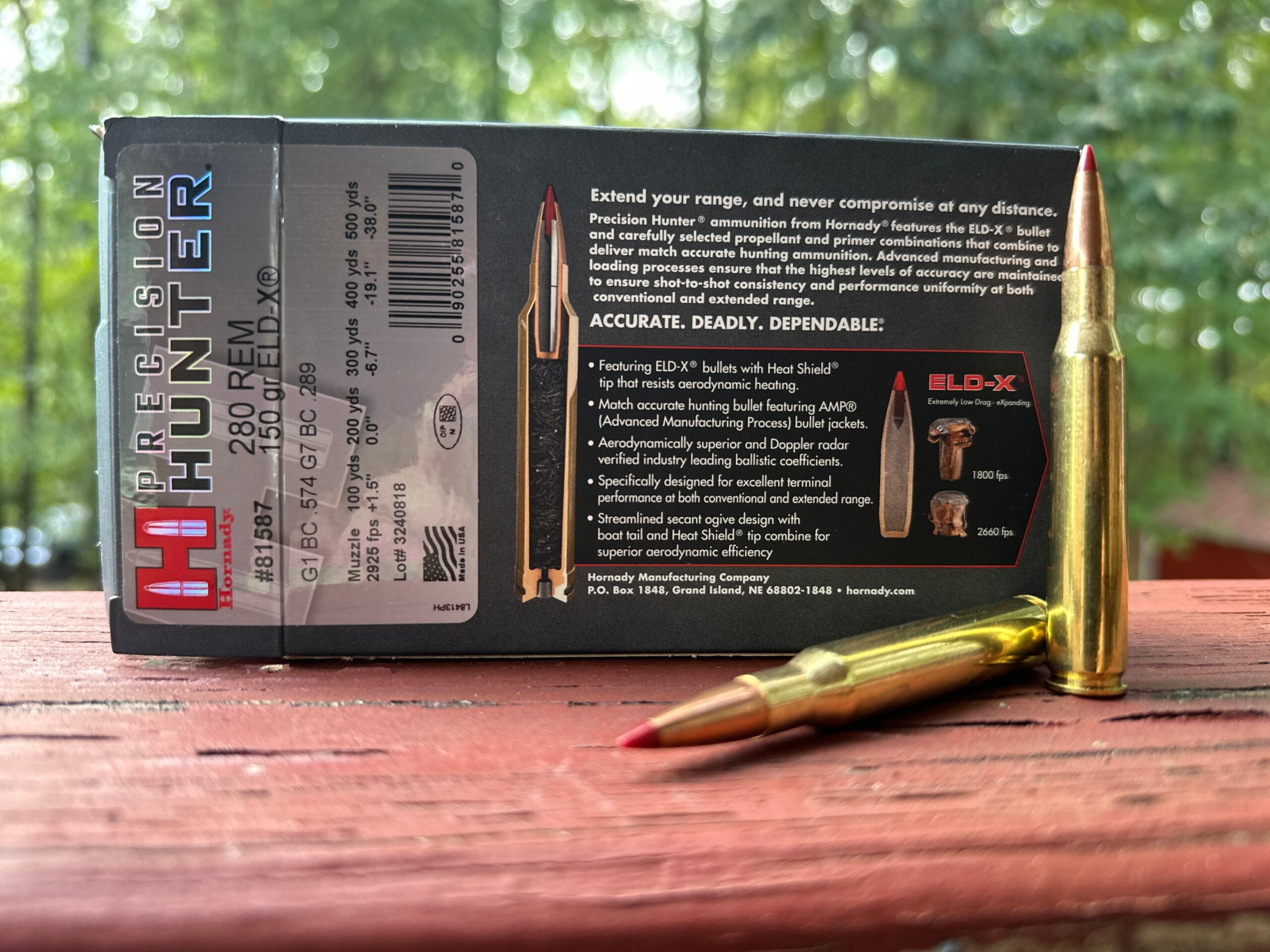
Our favorite .280 Remington cartridge is from Hornady, check it out.
Shop in-Stock .280 Remington Here
Pros:
- – Great combination of speed, energy, and trajectory; flatter than the .30-06 but more powerful than the .270.
- – Moderate recoil helps make follow-up shots more accurate and allows for faster shooting overall.
Cons:
- – Is frequently overlooked in favor of the .270 Winchester and 7mm Rem Mag, even though it can match or beat their performance.
Tips for Best Performance:
- – Shoot a 1: 9” twist barrel to properly stabilize heavier, high-BC bullets out to longer ranges.
- – Try 140- or 150-grain bonded bullets for mule deer; the right ones will provide a perfect mix of expansion and penetration.
- – Zero at 200–250 yards to get the full benefit of the cartridge’s flat trajectory.
6.5 PRC: The Creedmoor on Steroids
The 6.5 Precision Rifle Cartridge (PRC) is a new addition to this list. Debuted by Hornady in 2018, the 6.5 PRC is a hotter, faster, and harder hitting evolution of the massively popular 6.5 Creedmoor. Intended to propel heavier bullets at higher velocities out of a short-action magnum case, the 6.5 PRC offers impressive long-range ballistics with minimal recoil or shootability tradeoffs.
While the 6.5 PRC hasn’t quite reached the status of the Creedmoor, it is rapidly gaining a following with western hunters and precision shooters who want Creedmoor-level accuracy with more velocity, energy, and long-range capability. For western hunters who routinely take shots beyond 400 yards, or who want a flatter shooting cartridge for open-country mule deer and elk, the 6.5 PRC is hard to overlook.
A typical load (a 143 grain bullet) leaves the muzzle at 2,960 fps with approximately 2,780 ft-lbs of energy. Even 400 yards downrange it is still flying along at 2,381 fps with 1,800 ft-lbs, more than enough for clean, ethical kills on deer-sized and even elk-sized game. It will have around 18” of drop at that distance and a very manageable recoil of only 18 ft-lbs, making for a near ideal combination of reach, precision, and shootability.
Pros:
- – Basically a “Creedmoor+”– more velocity, more energy, and better long-range performance.
- – Excellent ballistic efficiency
Cons:
- – Fairly new and less common, ammo is often more expensive and harder to find.
- – Fewer rifle options than more established cartridges.
Tips for Optimal Performance:
- – Use a 1: 8” twist barrel to stabilize long, heavy, high-BC bullets.
- – Practice at appropriate, ethical shot distances; just because the 6.5 PRC can shoot farther doesn’t mean it should without adequate practice and ballistics data.
6.8 Western: Modern Magnum Performance in a Short Action
The 6.8 Western was recently introduced by Winchester and Browning in 2021. Designed to fill the gap between traditional long-range cartridges and heavy-duty big-game rounds, the 6.8 Western is chambered in a short-action .270 WSM case but is optimized to fire heavy-for-caliber, high-BC bullets for a lot of serious knockdown power and exceptional long-range ballistics in a short, efficient package.
What sets the 6.8 Western apart is its ability to propel 165- to 175-grain bullets with extreme velocity and energy while still having a relatively manageable recoil impulse for the class. Compared to the .270 Winchester and even the 6.5 PRC, this allows it to have a substantial advantage in terms of wind resistance, retained energy, and terminal ballistics at longer ranges, which is exactly what Western hunters need to cleanly fill a tag on mule deer.
A typical load with a 165-grain bullet is about 2,970 fps out of the muzzle with approximately 3,230 ft-lbs of muzzle energy. Even at 400 yards, it’s still clocking in at 2,350 fps and 2,000 ft-lbs of retained energy, making it more than capable of harvesting a mature mule deer or even a bull elk. Its drop trajectory is competitive as well, at about 18 inches of drop at 400 yards with a recoil impulse of just about 20 ft-lbs, making it a potent all-around round that has some reach, some power, and some shootability to it.
Shop in-Stock 6.8 Western Here
Pros:
- – Exceptional long-range energy and penetration makes it perfect for big-bodied mule deer or elk.
- – Great bullet performance and wind resistance thanks to the heavy, high-BC bullets it can stabilize.
Cons:
- – Heavier recoil than the 6.5 PRC or .270 Winchester.
Tips for Best Performance:
- – Run a 1: 8” twist barrel to stabilize the long, heavy bullets that will give you the most BC.
- – Use bonded or monolithic bullets for deep penetration on larger game.
- – Zero at 250 yards to take advantage of the flat-shooting capabilities on the wide range of Western terrain.
Lock In Your Cartridge and Make It Count
Our top picks might not come as a huge surprise to most experienced mule deer hunters, but we hope this list has highlighted how much these options can differ in terms of trajectory, recoil, and performance on game. There’s no one-size-fits-all “best” cartridge out there. The best one is the one that suits your needs, values, and hunting country best.
Will you need to make long, cross-canyon shots where velocity and energy are most important? Or, will you take most of your shots at closer ranges where recoil control and follow-up shots are more valuable? Do you prefer a classic, jack-of-all-trades round, a brute-force magnum, or a precision-shooting modern cartridge?
Match your needs to the proper cartridge and you’ll hunt with more confidence and make cleaner, more ethical shots. Of course, shot placement and practice will always matter more than the headstamp on your brass, but the right gear and preparation will have you ready when that gray ghost finally steps into the daylight.
Mule Deer FAQs
We try to answer all the questions we can in the article, but there are always a few extra ones that slip through the cracks. Here are some of the most common questions we have seen from mule deer hunters.
Q: What caliber does Steven Rinella use for mule deer?
Steven Rinella, host of MeatEater, has used and recommended all kinds of cartridges over the years for mule deer, but one of his long-time standbys is the .270 Winchester. That’s because it provides a perfect balance of flat shooting, light to moderate recoil, and tremendous terminal performance.
Q: What grain .308 is best for mule deer?
A 150- to 165-grain bullet in .308 Winchester is tough to beat for mule deer. That bullet weight provides a good balance of velocity, expansion, and penetration for plenty of knockdown power on mule deer without too much recoil. You might opt for a 165-grain soft point or bonded bullet in open country with the chance of longer shots, as they’ll penetrate deeper and retain energy better at those longer ranges.
Q: What is the best cartridge for mule deer hunting?
The best caliber for mule deer hunting is the one you can shoot best and have the most fun with. Our all-around favorite picks are the .270 Winchester for its flat, mid-range trajectory and light to moderate recoil, .308 Win for balanced recoil and power, and 6.5 PRC or 6.8 Western for long-range, wind-resistant shooting.
Q: Is a .30-30 or .308 better for deer?
For most situations, the .308 Winchester is a better choice over 30-30 for deer sized game. It shoots flatter, hits harder at distance, and retains more energy past 200 yards.The .30-30 Winchester remains a good option if you expect to hunt closer ranges in heavy cover or thick timber, but it doesn’t have the range or punch of the .308 for longer shots.








Very good review.
308 will be here when the rest are gone.
It was the military caliber go to round for years.
Ammo is available everywhere.
195 Grain +. The higher the grain weight the more knock down power.
Just my cents.
Thanks TimM