Prefer audio over written content? Listen to the article here:
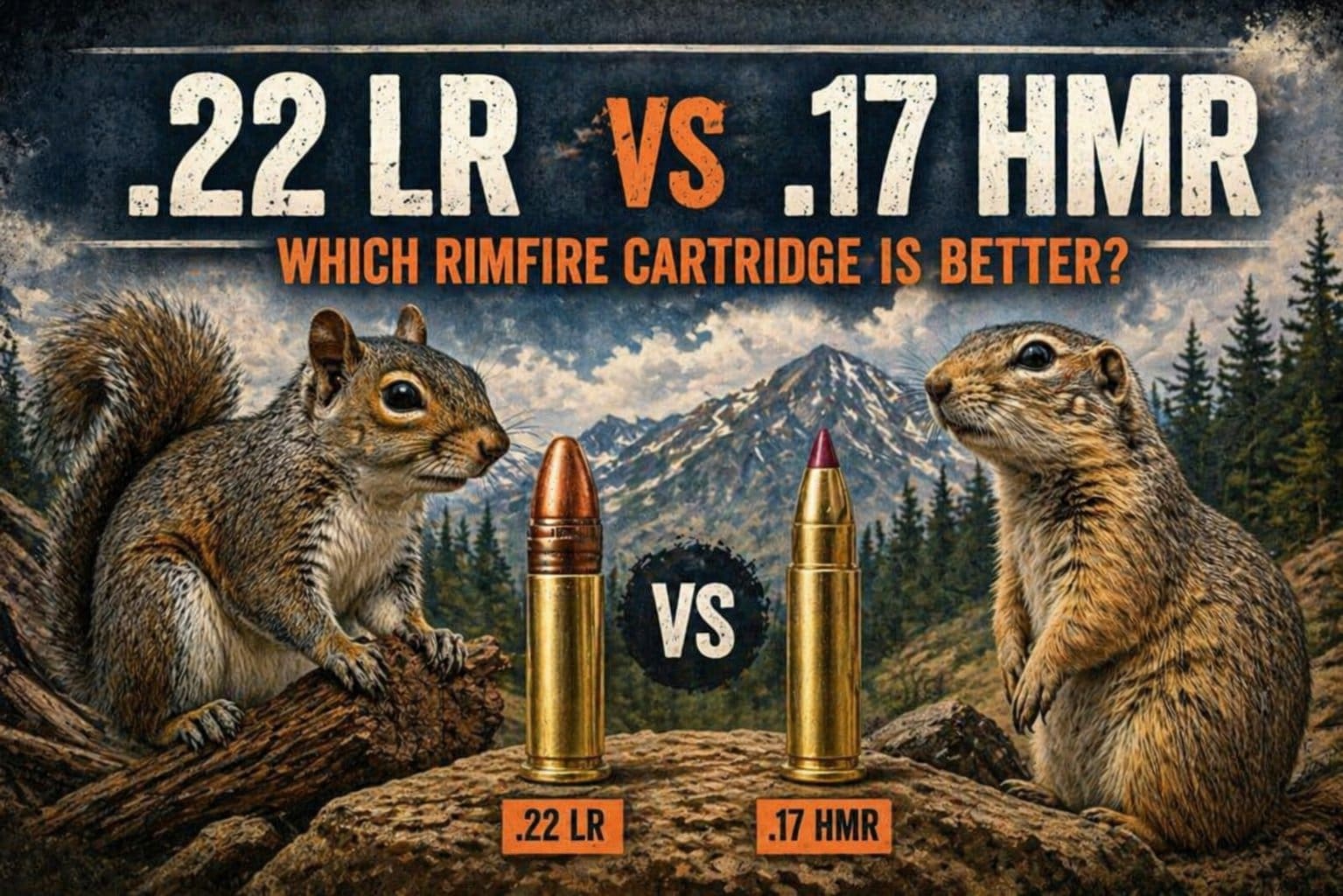
The .22 LR versus the .17 HMR comparison is hotly debated; is one better than the other or do they each have their own merits for different uses? Maybe you have been trying to pick between the two or been thinking about adding one or the other to your collection.
It might seem like a tough choice.
Both of these rimfire cartridges have loyal fans for good reason. The .22 Long Rifle has been a household name for over a century, powering everything from backyard plinking to serious small game hunting.
The .17 Hornady Magnum Rimfire is the new kid on the block, coming on the scene in 2002, bringing serious speed and flat shooting performance that turns heads in the varmint world.
The .22 LR wins for affordable plinking, training new shooters, and close range small game hunting thanks to dirt cheap prices and low recoil.
The .17 HMR shines for longer range varmint control with its blazing speed, flatter trajectory, and better downrange energy. Both have their advantages.
Many customers ask which one is “better,” but the real answer comes down to what you intend to use it for, how far are you shooting, and what kind of ammo budget you have.
Neither is universally superior to the other, rather it all comes down to your specific need, use, and preference. Both deliver tons of fun, regardless of their intended use.
We will break it all down in plain English so that you can make the smartest choice for your needs when it comes to a rimfire cartridge.
A Quick Look at the Cartridges
The .22 LR dates back to the late 1800s and still remains as one of the most popular and versatile rounds ever made. It typically fires a 30 or 40 grain bullet at velocities between 1,000 and 1,400 fps depending on the load.
Standard velocity ammo hovers around 1,070 fps, while high velocity “Stinger” types can push 1,640 fps. It is mild mannered, super reliable, and works in everything from tiny single shot firearms to semi-auto types of firearms.
The .17 HMR takes a .22 WMR case, necks it down, and launches a tiny 15.5 to 20 grain .17 caliber bullet at 2,400 to 2,650 fps. That speed gives it impressive energy and a laser-like trajectory compared to most other rimfires.
Hornady designed it specifically to fill the gap between the .22 LR and centerfire varmint rounds. And it delivers.
Both are rimfire, so they are affordable to shoot compared to centerfires, but their performance charts look very different from one another once the bullet leaves the muzzle.
Ballistics Breakdown: Speed, Energy, and Trajectory
Let’s compare some real world numbers without drowning you in charts.
A typical 40 grain .22 LR high velocity load leaves the muzzle at about 1,200 fps with roughly 128 ft-lbs of energy. At 100 yards it slows to around 1,000 to 1,075 fps and carries 87 to 103 ft-lbs.
By 150 yards it has dropped to roughly 930 fps and 70-80 ft-lbs of energy.
Now the .17 HMR with a 17 grain bullet leaves the muzzle at 2,530 fps and 242 ft-lbs. At 100 yards it is still moving over 1,800 to 2,150 fps with 123 to 174 ft-lbs remaining.
Even at 150 yards it holds around 1,500 fps and 85+ ft-lbs. That is real speed and punch at a long distance for a rimfire.
Trajectory makes the biggest difference. Zero a .17 HMR at 100 yards and it drops only about 3 inches at 150 yards and around 10 to 12 inches at 200 yards.
A .22 LR zeroed the same way drops 11+ inches at 150 yards and over 30 inches at 200 yards. This flat flight from the .17 HMR means fewer holdovers and more confident shots out past 100 yards.
Wind drift does favor the heavier .22 LR bullet slightly at longer ranges because the lighter .17 bullet gets pushed around more easily. Still, the .17 HMR’s speed usually wins the argument when it comes to longer range shooting.
If you want to dive deep into understanding more about ballistics and why they really matter, check out our article Internal External & Terminal Ballistics [What Truly Matters]
Plinking and Casual Target Shooting
When the goal is pure fun and burning through boxes of ammo without regret, .22 LR is king. You can buy bulk bricks of ammo for pennies per round and shoot all afternoon.
It is perfect for teaching kids or new shooters because recoil is almost nonexistent.
Subsonic .22 LR loads pair beautifully with suppressors for backyard or campsite plinking that won’t disturb neighbors. Mat-grade .22 LR ammo also gives competition shooters incredible precision at 50 and 100 yards.
The .17 HMR cost 2 to 4 times more per round, so high volume plinking gets expensive fast. Most shooters reserve it for days when they want that satisfying “crack” and dead-on hits on steel at 150+ yards.
It is fun in small doses, but your wallet will prefer the price of the .22 LR for bulk shooting sessions.
For the best .22 LR choices across uses, check out our guide The Best .22 LR Cartridge for Your Use [Hunting, Plinking & More].
Small Game Hunting: Squirrels, Rabbits, and Table Fare
For putting food in the freezer or pure enjoyment of small game hunting, the .22 LR often gets the nod, especially inside of 75 yards. Its heavier bullet at moderate speed creates nice clean kills on squirrels and rabbits with minimal meat damage when you take head or neck shots.
Many hunters say it preserves more edible meat than the explosive .17 HMR.
The .17 HMR works fine at close range too, but its high velocity can turn small game into mush on body shots.
Save the .17 HMR for when squirrels are up in the trees at longer distances or when you need to reach out further in open fields.
Both cartridges shine with hollow point ammo for expansion. Practice your head shot placement and you will bring home plenty of tasty meat either way.
For more ideas read our article The 10 Best Cartridges for Small Game Hunting.
Varmint & Predator Control at Distance
This is where the .17 HMR often steals the show. Prairie dogs, ground squirrels, woodchucks, and even coyotes at the edge of rimfire range are perfect targets.
The flat trajectory and retained energy let you make ethical kill shots out to 150-200 yards without complicated calculations and huge holdovers. Many varmint shooters call it their favorite “poor man’s varmint round.”
The .22 LR still handles closer pests just fine and lets you fire hundreds of rounds in a single session for the same money.
Subsonic .22 LR rounds are also much quieter, which helps when you don’t want to notify every animal within a half mile about what you are up to.
Accuracy & Real-World Performance
Both cartridges can be amazingly accurate in quality rifles. The .22 LR has a huge selections of match grade ammo and dedicated competition platforms. Many benchrest shooters swear by it for tiny groups at 50 and 100 yards.
The .17 HMR delivers outstanding inherent accuracy thanks to its high velocity and good ballistic coefficient for such a light bullet. Plenty of hunters report consistent sub-inch groups at 100 yards with standard hunting loads.
It shines when the wind is light and you want point and shoot simplicity at longer ranges.
Recoil is laughably low for both rounds, which is perfect for extended sessions, young shooters, or anyone with shoulder issues.
Firearm Options & Availability
The .22 LR has tons of rifle platforms available. Ruger 10/22, CZ 457, Savage Mark II, Henry lever actions, and dozens more.
You can find used ones cheap and there are aftermarket parts galore available to just about anything you want with your .22 LR firearm.
The .17 HMR platform options include Savage 93 series, CZ 457 combos (barrel swaps between .22 LR and .17 HMR), Tikka, Bergara, and Ruger Precision Rimfire. Combo guns are popular because one stock serves two different calibers.
Ammo for .22 LR is stocked in nearly every store that sells bullets. The .17 HMR is common online and at bigger gun shops but can be harder to find in more remote areas and smaller stores.
That’s why bulk buying online can really help keep your ammo stock up easier for either round.
Cost, Availability, and Smart Bulk Buying
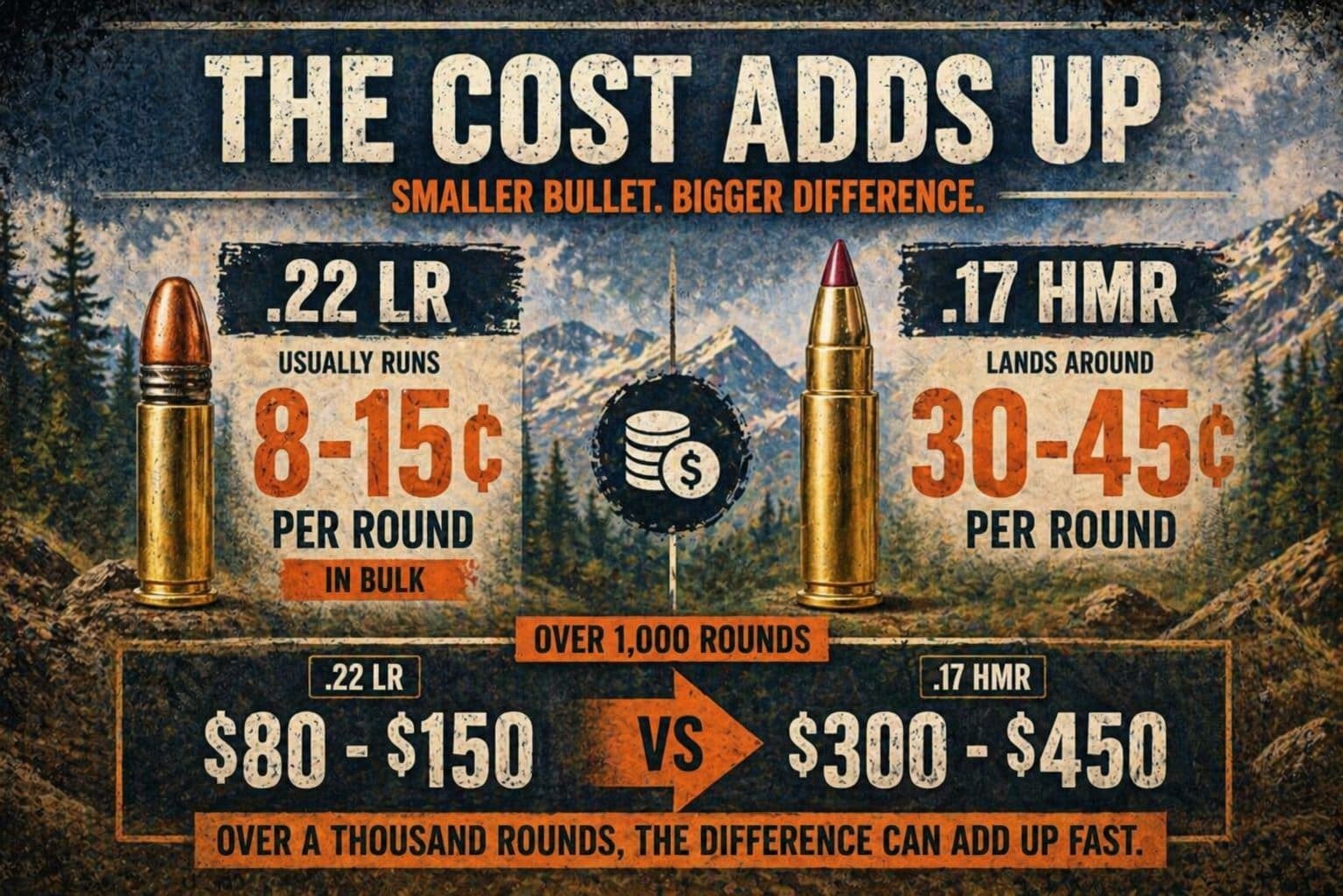
Here is the elephant in the room: the .22 LR usually runs 8-15 cents per round in bulk while the .17 HMR lands around 30-45 cents per round. Over a thousand rounds the difference can add up fast.
Stocking up on both is highly suggested for consistency and keeping a healthy (or insane) amount of ammo on hand for these rimfire calibers.
Bulk ammo in the 500 to 1,000 round range will last a good long while, even if you shoot on a very consistent basis.
For more information on smart bulk buying practices check out our guides Buying & Storing Bulk Ammo Effectively [A Step-By-Step Guide]
Noise, Suppressors, & Family Shooting
The .22 LR wins again for quiet shooting. Subsonic loads with a suppressor are whisper quiet and great for introducing family members or shooting near home.
The .17 HRM runs supersonic and stays loud even suppressed, though it is still very manageable.
Both are excellent for new shooters, but the .22 LR’s lower cost means more trigger time and faster skill building.
Maintenance & Long Term Ownership
Rimfire guns stay cleaner than centerfires, but they still need their love too. The .22 LR tends to leave more residue behind because of its burn rate.
With its popularity and affordability, the .22 LR tends to get more rounds fired through it more often, which means that it should be cleaned well after a long day of shooting before being stored. This will help keep the firearm functioning well and keep it from corroding.
The 17. HMR runs very clean thanks to its design. It leaves behind much less powder residue than the .22 LR, but it still should be cleaned well after being used.
Keep both rifles lubed and you will enjoy years and years of reliable services out of either of these rimfire firearms.
Making Your Cartridge Choice
When making your choice between the .22 LR and the .17 HMR, ask yourself these questions:
- How much shooting do I plan to do?
- What distances will I shoot most often?
- Is meat preservation important?
- What is my budget for ammo?
If high volume and low cost top your list, lean into the .22 LR. It is great for both new and experienced shooters who want to shoot all day long. This is also the go-to for small game hunters.
If reaching out to longer distances on targets or varmints is what you are looking for, the .17 HMR will satisfy your needs.
This is still a good rimfire round for both new and experienced shooters, especially if they want to practice shooting accurately at long range distances. Varmint hunters who are less worried about meat preservation will also love this cartridge over more expensive centerfire rounds.
The .22 LR versus .17 HMR debate doesn’t have one clear winner, as both are fantastic tools that excel in their own lanes.
The classic .22 LR offers unbeatable affordability, versatility, and gentle shooting characteristics that make it perfect for plinking, training, and close range small game hunting. It is the perfect old school rimfire round that everyone should have in their collection.
The modern .17 HMR brings impressive speed, flat trajectory, and extended range that varmint hunters and long range rimfire fans love.
It is a great addition to add longer range with a small caliber and can be a valuable training tool for big game hunters to practice year round at longer ranges for a much cheaper price than centerfire rounds.
Whatever you choose, buy ammo in smart bulk quantities, store it properly, and get out there and enjoy your shooting.
.22 LR Vs .17 HMR FAQs
Which Is Better for Beginners, .22 LR or .17 HMR?
The .22 LR is generally better for beginners due to its extremely low recoil, quieter report, and much lower cost per round. It allows new shooters to practice more ხშირად without fatigue or expense, helping build confidence and fundamental shooting skills quickly.
How Do .22 LR and .17 HMR Compare in Range and Accuracy?
The .17 HMR offers a flatter trajectory and better performance beyond 100 yards, making it easier to hit targets at longer distances. While both can be accurate, the .22 LR excels at shorter ranges, typically under 100 yards, with consistent precision.
Is .17 HMR More Powerful Than .22 LR?
Yes, the .17 HMR is significantly faster and carries more energy at longer distances than the .22 LR. Its higher velocity gives it better downrange performance, especially for varmint shooting, while the .22 LR is more moderate and suited for close-range use.
Which Cartridge Is Better for Small Game Hunting?
The .22 LR is often preferred for small game like squirrels and rabbits because it causes less meat damage at close range. The .17 HMR works well at longer distances, but its higher velocity can be overly destructive on edible game with body shots.
Why Is .22 LR so Much Cheaper Than .17 HMR?
The .22 LR has been produced for over a century and benefits from massive manufacturing scaling, keeping costs very low. The .17 HMR uses more advanced design and materials, resulting in higher production costs and a significantly higher price per round.