Prefer audio over written content? Listen to the article here:
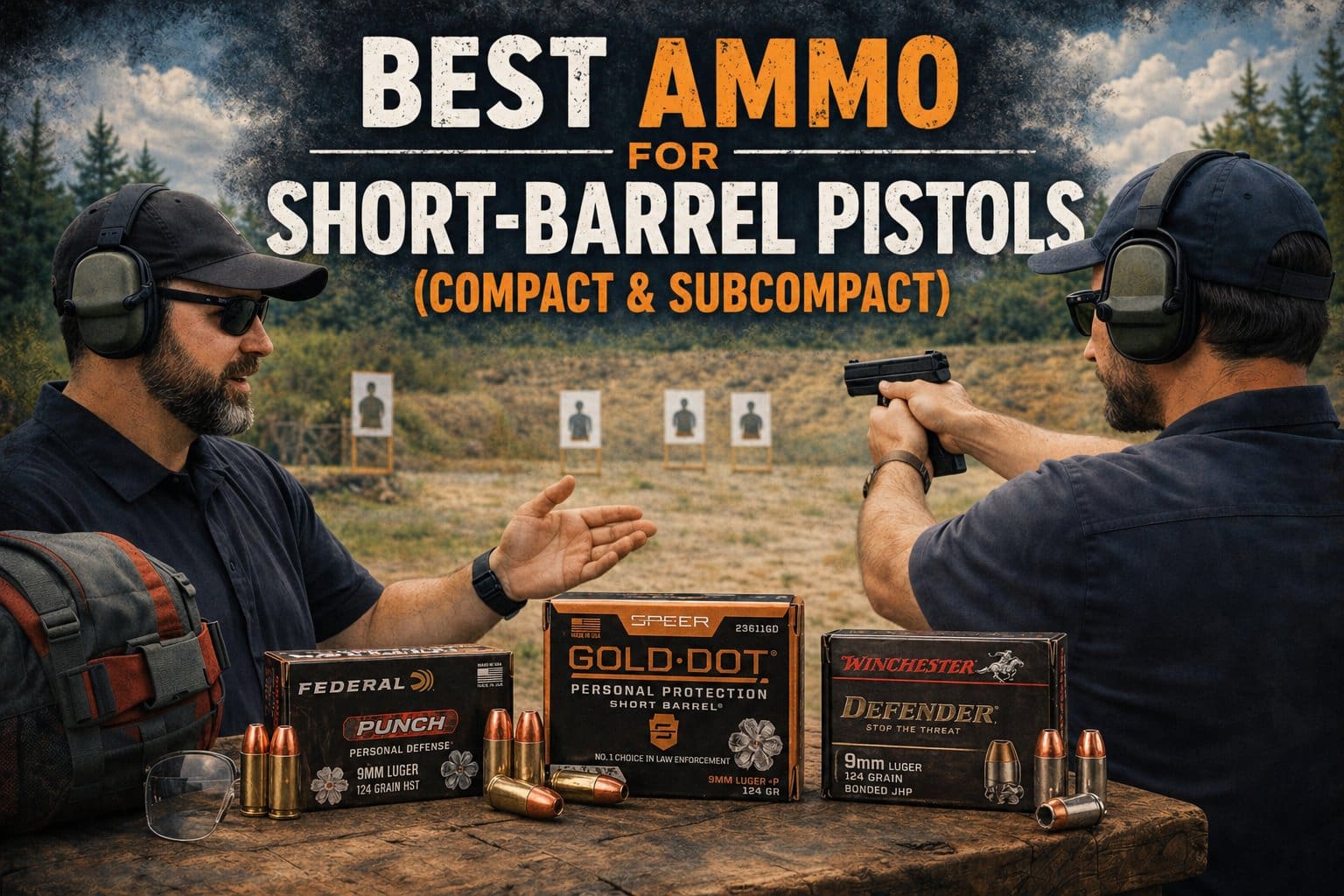
Compact and subcompact pistols make everyday carry easy and comfortable, but their short barrels, usually 3 to 4 inches in length, mean that ammo choice matters a lot.
You lose velocity with a shorter barrel, which can affect expansion and stopping power that are vital for everyday carriers. The same can be said for a snub-nose revolver with even shorter 1.5 to 3 inch barrels.
The best ammo for short-barrel compact and subcompact pistols vary depending on the caliber. For 9mm, the 124 grain +P jacketed hollow point is the go to.
For .380, 99 grain HST are the preferred choice. And for the snub-nose revolvers, 110 grain or 135 grain +P .38 Specials get the job done.
The best ammo is always going to be based on your individual preference for your particular firearm, but if you are looking for a compact or subcompact everyday carry firearm, these could help you make a more informed choice.
If you already have your go-to firearm, let’s find your go-to ammo.
Why Short-Barrel Pistols Change the Game
Compact semi-automatic pistols like the Sig P365 or the Glock 43X hide easily, but lose 50-100 fps compared to standard size pistols because of their shorter barrel lengths.
Snub-nose revolvers tend to lose even more velocity, sometimes as much as 100-150 fps due to barrel length and cylinder gap. That extra velocity loss makes reliable expansion trickier, but modern ammo is built to make up for your short barrel.
Despite these shortcomings, these guns are perfect for everyday carry, pocket carry, or quick home defense. They are small enough to carry comfortably and wield accurately in a hurry.
The right ammo choice is a necessity for these smaller firearms to make up for their lack of size. Most importantly, you need rounds that wake up fast and perform even when the powder has less time to burn.
Key Factors When Picking Ammo For Short Barrels
There are only a few things that really matter when you’re picking ammo for a compact, or subcompact pistol and changing any of them will change how your firearm performs in the field.
Let’s look at each of them closely.
Key Ballistics That Matter Most
Short barrels cut muzzle velocity due to less time for powder to burn behind the projectile, so you want loads designed for it. You are looking for bonded hollow points or polymer-tipped bullets that open at lower speeds.
For a deeper look, check out our article on Internal External & Terminal Ballistics [What Truly Matters] that explains how these factors play out in real life.
When looking for compact and subcompact ammo, aim for 1,000-1,150 fps at the muzzle. That will help keep expansion solid and penetration in the ideal 12-18 inch range.
Even with some loss of velocity in the shorter barrel, the 1,000-1,150 fps ballistics will get the job done well.
Bullet Weight: Finding the Sweet Spot
Finding the sweet spot for bullet weight varies by caliber. Lighter bullets may fly faster, but may not always penetrate deep enough through heavier clothing.
Heavier ammo carry momentum, but kick harder in the recoil department. Finding balance is key.
For 9mm semi-autos, the 115 to 124 grain range seems to be the sweet spot and are the most popular overall.
Pocket guns in .380 usually stick between 90 and 100 grain for the best performance in such a small firearm.
Revolvers tend to favor between 110 and 135 grain, either in .38 Special +P or .357 Magnum, which give the best mix of speed, control, and terminal performance.
For a deeper dive on bullet weight, check out our How Does Bullet Weight Actually Affect Performance? article.
Do Hollow Points Expand Out of Short Barrels?
Yes, when you choose the right ones. Modern designs like Hornady FTX or Speer Gold Dot Short Barrel open reliably from 2 inch revolver barrels or 3 inch semi-auto barrels.
Steer clear of bargain JHPs that might plug up or impact cycling. Stick with proven names.
See the gel tests in Do Hollow Points Actually Make a Difference in Self Defense? for proof.
+P Loads: the Extra Kick
The +P rounds add pressure and velocity without needing a longer gun and are particularly designed for smaller barrel firearms and self-defense rounds. Snub-nose revolvers especially love the +P with their short barrels.
This isn’t necessarily a must for your ammo selection, but it won’t hurt if you can find +P ammo in what you want to use.
It will give you that extra little fire power in your everyday carry, and make your bullet perform more like it would out of a standard-size pistol.
For a deeper breakdown of +P ammo, check out our article Should You Everyday Carry +P or +P+ Ammo? [A Break Down].
Top 9mm Picks That Deliver
Now that we have gone over what the key factors and aspects of good compact, subcompact, and snub-nose revolver ammo are, let’s get specific at which brands and types of ammo work the best.
The following loads shine in 3 to 4 inch barrels based on independent gel tests and chronograph data.
Speer Gold Dot 124gr +P: The short-barrel version is literally engineered for subcompacts. It has a bonded bullet, consistent 1,150 fps from a 3.5 inch barrel, 0.65 inch expansion, and 15+ inches of penetration.
It feeds like butter and shoots flat. Many law enforcement agencies trust it for a reason.
Federal HST 124gr +P or 147gr Standard: The HST expands beautifully, even at lower velocities. The 147gr option recoils softer while still hitting 12-14 inches. These are great for micro-compacts where muzzle flip plays a factor.
Hornady Critical Defense 115gr FTX: This polymer tip prevents clogging from clothing. It is designed around compact guns, it clocks 1,100+ fps from short barrels and creates a textbook wound channel.
These have become a very popular round for everyday carriers.
Winchester PDX +P 124gr: These rounds are bonded, have six-petal expansion, and are proven to perform well against light barriers. They are snappy, but very controllable, especially in the Sig P365.
Underwood 124gr +P Xtreme Defender: These are solid copper, no expansion, but has massive hydraulic wounding. If you want to be unique and have something different, this round punches way above its weight.
You can’t go wrong with any of these options in your 9mm, but be sure to test them and find what works best for you and your firearm.
.380 ACP Options for True Pocket Pistols
While the .380 might not be as popular as the 9mm, don’t sleep on the .380 for the tiniest subcompacts like the Ruger LCP or S&W Bodyguard. Modern .380 loads help close the gap with the 9mm.
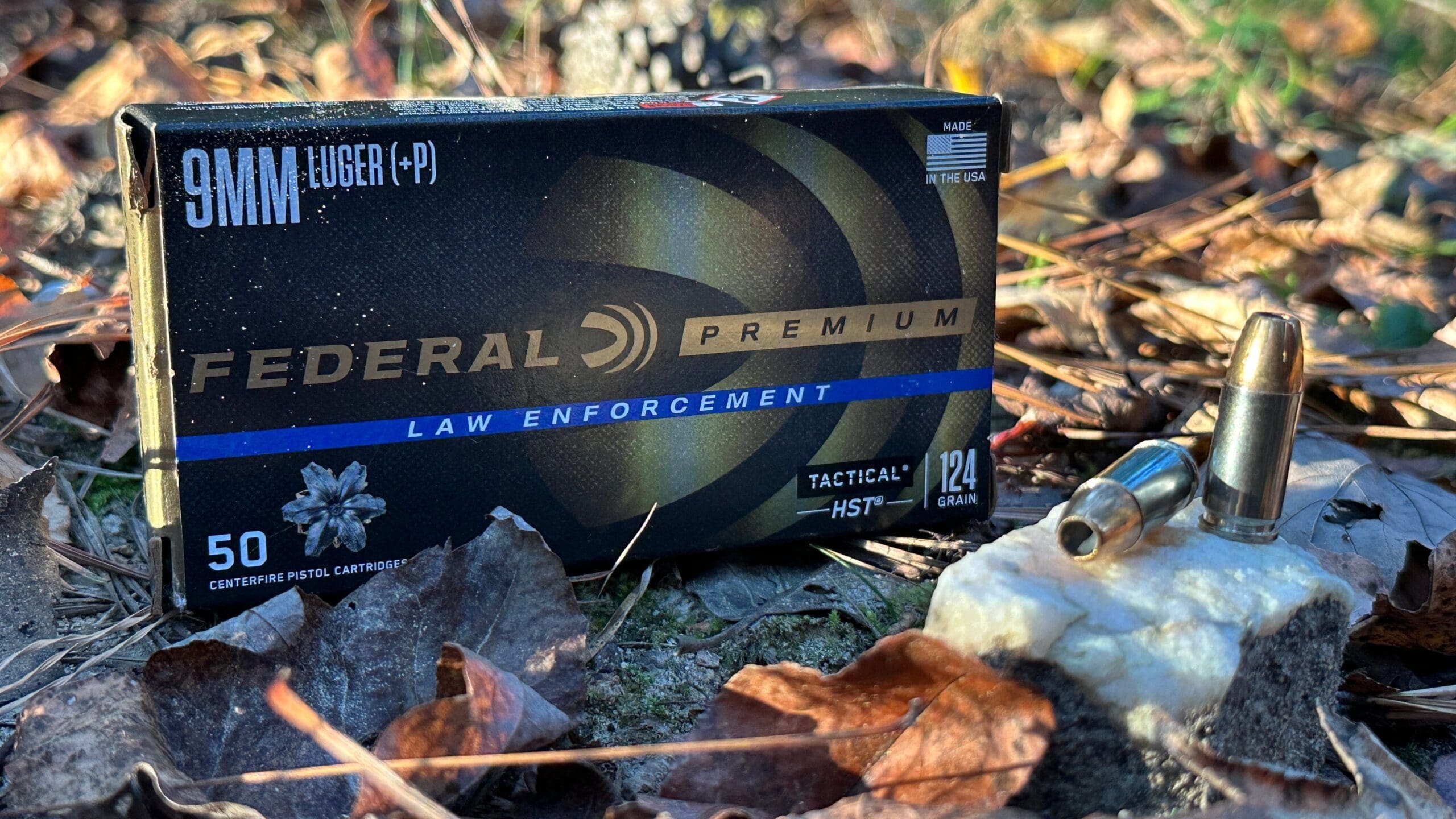
Federal HST 99gr: This is the gold standard for the .380 ACP. It passes the FBI-style testing from a 2.75 inch barrel.
This is a JHP with a shivved jacket that promotes expansion. This nickel-plated brass helps with feeding and is corrosion resistant. It is a slower round at 950-970 fps, but produces 192 ft-lbs of energy, with 0.50-0.65 inches of expansion.
Hornady Critical Defense 90gr FTX: This round is built for self-defense. With a polymer tip, it has 900-970 fps, delivering 160-180 ft-lbs of energy, with 12-14 inches of penetration.
The polymer tip ensures that clothing and barriers won’t plug the nose so that it can penetrate and expand reliably, even from a short barrel.
The heavier HST gives deeper and more consistent penetration with bigger expansion, but the Hornady’s lighter bullet and Flex Tip make it softer shooting and less likely to clog.
Both are excellent choices, with many carriers picking one or the other based on how their specific gun runs with them.
Snub-Nose Revolver Ammo
Snub-nose revolvers are a whole different breed of compacts compared to their semi-auto counterparts. Firearms like the S&W J-Frame and Ruger LCR have barrels between, 1.875 and 2.5 inches, which means even more velocity drop and no locked breech to help pressures.
This is where ammo plays a huge role.
Hornady Critical Defense 38 Special +P 110gr FTX: The FTX stands out as the top choice for revolvers. The Flex Tip prevents clogging and it expands well even at slower velocities, which are about 900-1,000 fps in snub-nose revolvers.
The light recoil in small frame revolvers makes follow up shots much easier and accurate.
Speer Gold Dot Short Barrel 135gr +P: This round was literally designed for snub-nosed revolvers, originally for the NYPD’s backups.
It delivers consistent expansion to 0.60+ inches and 12-15 inches of penetration, all while being very controllable. Many shooters refer to this as the gold standard for .38 Special carry revolvers.
If you are going with a .357 Magnum, find loads like the Speer Gold Dot Short Barrel 135gr and the Hornady Critical Defense 125gr FTX to soften the magnum snap and make it more controllable without giving away energy.
Avoid the super hot .357 magnum loads in these small frame revolvers unless you practice a ton. The recoil can be punishing and greatly affect accuracy under stress.
Testing New Ammo
If you are considering an ammo swap or are just interested in seeing if a different type of ammo might work better in your firearm, be sure to give it a thorough test before you use it as you everyday carry ammo.
Even though the ammo and the caliber of your firearm match up, it does not mean that they will be compatible and a good fit for you and your specific firearm.
Always function-test your chosen ammo in your specific gun. Different brands of firearms in the same caliber might act differently to the same brand of ammo.
For example, a certain type of ammo might work smoothly in a Glock, but might stutter or have issues cycling in a Sig P365. These things can happen.
Different round designs and might interact with the inner workings of your firearm than intended.
You want to be confident that your firearm and the ammo you are using will be in sync when the time comes and the heat is on in a high pressure situation. That is why testing new ammo is so important.
Don’t just rely on one magazine worth of test rounds and think you are set to go.
Practice and trial a certain round extensively until you feel confident in its performance and feel comfortable with every aspect of firing that round so that you aren’t surprised by anything when the time comes to perform.
Everyone has their own personal preferences, so testing different ammo can be really important in finding out what you like the best.
Compact and subcompact firearms can react differently than full size pistols, so finding ammo that is comfortable for you and your firearm is vitally important.
Comfort and confidence are key when it comes to compacts and subcompacts that are built for everyday carry.
Practice Ammo, Bulk Buying, and Smart Training
Defense ammo is expensive for a reason. They are built to be reliable and perform at the highest level possible. They aren’t built for just punching holes in paper targets.
With that being said, it is still good to practice with your exact defense ammo from time to time after you choose the right one for you.
If you want to practice more frequently, which we highly suggest, it is a good idea to use bulk practice FMJ rounds that match or closely match the ballistics of your everyday carry ammo.
Bulk buying FMJ practice rounds at around $0.25 per round can save you a ton of money and allow you to get more trigger time versus spending $1.00+ per round for defense ammo.
This will allow you to get used to the ammo and how your gun reacts without spending massive amounts of money.
Like we said, it is still good to practice with the actual defense ammo that you choose to carry with you everyday.
What we highly suggest is rotating your everyday carry ammo every 3-6 months. When it is time to rotate your everyday carry ammo, it is a great time to use that ammo being rotated out as practice ammo. This allows you to stay familiar with your everyday carry defense ammo of choice.
If you don’t rotate your carry ammo or want to know more about it, our article here is a must: Why You Should Be Rotating All of Your Ammo
Choose Smart and Train Often
Short-barrel pistols and snub-nose revolvers reward smart ammo choices to make up for the loss of velocity due to shorter barrels. Choosing proven ammo that are +P hollow points engineered for compact barrels is the way to go.
Brands like Speer Gold Dot, Federal HST, or Hornady Critical Defense rounds are known to be reliable performers when the heat is on.
They are engineered for compact and subcompact firearms with short barrels to counteract the lack of powder burn and subsequent loss of velocity.
Be sure to test the ammo and then practice often so that you become comfortable with how the ammo and your firearm perform together.
Bulk buy practice ammo that matches the ballistics of your everyday carry ammo to allow more trigger time on the practice range.
Stay safe, shoot straight, and train like your life depends on it, because one day it might!
Short Barrel Pistol Ammo FAQs
What Makes Ammo Different for Short-Barrel Pistols?
Short barrels reduce muzzle velocity because the powder has less time to burn, which can impact expansion and penetration. Ammo designed for these pistols uses specialized bullets that expand reliably at lower speeds, helping maintain effective terminal performance despite the velocity loss.
What Bullet Weight Works Best in Compact and Subcompact Pistols?
The ideal bullet weight depends on caliber, but balance is key. In 9mm, 115 to 124 grain is commonly preferred, offering a mix of velocity and control. Heavier bullets penetrate better, while lighter ones may shoot faster but sacrifice depth.
Do Hollow Points Work Effectively in Short Barrels?
Yes, modern hollow points are specifically engineered to expand at lower velocities typical of short barrels. Designs like bonded cores or polymer tips help prevent clogging and ensure consistent expansion, even from barrels as short as two to three inches.
Is +P Ammo a Good Choice for Short-Barrel Handguns?
+P ammo increases pressure and velocity, helping compensate for the performance lost in shorter barrels. It can improve expansion and energy delivery, especially in compact firearms, but may also produce more recoil, so it should be tested for control and reliability.
How Should You Test Ammo for a Compact or Subcompact Pistol?
You should run multiple magazines of your chosen ammo through your firearm to confirm reliable feeding and performance. Different guns can react differently to the same load, so consistent testing ensures your carry ammo functions properly under realistic conditions.