Prefer audio over written content? Listen to the article here:
If you have ever been at the range and wished your semi-auto rifle or pistol could keep up with your trigger finger a little better, you have probably heard the buzz around Forced Reset Triggers , or FRTs.
These clever little upgrades have been turning heads and emptying magazines faster for years now. In simple terms, FRTs make your gun reset the trigger automatically after every shot so you can send rounds down the range quicker without crossing the line into fully automatic territory.
A Forced Reset Trigger (FRT) is a drop-in upgrade for many semi-automatic firearms that uses the gun’s own recoil energy to push the trigger forward after each shot.
This lets you fire much faster while keeping everything 100% legal as a semi-auto firearm. As of May 2026, FRTs are federally legal.
Thanks to several major court wins and a DOJ settlement, FRTs are completely legal for use.
They are a blast for range days, training, or just having fun with your AR or Glock, but always double check your local laws and the rules of the firing range you are attending.
The short answer above covers the basics, but there is way more to unpack if you are thinking about picking one up.
Let’s take a deeper dive with a friendly chat about how these triggers work, why people love them, and what the law says about them right now.
What Exactly Is a Forced Reset Trigger?
Picture your standard trigger on an AR-15 or Glock. You pull the trigger, it fires the round, and your finger has to let go and reset before you can shoot again.
An FRT changes the game by forcing the reset portion of the process for you. It is still one trigger pull and one shot, just like any other semi-auto firearm would function. The magic of the FRT happens behind the scenes with a clever mechanical assist.
Unlike a binary trigger, which fires on both the pull and release function of the trigger, an FRT keeps things simple and familiar.
You hold the trigger back and let the firearm do the work on the reset. It feels almost like a rapid semi-auto stutter, but it is all mechanical and totally legal under federal rules.
How Does a Forced Reset Trigger Work?
Here is the cool part without getting too deep in the weeds on function. When your rifle or pistol cycles after a shot, the bolt carrier group or slide on a pistol, moves rearward and then slams forward.
The FRT uses that energy to physically push the trigger shoe forward into the reset position. Your finger barely moves and you are ready to pull again almost instantly.
It is like the gun is giving your finger a gentle nudge forward so you don’t have to actively reset the trigger by releasing the previous trigger pull.
The end result? Super-fast follow-up shots that still require a separate trigger function every time. No springs stretched to the limit, no cheating the system, just smart engineering.
If you want to see it in action, check out this very straightforward YouTube breakdown:
Real-World Uses: When an FRT Makes Sense
FRTs shine on the shooting range. Whether you are plinking steel or running drills, that forced reset lets you put more rounds on target faster.
It is perfect for practicing defensive skills or just having a ton of fun burning through ammo.
If you are thinking about home defense, pairing an FRT with a solid AR-15 setup can help with rapid target acquisition under stress.
Check out our article on Top 5 Home Defense Cartridges in an AR-15 Platform for the best ammo choices to go with it.
Out at the range, the speed feels addictive but controllable. The shooter stays in charge the whole time without the runaway full-auto feel.
It is also great for competition shooters who want an edge without switching to dedicated race guns for high speed.
The Honest Downsides of Forced Reset Triggers
No gear is perfect and the FRTs come with some real trade-offs worth knowing before you buy. First off, reliability can sometimes be finicky.
Many users report issues like failure to reset, dead triggers, or short-stroking if your rifle isn’t perfectly tuned. With the right buffer weight, gas system, and BCG, you will be just fine. Too much finger pressure and the reset simply won’t happen.
They can also add increased wear and tear on your firearm. The faster cycling generates more heat and stress on parts, which can shorten the life span on springs, bolts, and other components if you shoot a ton.
Control and accuracy take practice with an FRT. The rapid rate can overwhelm newer shooters, leading to muzzle flip and poor shot placement, or even safety slips if your shooting fundamentals break down.
It is easy to burn through ammo quickly too, which can get pretty expensive pretty quickly.
Finally, there is a learning curve and ongoing legal patchwork. While federally legal, some states ban or restrict FRTs, and certain models have had quality complaints.
They are awesome for fun range days but might not be your first choice for a defensive gun.
Rifle FRTs Vs. Glock FRTs: Our Picks at Velocity Ammo Sales
At Velocity Ammo Sales, we keep things simple and stock FRTs that actually work.
For your AR-15 or similar rifle platforms, we carry the Partisan Triggers Disruptor AR-15 Forced Reset Trigger. It is a solid drop-in unit built for mil-spec lowers in .223, 5.56 or .300BLK.
We also offer the Atrius Forced Reset Selector if you want ambidextrous control and a bit more versatility on the same platforms.
For your Glock, we have got the Trinity Glock FRT. It is precision-machined with a stainless steel trip and a tough polymer shoe that holds up round after round. Perfect for Gen 1 though 5 Glocks in 9mm and similar calibers.
Both options are designed for reliability and easy to install. There is no gunsmith needed for most setups.
Pairing Your FRT with Bulk Ammo for Serious Practice
Here is where things get practical and why we love stocking up on ammo any time that we can. An FRT is going to eat ammo faster than a standard trigger, so you will want to stock up smartly.
Our Buying & Storing Bulk Ammo Effectively [A Step-By-Step Guide] can walk you through exactly how to keep your range days going without breaking the bank.
Grab a few thousand rounds of 5.56 or 9mm, store them right, and you can spend an afternoon burning through mags while getting comfortable with the FRT’s rhythm.
Pro tip: start slow and build speed so you stay safe and accurate. Don’t blow through all your ammo spraying shots all over the range.
Navigating the FRT Legal Landscape in 2026
This is the big question that everyone asks. Good news: as of May 2026, FRTS are federally legal.
After years of back-and-forth, a 2024 court ruling and a May 2025 DOJ settlement with Rare Breed Triggers confirmed that they are not machine guns. The ATF stopped classifying them that way, and owners got their gear back.
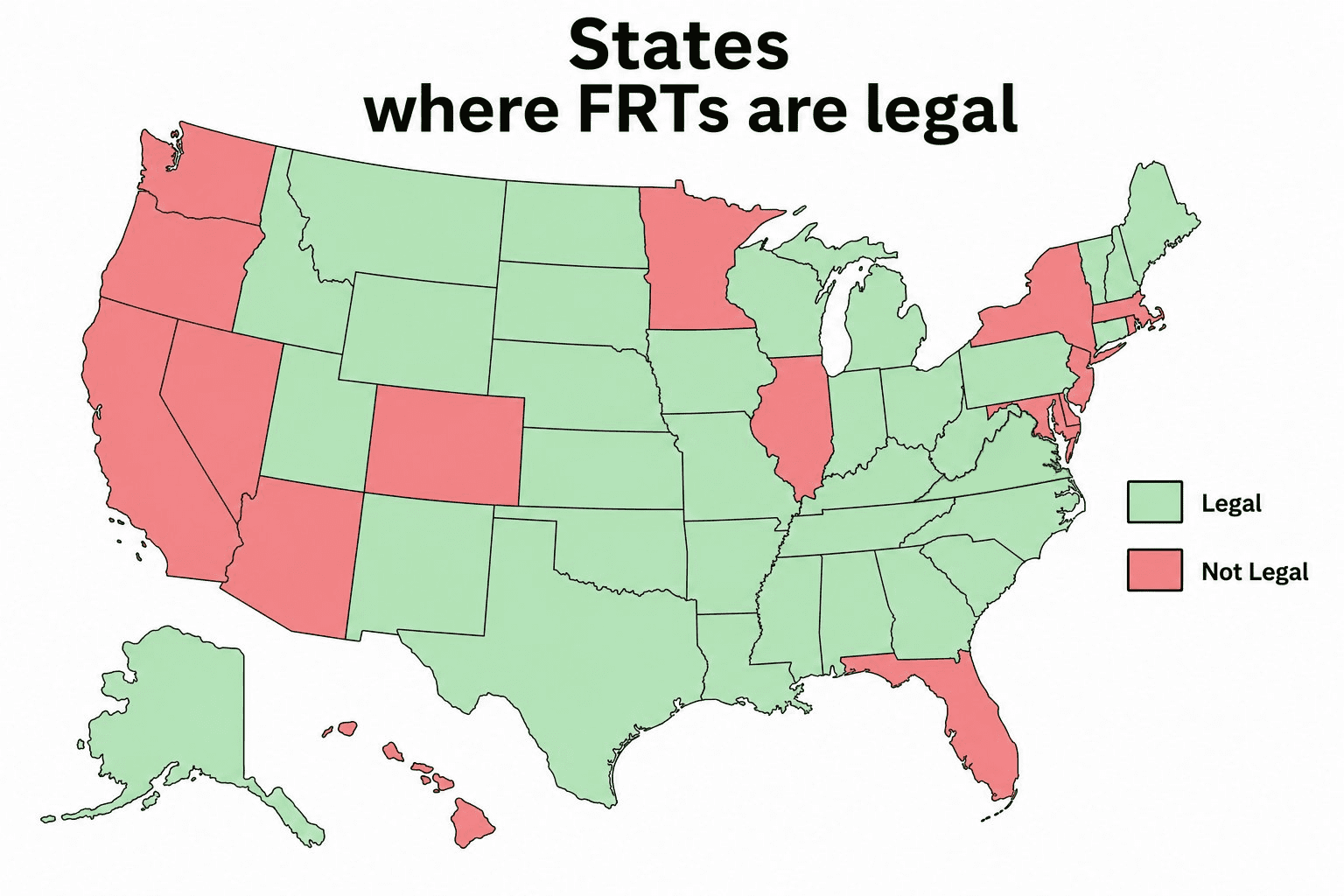
That said, some states have their own rules on “rate of fire increasing devices.”
As of 2026, places like California, New York, New Jersey, Illinois, Maryland, Massachusetts, Hawaii, Florida, Washington, Oregon, and a handful of territories have restrictions or outright bans on certain triggers.
Always check your local laws before buying or traveling. Our article on Crossing State Lines With Firearms [What Every Owner Should Know] is a must-read if you hit the road with your gear.
If you run into magazine questions, peek at States With Firearm Magazine Capacity Limits in 2025 for the latest scoop.
Bottom line? Federally you are good, but state laws vary and you need to do your homework or chat with a local expert.
Installation Tips and Safety First
Installing is usually very straightforward. Drop the old trigger out, pop in the new one, and test the function.
Always follow the manufacturer instructions for your exact model of FRT and for your specific firearm. Safety check by dry firing a bunch before live rounds, and never force anything.
Remember, faster shooting means more responsibility. Keep your finger off the trigger until you are ready, and practice proper muzzle discipline.
If you are new to FRTs, start with some lighter loads and build up to what you normally use. Don’t just blow through all of your ammo with no target accuracy.
While FRTs can be fun, there is also added responsibility with a firearm that is now capable of firing rounds at a faster rate. Don’t just waste your ammo for the sake of speed.
We also suggest that you pair your firearm now equipped with an FRT with quality ammo to keep things reliable. Our bulk packs are perfect for breaking in that new trigger.
Is an FRT Right for You?
Forced Reset Triggers bring a ton of excitement and capability to your everyday semi-auto without stepping over any legal lines at the federal level.
Whether you are an AR guy, a Glock fan, or just love fast, fun shooting, they deliver exactly what they promise, which is quicker resets for faster follow up shots and more smiles per magazine.
If you aren’t in the need for faster shooting but rather just need good quality shots in your everyday carry, a Forced Reset Trigger might not be needed for your situation at this time.
So while Forced Reset Triggers can be very fun for those day trips to the shooting range, they might lack some usefulness in practicality.
The choice is yours on whether or not to install an FRT on your semi-auto AR-15 or pistol platforms.
If you are looking for more speed, more fun, and burning through more ammo, the FRT is exactly what you are looking for. If you are a newer shooter or not in need of added speed yet, put a hold on the FRT.
Forced Reset Trigger FAQs
What Is a Forced Reset Trigger and How Does It Work?
A forced reset trigger is a drop-in upgrade for semi-automatic firearms that uses recoil energy to push the trigger forward after each shot. This automatic reset allows faster follow-up shots while still requiring a separate trigger pull for every round fired.
Are Forced Reset Triggers Legal in 2026?
As of 2026, forced reset triggers are federally legal following court rulings and a DOJ settlement confirming they are not classified as machine guns. However, several states have their own restrictions, so it is important to verify local laws before purchasing or using one.
Can You Install a Forced Reset Trigger on Both Rifles and Pistols?
Forced reset triggers are available for multiple platforms, including AR-15 rifles and certain Glock pistols. Most models are designed as drop-in components, making installation relatively simple without gunsmithing, provided they are compatible with your specific firearm.
What Are the Downsides of Using a Forced Reset Trigger?
While fun and fast, forced reset triggers can introduce reliability issues if the firearm is not properly tuned. They may also increase wear on internal parts, reduce accuracy for inexperienced shooters, and significantly increase ammunition consumption during extended range sessions.
Are Forced Reset Triggers Good for Home Defense or Beginners?
Forced reset triggers are generally better suited for range use and experienced shooters. The increased firing speed can be difficult to control under stress, making them less ideal for beginners or defensive scenarios where precision and deliberate shooting are more important.