If you own a rifle chambered in 6.5 Creedmoor, you have probably come across ammo with different grains such as 120, 140, and 147. They have the same case size, work in the same magazines, but they have completely different jobs once they leave the muzzle of your rifle.
The real question is, which of the three is best for hunting, long-range shots, or a mixture of both?
The 120 grain 6.5 Creedmoor is the fast hunting pick for closer shots. The 140 grain is the all-around workhorse that gives you options for both hunting and mid-range target shooting.
The 147 is the standard match load for long-range shots with wind. You match the weight with your intended job.
Some hunters only swear by the lighter, faster 120 grain bullets while those long-distance range masters treat the 147 like they are a godsend.
Then there is the guy that grabbed the first box of 140 grain that he saw and has never looked back while being effective at taking deer and striking that steel gong a good poke away.
Top 6.5 Creedmoor Ammo Picks by Grain Weight
Picks for lead-free deer loads, everyday whitetail hunting, long-range wind and bulk match shooting.
-
Best for Lead-Free Deer Hunting
-
Best for Everyday Whitetail Hunting
-
Best for Long-Range Shooting in Wind
-
Best for Buying Match Ammo by the Case
Why These Three Weights Dominate 6.5 Creedmoor
When Hornady created the 6.5 Creedmoor cartridge in 2007 as a short-action target puncher that can still be used to hunt, the idea was to create a long, skinny 6.5 mm bullet that cut through the air well, had mild recoil, and was still magazine friendly.
Well, they definitely succeeded, as the 6.5 Creedmoor has quickly become a popular cartridge in both target shooting and hunting.
The light 120 grain is the speed demon of the group, leaving a 24-inch barrel at about 2,900 fps. They are snappy and have a flat trajectory which is great for deer hunting.
The 140 grain middle weight is considered the default factory weight for this cartridge.
The heavy 147 grain match is built to hold speed in the wind to make those long-distance shots. The accuracy with these rounds can be quite surprising, but that’s what they were designed for.
Weight itself changes a number of factors including drop, recoil, and knockdown energy. Our guide on How Does Bullet Weight Actually Affect Performance? covers anything you might want to know about how weight changes things.
None of these are magnum rounds, which keeps the recoil extremely manageable in a lighter weight hunting rifle. This is why the 6.5 Creedmoor has become so popular at both the shooting range and in deer camp.
The bullet weight you pick will just decide if your rifle is considered a woods gun, a do-it-all rifle, or a long-distance wind fighter.
Factory Ballistics for 120, 140 & 147 Grain Loads
The chart below shows typical factory numbers when fired from a 24-inch test barrel, using Hornady’s 120, 140, and 147 grain ELD Match loads with a 100-yard zero.
| Spec | 120 Grain | 140 Grain | 147 Grain |
|---|---|---|---|
| Muzzle Velocity | 2,900-2,910 fps | 2,690-2,710 fps | 2,695 fps |
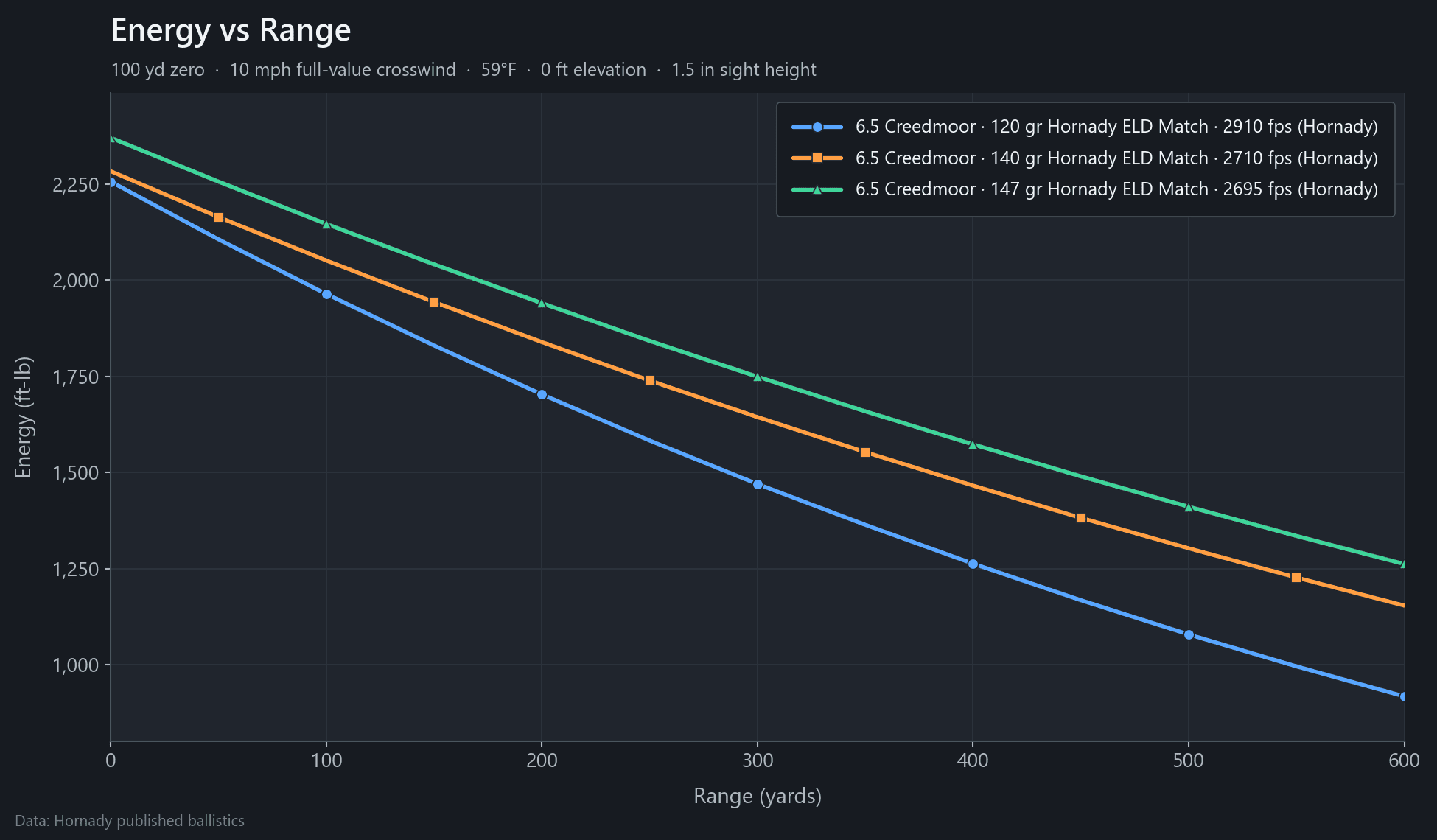
| Muzzle Energy | 2,250 ft-lbs | 2,280 ft-lbs | 2,370 ft-lbs |
| Drop at 300 Yards | 12 inches | 13-14 inches | 13 inches |
| Energy at 400 Yards | 1,280 ft-lbs | 1,440 ft-lbs | 1,590 ft-lbs |
| Best Range | Inside 300 Yards | 300-400 Yards | 500+ Yards |
| Best Job | Hunting & Varmint | Hunting & Shooting Range | Match Shooting & Wind |
If you imagine these bullets all racing each other, the 120 jumps off the starting line compared to the other two. Past 300 yards, the 140 and 147 start to catch up and surpass the 120 on performance.
The further out they go, the more each bullet starts to deviate from the others.
If you are more interested in the energy they carry, especially for hunters, read our What Is Firearm Muzzle Energy? [Why It Actually Matters] article to learn more.
How Weight Changes Bullet Flight
Lighter bullets leave the muzzle faster. That is why the 120 grain bullet is about 200 fps faster than the 147 grain. Inside of 250 yards, that extra launch speed helps a lot and performs well.
Past 250 yards, the lack of weight starts to negatively affect the bullet’s flight.
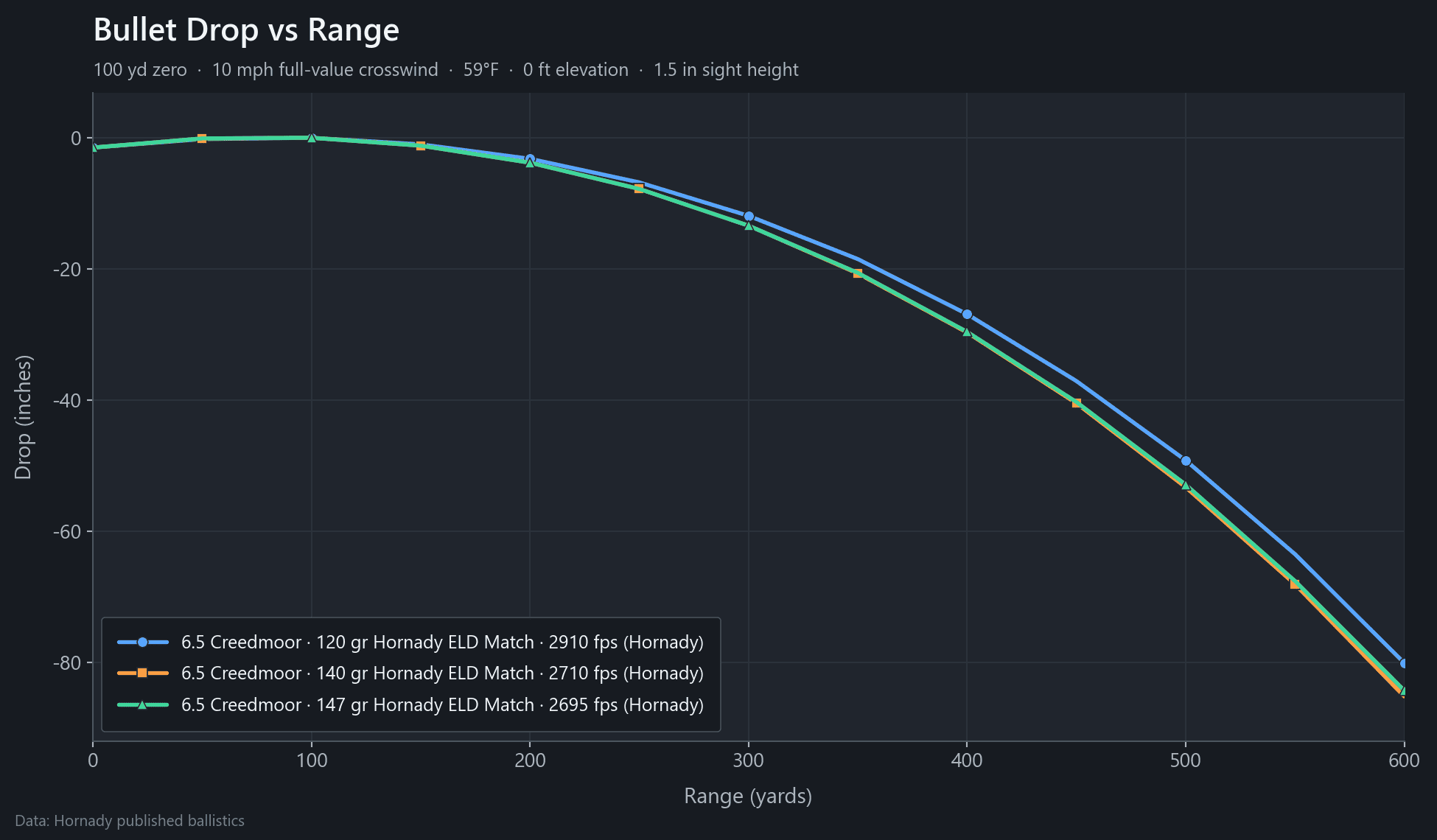
A 147 grain ELD Match has better ballistics that help carry it much further and be more efficient at longer distances. The heavier bullet might start out slower, but it sheds that speed more slowly as it travels.
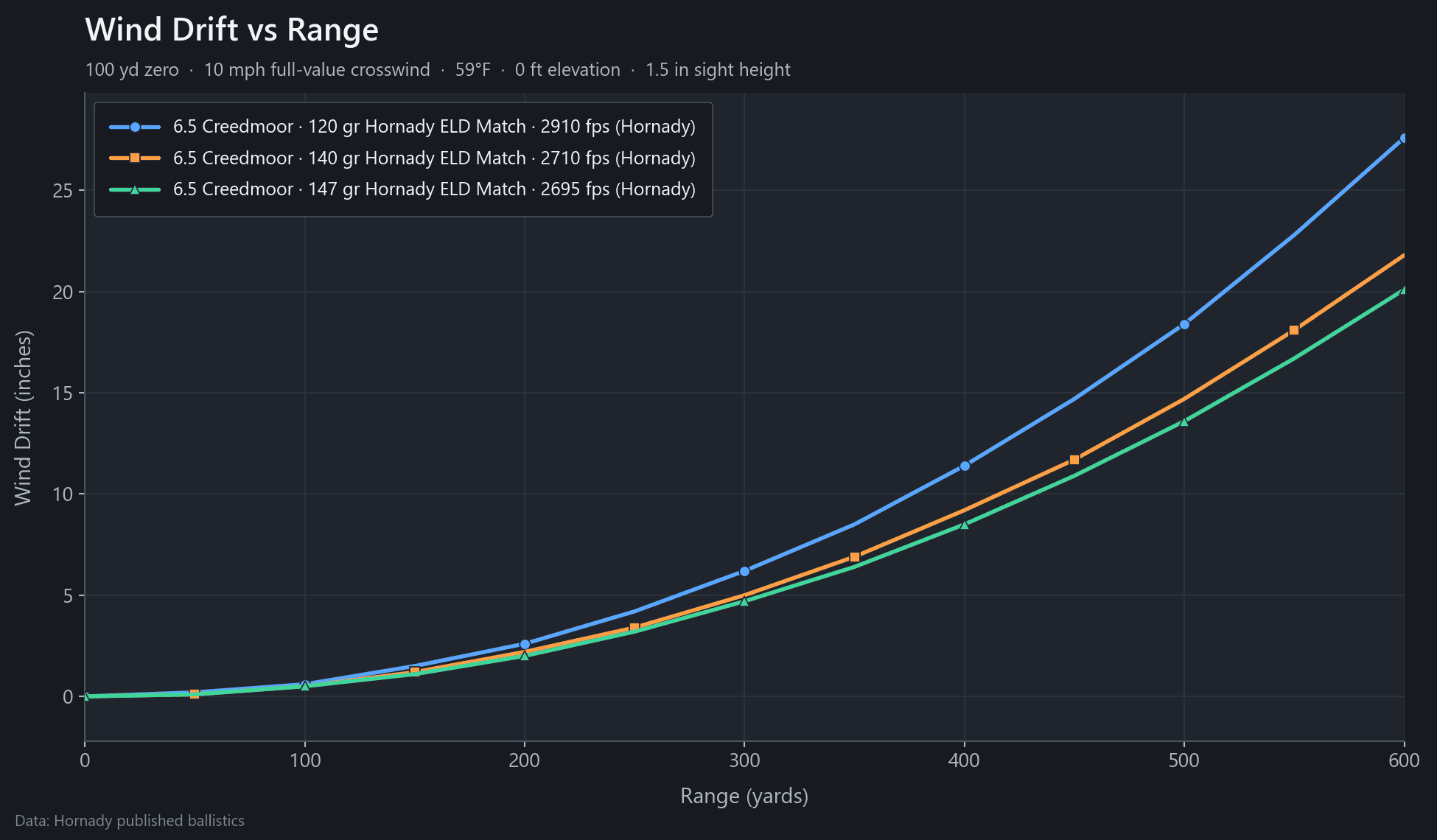
At 600 yards, it’s still fast enough to cut through the wind far better than lighter bullets.
That is the whole idea behind our How Ballistic Coefficients Effect Long Range Shooters article. The higher ballistic coefficient of a heavier bullet shortens its time of flight. Less time in the air means less drop and less drift. On a calm day it won’t make a difference, but on a windy prairie shot at 400+ yards, it will make all the difference.
Recoil stays very mild across all three of these weights. You might feel the 147 a little more, but it won’t cause you to start flinching.
This makes follow-up shots much easier. This has quickly become the reason the 6.5 Creedmoor has gained popularity in the hunting community.
If you are still deciding on the right cartridge, not just grain weights, check out our 6.5 Creedmoor Vs .308 Win: Best Choice for Hunters & Shooters breakdown article. It shows where the Creedmoor pulls ahead and where the .308 is still a heavy hitter on big game animals.
Hunting: What Each Bullet Grain Does in the Field
Deer can’t read a ballistics chart. All they care about is shot placement, bullet expansion, and knockdown power. Bullet construction matters more than the numbers on the box.
120 Grain 6.5 Creedmoor for Hunting
Use the 120 grain when the shot is close to mid-range and you want that quick, flat shot. A 120 grain copper or bonded core hunting bullet at 2,900 fps opens up fast and pounds energy into the side of a deer.
It makes a great weight for the woods or when sitting over a food plot.
Construction is the more important part to pay attention to with the 120 grain. A thin varmint tip can come apart quickly if it hits bone instead of vitals.
Pick a good controlled-expansion 120 grain if the animal you are after is bigger than a coyote. Barnes-style copper construction bullets are a good go-to if you need both speed and a bullet that stays together well.
If you are open to going a touch lighter, the G9 Defense 113 Grain Depth Charge is a lead-free monolithic hunting bullet built around that same idea of speed plus a bullet that holds together.
Past 350 to 400 yards the 120 grain gives up a lot of energy compared to the heavier two.
It will still kill deer with a good shot, but it is not the load you choose if you are planning to go out much further than that. The effective range of the 120 grain is about 300 yards for most deer hunting.
140 Grain 6.5 Creedmoor for Hunting
The 140 grain has become the hunting go-to for many. You can find 140 grain 6.5 Creedmoor on almost any shelf in soft points, bonded cores, and polymer hunting tips.
Velocity stays up and energy at 300 yards is still in the mid-1,600s with the right bullet.
Those ballistics cover almost every ideal whitetail shot you might want to take in the U.S. If you were worried if this cartridge is a good pick for whitetail, read our article Is 6.5 Creedmoor Actually a Reliable Round for Whitetail?
The 140 grain bullet also doubles well as a good practice round. A 140 grain match or FMJ round will often land close to where your 140 grain hunting round zeroes. Check them both on paper. The same bullet weight doesn’t mean the same impact location.
Our 6.5 Creedmoor ammo lineup carries hunting loads from several brands, so it is worth a look before your next hunt.
147 Grain 6.5 Creedmoor for Hunting
The 147 grain is a match bullet first and foremost. Hornady ELD Match 147 grains group like a dream and buck wind well, but they are not designed as a deer round.
Some hunters still use them and plenty of deer have been taken that way, they just aren’t the best choice.
If you want a heavier hunting bullet, look at the 143 grain ELD-X or a bonded 140 grain. Those are built to open up, unlike the 147. For a good look at bullet design, check out The Best Bullet Design for Whitetail Hunting to get more information that looks at more than just bullet weight.
Elk and similar-sized game ask for more bullet. A good 140 grain bonded or copper load at a respectable distance will beat the fragile 147 grain match bullet. Save the 147 grain for target practice and match shoots.
Long-Range Shooting: Where the 147 Grain Pulls Ahead
Past 500 yards, the high ballistic coefficient really starts to pay off in the 6.5 Creedmoor. The time of flight really shrinks, making it less affected by wind.
It also stays supersonic a lot farther out than the light and speedy 120 grain.
A typical 147 ELD Match round fires at 2,695 fps and holds about 1,590 ft-lbs of energy at 400 yards. It will even stay in the fight and on target at 800 yards.
Match loads are where buying by the case really pays off, and our bulk 6.5 Creedmoor ammo page is where the 200-round Hornady Match cases show up.
The 120 is faster out of the muzzle, but it will lose the speed battle with the 147 grain somewhere between 300 and 400 yards.
A 140 match round is the compromise here. Hornady makes a 140 grain ELD match that fires at 2,710 fps and it is a factory favorite in a lot of rifles.
If your rifle loves the 140 grain and you rarely shoot past 600 yards, the 147 grain might be a little more than you need.
Factory match ammo in this cartridge is good enough that most shooters are never forced into getting a press to make their own handloads. For more on that, check out How Match Graded Factory Ammo Stacks Up Against Handloads.
Wind can still be a factor. If you find yourself shooting in windy areas frequently, the 147 might be a good option simply because it doesn’t wander as far in the wind.
It won’t be perfect against the wind, but it moves less than the lighter weights.
Match the Weight to the Job
The 120, 140, and 147 grain 6.5 Creedmoor are not three versions of the same idea. They serve three separate functions for the cartridge.
The 120 is a fast hunting and mid-range load. The 140 is the everyday middle of the road that most will take. The 147 is the high ballistic coefficient bullet that earns its pay at long distance with wind.
Be sure that you pick the weight that best fits the job that you and your 6.5 Creedmoor rifle plan to tackle the most.
Outside of weight, be sure to also pick the right bullet construction for the job as well. Without that, weight means nothing.
For most of you deer hunters, we highly suggest you go with the 140 grain to give you the best balance with every trigger pull.
When you are ready to make a choice, pull the trigger and stock up on enough hunting and practice ammunition to keep you in the woods and at the range for a long time to come.
6.5 Creedmoor Grain Weights FAQs
What Is the Best Grain Weight for 6.5 Creedmoor?
For most shooters, 140 grain is the best all-around 6.5 Creedmoor weight. It balances hunting performance, manageable recoil, availability, and range accuracy. Choose 120 grain for closer deer hunting and 147 grain for long-range match shooting in wind.
Is 120 Grain 6.5 Creedmoor Good for Deer Hunting?
Yes, 120 grain 6.5 Creedmoor can work very well for deer inside about 300 yards when loaded with a controlled-expansion hunting bullet. Its speed gives a flat path, but bullet construction matters because fragile varmint-style bullets may break up too quickly.
Should You Use 147 Grain 6.5 Creedmoor for Hunting?
The 147 grain load is usually better treated as match ammunition than hunting ammunition. It bucks wind and groups well, but many 147 grain match bullets are not designed for reliable expansion. For deer or elk, a 140 or 143 grain hunting bullet is safer.
Do Different 6.5 Creedmoor Bullet Weights Need Different Zeros?
Yes. A 120, 140, and 147 grain load can leave the muzzle at different speeds and show different drop, wind drift, and impact points. Zero your rifle with the exact load you plan to hunt, practice, or compete with.
Which 6.5 Creedmoor Grain Is Best for Long-Range Shooting?
The 147 grain 6.5 Creedmoor is generally the strongest long-range choice, especially past 500 yards. Its higher ballistic coefficient helps it hold velocity, stay supersonic longer, and drift less in wind. A 140 grain match load is a practical mid-range compromise.