
Prefer audio over written content? Listen to the article here:
If you’re interested in long-range shooting, hunting, or self-defense, then you need to understand muzzle energy.
Muzzle energy is important to understand when selecting a new cartridge, firearm, or ammunition because it’s a good measure of how a specific cartridge or ammunition will perform on game animals or for self-defense.
Muzzle energy quantifies the kinetic energy a projectile has the moment it leaves the barrel of a firearm.
Muzzle energy is derived from ballistic calculations used to determine the amount of force a bullet will transfer to its target on impact.
While muzzle energy is just one ballistic calculation, it’s an important one that can help hunters and shooters determine the power of a gun and how much energy it will impart on a target.
Let’s dive into more detail and learn how to calculate muzzle energy, exactly what it is, what influences it, and why shooters need to understand it.
What is Muzzle Energy?
Another way to think about muzzle energy is that it is how hard the bullet would hit if it impacted it’s target right at the end of the firearm’s barrel.
Muzzle energy is a measurement of translational kinetic energy, or, more simply put, for firearms, stopping power.
Calculating muzzle energy is often used to gain a better understanding of the potential terminal performance of a cartridge.
Muzzle energy is related to calibers, like .264 (6.5mm), .270, .284 (7mm), and so on. Generally, the larger the caliber, the more muzzle energy it produces.
However, there is even a closer relationship when comparing cartridges. You can think about it this way.
There are multiple cartridges chambered in .264 caliber. Two of the most common are the 6.5 Creedmoor and the 6.5 PRC.
The 6.5 PRC, on average, will produce more muzzle energy than a 6.5 Creedmoor. That said, handloaders could load a 6.5 PRC to have less muzzle energy than a 6.5 Creedmoor.
It can all get a little complicated. So let’s think about it like this.
The bigger the cartridge, the more energy it will typically produce. For example, a .22LR produces significantly less than a .300 Winchester Magnum. A .22LR also recoils significantly less than a .300 Winchester Magnum.
Muzzle energy is directly related to recoil. Isaac Newton’s third law of motion states this best.
“For every action there is an equal and opposite reaction”. We’ll discuss this more later on, for now let’s discuss how to calculate muzzle energy.
How to Calculate Muzzle Energy
To calculate muzzle energy, you’ll need two values. The weight of the projectile in grains, and the velocity at which it moves in feet per second. The formula is below.
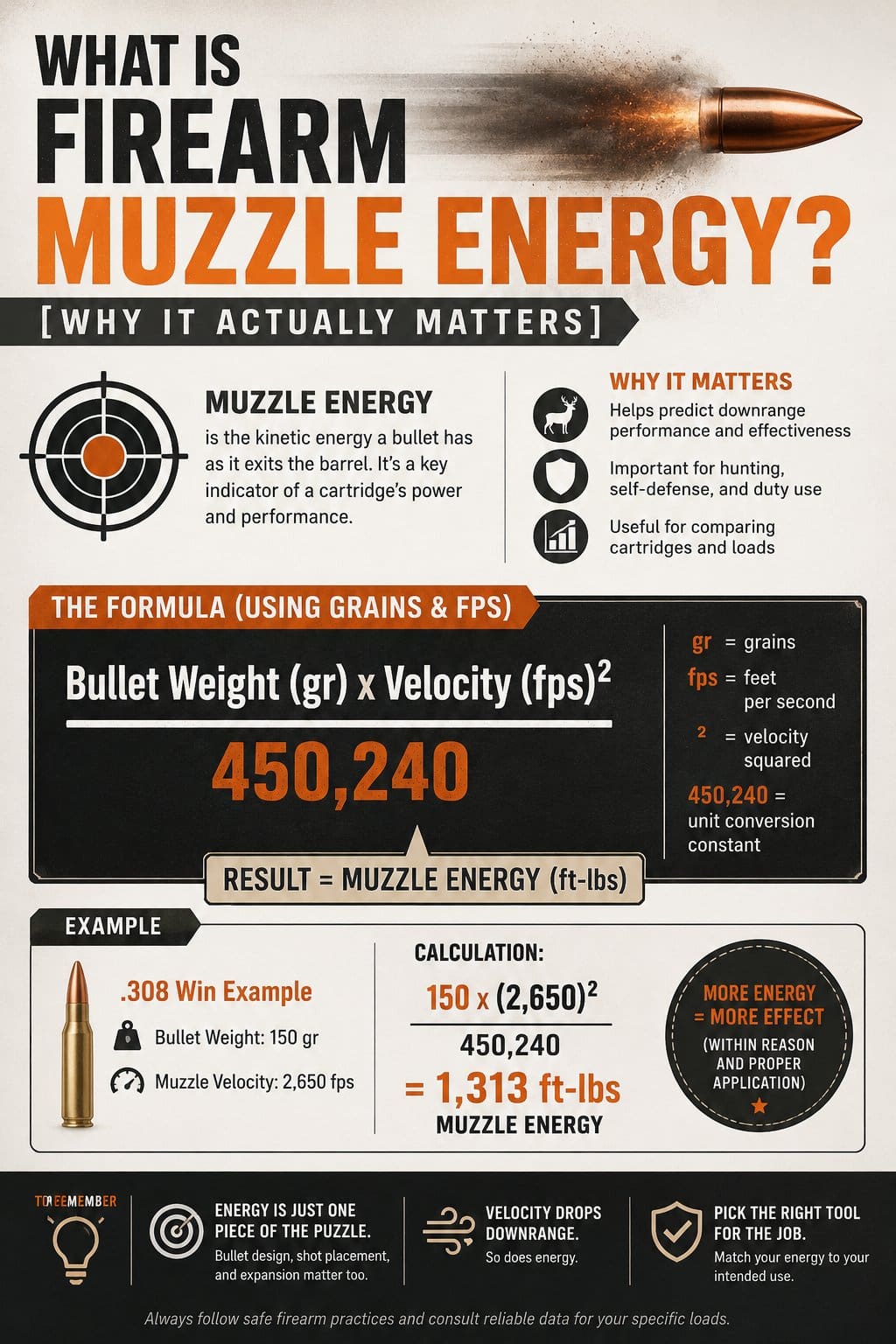
The formula is relatively simple. You square the velocity of the bullet in feet per second, multiply it by the weight of the bullet in grains (gr), and then divide the product by the constant divisor of 450,240.
It’s worth noting that this formula only works when all the units stay the same in the formula above.
Now, let’s break the formula down. The bullet weight portion of the formula is pretty straightforward. It’s the weight of the bullet in grains.
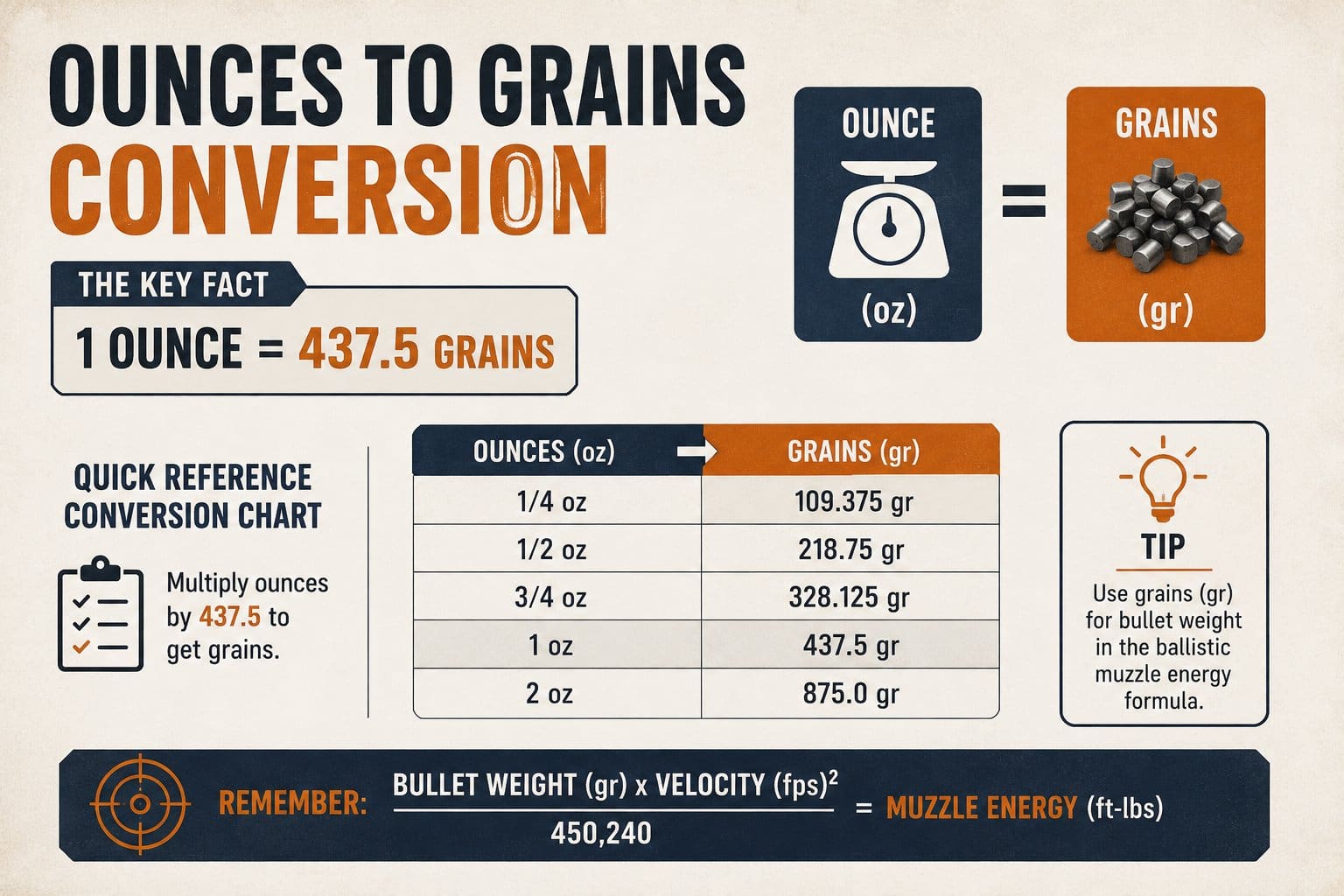
If you are trying to calculate muzzle energy for a bullet that’s commonly measured in ounces, like a shotgun slug, you will need to convert it to grains before using the formula.
There are 437.5 grains in an ounce, so you can simply multiply the ounce measurement by 437.5 grains. An example formula is below that converts a ¾ ounce 20 gauge shotgun slug to grains.
Next, we have velocity, and this is where things get tricky. To know the velocity of your bullet, you’ll need a chronograph. There is a cheaper option. If you are a long-range shooter, you can shoot several times at different distances to estimate your bullet drop. This video from Vortex Optics does a great job of explaining this process.
Then you can use a ballistic calculator to backcalculate your velocity until the drop values are correct. That said, a good chronograph will deliver better results.
Last is the constant divisor. A constant divisor is a value that stays the same throughout the formula and is used to divide a number.
While the formula isn’t too difficult, there are many factors that influence muzzle energy; we’ll talk about those next.
If you’re still struggling to understand how to calculate muzzle energy, this video does a good job of explaining it by comparing different pistol cartridges and ammunition.
What Influences Muzzle Energy
Now that we’ve broken down the formula, we can discuss what influences muzzle energy and the factors you can control.
Bullet Weight
Bullet weight is the easiest variable to control. It’s as simple as purchasing different ammunition in the store and looking for heavier bullet weights to increase muzzle energy and lighter ones to reduce energy, this is assuming the powder charge stays the same.
Estimated muzzle energy is often printed on the box of ammunition. However, we already know that bullet weight isn’t the only factor.
If you want to know more about picking the perfect bullet weight, read our other article here: How Does Bullet Weight Actually Affect Performance?
Barrel Length
The velocity of the bullet can also be controlled to some extent. Typically, the longer the barrel of the firearm, the higher the muzzle velocity.
A good rule of thumb for rifles is that for every 1 inch a barrel is reduced, there will be a 25-foot-per-second loss in velocity.
In general, longer barrels equate to higher velocities and, therefore, higher muzzle energies. This also means that, all things being equal, the bullet will maintain higher terminal performance.
Barrel length is the low-hanging fruit, but what can you do if you don’t want to swap barrels or buy a new gun, but would like to increase muzzle energy? There are a couple more options.
If you want to know more details about barrel length and how changing it would change your performance, this article is a must: How Barrel Length Affects Bullet Velocity and Performance
Optimize Ammunition with Handloading
First, if you are a handloader, you can optimize your load for your specific rifle. This means choosing the best components like brass, primers, bullet weight, powder type, and charge to increase velocities.
This can be fairly technical and takes time to learn and to read reloading manuals to ensure you are doing it safely and effectively.
If you don’t reload, you can look for plus pressure (+p) ammo, typically found for pistol calibers.
Plus pressure ammo is loaded hotter with more powder and can’t be fired in all guns, so make sure to check your firearm’s owner’s manual to ensure it’s safe before using +P ammunition.
You can look for ammunition that is optimized for specific use cases, like hunting big game, defense against dangerous game, or target shooting.
If you’re thinking about +P ammo or maybe using it for your concealed carry, read this article first: Should You Everyday Carry +P or +P+ Ammo? [A Break Down]
Now that we know what muzzle energy is and the factors that influence it, let’s discuss why it’s important and why you might want to consider it when selecting a new firearm or ammunition.
Why Is Muzzle Energy Important?
There are several scenarios where muzzle energy becomes important. Like we previously discussed, muzzle energy can be used as a measure of how much energy will be transferred to a target.
A couple of scenarios where muzzle energy is important are for self-defense situations and hunting.
Muzzle Energy and Self Defense
Generally, for self-defense, people want a good balance of muzzle energy and recoil. Remember, all things held equal, the more muzzle energy, the more recoil, and the more stopping power.
If we were only considering recoil, we might choose .22LR for self-defense, but that is rarely the best choice.
A .22LR doesn’t have very much stopping power or muzzle energy, and therefore may not stop the threat before they can do their victim harm.
This is why the 9mm Luger and .380 ACP are very popular cartridges for self-defense. The 9mm produces more energy than the .380 ACP and is a favored cartridge for self-defense by law enforcement officers, military, and concealed carry permit holders.
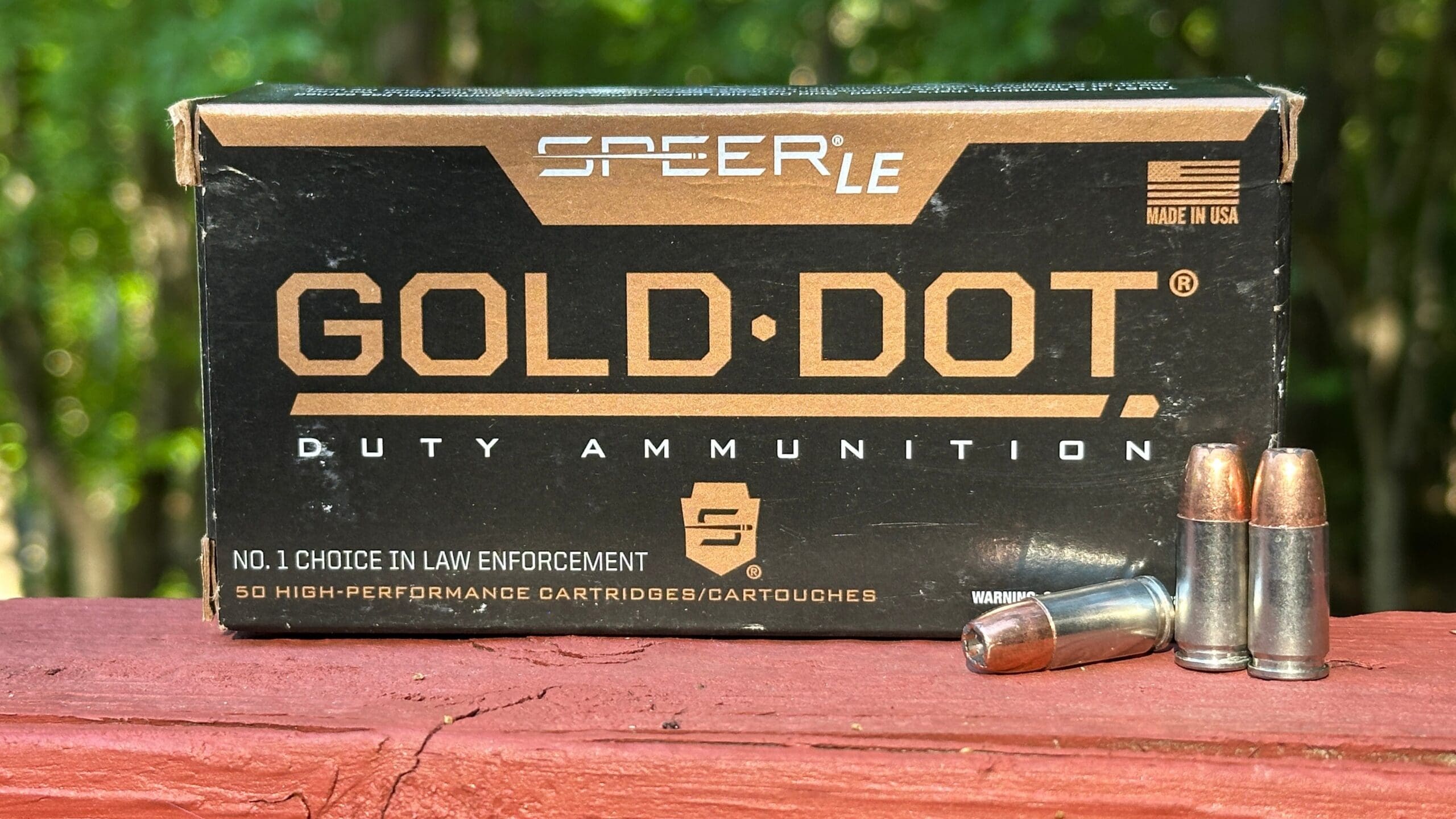
One of our favorite 9mm self defense cartridges is the Speer Gold Dot 124 Grain +P JHP. The +P packs a punch and these rounds regularly lay down the law.
However, even the 9mm Luger can sometimes have too much recoil for micro compact pistols. This is where the .380 ACP shines. The .380 ACP contains a 9mm bullet, often in lighter weights, a shorter case, and uses less powder.
Now that we know the formula for muzzle energy and what can influence it, we intuitively know that the .380ACP will have less muzzle energy and recoil than the 9mm Luger, and for some, may be a better cartridge, especially in micro compact pistols.
Muzzle Energy & Hunting
For hunting, muzzle energy is important for similar reasons. Self-defense shootings typically occur at less than 7 yards or 21 feet so muzzle energy is more of a direct comparison of how much energy the bullet will transfer to the target.
For most hunting scenarios, hunters are actually more concerned about something called terminal energy, which is the amount of kinetic energy a bullet is carrying at impact.
As the bullet leaves the muzzle, there are various forces at work against it, slowing it down, decreasing its velocity, and therefore reducing its energy.
These forces include gravity, wind, air resistance (i.e., drag), and the aerodynamics of the bullet, often summed up by a ballistic coefficient.
If you want to know more about ballistic coefficients, we went over it in detail here: How Ballistic Coefficients Affect Long Range Shooters
Ballistic calculators are typically used for calculating the ballistics of the bullet and take into account the internal, external, and terminal ballistics. Why does all this matter? In general, the higher the muzzle energy of a bullet, the more energy it will retain downrange.
Now, like most things, there are caveats, like when comparing an aerodynamic bullet like the 6.5mm with a 30 caliber bullet in dissimilar cartridges like a 6.5 PRC and a .308 Winchester.
Because the 6.5mm bullet from the 6.5 PRC likely has a higher ballistic coefficient, meaning it’s more aerodynamic.
The 6.5 PRC will retain more energy at further distances than the 30 caliber bullet from the .308 Winchester.
Now, why does muzzle energy really matter for hunting? For different game animals, there are loose thresholds on the minimum terminal energy for a lethal kill.
For elk, the standard is 1,500ft lbs, and for deer it is 1,000 ft lbs. These numbers can vary a bit depending on who you ask or what source you are using, but these are a safe estimate.
It’s always better to err on the side of caution of more energy.
Why Does Muzzle Energy Affect Recoil?
Muzzle energy is directly correlated with recoil. This is true for any type of firearm, from shotguns to pistols to centerfire rifles.
This is one thing that is often overlooked by inexperienced hunters and shooters who get into the hype about the new magnum cartridges like the 7PRC or 300PRC.
These are certainly effective cartridges, but they also produce approximately the same or more recoil as a .300 Winchester Magnum; an extremely effective cartridge, but probably not the best one to learn on.
The 6.5 PRC, 6.5 Creedmoor, .270 Winchester, .308 Winchester, 7-08 Remington, and many more produce a lot less recoil and are capable of cleanly taking deer, black bear, and elk.
These lighter recoiling rifles will be easier for new shooters to shoot accurately. This brings me to my next point. Regardless of the cartridge, hunters and shooters should understand how to mitigate recoil.
Mitigating Recoil
Learning how to handle recoil from a firearm is a learned skill that comes with practice and training.
If we remember back to the beginning of the article, where we discussed Newton’s Third Law of Motion, “For every action there is an equal and opposite reaction”, we understand why more muzzle energy equates to more recoil.
However, it’s important to understand that this only holds true when comparing two identical guns of the same weight.
A heavier gun is harder to move, and therefore reduces recoil, so one easy method to reduce recoil is to use a heavier gun.
Additional methods include using recoil pads, learning proper shooting techniques, and, for training, even using reduced power loads.
Muzzle Energy – The Key Performance Statistic
Muzzle energy is an important ballistic measurement because it helps shooters compare cartridge performance in practical terms. Whether you’re selecting a hunting round, choosing a self-defense load, or comparing calibers, understanding muzzle energy gives you a better idea of how much force a bullet can deliver.
However, muzzle energy is only one part of the equation. Accuracy, recoil, bullet construction, and shot placement all play major roles in real-world performance. The best cartridge is not always the one with the highest energy, but the one you can shoot effectively and confidently.
By understanding how muzzle energy works and what influences it, shooters can make smarter decisions when choosing firearms and ammunition for hunting, self-defense, or long-range shooting.
Firearm Muzzle Energy FAQs
What Does Firearm Muzzle Energy Measure?
Muzzle energy measures the kinetic energy a bullet has the moment it exits the barrel. It reflects how much force the projectile can deliver to a target, making it a useful indicator of a cartridge’s potential effectiveness for hunting or self-defense scenarios.
How Do You Calculate Muzzle Energy?
Muzzle energy is calculated using bullet weight in grains and velocity in feet per second. Multiply the bullet weight by the square of its velocity, then divide by 450,240. Accurate velocity measurements typically require a chronograph or careful ballistic estimation.
What Factors Influence Muzzle Energy?
Muzzle energy is primarily influenced by bullet weight and velocity. Velocity can be affected by barrel length and ammunition design, while handloading or using higher-pressure rounds can also increase energy. Each factor works together to determine overall ballistic performance.
Why Is Muzzle Energy Important for Hunting?
Muzzle energy helps hunters estimate how much force a bullet can deliver to game. Higher energy generally improves effectiveness, especially at longer distances, though retained energy matters more. Ethical hunting often depends on meeting minimum energy levels for specific animals.
How Does Muzzle Energy Affect Recoil?
Higher muzzle energy typically results in greater recoil due to the equal and opposite reaction described by physics. More powerful cartridges push back harder on the shooter, though firearm weight and recoil management techniques can help reduce the felt impact.