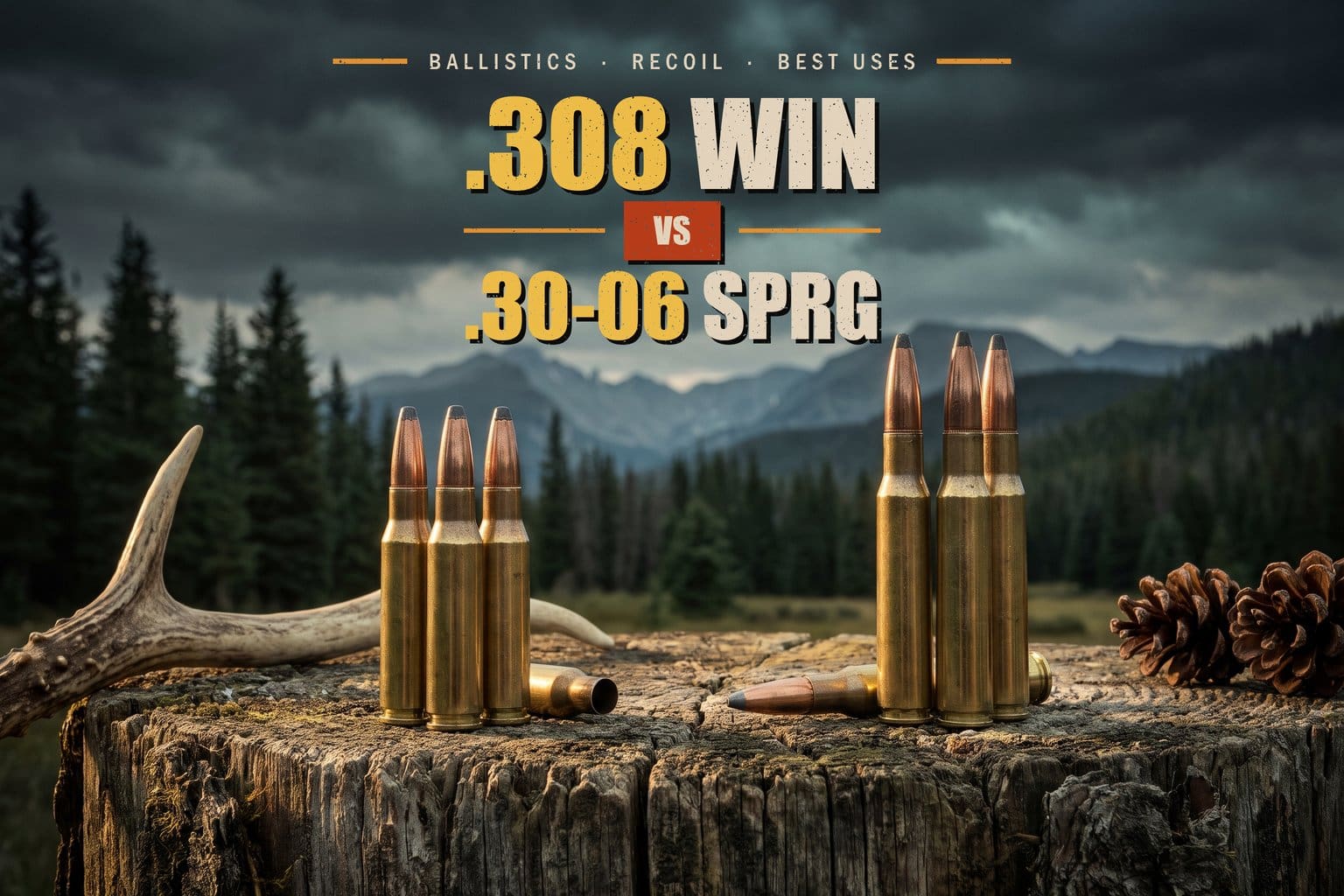
It seems like every deer camp has this argument year after year. Which is better, the .308 or the .30-06? One hunter swears by the .308 while the other won’t give up his decades-old .30-06 that his grandfather carried.
Both of these cartridges shoot a .308 inch bullet and have filled many freezers with venison over the years.
The .308 Winchester and the .30-06 both kill deer well inside of 300 yards. The .30-06 is a little faster and handles heavier bullets better while the .308 offers less recoil, fits inside of a shorter action, and is easier to shoot. The deciding factor comes down to bullet weight and recoil.
TL;DR: The Best .308 or .30-06 Pick for Your Hunt
Deer camp starts soon and you’d rather settle this argument than read about it. Here’s where each cartridge comes out on top:
Best for Whitetail & Mule Deer: .308 Winchester. It matches the .30-06 on deer inside 300 yards with less recoil and a shorter, lighter rifle to carry. Shop .308 Winchester hunting ammo.
Best for Elk, Moose & Big Bears: .30-06 Springfield. It pushes 180 grain bullets faster and steps up to 200 and 220 grain loads when you need more margin. Shop Hornady Precision Hunter 178 Grain ELD-X.
Best for One Rifle From Deer to Elk: .30-06 Springfield. A 165 grain load handles deer, and the same rifle takes heavier bullets when an elk tag comes through. Shop Hornady Superformance 165 Grain SST.
Best for Cheap Range Practice: .308 Winchester. Military-style 147 and 150 grain FMJ shows up in bulk more often and usually costs less per round. Shop Federal American Eagle 150 Grain FMJ.
.308 Vs .30-06 Specs Side by Side
The difference in case length (the .30-06 case is almost a half-inch longer) has a lot to do with the differences outlined below.
| Spec | .308 Winchester | .30-06 Springfield |
|---|---|---|
| Year Introduced | 1952 | 1906 |
| Bullet Diameter | .308 Inch | .308 Inch |
| Case Length | 2.015 inches | 2.494 inches |
| Total Cartridge Length | 2.810 inches | 3.340 inches |
| Action Type | Short | Long |
| Typical Grain Loads | 150-180 grains | 150-220 grains |
| Common Muzzle Speed | 2,570-2,820 fps | 2,700-2,910 fps |
If you want more on the .30-06 Springfield, check out our article on .30-06 for Modern Hunters: Still Relevant or Time to Move On?
Ballistics: How Big the .30-06 Speed Edge Really Is
The .30-06 has more case capacity to hold powder, so it usually leaves the muzzle about 80 to 130 feet per second faster than the .308 with the same bullet weight.
Typical hunting loads in the .30-06 will still generally achieve higher velocities due to the longer case, even though the .308 operates at a higher pressure limit (roughly 62,000 psi).
Here are common factory hunting speeds and energy from a typical 24-inch hunting barrel.
| Load | .308 Speed/Energy | .30-06 Speed/Energy | Edge |
|---|---|---|---|
| 150 grain | 2,820 fps / 2,649 ft-lbs | 2,910 fps / 2,821 ft-lbs | .30-06: +90 fps / +172 ft-lbs |
| 165 grain | 2,700 fps / 2,671 ft-lbs | 2,800 fps / 2,873 ft-lbs | .30-06: +100 fps / +202 ft-lbs |
| 180 grain | 2,620 fps / 2,744 ft-lbs | 2,700 fps / 2,914 ft-lbs | .30-06: +80 fps / +170 ft-lbs |
These numbers hold true even out at 300 yards. The .308 still flies the 150 grain Remington Core-Lokt bullet at around 2,010 fps and generates around 1,345 ft-lbs. The .30-06 is closer to 2,080 fps and about 1,445 ft-lbs.
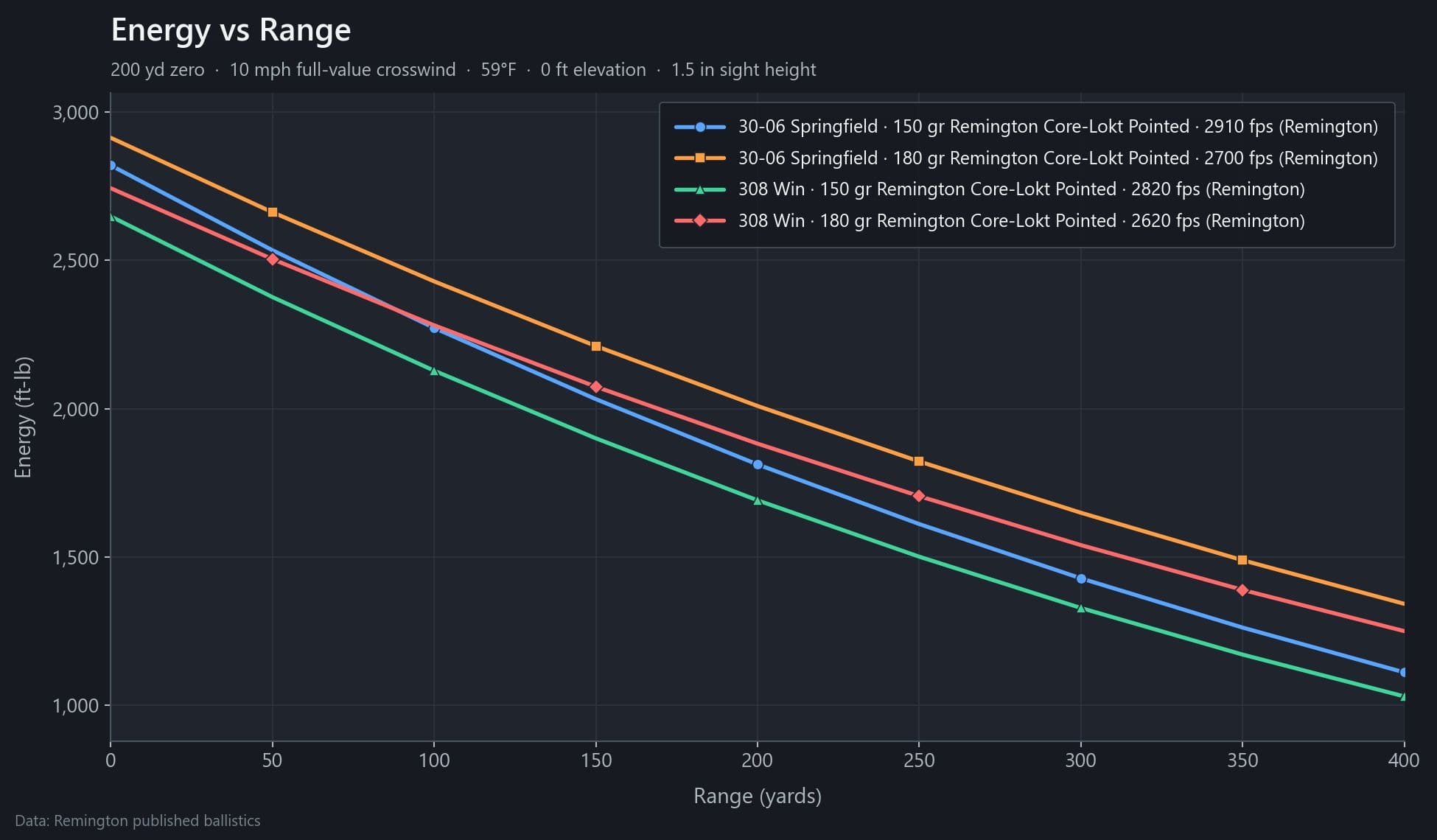
Both of these cartridges are still well above what is needed to ethically take down a whitetail with good shot placement.
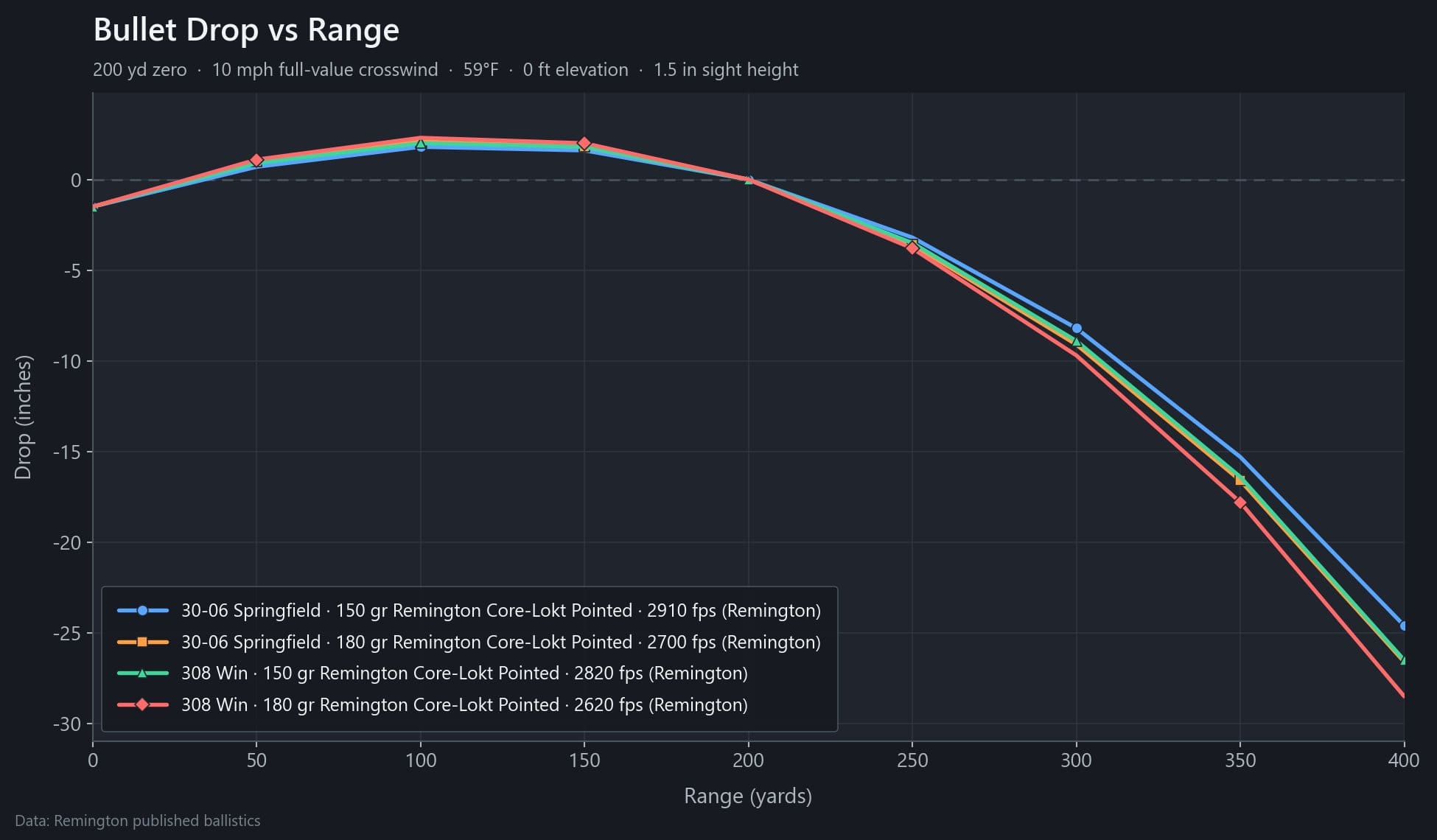
Drop of the bullet continues to tell the same story. When zeroed at 200 yards, the .30-06 flies about an inch flatter at 300 yards.
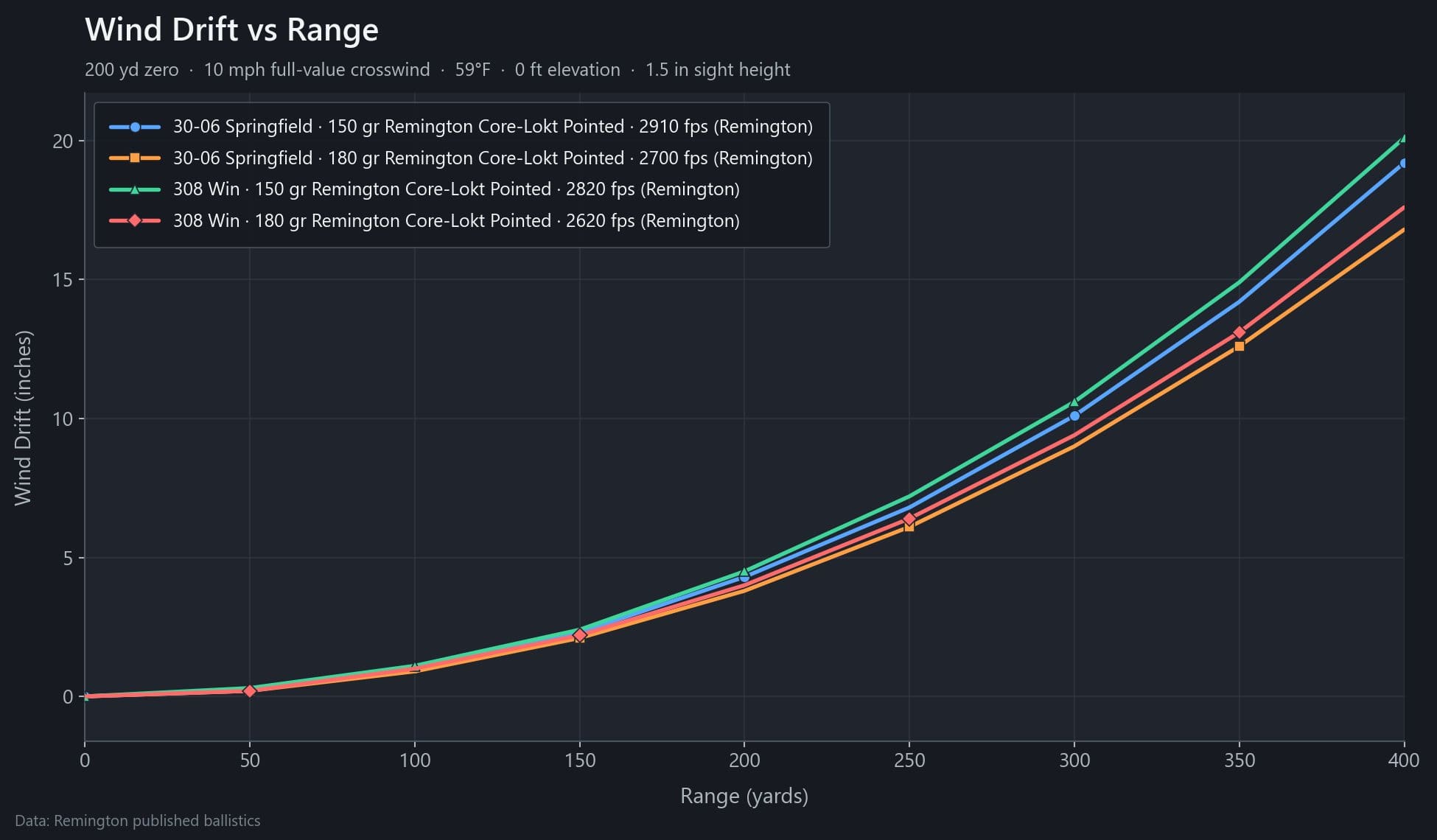
Wind drift gives a slight edge to the faster load, but it’s not dramatic. With a 10 mph crosswind, both 150 grain loads will drift about 10 inches at 300 yards.
Do not expect the little extra the .30-06 provides to help save a bad hold in higher winds. Take the wind into account.
If you want to find out more about ballistics, check out our What Is Firearm Muzzle Energy? [Why It Actually Matters] article.
Recoil: Where the .308 Pulls Ahead
With that shorter casing and a little less powder, the .308 beats up your shoulder a bit less than the .30-06.
In an 8-pound rifle with a 150 grain .308 load, it produces about 16 ft-lbs of recoil. The same weight in a .30-06 is closer to 18 ft-lbs.
Step up to 165 grains and the split becomes 17 versus 20 and again at 180 grains it is about 18 versus 20.
This comes out to about 10 to 15 percent less kick in favor of the .308. For some that might be marginal, but in the field or at the range, that punishment adds up on multiple shots.
Rifle weight and setup can also be a big difference maker. A stripped-down, 7-pound mountain .30-06 is going to slap your shoulder more than a 9-pound .308 equipped with a muzzle brake and a thick buttpad.
Rifle fit and stock shape matter just as much as the cartridge in this comparison.
A .308 that you shoot well will beat out a .30-06 that makes you flinch when you are expecting punishment.
.308 Short Action Vs. .30-06 Long Action
The .308 lives in a short action setup while the .30-06 needs a long action. That sounds like a detail you could gloss over until you carry the extra weight of the long action around for a day.
Short action rifles tend to be lighter, and the shorter bolt throw makes many hunters feel quicker when cycling rounds.
Modern semi-auto rifles like AR-10 style guns are almost always run in .308 or 7.62 because of the short action.
The long action is not necessarily a flaw, but it is the price that you pay for the extra powder room in the casing and access to heavier bullets like the 200 and 220 grains.
Magazine capacity definitely can favor the shorter round of the .308, especially in a blind magazine or a compact rifle. For a bolt gun with a hinged floorplate, the difference is usually one round at the very most.
If you want to see both rifles and both actions side by side, Ultimate Reloader runs through the rifles, reloading, and ballistics for each cartridge in this head-to-head.
.308 Vs .30-06 for Whitetail & Mule Deer
Inside of 300 yards, the .308 and .30-06 are a draw on whitetails and mule deer.
A 150 grain soft point or a 165 grain controlled expansion bullet from either of these cartridges will drop a deer cleanly with good broadside shot placement.
Many woods hunters that stay within 150 yards prefer the .308 because the rifle can be shorter, lighter, and the recoil is lighter.
Those hunters that need the longer reach can use either, but the .30-06’s extra speed is usually popular for those taking longer shots. Most choose a 165 grain bullet as the all-around pick for both cartridges.
On the .30-06 side, Hornady Superformance 165 Grain SST is a good example of that all-around weight, with a little extra speed for longer shots.
If you choose the .308 for deer hunting, check out our article on the Best Deer Hunting Ammo for .308 Rifles [Field-Tested Picks for Whitetail].
.308 Vs .30-06 for Elk, Moose & Big Bears
This is the area of hunting where the .30-06 starts to pull away thanks to its longer casing.
Elk and moose have heavier shoulders and wider chests that call for heavier bullets built to penetrate deeper.
The 180 grain .308 is a fair elk load with a tough bullet and a good angle for shot placement, but it just doesn’t have much room for margin of error.
The .30-06 on the other hand can push that same 180 grain bullet faster and it can also make the step up to heavier 200 and 220 grain bullets.
Hornady Precision Hunter 178 Grain ELD-X is a solid fit for that job in a .30-06, since the bullet is built to hold together on bigger animals.
Those heavier bullets are the old-school answer for elk, moose, big black bears, and sometimes even the occasional brown bear.
Neither of these cartridges is a .300 magnum. If you venture out past 400 yards regularly on these bigger animals, look at a faster round or get closer.
Inside 300 yards, both of these cartridges are good elk cartridges. The .30-06 is just more forgiving if anything were to not be exactly perfect.
Ron Spomer’s breakdown of elk cartridges backs up this section, with a strong case for 180 grain .30 caliber bullets and bullet construction above everything else.
.308 Vs .30-06 for Hogs & Black Bears
Hogs are tough for their size and they rarely give you a good, still broadside shot. Either cartridge will work in a 150 or 165 grain bullet.
If you hunt big boars in thick cover, we highly suggest that you lean heavier and pick a good bullet that stays together and penetrates well.
Black bears are similar. A 165 or 180 grain hunting bullet is plenty for most bears inside of 200 yards.
Tougher bullets are a good pick for quartering shots on bears and the ballistic differences between these two cartridges won’t make much difference if the bullet doesn’t hold together.
Best .308 & .30-06 Bullet Weight by Game & Range
Bullet weight can change a hunt more than which cartridge you choose in this argument. Light bullets are fast and open quick while heavier bullets penetrate better and fight wind more.
We covered all that in How Does Bullet Weight Actually Affect Performance If you want the finer details.
| Bullet Weight | Yardage | Animals | Cartridge Choice |
|---|---|---|---|
| 150 grains | Inside 200 Yards | Deer, Close-Range Hogs | Either |
| 165-168 grains | Inside 300 Yards | Deer, Hogs, Black Bear | Either |
| 175-180 grains | 250-350 Yards | Bigger Mule Deer, Elk | Either |
| 200-220 grains | Inside 300 Yards | Elk, Moose, Black Bear | .30-06 |
Let Your Real Shots Pick the Cartridge
If you are still trying to decide, write down the real shots you think you will take on the animals you plan to hunt. If almost everything is deer inside 200 yards, get the .308.
If you want a lighter, short action rifle that has a milder recoil and ammo is easier and cheaper to buy in bulk, the .308 is your pick.
You also have more rifle choices. You have the option of semi-auto, compact bolt guns, and a rifle that can double as a great shooting range gun.
For range work, Federal Gold Medal Match 175 Grain has a long track record for accuracy and comes in a 200 round case.
If you hunt mixed country and plan to draw an elk tag or want heavier bullets, buy the versatility of the .30-06.
The .30-06 is your pick if you already have one that shoots well or if you want a versatile rifle that will handle anything from deer to elk and even moose.
For range days, Federal American Eagle 150 Grain FMJ in .30-06 keeps practice simple and is loaded with M1 Garand owners in mind.
If you already own one or the other, the choice is already made and you aren’t going to gain much by buying another gun in the same category.
At the end of the day, the .308 and .30-06 aren’t rivals, they are cousins in the same family. Both will get the job done in most cases, especially on deer.
If you want more of a grain-by-grain breakdown for the .308, check out our article on the Best .308 Bullet Grain for Your Use [Full Guide] for anything from varmints to elk.
.308 Vs .30-06 FAQs
Which Is Better for Deer Hunting, the .308 or .30-06?
For deer inside 300 yards, both cartridges work very well with proper bullets and shot placement. The .308 is easier to shoot and carry in compact rifles, while the .30-06 offers a small speed and energy advantage.
Which Cartridge Has More Recoil, the .308 or .30-06?
The .30-06 usually kicks harder because it burns more powder and often pushes heavier bullets. In similar eight-pound rifles, the .308 may recoil roughly 10 to 15 percent less, which can help hunters avoid flinching.
Does the .30-06 Have Better Ballistics Than the .308?
Yes, but the difference is modest. With the same bullet weight, the .30-06 commonly runs about 80 to 130 feet per second faster and carries a little more energy, though both remain effective on deer at typical ranges.
Is the .308 Enough for Elk Hunting?
The .308 can take elk at reasonable ranges with a tough 165 to 180 grain bullet and careful shot placement. The .30-06 gives more margin because it drives 180 grain bullets faster and can use 200 grain loads.
Who Should Choose a .30-06 Over a .308?
Choose the .30-06 if you want one rifle for deer, elk, moose, black bears, and heavier bullets. It is especially useful in mixed or Western hunting country where longer shots and tougher animals are more likely.