Prefer audio over written content? Listen to the article here:
Plenty of people would argue with me, but it’s hard to pick a better duo than the .308 Winchester and the white-tailed deer. As abundant as whitetails are across the country, you can use a .308 to hunt them just about anywhere.
Whether you’re sitting in the dense pines of the Southeast and spot a deer for the first time at 15 yards or glassing a whitetail from an opposing mountainside in the West before making a long stalk, having a .308 in your hands is never a bad idea.
Because the .308 is so popular for not only whitetail but large game hunting in general, there are hundreds, if not thousands, of different loads to choose from.
I know how intimidating it can be when you’re scrolling through options online or standing in the ammo aisle trying to pick the perfect cartridge.
After all, you’ve already put in the work. You’ve bought or leased land, braved public ground, spent hours scouting, found the perfect stand location, and hopefully had enough luck to get a mature buck within range.
The last thing you want is to wonder whether you brought the right ammunition when the moment of truth arrives.
In this article, we’ll break down some of the best .308 deer hunting loads and explain which hunting scenarios they are best suited for.
The cartridge you choose for a 20-yard shot through thick timber isn’t necessarily the same cartridge you’d choose for a 400-yard shot across a valley. By the end, you’ll know exactly which .308 load is the best fit for the way you hunt.
.308 Deer Hunting Ammo: Top Picks by Hunting Scenario
Field-tested loads matched to woods, fields, long-range shots, and more
-
Best for All-Around Hunting
-
Best for Dense Woods and Close Range
-
Best for Long-Range Hunting
-
Best for Large-Bodied Whitetails
-
Best Budget Option
How We Evaluated .308 Deer Hunting Ammo
As a whitetail hunter with more than twenty seasons under my belt, I have used quite a few different cartridges. One I always keep coming back to is the .308 Winchester.
I’d say that, without a doubt, more than half of the deer I’ve killed with a rifle have been taken with a .308.
During that time, I’ve tried dozens of loads and cartridges, usually eager to test whatever new round was getting attention that year.
Along the way, though, I’ve also found a handful of loads that I know I can depend on in just about any situation.
However, one man’s field-tested opinion doesn’t constitute fact, so we’ll dive deeper into these cartridges than just my personal experience with them. We’ll look at their ballistics, what the manufacturer designed them to do, and the whitetail hunting scenarios where they perform best.
Also, to save my own hide, every rifle is different. The most accurate load in my rifle may not be the most accurate load in yours. Test a few different loads in your own rifle before heading into the woods.
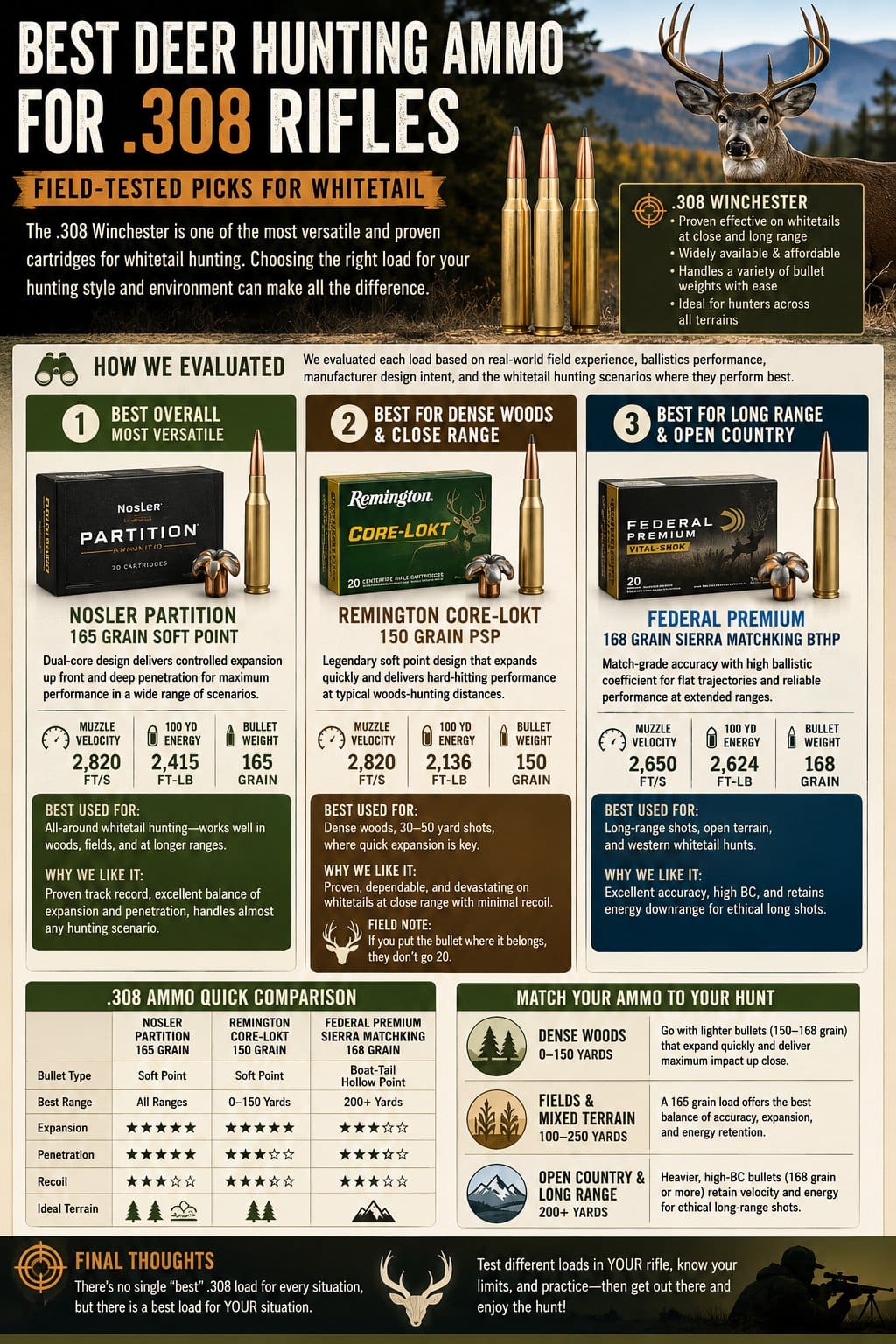
Best Overall Deer Hunting Ammo for .308 Rifles
The best overall deer hunting load for the .308 Winchester is the one that’s the most versatile. One of the reasons the .308 has remained so popular for generations is that it can do just about anything a whitetail hunter could ask of it.
With the right ammunition, it can be tuned for dense woods, agricultural fields, long-range shots, or large-bodied northern bucks.
If you’re looking for one load that can handle a little bit of everything, I’d stick with a middle-of-the-road 165-grain bullet. It offers an excellent balance of expansion, penetration, recoil, and downrange performance.
There’s no perfect load for every situation, but if somebody walked up to me and said, “Patrick, I’m hunting the woods of Georgia this week, Kentucky later in the season, and then heading out West to chase whitetails before the year is over. I only want to buy one box of ammo. What should I get?”
I’d probably hand them a box of Nosler Partition 165 Grain Soft Points.
The Nosler Partition is one of the most proven hunting bullets ever made. Its dual-core design allows the front section to expand quickly while the rear section stays intact for deep penetration.
Combined with a versatile 165-grain bullet weight, it gives hunters a load that’s capable of handling almost any realistic whitetail hunting scenario.
Even so, I still recommend choosing a cartridge that matches your specific hunting style whenever possible.
The Nosler Partition may be the best all-around choice, but as you’ll see throughout this guide, the best .308 deer load often depends on where you’re hunting and the shots you’re most likely to take.
Best .308 Ammo for Dense Woods and Close-Range Hunting
I spent most of my time hunting in the Southeast United States, where 30- to 50-yard shots through the woods are fairly common.
At those distances, where a mature whitetail might push 200 pounds if you’re lucky, you can easily get away with a lighter bullet.
I tend to stick close to 150-grain loads, although I’ve had good experiences with 165- and 168-grain options as well.
These lighter bullets generally expand more readily than their heavier counterparts at typical woods-hunting distances. They also tend to produce slightly less recoil. The difference isn’t dramatic and may be unnoticeable to many shooters, but the physics says it’s there.
The cartridge I like best for this category is the Remington Core-Lokt 150 Grain PSP. Remington Core-Lokts are legendary in the space, and personally, I prefer the traditional lead-tipped soft-point design over the newer polymer-tipped versions.
The 150 grain soft point comes out of the barrel at 2,820 ft/s and at 100 yd still retains 2136 ft-lb of muzzle energy.
It’s a quick round that has all the power you’ll need for whitetail and is sure to rapidly expand.
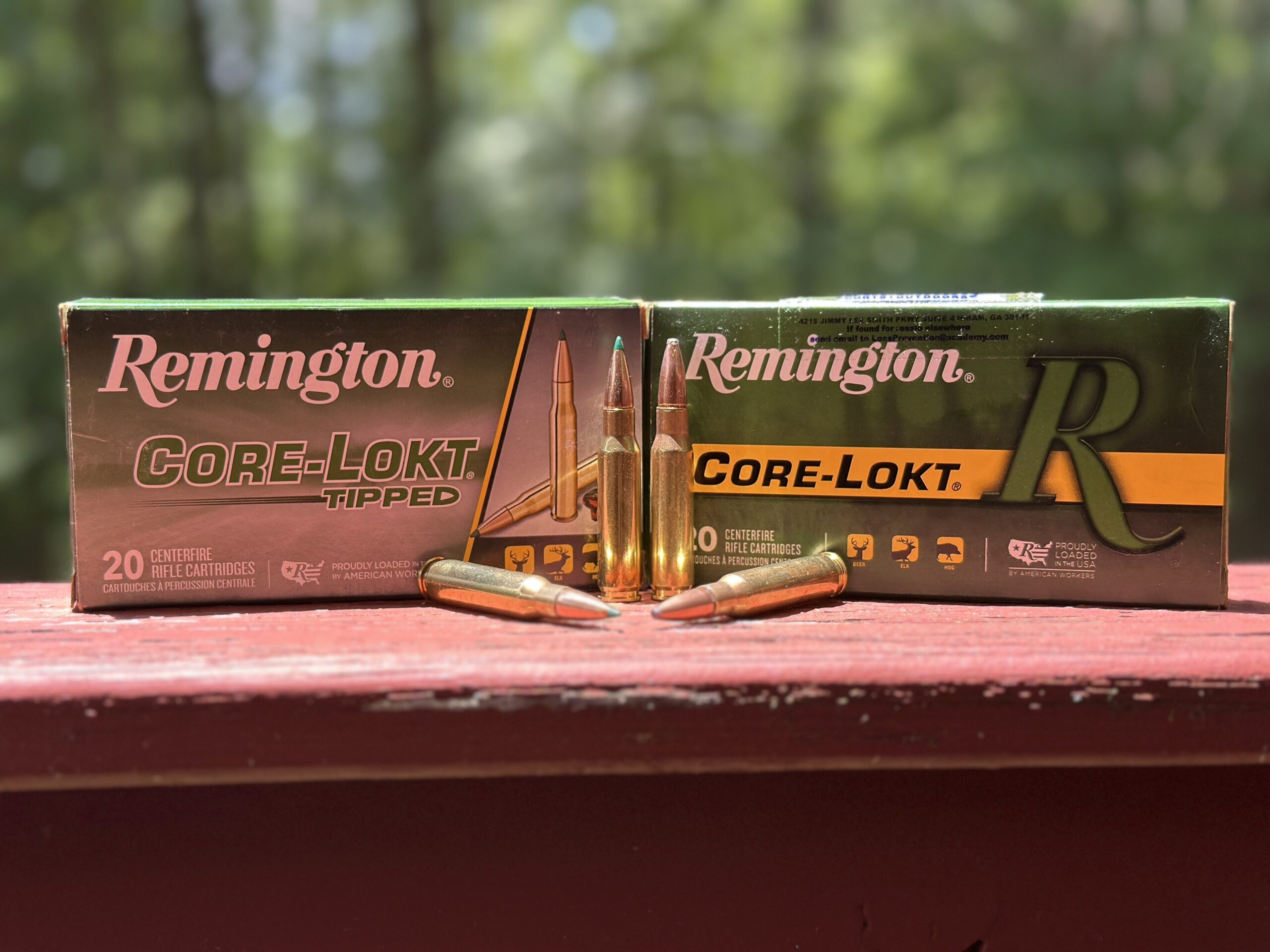
I’ve killed no fewer than 30 deer with a Remington Core-Lokt, and I’ve definitely learned to depend on it. In my experience, if you put the bullet where it belongs, they don’t go 20.
As boastful as it sounds, I often joke with my dad that I’ve got to quit using Core-Lokts because I’d like to track a deer every now and then!
If you like tracking deer for a few hundred yards, the 6.5 Creedmoor is the cartridge for you. All jokes aside, we did a deep dive on it here: Is 6.5 Creedmoor Actually a Reliable Round for Whitetail?
Best .308 Ammo for Agricultural Fields and Mixed Terrain
In the .308 Winchester, you’ve basically got three common bullet-weight categories: 150 grains, around 165 to 168 grains, and 180 grains.
There are some specialty loads that dip down near 100 grains and others that climb all the way to 220 grains, but I wouldn’t recommend those for most whitetail hunters.
If you want to see exactly when to use every single type of .308 bullet grain, we did an entire ride about it: Best .308 Bullet Grain for Your Use [Full Guide]
If you’re hunting terrain that’s a mix of woods and fields, a middle-of-the-road bullet weight is hard to beat. Maybe you’re planning to hunt a field edge for the first half of the season and a funnel in the hardwoods for the second half.
Maybe you’re hunting in an agricultural county where a deer could step out at 50 yards or 250 yards. In those situations, versatility becomes more important than optimizing for any single scenario.
For most hunters, a 165-grain bullet is perfect for mixed terrain hunting. It offers a great balance of expansion, penetration, and retained energy while still shooting flat enough for longer field shots.
I’d recommend the Nosler Partition 165 Grain Soft Point. The Nosler Partition has earned a legendary reputation among hunters because of its dual-core design. The front section expands rapidly to create a large wound channel, while the rear section stays intact to drive deep through the animal.
If you want to dive deeper into bullet designs, this article was written just for you: The Best Bullet Design for Whitetail Hunting
That combination makes it a good choice whether you’re taking a 50-yard shot in the woods or reaching across a field at 200 yards or more.
It retains plenty of energy at distance while providing the penetration needed for larger-bodied Midwestern whitetails and challenging shot angles.
For that 200 yard shot, the Nosler Partition still delivers roughly 2,053 foot-pounds of energy, which is more than enough for whitetail deer and larger game like black bear or elk.
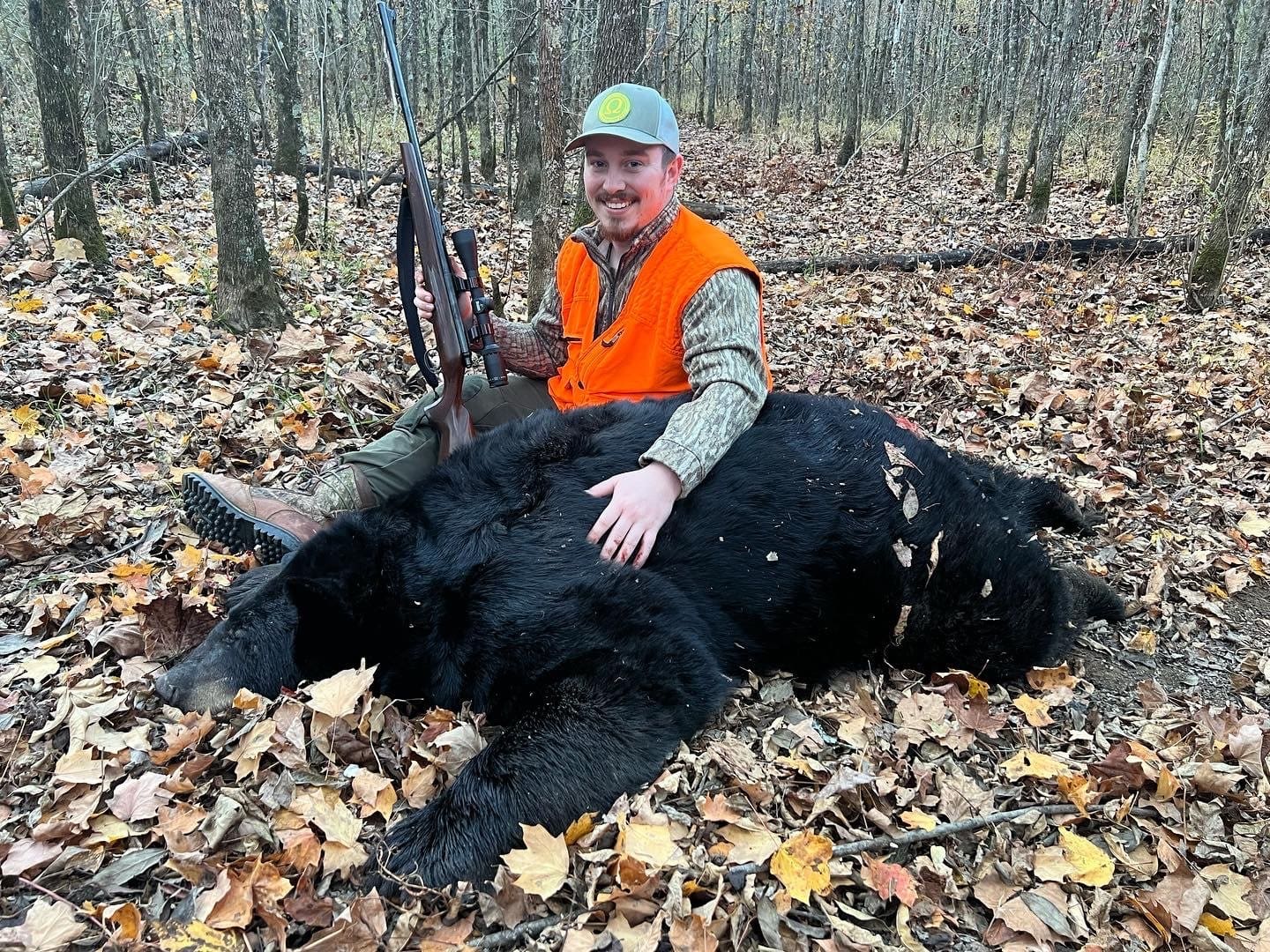
Plus if you live in a state like Georgia that just has a large game season or you can snag a bear tag along with your deer tag, having a versatile .308 in your hand in mixed terrain means that you could take bear if you happen upon one, like I did here.
Back in 2023 I was deer hunting before I saw this 350 pound sow appear out of the thicket not twenty yards in front of me.
Best .308 Ammo for Long-Range Deer Hunting
The vast majority of whitetail hunters are shooting deer well within 200 yards, and many shots happen inside 50 yards. However, some hunters out West may find themselves taking shots at 400 yards or more.
For the sake of argument, I’ll call anything beyond 300 yards a long-range shot for whitetail.
When you start reaching out to these distances, your ballistics matter a lot more than they did at 100 yards. Now you need to pay attention to ballistic coefficient, velocity retention, bullet drop, and even wind drift.
This is also where I would generally move away from traditional soft points and start looking at polymer-tipped hunting bullets, which tend to offer higher ballistic coefficients and better long-range performance.
I would also lean toward a heavier bullet, typically around 180 grains. While a heavier bullet doesn’t necessarily shoot flatter, it often retains velocity and energy better at extended distances, especially when paired with an aerodynamic bullet design.
That extra retained velocity helps reduce wind drift and ensures reliable terminal performance when the bullet finally reaches its target.
Expansion becomes especially important at longer ranges because impact velocities are much lower than they are at 50 or 100 yards. A long-range hunting bullet is built to expand reliably even after shedding a significant amount of speed over several hundred yards.
This category applies most to Western hunters, where you’ll often find both whitetail and mule deer (which can be hard to tell apart at a distance). In many states, hunters draw a tag that can be used for either species.
Fortunately, the two animals are similar enough in size that your ammunition choice probably wouldn’t change if they were standing at the same distance in the same terrain.
If you’re interested in mule deer hunting, be sure to check out our guide: The Best Cartridges for Mule Deer Hunting [Ranked].
The Norma 180 Grain Bond Strike Is a great cartridge here. It has 2,357 Foot pounds of energy out of the gate and still retains 1,575 foot pounds of energy out to 400 yards. This is a bonded bullet that’s made for long-range shooting with medium-sized game like Whitetail. You probably couldn’t find a cartridge that screams long-range deer hunting more than this one does.
Best .308 Ammo for Large-Bodied Northern Whitetails
While I do a lot of hunting in my home state of Georgia, I frequently lease land in Kentucky. This past season, I shot a three-year-old buck at roughly 50 yards using a 150-grain Remington Core-Lokt.
The deer only made it about 40 yards before going down, so there was never any doubt about recovering him.
However, when I skinned the deer, I found the bullet lodged in the opposite shoulder. The Core-Lokt had performed exactly as intended, but it got me thinking.
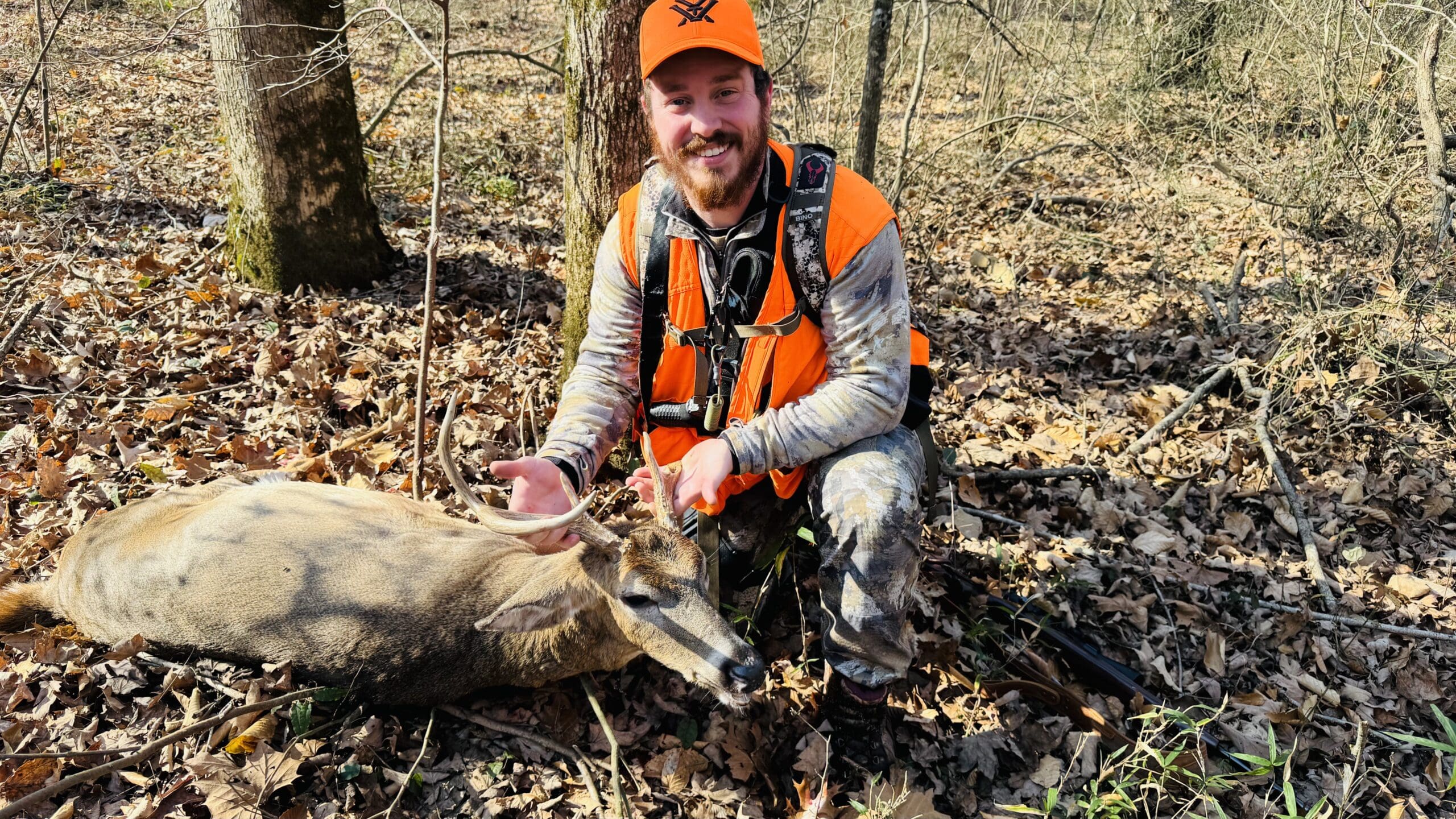
If that buck had been four or five years old with another 50 or so pounds on his frame, I’m not nearly as confident the bullet would have stopped in the same place.
If you’re hunting farther north where mature bucks regularly reach weights that are uncommon in the South, penetration becomes a bigger problem. You want a bullet that can drive through a heavy shoulder, handle quartering shots, and still reach the vitals.
For those situations, I like stepping up to a 180-grain bullet. The added weight gives you more penetration and a little more margin for error when shot angles aren’t ideal.
Because the truth is, we don’t all live inside the perfect hunting shows we watch on Sundays. Deer don’t always stop broadside in the middle of a food plot.
Sometimes they’re quartering toward you, quartering away, or moving through thick cover. Having a bullet that can handle those less-than-perfect situations is important.
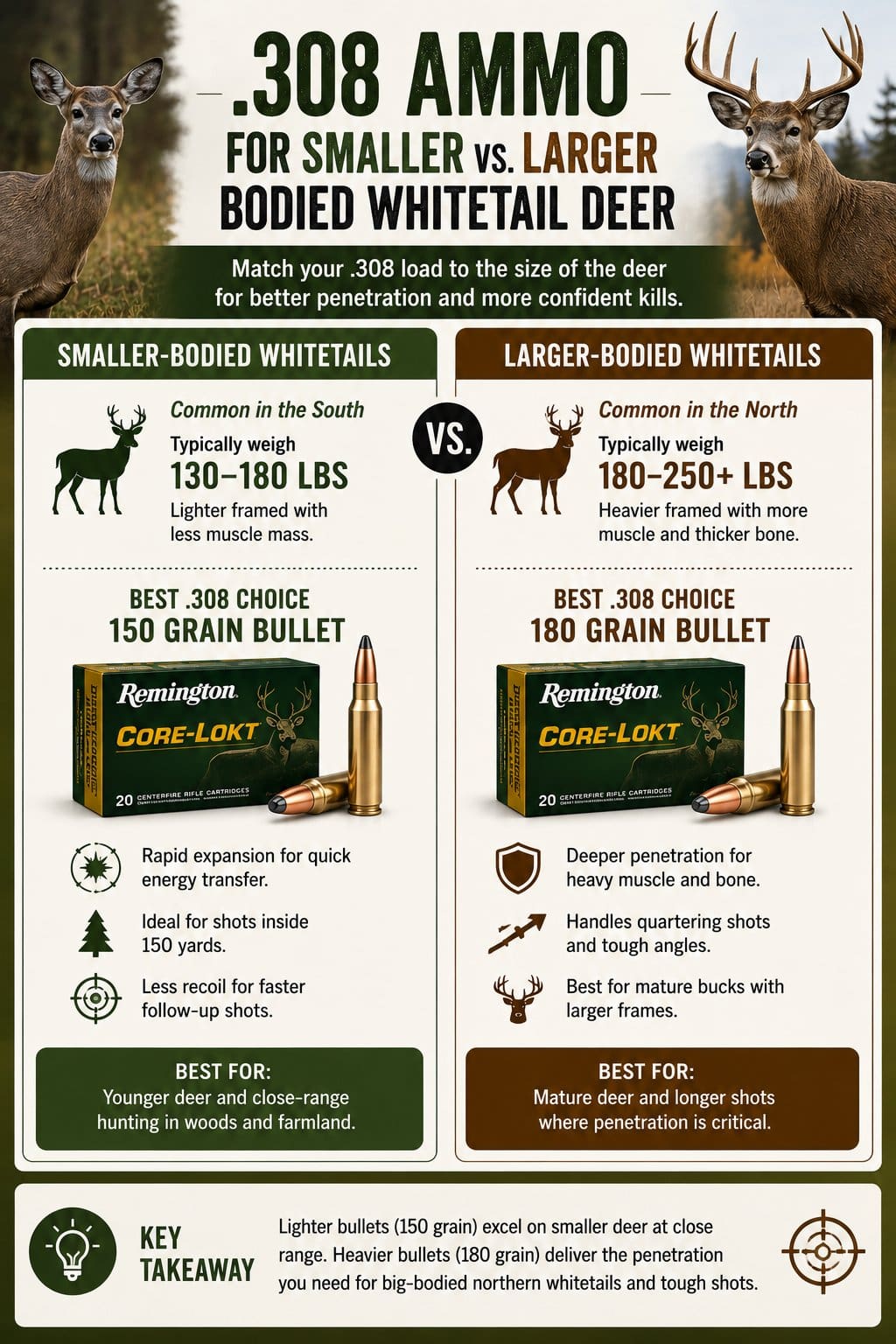
I may have just spent a paragraph ragging on my 150-grain Remington Core-Lokt, but I still love the design. When I wanted more penetration, I didn’t switch brands or bullet styles; I moved up to the 180-grain version.
The Remington Core-Lokt 180 Grain PSP leaves the muzzle with 2,288 foot-pounds of energy and still carries 1,895 foot-pounds at 200 yards. It’s a hard-hitting load that can handle a variety of hunting situations, but I like it best when for large-bodied northern whitetails where penetration is a requirement.
Best Budget .308 Deer Hunting Ammo
It’s no secret that .308 Winchester ammunition can get expensive. The good news is that most deer rifles don’t see nearly as much range time as an AR-15 or a competition rifle.
Many hunters can make it through one, two, or even three seasons with a single box of hunting ammunition.
Because of that, I could make the argument that spending a little extra on a premium hunting load is often money well spent. Still, if you’re trying to save some money, there are a few solid options available.
My top pick in this category is the Winchester Deer Season XP 150 Grain. These cartridges have historically been among the more affordable deer hunting loads on the shelf, and they offer plenty of performance for typical whitetail hunting within a couple hundred yards.
Saving money isn’t a bad thing either; I’ve seen plenty of deer killed with budget ammunition and plenty killed with premium ammunition. Shot placement still matters a whole lot more than the logo on the box.
Another option is buying your hunting ammunition in bulk. While the upfront cost is higher, a case of .308 hunting ammunition could realistically last the average deer hunter a decade or more between range sessions, sight-in days, and actual hunting.
If you aren’t so sure about buying in bulk, this article breaks it down in black and white: Is Buying Ammo in Bulk Worth It? [The Cold Hard Facts]
Best Lead-Free .308 Deer Hunting Ammo
Lead-free ammunition is still relatively new to a lot of hunters. Most of us grew up thinking of bullets as being made from lead and copper, but some states, like California, have regulations against using lead ammunition for hunting.
Other hunters simply prefer lead-free bullets because they process their own venison and want to minimize the amount of lead left behind after a shot.
The real appeal of lead-free ammo is the copper monolith bullet. Since copper is much harder than lead, these bullets retain their weight extremely well and penetrate much deeper than most traditional lead-core designs.
Instead of needing a heavy 180-grain bullet to punch through a big-bodied buck, you can often get similar penetration from a lighter copper bullet.
If you’ve been following copper ammunition for a while, you probably remember when it was initially released and got a lot of flak for being too hard and not expanding very well.
Modern designs have improved that dramatically, and today’s copper bullets expand reliably while still delivering the deep penetration they’re known for.
You have several good options if you’re looking for a lead-free .308 load. Remington offers an all-copper Core-Lokt load, while Winchester’s Copper Impact line has also earned a strong reputation among hunters.
Either one will hit hard and have no problem bringing down a whitetail if you do your part.
Loading Your Perfect 308 Cartridge
The .308 Winchester has earned its reputation as one of the best deer cartridges ever made.
It’s accurate, widely available, easy to shoot, and powerful enough to handle whitetails from the Georgia pines to the agricultural fields of the Midwest and beyond.
The good news is that there really aren’t many bad .308 deer loads on the market today. The challenge isn’t finding a cartridge that can kill a whitetail, it’s finding the one that’s best suited for the way you hunt.
Whether you prefer a lightweight soft point for close-range shots in the woods, a versatile 165-grain bullet for mixed terrain, or a heavy bonded bullet for long-range hunting and large-bodied bucks, the .308 has an option that fits the job.
At the end of the day, no cartridge can make up for poor shot placement. Find a load your rifle shoots accurately, spend some time behind the trigger, and when that mature buck finally steps into range, you’ll be ready.
.308 Deer Hunting Ammo FAQs
What Is the Best .308 Ammo for Whitetail Deer?
For an all-around whitetail load, a 165-grain soft point such as the Nosler Partition is hard to beat. It balances expansion, penetration, recoil, and retained energy well enough for woods, field edges, and most realistic deer-hunting distances.
Is 150-Grain .308 Ammo Enough for Whitetail Deer?
Yes. A 150-grain .308 soft point is plenty for typical whitetail hunting, especially in dense woods where shots are often inside 100 yards. It expands quickly, recoils mildly, and works best when placed through the vitals.
What Bullet Weight Is Best for .308 Deer Hunting?
Most hunters should choose bullet weight by terrain and deer size. Use 150 grains for close woods, 165 grains for mixed ground, and 180 grains for large-bodied bucks, tougher shot angles, or extended-range hunting where penetration matters.
What .308 Ammo Is Best for Long-Range Deer Hunting?
For shots beyond about 300 yards, look for a heavier, aerodynamic hunting bullet, often around 180 grains. Bonded or polymer-tipped designs help retain velocity, resist wind better, and expand reliably after impact speed has dropped.
Is Lead-Free .308 Ammo Good for Deer Hunting?
Modern lead-free .308 loads can be excellent for deer. Copper bullets retain weight extremely well, penetrate deeply, and newer designs expand far better than early versions. They are especially useful where regulations require nonlead ammunition or hunters want cleaner venison.