Prefer audio over written content? Listen to the article here:
If you’re like me, you’re constantly searching for the best deals on ammunition while also trying to avoid low-quality ammo. It can be hard to balance these two things, especially if you’re shooting for precision.
For pistols and semi-automatic rifles, precision ammunition may not matter as much to you as what’s most affordable.
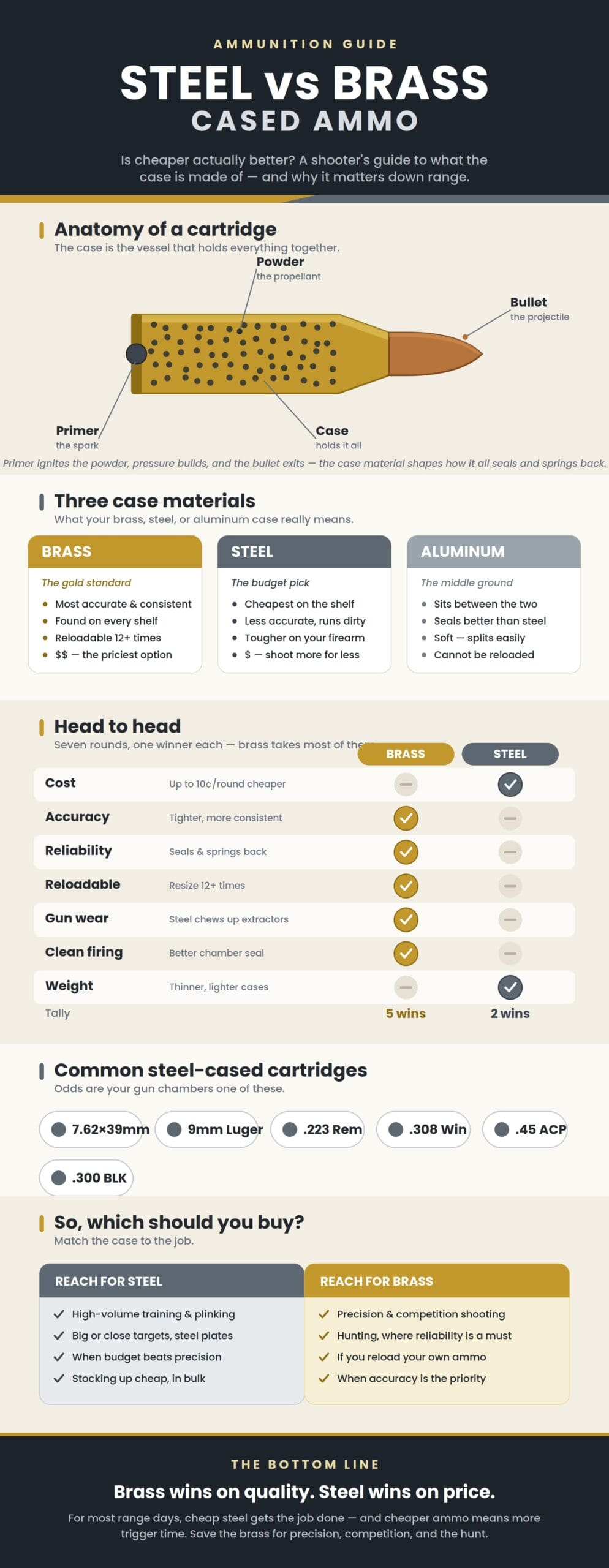
Brass-cased ammunition is often more expensive than steel-cased ammo, but it’s also usually more accurate, reliable, and can be reloaded. In contrast, steel-cased ammunition has the leg up on cost, and cheaper ammunition means you can shoot more for the same cost.
Below, we’ll dive into the basics of what ammunition cases are and their function, the different materials cases are made from, how they can influence ballistics, and discuss the pros and cons of brass vs steel ammunition.
What Are Ammo Cases?
Before we dive into the specifics of the differences between case types, let’s first discuss what a case is and how it functions. Most simply, ammo cases act as a vessel and hold the primer, powder, and bullet in place.
When the primer is ignited on the back of the case, it lights the powder inside, creating pressure that propels the bullet out of the case mouth.
The specific type of material a case is made from heavily influences how the case expands after being fired and how much it springs back, which influences the bullet’s ballistics.
Brass Cartridge Cases
Brass is the most common metal that ammunition cases are made from. Brass-cased ammo is easily found on store shelves and online everywhere. Actually, you’ll likely have to go out of your way to buy ammunition that doesn’t use a brass case.
Brass is common for several reasons; first, it’s the gold standard because it produces accurate, reliable, and consistent ammo. It also wears less on guns firing it than other case materials.
You may also see nickel-plated brass cases, which further increase feeding reliability and reduce wear on your firearm. Even though they look silver and shiny, there’s still brass underneath.
Steel Cartridge Cases
Next up is steel. Steel-cased ammunition is often the cheapest available. It is often less accurate than brass-cased ammo and produces slightly slower velocities in some calibers due to the case not forming a tight seal to the chamber.
Steel cases are also known to cause more wear on firearms, especially extractors, the part that grips the rim of the case and pulls it from the chamber before ejecting it.
It can also make guns dirtier because it doesn’t seal the chamber as well as brass, allowing more gas to escape and carry the burnt powder residue.
Aluminum Cartridge Cases
Aluminum cases fall somewhere between brass and steel cases in cost, accuracy, effect on velocity, and consistency. Aluminum cases expand better than steel, and because of this, they will seal the chamber better, which leads to a slight increase in velocity. Additionally, aluminum-cased ammunition is often more consistent than steel.
However, while aluminum-cased ammo is more malleable than steel, it’s also less durable. It is much more prone to splitting than brass or steel-cased ammunition, and because of this, cannot be used for reloading. It can also cause feeding and extraction issues in some guns because of the softness.
For the rest of the article, we will only focus on brass and steel cases, but because you may see some aluminum-cased ammo while shopping, especially for pistol ammunition, I thought it best to discuss it briefly here.
Common Cartridges Loaded in Steel Cases
If you’re reading this article, there’s a good chance that you already own a gun chambered in a cartridge that has steel-cased ammo available. Steel-cased ammunition is available for some of the most common cartridges ever produced.
The most common cartridges loaded in steel cases are 7.62x39mm, 9mm Luger, and .223 Remington. However, there are other cartridges commonly loaded in steel cases as well, these include .308 Winchester, .45 ACP, and .300 Blackout.
Additionally, ammo for the 7mm Backcountry cartridge is only loaded in steel cases, albeit a proprietary blend of metals that works extremely well for this round. The steel alloy case can handle the additional pressure created by this round.
However, the steel alloy is different from the typical steel cases found on the other cartridges listed above.
Case Materials Influence on Ballistics
The case material often influences the internal and external ballistics of ammo. While it’s hard to make direct comparisons, if everything is held equal, brass-cased ammunition will often have higher velocities than steel ammunition.
However, steel-cased ammo is typically loaded with lower-quality components, while brass ammunition is often loaded with higher-quality components, which has a greater effect on the ammunition’s performance as well.
The quality of the brass case itself can also have an impact on ballistics. Not all brass cases are created equal. Some brands of brass have different capacities even when comparing the same cartridges.
Different capacities and brass thickness can change pressures, which can affect velocity and accuracy.
If you want more details on what exactly affects internal and external ballistics, this article was made for you.: Internal External & Terminal Ballistics [What Truly Matters]
Cartridge Affordability by Case
Affordability is where steel-cased ammo shines. Steel-cased ammunition is almost always cheaper than brass-cased ammunition. Steel-cased ammunition can be found up to 10 cents cheaper per round compared to brass.
This is largely because steel is cheaper than brass, and it’s also cheaper to manufacture casings from it.
If you want to find the best savings, look for imported steel-cased ammunition and purchase it in bulk. Military surplus ammo can also be found at steep discounts, and in some cartridges, like the 7.62x39mm, are commonly loaded in steel cases.
If you’re interested in learning more about the benefits of purchasing military surplus ammunition, you can read our article When to Use Military Surplus Ammo: Tried-and-True or Trouble?
However, if you enjoy reloading, you may want to think twice.
Reloading Vs Buying Loaded Ammunition
Reloading your own ammo can save you a fair amount of money over time, especially if you are reloading ammunition that costs $2 or more per round.
Personally, I reload 6.5 PRC and 6.5 Creedmoor ammunition. I’m often saving $1 or more per round.
That said, to reload, you also have to purchase reloading equipment. If you’re buying new or higher-end equipment, it can take a long time to recoup the costs.
An alternative is to visit your local pawn shops or thrift stores and buy used. In fact, that’s exactly what I did.
Everything I reload with is used except my scale and dies. It saved me hundreds of dollars vs buying new, but it can take some time to find the right equipment.
The other option is to purchase your ammo new. This is by far the easiest option, and if you don’t shoot much, probably the best option.
One downside of purchasing loaded ammunition is that you may not be able to find exactly what you want.
Reloading gives you the ability to create your own rounds and combinations of brass, bullets, primers, and powder, and customize them to your own firearm. However, this can also be time-consuming and expensive.
If you’d like to learn more about the reloading process and its pros and cons, our article, Is The Time & Money Spent Reloading Actually Worth It? is an informative read.
Reloading Brass Vs. Steel Cases
Brass cases are the gold standard for reloading. Brass is malleable and easy to size; if done properly, high-quality brass can be resized a dozen or more times.
Common issues with brass cases nearing the end of life include splitting case mouths and loosening primer pockets.
If you already reload or are just interested in learning more about taking care of brass used for reloading, give Brass Care For Habitual Reloaders [A Step-By-Step Guide] a read, as it does a fantastic job of explaining the process and why brass care is important for reloaders.
Brass cases are the standard, largely due to their malleability, which also helps seal the chamber. When comparing two cases, one brass and one steel of the same thickness, the steel case will be able to handle higher pressures.
However, steel cases are widely considered unreloadable.
In all fairness, they can be reloaded; however, they are more difficult to size than brass because of their lack of malleability, which can also cause them to get stuck in the die more often.
Additionally, imported cases often use different types of primers than brass, which can be difficult to remove. Last, steel cases will wear out reloading dies faster because of their hardness.
Steel cases also tend to split or crack after reloading once or twice. All this to say, yes, steel cases are technically reloadable; however, it’s highly advised not to.
Steel Vs Brass Case Reliability
When hunting or participating in competition matches, reliability is a requirement. In these scenarios, brass is best. Brass cases are more reliable than steel.
The malleability of brass allows it to expand to seal the chamber and then spring back, which assists with extraction from the chamber and ejection. The expansion to seal the chamber also helps keep the gun cleaner.
Clean guns are more reliable than dirty guns, and because of the seal brass creates, it takes more shots with brass-cased ammunition to make a gun dirty than with steel. Additionally, steel-cased ammunition is harder on guns than its brass counterpart.
Because steel is harder than brass, it can wear firearm components faster, which can lead to ejection failures. The most likely place to see wear from firing steel-cased ammunition is on the extractor.
The extractor is what “grabs” the rim of a shell and pulls it back out of the chamber.
Once the extractor gets too worn or breaks, it will no longer reliably extract the spent casing.
Extractors can be replaced, but it’s something to keep in mind, and if you shoot a lot of steel, be prepared to replace them sooner than if you were shooting brass-cased ammunition.
Advantages and Disadvantages of Brass Vs Steel Cased Ammunition
While there are many advantages of brass-cased ammo, there are relatively few for steel-cased ammo. Brass-cased ammunition only has one major disadvantage when compared to steel-cased ammunition, and that is price.
In contrast, steel-cased ammunition has quite a few disadvantages. Steel cased ammo is dirtier, produces less accurate loads, shouldn’t be reloaded, and is harder on gun parts, especially extractors.
Additionally, steel-cased ammo isn’t allowed at many ranges due to the steel cases mixing with the reloadable brass cases and some steel-cased ammo being loaded with steel core ammunition that can damage targets and create additional hazards.
That said, steel-cased ammo is much cheaper than brass-cased ammunition and can typically handle higher pressures. Because of this, steel cases can be made thinner than brass, and therefore, steel ammo is often lighter than its brass counterpart.
That said, the weight savings are negligible unless you are carrying or storing many rounds of ammo at once or need to save a few ounces. Which is why when you do find this ammo, it’s usually foreign military surplus. It was cheaper to produce and lighter to transport, a win-win if you didn’t care about much else.
When Is Steel Ammunition A Better Choice Than Brass?
Throughout this article, you’ve probably noticed a pattern. Typically, the benefits of brass-cased ammo outweigh the benefits of steel-cased ammo. Because of this, you may be wondering why someone would even buy steel-cased ammunition.
As I previously mentioned, steel-cased ammunition is often much cheaper than brass-cased ammo. Because of this, when shooting high volumes like for training or target practice, it is often advantageous to shoot steel-cased ammo.
While steel-cased ammo often isn’t as accurate as brass-cased ammunition, when shooting silhouettes, steel plates, or other large targets, especially at close range, the difference usually isn’t noticeable.
It becomes much more discernible when precision shooting. For precision shooting, brass-cased ammo is better.
However, for high-volume practice shooting, it’s hard to beat cheap steel-cased ammo. Just know that steel-cased ammo can wear out parts like extractors faster. Usually, they are pretty easy and cheap to fix yourself.
Cartridge Cases for a Steal
For most target shooters, steel cased ammunition will give them the best bang for their buck. However, it’s best to avoid steel-cased ammunition in precision matches or when shooting competitively due to the reduced accuracy and reliability.
Still, steel cased ammunition is worth a look for most shooters. It’s cheap and gets the job done. Cheaper ammunition also allows people to hit the range more often, and more practice leads to better shooters.
While steel-cased ammunition has its downsides and isn’t better than brass-cased ammunition, for target practice, it’s hard to beat.
Steel vs. Brass Ammo FAQs
Is Brass-Cased Ammo Better Than Steel-Cased Ammo?
Brass-cased ammo is generally better for accuracy, reliability, cleaner operation, and reloading. Its case expands and springs back more effectively, helping extraction. Steel-cased ammo wins mainly on price, making it attractive for high-volume practice.
What Are the Main Downsides of Steel-Cased Ammo?
Steel-cased ammo is usually dirtier, less consistent, harder on extractors, and more difficult to reload. Because steel does not seal the chamber as well as brass, more gas and residue can escape during firing.
When Should You Use Steel-Cased Ammo?
Steel-cased ammo makes the most sense for inexpensive, high-volume range practice where maximum precision is not required. It works well for close-range drills, silhouettes, and casual target shooting, provided your firearm runs it reliably.
Can Steel Cases Be Reloaded?
Steel cases can technically be reloaded, but it is usually not worth doing. They are harder to resize, may use difficult primers, can wear dies faster, and often crack after very few reloads compared with brass.
Why Do Some Ranges Ban Steel-Cased Ammo?
Ranges may restrict steel-cased ammo because the cases can mix with reloadable brass and complicate cleanup. Some steel-cased loads also use steel-core projectiles, which can damage targets, spark on impact, or create safety concerns.