Prefer audio over written content? Listen to the article here:
If you hunt the West, the argument between the 7mm PRC and the .300 Win Mag has probably come up more than once. One is the new school while the other has been filling freezers since the 1960s.
Both cartridges are true magnums, but when it comes to those long-range kill shots, what would you prefer to have in your hands when you are trying to take down a mule deer, elk, or bear?
The 7mm PRC wins the long-range work with its flatter flight path past 400 yards and less recoil. The .300 Win Mag is the go-to for harder hits at relatively closer ranges and is easier to feed.
Both cartridges are highly capable of taking down large game at long range, but they do it in different ways.
TL;DR: Which Cartridge is Best For You
The classic answer for which cartridge is better is always “it depends” but depending on your specific use case there’s usually one cartridge that’s better suited than another. Here is our take:
7mm PRC vs .300 Win Mag: Top Ammo Picks
Quick picks by use case, from open-country long shots to close-range elk in timber.
-
Best for Long Shots in Open Country
-
Best for Competitive Long-Range Shooting
-
Best for Elk, Moose, and Bear in Timber
-
Best for Non-Lead Deer Hunting
-
Best for Long-Range Practice
-
Best for Stocking Up on a Budget
7mm PRC & .300 Win Mag Specs Side by Side
Anecdotes only get you so far. Here are the hard numbers.
| 7mm PRC | Spec | .300 Win Mag |
|---|---|---|
| 2022 | Year Introduced | 1963 |
| .284 inch | Bullet Diameter | .308 inch |
| 160-180 grain | Typical Hunting Bullets | 165-200 grain |
| 2,950-3,100 fps | Common Muzzle Velocity | 2,860-3,150 fps |
| ~3,500 ft-lbs | Muzzle Energy | ~3,500-3,800 ft-lbs |
| 65,000 psi | SAAMI Max Pressure | 64,000 psi |
| 26-29 ft-lbs | Recoil (8.5 lb Rifle) | 30-37 ft-lbs |
| 1:8 | Common Twist Rate | 1:10 |
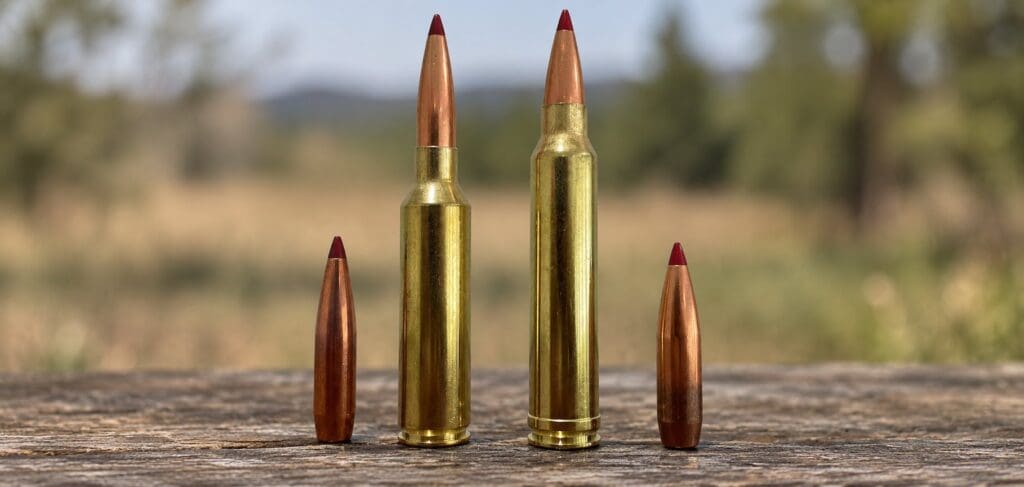
Long-Range Ballistics: The 7mm PRC Pulls Ahead
At 100 and 200 yards, the 7mm PRC and the .300 Win Mag look like identical ballistic twins.
It isn’t until we pass about 400 yards that the 7mm PRC starts to pull ahead and really take on the performance that it was designed for.
The secret sauce to the 7mm PRC’s performance is in the shape of its bullet. Hornady built the 7mm PRC to be a long, sleek version of the 7mm.
It has an extremely high G1 ballistic coefficient that is around .689. This means that it cuts through the air with less drag.
A high ballistic coefficient means that the bullet fights drag better, resulting in it carrying more speed for longer, dropping less, and is less affected by wind.
If you want more information on ballistic coefficients, check out our article How Ballistic Coefficients Effect Long Range Shooters.
Factory Load Comparison
The Hornady Precision Hunter 175-grain ELD-X in 7mm PRC leaves the muzzle at 3,000 fps.
That exact load sells quickly, so it is worth checking what 7mm PRC is actually on the shelf before you plan a season around it.
A typical 180-grain .300 Win Mag hunting load fires around 2,960 fps. These are extremely similar rounds at the start.
With both being zeroed at 200 yards on a setup, the 7mm PRC will drop about 6 inches at 300 yards and 34 inches at 500 yards while the .300 Win Mag will be very close at 300 yards and a few more inches of drop at 500 yards. This will all depend on the exact bullet design in the .300 Win Mag.
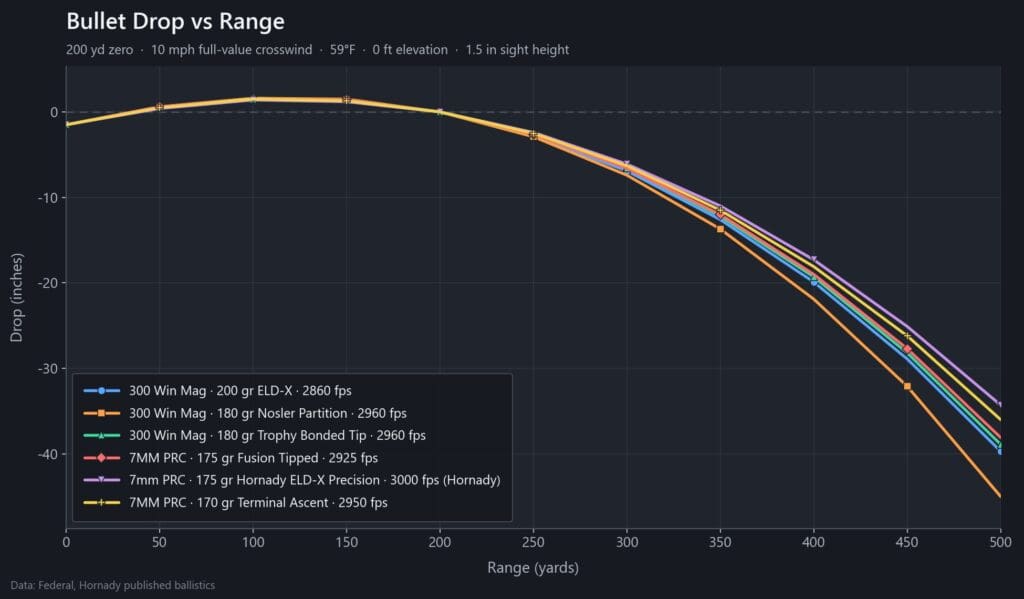
The gap of drop continues to grow as the range of the shot gets further and further. The 7mm PRC really carries its speed well past 600 yards, leading to less drop.
That is why prairie hunters and high-country shooters go with the 7mm PRC when the shot gets long.
Energy That Actually Arrives
Muzzle energy is definitely a starting point, not the whole story. That 175-grain 7mm PRC load starts near 3,500 ft-lbs while the 180-grain .300 Win Mag load sits in the same neighborhood when they leave the barrel.
After 100 yards, the 7mm PRC is already outperforming the 180-grain .300 Win Mag load in retained energy, and the difference grows with distance.
If you want a simple look at muzzle energy and what it means, check out our article What Is Firearm Muzzle Energy? [Why It Actually Matters].
A common rule of thumb for hunters when it comes to energy retention is that you want 1,500 ft-lbs to take down large animals like elk and about 1,000 ft-lbs to take down deer.
Both of these cartridges definitely have this capability and stay above those marks at 400 yards with quality bullets. The 7mm PRC keeps 2,000 ft-lbs of energy out to around 550 yards. That’s about 100 yards farther than a mid-weight .300 Win Mag hunting load.
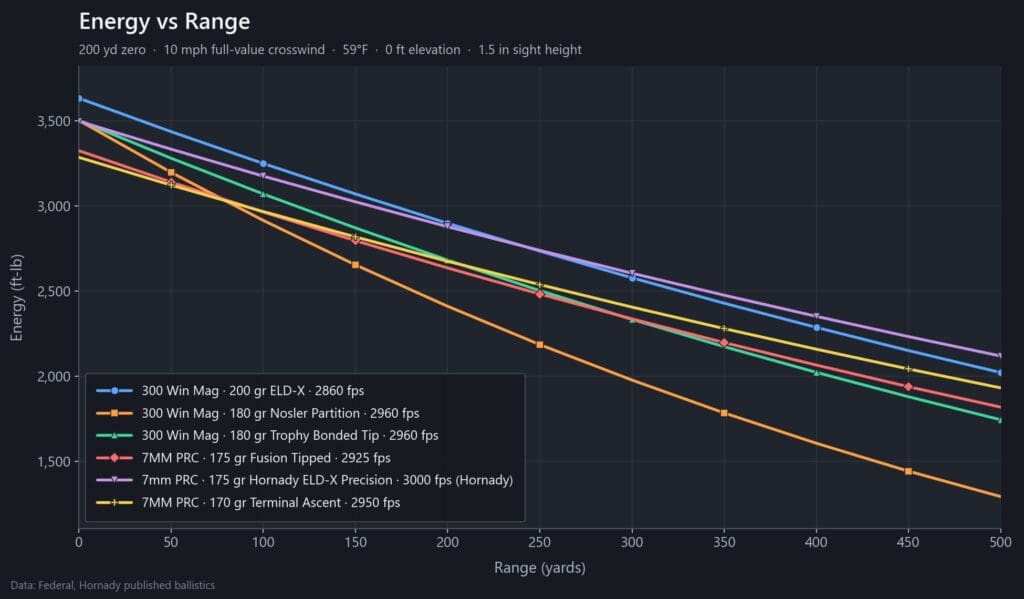
The further the shot, the more the 7mm PRC pulls away from the .300 Win Mag in terms of retained energy. So if you want more knockdown power at those longer distances, the 7mm PRC gets the job done with less drop.
Barrel length, temperature, and the exact bullet type will alter these numbers, but the pattern of differences will stay roughly the same. The 7mm PRC is simply designed to hold speed and perform better at longer distances.
The .300 Win Mag starts out stoutly, but fades a little faster with its historically fatter bullet shapes that slow it down.
If you want to hear the full comparison walked through, John McAdams covers both cartridges in detail here.
Wind Drift: The Quiet Deal Breaker
Long-range misses are more often the result of wind than of bullet drop.
A 10 mph crosswind on a 400-yard shot will blow a .300 Win Mag bullet about 10 to 12 inches off course. That same crosswind on a 7mm PRC will only blow that bullet about 7 inches.
That might be the difference between making a kill shot and simply wounding an animal. The vitals on a mule deer are only about 10 inches wide.
That extra drift could be the difference between a high shoulder hit and a gut shot that you simply don’t want to deal with.
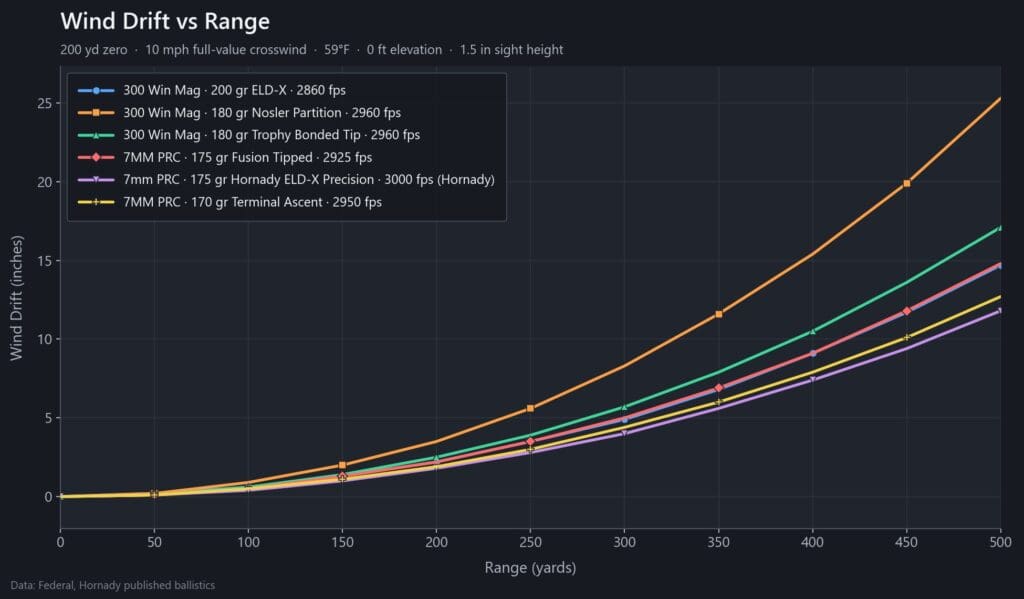
This is the reason why the 7mm PRC wins the real long-range argument, hands down. This is not a small edge over the .300 Win Mag, but instead a real difference maker.
So if you hunt in windy areas like ridges or sage flats, that lack of bullet drift matters more than a few extra ft-lbs of energy at the muzzle.
Recoil: Why the 7mm PRC Is Easier to Shoot
Neither of these is a soft shooter. The 7mm PRC usually produces about 26 to 29 ft-lbs of recoil while the .300 Win Mag produces around 30 to 37 ft-lbs of recoil.
This being tested in a standard 8.5-pound rifle, the .300 Win Mag creates around 15 to 20 percent more recoil, depending on the bullet weight and amount of powder.
You will still feel the recoil even when bench rested and probably feel it even more in a lighter mountain rifle without a muzzle brake with either of these cartridges.
Recoil is not just about comfort, especially on long-range shots in the field. It could mean the difference between spotting your own hits or misses and staying on target for a follow up shot.
It can also mean the difference between making a good first shot or not if you get used to flinching to prepare for the recoil on trigger pull.
A milder recoil can help you feel more comfortable with every shot and comfort is what you want for making those long-range shots on a game animal. For that, most lean towards the milder recoil of the 7mm PRC.
A muzzle brake or a suppressor can really change the picture for both of these cartridges. A braked .300 Win Mag can feel more manageable, but will still feel pretty sharp in recoil.
A braked 7mm PRC can feel a lot smoother and really feel tame when compared to a non-braked 7mm PRC.
Hunting Performance in the Field
Both cartridges kill big game cleanly provided the bullet hits the right spot. So which one gets you into position to put it there? Here is the breakdown by animal.
Mule Deer & Whitetail
Either of these cartridges is more than what you need on a deer that is inside of 400 yards.
A well-placed shot with either the 7mm PRC or the .300 Win Mag will drop a mule deer or whitetail cleanly with little issues. Plain and simple.
The 7mm PRC makes its money on mule deer in open country at long ranges. There is less wind drift, less drop for a flatter shot, and retains a ton of energy for knockdown power.

If mule deer are your main focus, our ranked list of The Best Cartridges for Mule Deer Hunting [Ranked] will help you make the best overall choice of cartridge, but you can’t go wrong with the 7mm PRC.
The .300 Win Mag still has its loyal followers for deer. A 180-grain bonded or partition bullet will hit with a wide .30 caliber bullet that packs energy and knockdown power.
If you would rather skip a lead core, the Federal Premium Euro Copper 165 Grain is a monolithic load that stays easy to find.
Elk
Elk is the true test for these two cartridges. A mature bull elk is heavy, tough, and usually makes you take tough shots.
You will want a bullet that holds together and a cartridge that still has the authority to make the kill shot at 350 to 500 yards.
The .300 Win Mag has a half-century track record of putting big elk on the ground. The heavy 180- to 200-grain bullets with bonded cores became a combination that hunters came to trust.
Those bonded loads rotate through fast, so check the current .300 Win Mag lineup instead of counting on one specific box.
The .300 WIn Mag has worked in both wooded areas and on the open range for decades. It’s hard to beat that kind of track record.
The 7mm PRC is newer, but has quickly made a name for itself in the field. A 175-grain ELD-X or a 160-grain copper bullet at 3,000 fps carries a lot more energy at a longer distance to still take down an elk thanks to its bullet design.
It tends to be easier to shoot, which creates better shot placement, which will beat caliber bragging rights any day of the week.
If your elk shots are usually inside of 300 yards and in timber, the .300 Win Mag’s extra size and power at closer ranges is an advantage.
If your elk shots will be in more open areas or across windy canyons in the mountains, the 7mm PRC will help fight wind and carry more energy with less drop.
Moose, Black Bear & Mixed Bag Hunts
For moose and black bear, the bullet is more important than the cartridge. With the right bullet type, these cartridges will drive through tough bodies and thick bones of these large animals.
The Black Hills Gold 165 Grain Hornady CX holds over 95 percent of its weight, which is the kind of construction that matters more than caliber on a big-bodied animal.
The .300 Win Mag will give you a heavier bullet option off the shelf that is able to take down these big animals, but also gives you lighter options for deer without needing a different rifle. That makes the .300 Win Mag a very versatile cartridge.
The 7mm PRC covers the same animals with a 160- to 180-grain hunting bullet, and it reaches farther out than the Win Mag to do it. That makes it versatile and good for longer range, giving it a slight advantage.
For mixed-bag hunters who hunt for a wide variety of animals in different terrain, the 7mm PRC tends to be favorable for versatility, long-range ability, lighter rifles, and less recoil with great performance.
Ballistics Lab put both cartridges through steel, wood, and water jugs to see which one hits harder up close.
Which Cartridge Should You Buy?
Buy the 7mm PRC if your hunts include wind, open country and shots past 300-400 yards. You want this high quality hunting bullet that has a flatter trajectory, milder recoil, and holds big energy at long ranges while living in a middleweight hunting rifle.
Buy the .300 Win Mag if you want a proven elk and moose cartridge with a wide variety and availability of ammo. It has good knockdown power at slightly shorter ranges but will still perform well outside of 300 yards with some practice.
If you don’t plan on taking shots out past 300 yards, neither of these cartridges is what you are looking for. If that’s the case, check out the .308, .30-06, or a 6.5 PRC.
If you already own a .308 and wonder how the .300 Win Mag stacks up against it, check out our guide .308 vs .300 Win Mag: Ballistics, Range & Real-World Use which covers that older family fight.
Pick the cartridge that is going to match your hunting environment, your game animal of choice, and the recoil you want to handle. Test, practice, stock up on ammo, and get out in the field to fill that tag of choice.
If you land on the .300 Win Mag, buying in bulk is the cheapest way to keep enough on hand to practice.
7mm PRC vs .300 Win Mag FAQs
Which Cartridge Is Better for Long-Range Hunting?
The 7mm PRC is usually better when shots stretch past 400 yards, especially in wind. Its high-BC bullets retain velocity, drift less, and shoot flatter than many .300 Win Mag hunting loads, while producing less recoil for steadier field shooting.
Is the .300 Win Mag Better for Elk or Moose?
The .300 Win Mag remains excellent for elk, moose, and black bear, particularly inside 300 yards or in timber. It offers heavier bullet choices, strong close-range impact, decades of field proof, and far better ammunition availability in most hunting stores.
How Much Recoil Does the 7mm PRC Have Compared to the .300 Win Mag?
In an 8.5-pound rifle, the 7mm PRC typically produces about 26 to 29 foot-pounds of recoil, while the .300 Win Mag often runs around 30 to 37. That difference can help reduce flinching and improve follow-up shots.
Which Has Better Ammo Availability?
The .300 Win Mag is much easier to find. Nearly every major ammunition maker loads it, and stores often carry several hunting and practice options. The 7mm PRC is growing quickly, but selection is still thinner, especially in smaller towns.
Should I Choose 7mm PRC or .300 Win Mag for Deer Hunting?
Both are more than powerful enough for whitetail or mule deer inside 300 yards. The 7mm PRC makes more sense for open-country mule deer and windy, extended shots, while the .300 Win Mag is strong for closer terrain and hunters who value common ammo.