Prefer audio over written content? Listen to the article here:
If you spend any amount of time hunting small game or varmints, you have probably heard about the argument between the .22 WMR and the .17 HMR.
One side of the argument thinks that the .17 HMR is an absolute laser of a round while the other side believes that the .22 WMR has the power and hits harder.
These two rimfire cartridges are really close when you look at them on paper. So which is better?
The .17 HMR is the better long-range small varmint cartridge thanks to its speed and flatter trajectory.
The .22 WMR is the better choice when you need extra energy for bigger-bodied game and varmints. You pick the one that fits the animal and the distance you intend to be shooting.
TL;DR: Which Cartridge is Best For You
The classic answer for which cartridge is better is always “it depends” but depending on your specific use case there’s usually one cartridge that’s better suited than another. Here is our take:
Buy the .17 HMR if your main target is smaller game and varmints out past 100 yards. This will give you a flat trajectory with less holdover that puts a violent strike on a small animal.
Buy the .22 WMR if your target list includes bigger-bodied varmints like raccoons, foxes, and coyotes inside of 125 yards. You will want a heavier, wider round with better knockdown power.
.22 WMR vs .17 HMR: Top Ammo Picks
The right rimfire load for every job, from prairie dogs past 100 yards to foxes and coyotes at moderate range.
-
Best for Prairie Dogs Past 100 Yards
-
Best for Squirrels & Rabbits
-
Best for Groundhogs & Raccoons
-
Best for Foxes & Coyotes at Moderate Range
-
Best for All-Day Pest Shooting
-
Best for a Truck or Barn Gun
How the .22 WMR & .17 HMR Compare on Paper
Anecdotes only get you so far. Here are the hard numbers.
| Spec | .22 WMR | .17 HMR |
|---|---|---|
| Year Introduced | 1959 | 2002 |
| Bullet Diameter | .224 in | .172 in |
| Typical Bullet Weight | 30-50 grain | 15.5-20 grain |
| Common Muzzle Velocity | 1,530-2,200 fps | 2,375-2,650 fps |
| Typical Muzzle Energy | 260-325 ft-lbs | 220-265 ft-lbs |
| Practical Field Range | 100-150 yards | 150-200 yards |
| Best Known For | Energy & Penetration | Speed & Flat Trajectory |
Velocity & Trajectory: Why the .17 HMR Feels Like a Laser
A 17-grain .17 HMR V-Max leaves the muzzle around 2,550 feet per second while a 30-grain .22 WMR V-Max is closer to 2,200 feet per second.
A 40-grain .22 WMR JHP is usually around 1,900 feet per second.
The speed gap between the .17 HMR and the .22 WMR shows up on target as less drop. Zeroed at 100 yards, the typical 17-grain .17 HMR sees only about 2.5 to 3 inches of drop at 150 yards.
A 40-grain .22 WMR that is also zeroed for 100 yards has a drop of about 6 inches at 150 yards.
At 200 yards, the gap between these two rounds grows even more. The .17 HMR drops 7 to 9 inches while a 40-grain .22 WMR drops 16 to 19 inches.
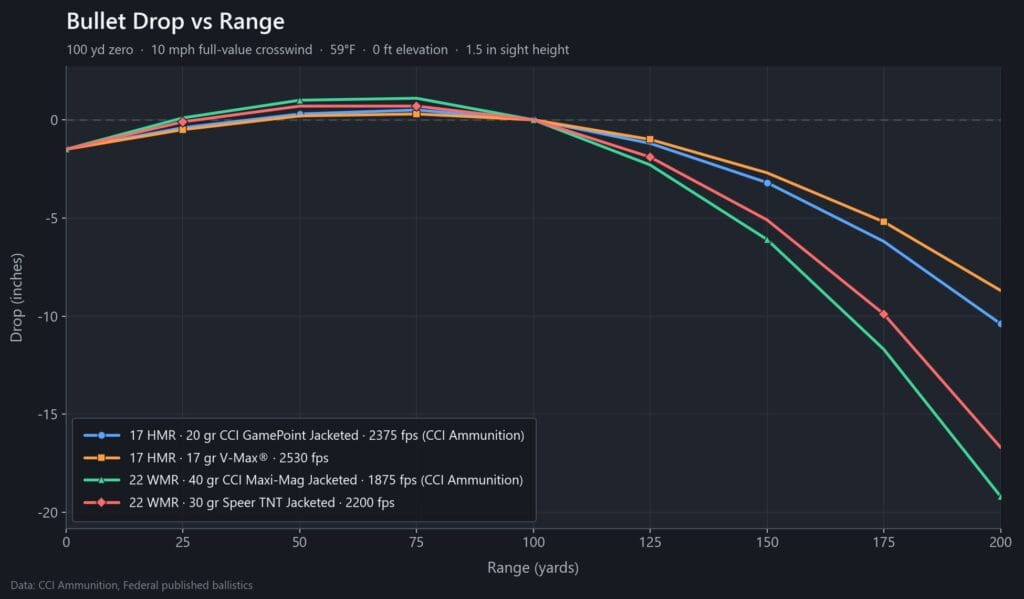
That is a huge gap! On a small game animal like a squirrel, that extra arc is the difference between a holdover guess and a confident shot that will hit the mark.
This is the exact reason that hunters who shoot really small game love the .17 HMR.
The target is tiny and the range can vary greatly. The last thing they want to worry about is figuring out the bullet drop and the right holdover to make a shot.
Don’t forget about barrel length too. It still matters for smaller rimfire cartridges. Our article on How Barrel Length Affects Bullet Velocity and Performance will help you understand why a shorter carbine barrel can waste speed.
Energy & Killing Power: Why the .22 WMR Hits Harder
Speed is not always the most important thing. Energy, or knockdown power, is also a key component, especially if you are planning to hunt larger-bodied small game and varmints.
With a 40- or 50-grain load, the .22 WMR carries a heavier bullet, so even though it’s slower, it will hit harder.
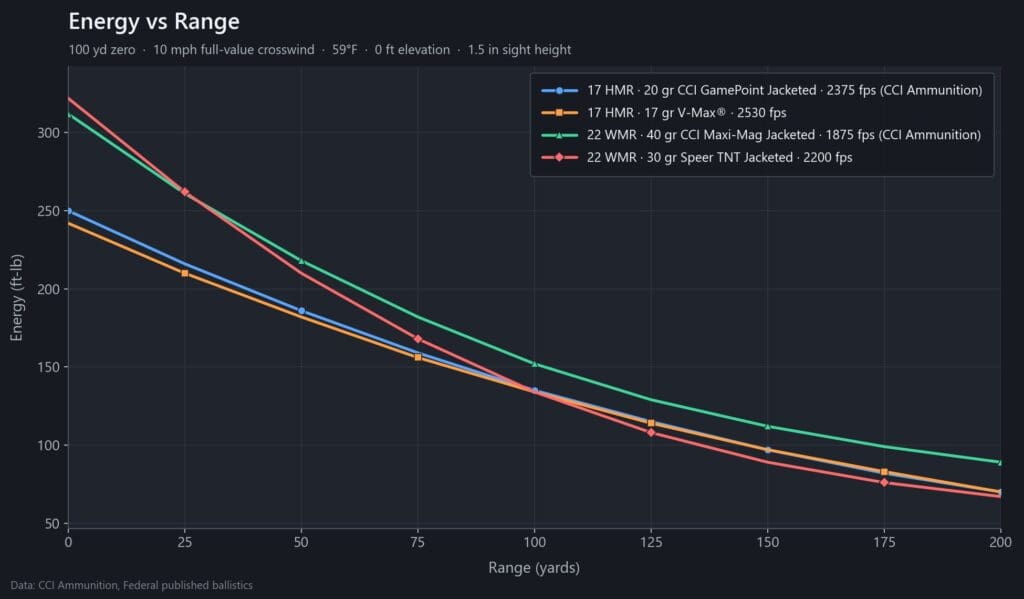
A 17-grain .17 HMR fired at 2,550 fps starts with about 245 foot-pounds while a 40-grain .22 WMR fired at 1,900 fps has 324 foot-pounds. These are measurements at the muzzle when first fired.
The bullets start flying downrange and both rapidly lose energy, but the .22 WMR maintains a slight advantage. At 100 yards, the .17 HMR is still carrying about 137 ft-lbs of energy while the .22 WMR is still carrying about 155 ft-lbs of energy.
At 150 yards, the .22 WMR still holds a narrower lead, roughly 113 ft-lbs to 99.
If those numbers don’t really make sense, check out our article What Is Firearm Muzzle Energy? [Why It Actually Matters] to see why energy matters for bullet expansion and how it affects knockdown power.
To put it simply, the .22 WMR has about the same amount of knockdown power at 100 yards as the .17 HMR has at about 75 yards!
That is a very general comparison between the two cartridges but it still shows how these two rimfire cartridges differ when used on a bigger varmint.
The size of the bullet itself also plays a factor. A .224-inch bullet is simply wider than a .172-inch bullet, so when it hits its target, it is going to create a larger wound channel and have better ability to cut through fur, bone, and muscle.
Plus, the heavier bullets of the .22 WMR will retain more energy for longer even though it is traveling slower than the typical .17 HMR that has a lighter bullet.
If you want to know more about how bullet weight affects ballistics, check out our article How Does Bullet Weight Actually Affect Performance?
If you want to see the mass-versus-velocity argument play out in ballistic gel, Vortex Nation shot both cartridges at 50 and 100 yards in this video.
Matching the Rimfire to the Animal
Ballistics charts answer only half of this question. The animal in your sights answers the other half.
Prairie Dogs, Ground Squirrels, & Similar Pests
The .17 HMR was built for this type of hunting. The speed and flat trajectory of the .17 HMR is perfect for these small bodied animals without needing to be super close to them.
The result of this round is a quick strike that stops them dead in their tracks without the need for much holdover.
This is where knockdown energy is not the most important thing. You don’t need much power to kill a 2- to 3-pound animal.
The .22 WMR will still kill them, but with a lot of leftover energy, the need for more holdover at longer ranges, and possibly more meat loss on an animal you plan to eat.
Go with the .17 HMR if you plan to hunt these types of animals.
Squirrels & Rabbits
Both cartridges work on these animals inside of 75 to 100 yards. Head shots with either of these are clean kills with no meat damage.
Body shots in general on these animals ruin a lot of usable meat, so make sure you take a quality shot to preserve as much meat as possible.
It is recommended to use a 20-grain .17 HMR GamePoint or 40-grain .22 WMR jacketed soft points for hunting.
These softer points expand, but don’t shred the meat of the animals you are shooting at, making a clean kill and keeping more meat.
Groundhogs, Rockchucks, & Raccoons
This is where the .22 WMR starts to take over. These animals have more bone and more body mass. A .17 HMR bullet fragments quickly and can fail on anything that isn’t a perfect shot.
The 40-grain .22 WMR hollow point is better at penetrating and hitting the vitals.
Plenty of hunters have taken these larger-bodied animals with .17 HMR, but it leaves less room for error. The added knockdown power of the .22 WMR makes it the more popular choice as the animals get larger.
So if your pest list includes these larger-bodied varmints, the .22 WMR is the wiser choice.
For a look at both rounds on actual groundhogs, this video from Blocketh Outdoors takes a pair of CZ 457s into the field.
Foxes & Coyotes
Between these two, the .22 WMR is the only real choice for fox- and coyote-sized varmints. The .17 HMR just doesn’t have enough power to take down these animals unless the shot is at close range and perfect placement.
It still isn’t a .223, but a 40- or 50-grain expanding load in the .22 WMR has taken a lot of foxes and coyotes at a pretty modest range. If you use a chest or head shot, you will be just fine.
For a wider range of small game cartridge options, check out our list of The 10 Best Cartridges for Small Game Hunting. The .22 WMR and .17 HMR both find their place on this list as rimfire cartridges.
Ammo Cost, Availability, & Bulk Buying
Neither of these rimfire cartridges is as cheap as the .22 LR, but they still won’t break the bank.
The .17 HMR is usually between $0.30 and $0.50 per round while the .22 WMR is in the same range and slightly more expensive for premium hunting rounds.
You may not be able to find them in great abundance at your local hardware store, but most bigger gun and ammo shops will have them as well as online.
The bigger issue isn’t the price, but the quantity. Varmint shooting burns a lot of ammo and the last thing you want to do is run out. When you find the cartridge and ammo option you want, be sure to buy in bulk.
It will ensure that you have plenty of ammo on hand and it will help drive the overall price down.
If you are interested in comparing other rimfire cartridges, check out our guide .22 LR vs .17 HMR: Which Rimfire Cartridge Is Better? that covers the matchup between those two cartridges.
Pick the Animal First, Then the Rimfire
The .22 WMR and .17 HMR are very close cousins to each other that do different jobs in their own way. One is the heavy hitter while the other is the speed demon.
Neither one is a do-it-all, go-to cartridge, but each one is capable of doing its job extremely well.
If you spend more time chasing smaller varmints at crazy distances due to their skittishness, the .17 HMR is the better rimfire cartridge.
If you spend more time on mixed-size farm pests that have slightly larger bodies that need more punch to take down, the .22 WMR is the better choice.
Either way, pick the cartridge that matches the animal and distance situation that best fits your needs.
Once you make your choice, stock up on your favorite ammo choice to ensure that you have all the ammo on hand you could possibly need.
.22 WMR Vs .17 HMR FAQs
Which Is Better for Long-Range Varmint Hunting, .22 WMR or .17 HMR?
The .17 HMR is generally better for small varmints at longer rimfire distances because it shoots faster and flatter. With less drop past 100 yards, it makes hits easier on tiny targets like prairie dogs and ground squirrels.
Does .22 WMR Hit Harder Than .17 HMR?
Yes. The .22 WMR fires heavier, wider bullets and usually carries more energy than the .17 HMR, especially at 100 to 150 yards. That extra punch helps with penetration on larger-bodied pests such as raccoons, groundhogs, and foxes.
Can .17 HMR Be Used for Squirrels & Rabbits?
It can be, but shot placement matters. The .17 HMR works well on squirrels and rabbits inside practical ranges, especially with controlled-expansion loads. Head shots help avoid excessive meat damage, while body shots can ruin usable meat quickly.
Is .22 WMR Better Than .17 HMR for Coyotes?
Between the two, .22 WMR is the more suitable coyote choice, but only at modest ranges with careful shot placement. Use heavier expanding bullets and aim for vital areas. The .17 HMR leaves very little margin for error.
Are .22 WMR & .17 HMR Interchangeable?
.22 WMR and .17 HMR cartridges are not interchangeable, even though they are similar in overall size. The .17 HMR uses a necked-down .22 WMR case, but the bore and chamber dimensions are different.