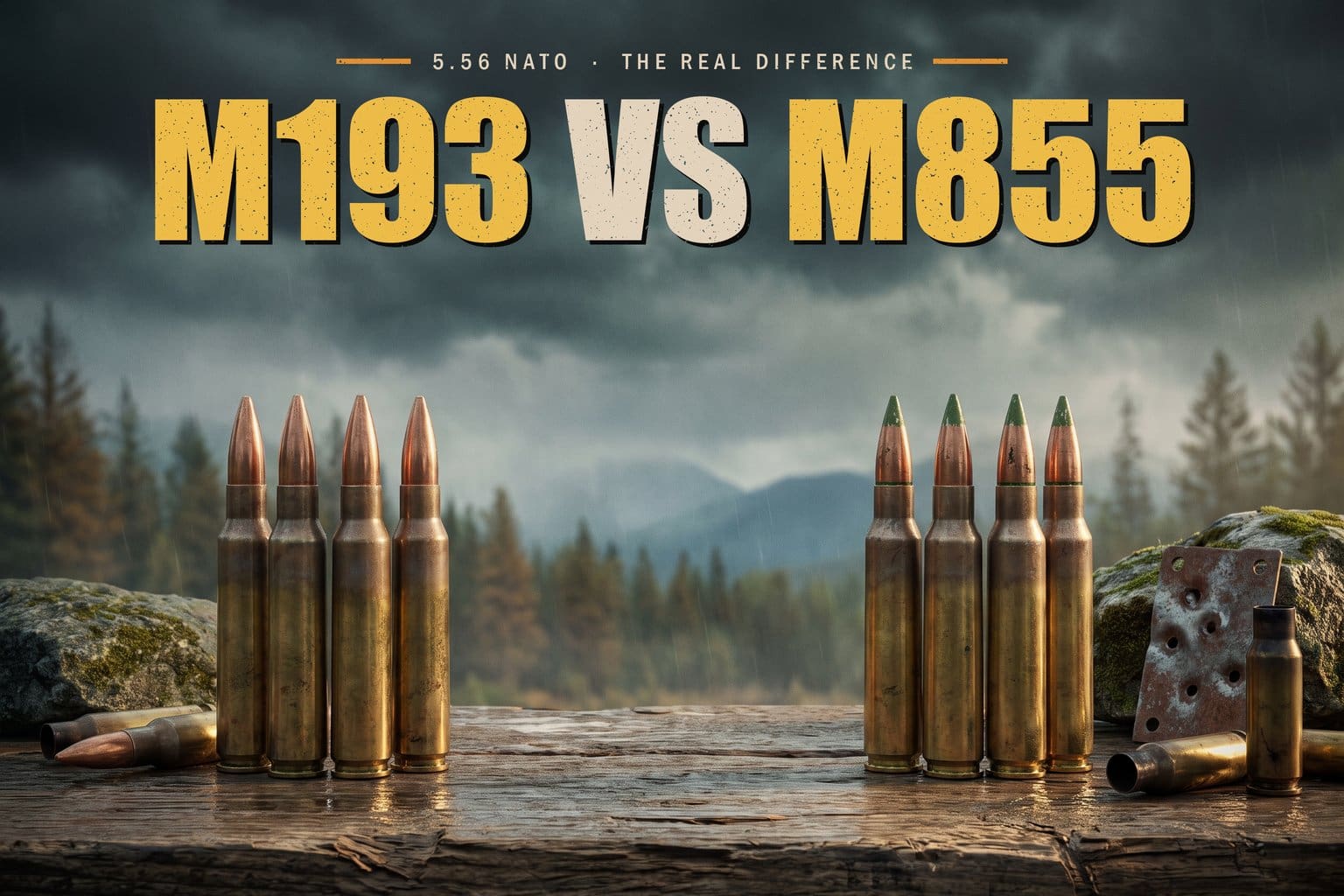
If you own an AR-15, you have seen these two labels on boxes of ammo probably a thousand times. One box says M193 and the other says M855 or green tip.
Don’t let that fool you. They are both 5.56 NATO cartridges, both feed in the same magazines, and both can be bought in bulk for roughly the same price.
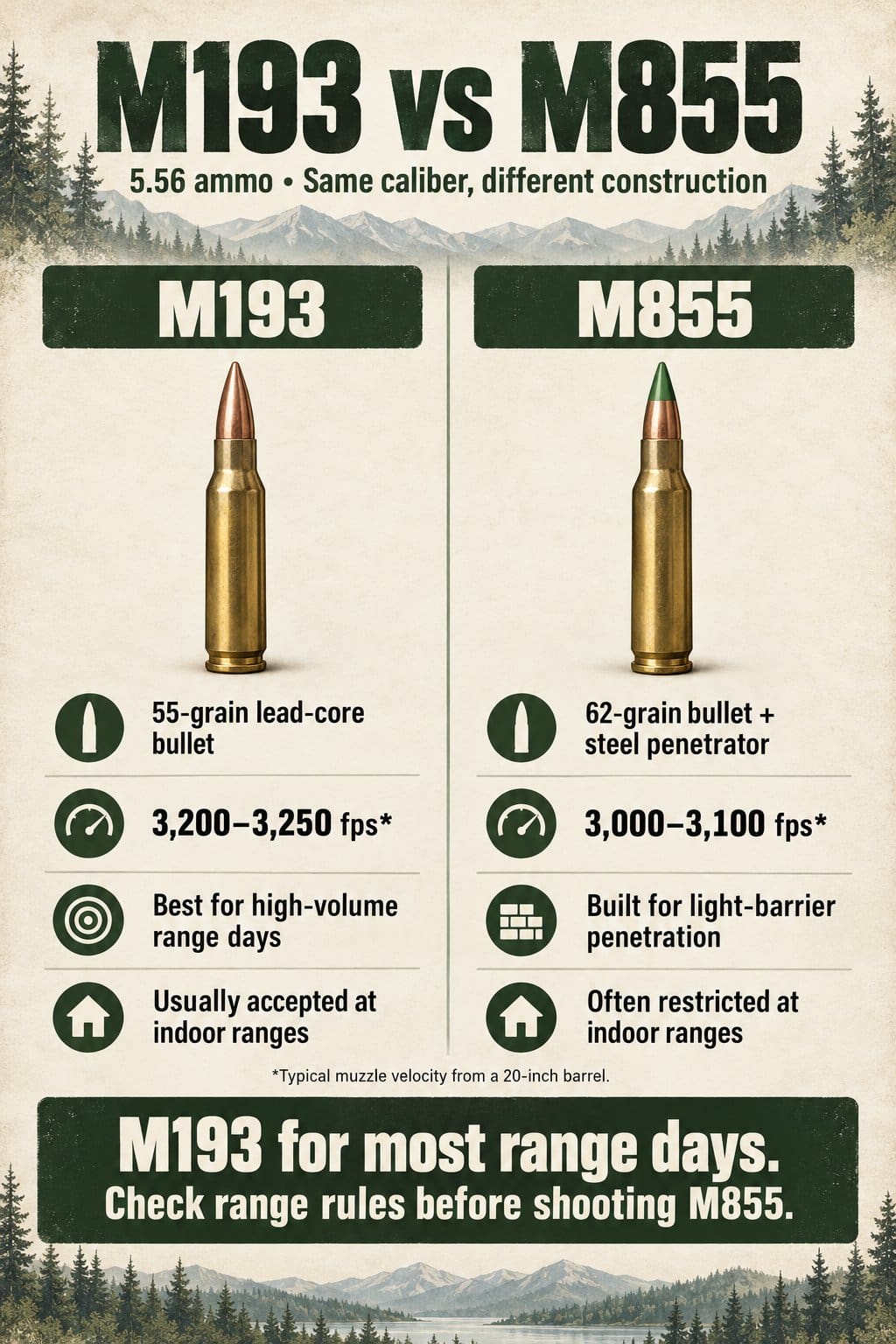
The M193 is a 55-grain lead-core 5.56 that flies faster and fragments better on soft targets. The M855 is a 62-grain green tip with a steel penetrator that punches barriers better and holds energy farther away.
Pick the M193 for range and close work. Pick the M855 when you need extra penetration.
What These Two Rounds Actually Are
The M193 is the original 5.56 round developed for the U.S. in the mid-1960s. It fires a 55-grain FMJ boat-tail bullet with a simple lead core. Nothing overly lavish about this basic round, but it gets the job done.
The M855 arrived later as the U.S. version of the NATO SS109 round. It was adopted in the early 1980s and uses a 62-grain FMJ boat-tail bullet with a lead base and steel penetrator in the nose.
The tip is painted green so that troops could tell the difference between the M193 and M855.
Both are military pattern 5.56 NATO cartridges, but they are not the same as the .223 Remington, even though they look extremely similar. The chamber pressures, throat length, and specs are different from the .223 Remington.
If the distinction between the 5.56 NATO and the .223 Remington interests you, check out our article on 5.56 NATO Vs .223 Remington: What’s the Actual Difference? It will cover pressure, chambers, and why mixing them is not always a good idea.
You might also see the XM193 and the XM855 label on store shelves. The X simply means that it is a commercial load built to the military pattern.
This also means that it is not a government-accepted lot of ammunition. Performance is still close, but the quality still depends on the manufacturer.
M193 & M855 Specs Side by Side
The ballistics are as similar as you might expect, but these numbers matter.
| Spec | M193 | M855 |
|---|---|---|
| Year / Origin | 1960s – U.S. 5.56 Ball | Early 1980s, U.S. Version of SS109 |
| Bullet Weight | 55 Grain | 62 Grain |
| Core | Lead, Copper Jacket | Lead Core, Steel Penetrator |
| Tip Color | Plain Copper | Green Paint |
| Muzzle Velocity (20” Barrel) | 3,200-3,250 FPS | 3,000-3,100 FPS |
| Muzzle Energy | 1,260-1,290 ft-lbs | 1,250-1,330 ft-lbs |
| Best Twist | 1:12 to 1:7 | 1:9 to 1:7 |
| Standout Trait | Speed & Fragmentation | Barrier Penetration |
Bullet Construction: The Whole Story
The M193 is a classic FMJ construction where lead fills the copper jacket. When that FMJ round hits soft tissue at a high speed, the jacket tears and the core breaks apart.
This fragmentation pattern is why Vietnam-era reports talk about surprisingly large wounds coming from such a small bullet. The wound effect was due to velocity and light jacketing, not an intended outcome, but it’s why the little bullet became famous.
The M855 was built for an entirely different purpose. The front of the core is a hardened steel penetrator that is backed by lead. The steel tip was created to punch through light steel plates and helmets at longer range.
This same hard-nosed round also makes the bullet break apart less on soft targets. The tradeoff was by design. FN developed the SS109 in Belgium so the 5.56 NATO cartridge could penetrate a steel helmet and light steel armor plate at long range, against more heavily equipped opponents than the M193 was designed for.
Bottom line, the difference in bullet construction has its tradeoffs. The M855 is tougher against barriers such as sheet metal, auto glass, and light steel plate. The M193 does its damage against unprotected soft targets at typical AR velocities.
Neither cartridge is a modern expanding defensive hollow point, but that is not what either of them was designed for. They were designed to be ball ammo constructed to perform two different jobs.
If you want the physics behind why the different construction of these bullets matter more than just energy, check out our guide on Internal External & Terminal Ballistics [What Truly Matters].
Ballistics: Velocity, Energy & Barrel Length
Ballistic data on these two rounds are based on a 20-inch barrel, but most civilian AR-15s have 16-inch barrels while plenty of pistol and SBR setups come in around 10.5 to 14.5 inches.
As the length of the barrel shortens, it will change how each of these cartridges perform, so keep that in mind.
From a 16-inch carbine setup, most M193 loads stay between 2,900 and 3,100 fps. The M855 usually comes in closer to 2,800 to 2,950 fps.
If we drop to even smaller barrels, such as the 10.5-inch barrel, it will continue to drop several hundred feet per second off of the common loads.
Velocity matters, especially for the M193 which relies on velocity for fragmentation. A common rule of thumb for the M193 is that fragmentation is more reliable above 2,500 to 2,700 fps.

In shorter barrels at roughly 150 yards, you might already be below that window to get it to fragment well.
The M855 is less reliant on velocity to do its job. More important to its function is the steel tip and extra mass, which keeps it punching through its intended target.
Extra barrel length will still help it maintain extra energy on those longer shots, but the performance cliff is not as sharp thanks to the added weight.
A short barrel costs both rounds velocity. The M193 feels the loss more, since fragmentation is basically what it does; the M855 relies a bit more on weight and penetrator to do its job.
If you want a deeper dive into how barrel length can affect the ballistics of bullets and their performance, check out our article on How Barrel Length Affects Bullet Velocity and Performance.
Typical Numbers From a 20-Inch Barrel
This chart is what most bullet manufacturers publish for the M193 and the M855. These numbers will be slightly smaller in a typical 16-inch AR-15 setup.
| Distance | M193 – 55 Grain | M855 – 62 Grain |
|---|---|---|
| Muzzle Velocity | 3,250 FPS | 3,050 FPS |
| Muzzle Energy | 1,290 ft-lbs | 1,280 ft-lbs |
| 100-Yard Velocity | About 2,850 FPS | About 2,750 FPS |
| 300-Yard Drop (100-Yard Zero) | About 11 inches | About 12 inches |
As you can see from the side-by-side ballistic comparison, these two cartridges have roughly the same ballistics. This is actually a great benefit.
With these two rounds, you could realistically switch between the two in the same AR setup with very little if any setup changes needed if you have the right twist rate.
Mr.Guns ’n Gear chronographs both rounds out of 16-inch and 11.5-inch barrels and then shoots them into gel, which makes the barrel-length point easy to see.
Soft Targets Vs. Barriers
The M193 tends to yaw and fragment in soft tissue at fast speeds. That creates a wider wound channel than the small hole that it would suggest by looking at it.
Past the fragmentation window, as it slows down, it acts more like a small caliber bullet that just punches small holes in its target.
The M855 was built to stay together and punch holes in harder targets. Some reports from the 2000s show that it punches through a soft target with modest performance but not necessarily debilitating like the M193. This is why some troops called the M855 inconsistent against unarmored targets.
Change that target to a car door, a windshield, or light steel armor, and the M855 usually performs much better. The steel penetrator keeps a small, hard point on impact against that hard target.
An M193’s soft lead core tends to smear and waste energy when it hits a hard target, making it less effective.
Here is the wrinkle in this argument. Against some hard steel plates at very high velocity, the M193 can actually punch better than the M855.
The steel tip of the M855 can slow down on impact against harder steel, which allows the lead behind it to splash around the tip instead of driving through.
Now, this is more of a weird curiosity issue, not necessarily a reason to pick the M193 for penetrating barriers better than the M855.
For most civilian shooters the rule of use between these two cartridges stays simple. On a soft target at carbine distances, the M193 has the edge. If it is a light barrier or a longer range shot, the M855 has the edge.
Neither replaces a purpose-built defensive hollow point or bonded load, but they each serve their own purpose.
Banana Ballistics shot XM193 and M855 into mild steel plates from a 26-inch bolt gun, so your carbine will run slower, but the barrier gap still shows clearly.
Matching the Round to the Job
Like anything else in shooting, what you’re doing determines which bullet is best for the job.
Indoor Range Rules
Know the rules of your shooting range, especially indoor ranges. Most indoor ranges ban steel-core bullets. This is usually checked with a magnet. M855 obviously fails. M193 usually passes. Some imported ammo, though, uses steel jackets instead of copper; if you run a magnet over them, they’ll stick. So check your box before you head out.
Steel Targets
Plinking on steel targets at close range with either of these cartridges is a bad idea. Both are fast and powerful enough to pit or crack cheaper plates.
Aim for 100+ yards of separation from the target, use steel that’s rated AR500 or better, and read up on the manufacturer’s rules on green tip, as some target makers say not to shoot M855 at their plates at all.
High-Volume Range Days
The M193 is probably going to be favored here because they are a few cents cheaper per round than the M855 rounds, which if you are going to burn through 500 to 1,000 rounds in a day can really add up in savings.
If plain 55-grain FMJ is all you need for volume, the First Breach 55 Grain FMJ 1,000-round case is one of the lower cost-per-round options we carry.
The M855 would be popular if you are doing a lot of longer-range shooting on your range days. They will be more consistent at longer ranges.
Home Defense
Ball ammo in general is compromised indoors. An FMJ can over-penetrate walls and both of these cartridges fall into those types of rounds.
So neither the M193 nor the M855 would be a good option for a home defense AR setup if a more modern expanding type is available.
If FMJ rounds are your only current option, the M193 is the less bad of the two at typical home defense ranges because it will dump energy and fragment.
The M855 was built to punch through targets, so that would not be a good fit for home defense.
If you are looking for the best home defense rounds for your AR-15 platform, look at our article Top 5 Home Defense Cartridges in an AR-15 Platform. That will help you find a more suitable AR-15 cartridge for home defense.
Bulk Buying & Military Surplus
Both of these rounds are easy to find in bulk and if you plan to shoot a lot, which is easy to do in the AR-15 setup, you should be buying bulk for the best savings.
The M193 is the volume king, easily found in 500- and 1,000-round bulk cases all the time. They usually cycle extremely well, are cheap to train with and spend the day at the range, and work with most barrels.
If you want M193 by the case, the ATS 55 Grain M193 FMJ 540-round pack is built for exactly that kind of high-volume range day.
The M855 costs a little more, but is still considered a bulk item. It’s also available in 500- and 1,000-round cases for more substantial savings when purchasing in volume.

For green tip in bulk, the PMC 556K 62 Grain Green Tip 1,000-round case gives you M855-pattern performance without buying box by box.
If you want to build up your bulk ammo stash for your AR-15, start with our article Best Bulk 5.56 Ammo for AR-15 Owners [Range, Defense & Stockpiling]. It will help you get started on bulk buying for your AR-15.
Also check out military surplus rounds, as both of these were designed for military use. True M193 and M855 military ammo come in sealed ammo cans with lots of data and crimped primers.
Most civilians buy commercial XM ammo, but surplus ammo can be found.
They can be a bargain, but they can also be dirty, inconsistent, or poorly stored. Take a look at our article on When to Use Military Surplus Ammo: Tried-and-True or Trouble? to learn more about the ins and outs of military surplus ammo.
Buy M193 for Volume & M855 for Barriers
Buy M193 if you spend most of your time shooting at the range, in training classes, or using a general-purpose carbine setup.
It’s cheaper, accepted at most if not all ranges, and better on soft targets inside typical AR distances.
Buy the M855 if you want the extra bite on light barriers, a slightly heavier bullet for longer shots, or a load that matches a lot of NATO-issued ammo. Be sure that your shooting range allows them first.
Not sure yet? A 20-round box of Winchester 62 Grain M855 Green Tip is enough to check your range’s rules and confirm your zero before you commit to a case.
Buy both if you shoot a lot and want a well-rounded arsenal of ammo for different purposes.
Our 5.56 NATO bulk collection keeps both loads in one place, so you can compare what is on the shelf before you stock up.
That’s the honest answer for the difference between the M193 and M855. Same caliber, different construction, different use for different jobs. Choose what fits your needs. Most should stick with the M193, but the M855 can be fun too.
M193 Vs M855 5.56 Ammo FAQs
What Is the Main Difference Between M193 and M855 Ammo?
M193 uses a 55-grain lead-core bullet built around speed and reliable fragmentation at close to moderate distances. M855 uses a 62-grain bullet with a steel penetrator, giving it better performance through light barriers and somewhat better retained energy downrange.
Does the Military Use M193 or M855 Ammo?
M193 was the early U.S. 5.56 ball load used with Vietnam-era rifles, while M855 became the U.S. version of NATO’s SS109 cartridge in the 1980s. Commercial XM193 and XM855 loads copy those patterns but are not government-accepted lots. The Army and Marine Corps now issue a lead-free successor called the M855A1. The Army started replacing M855 in 2010, and the Marines followed in 2017.
Is M193 or M855 Better for Range Shooting?
For most range use, M193 is usually the easier choice because it costs slightly less, works well in common AR-15 barrels, and is accepted at more indoor ranges. M855 may be restricted because its steel penetrator attracts a magnet.
What Are the Disadvantages of M855 Ammo?
M855 is often banned at indoor ranges because its steel penetrator is magnetic and can damage backstops. It also costs slightly more than M193, may perform inconsistently on unarmored soft targets, and is a poor choice for home defense due to penetration.
Is M193 or M855 Better for Home Defense?
Neither load is ideal for home defense because full metal jacket 5.56 can over-penetrate walls. If those are the only choices, M193 is generally preferable at close range because it is more likely to fragment and dump energy than M855.