Prefer audio over written content? Listen to the article here:
If you have ever stood in front of an ammo shelf at your local sportsman shop staring at boxes labeled 5.56 NATO and .223 Remington wondering what the difference is, you are not alone.
These two cartridges look almost identical and are frequently tossed around interchangeably in conversations, but are they really the same thing? Yes and no.
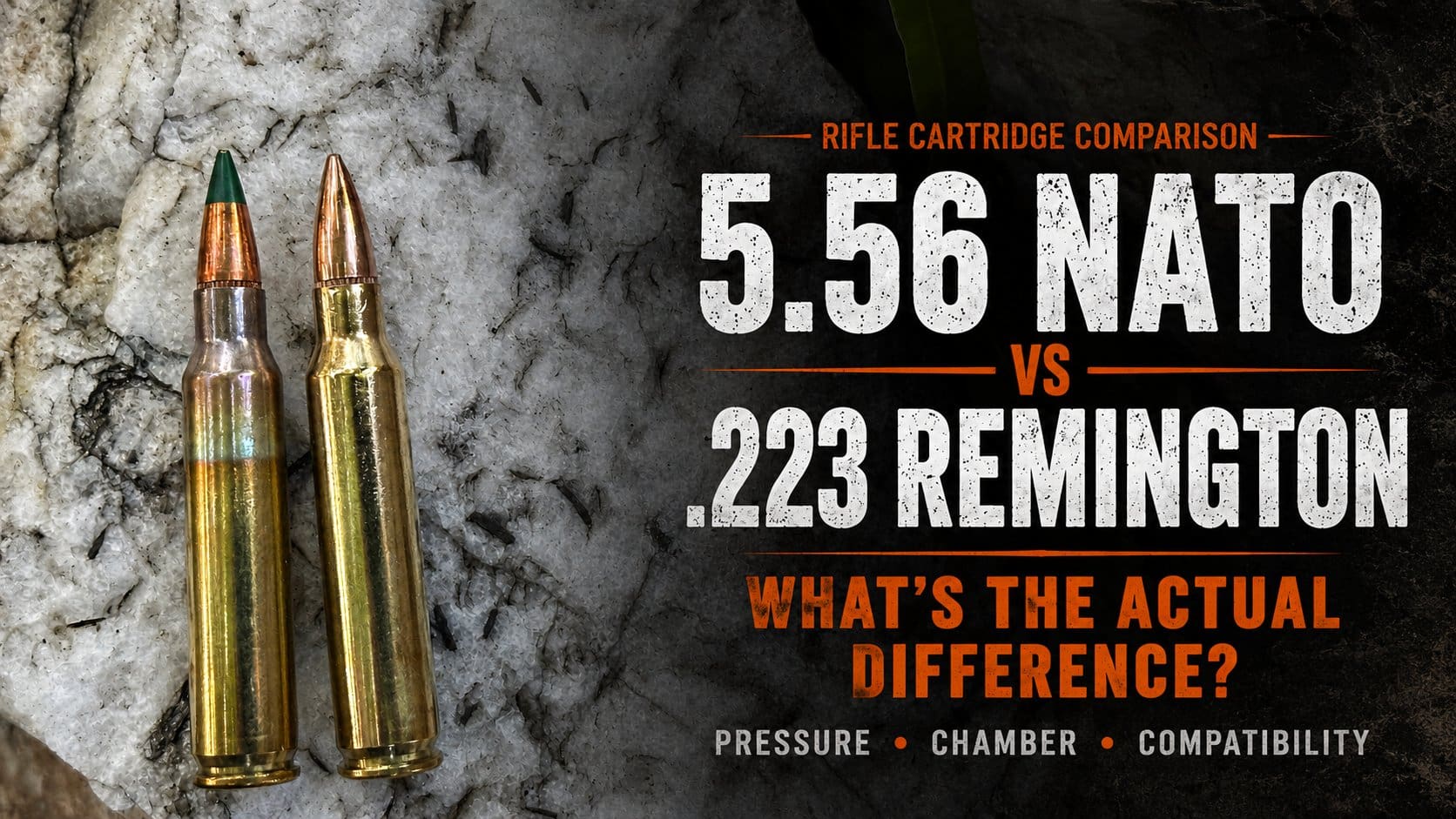
The short answer: 5.56 NATO and .223 Remington share the same basic dimensions and bullet diameters, but the 5.56 runs a higher pressure with a longer throat in its chamber.
You can safely fire a .223 in a rifle chambered for 5.56, but firing a 5.56 in a pure .223 chamber risks overpressure issues.
Now with that simple answer, let’s take a deeper dive into the differences between the 5.56 NATO and the .223 Remington so that you can pick the right ammo for your AR-15 setup.
A Quick History Lesson
The story of these two rounds starts in the 1950s and 60s when the military wanted a lighter, high- velocity round to replace the 7.62×51 NATO.
Remington developed the .223 in 1964 as a civilian varmint cartridge but was based on early military experiments. The 5.56x45mm NATO became the standardized military version a few years later.
Both of these cartridges fire the same .224 inch diameter bullets, but the military version got tweaks for reliability in combat conditions.
It is the difference between a civilian design and a military design. That is where the real differences begin.
The Biggest Difference: Pressure!
Here is the heart of the matter when it comes to these two cartridges: the .223 Remington follows SAAMI specs with about 55,000 psi chamber pressure while the 5.56 NATO runs hotter, often around 58,000-62,000 psi depending on the load and testing method.
That extra bit of pressure in the 5.56 NATO comes from slightly different case dimensions and loading.
The 5.56 cases often have thicker walls and allow room for a bit more powder to create the added pressure. This is what gives that military ammo more consistent performance under harsher conditions, but also puts more stress on the firearm.
In a simple thought, think of the 5.56 as a +P version of the .223. It delivers more power, but your firearm needs to be built for it.
Chamber Dimensions & the Throat
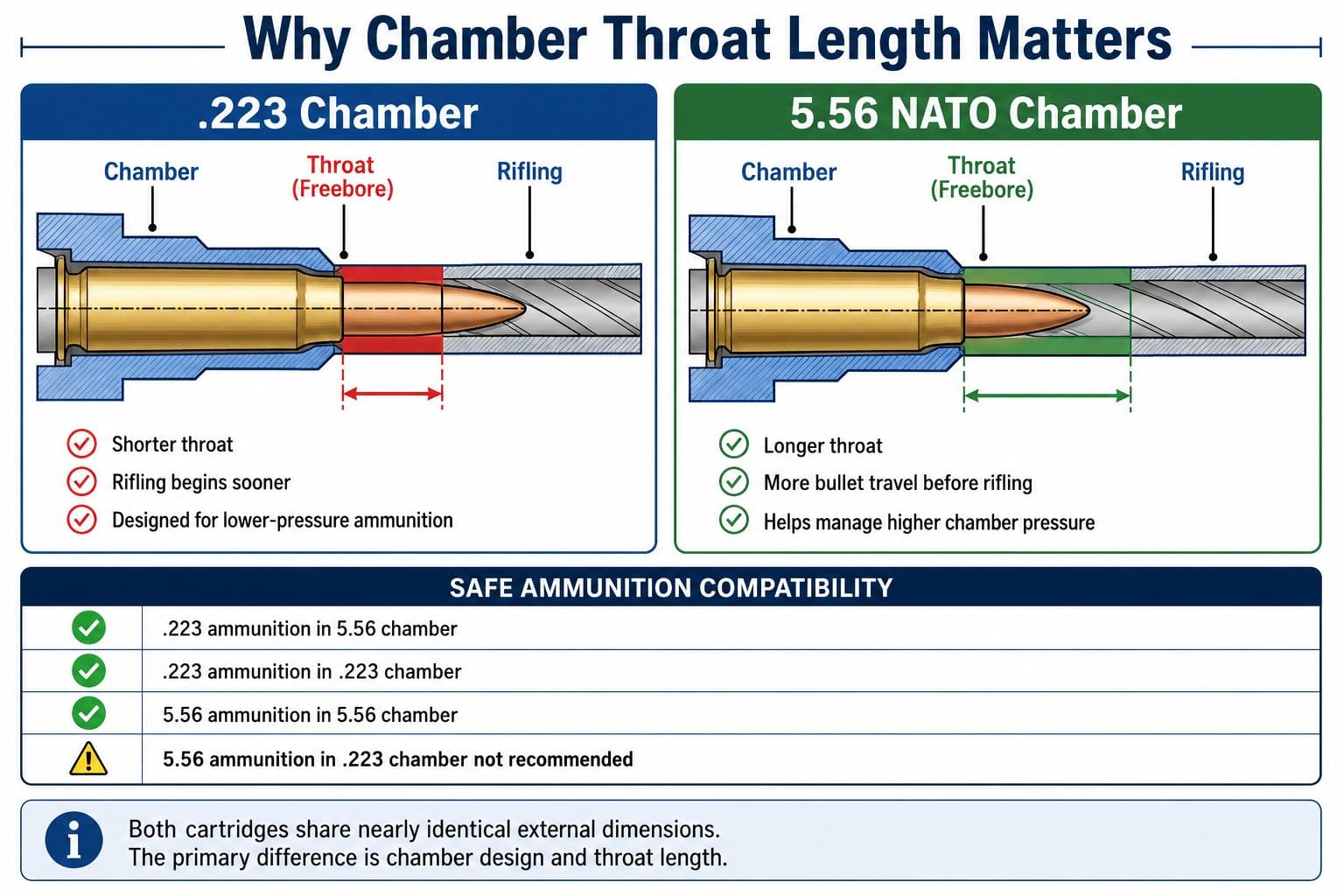
The throat is the unrifled section right after the chamber where the bullet sits before engaging with the rifling.
A 5.56 NATO chamber has a longer throat, roughly 0.125 inches longer than a .223 chamber.
This extra space lets the bullet move forward a bit before the rifling takes effect. This helps manage the higher pressures of the 5.56 safely.
A tighter .223 chamber gives potentially better accuracy with lighter loads, but leaves less margin when pressures spike.
This is the main reason why .223 Remington is safe to fire in a 5.56 chamber but not the other way around. The .223 Remington chamber simply doesn’t have the added room to safely handle the added pressure of the 5.56 NATO.
Safety Rule of Thumb for these two cartridges:
- .223 ammo in 5.56 chamber = Safe (though sometimes creates slightly less velocity).
- 5.56 ammo in .223 chamber = Not recommended as it can cause excessive pressures, flattened primers, or even severe damage to the firearm that can cause injury.
Many modern rifles are using a .223 Wylde chamber, which is a hybrid that handles both .223 and 5.56 safely and accurately.
Velocity & Ballistics Breakdown
While comparing velocities and ballistics, keep in mind that actual velocities depend heavily on barrel length , bullet weight, and specific loads.
In general, .223 loads are usually tested in longer barrels between 22-24 inches and can show higher velocities while 5.56 is usually tested in 16-20 inch barrels and also run hotter.
A typical 55 grain 5.56 NATO fired from a 16 inch barrel might hit around 3,100-3,200 fps, while a similar .223 could be a touch slower or faster depending on the manufacturer.
Heavier bullets, 62-77 grain, shine in 5.56 for better downrange energy and wind resistance at longer distances.
Check out our full guide on Best 5.56 NATO Grain for Your Use [Full Guide] for recommendations tailored to your needs.
Bullet weight plays a huge role here too. Lighter bullets zip out faster with flatter trajectories, but also lose steam and knockdown power quicker. Heavier bullets carry more energy farther.
Dive deeper into bullet weight in How Does Bullet Weight Actually Affect Performance?.
How Barrel Length Changes Everything
Your rifle’s barrel length dramatically affects how these cartridges perform.
Short barrels between 10.5 and 14.5 inches lose more velocity, especially with .223 loads in 5.56 chambers. Longer barrels between 18 and 20+ inches let both reach their potential.
With that being said, if you are using a shorter barrel, the 5.56 NATO is more favorable if you still want more speed and reach.
As the barrel gets longer, the .223 and the 5.56 tend to get closer in performance with one another.
For a deeper dive into barrel length effects, check out our article on How Barrel Length Affects Bullet Velocity and Performance for the full scoop on optimizing your setup.
Internal, External, & Terminal Ballistics
Understanding ballistics can help you choose your ammo wisely. You will be way ahead of the game if you know the following:
- Internal: Pressure buildup inside the chamber.
- External: Flight path, drop, and wind drift.
- Terminal: What happens when the bullet hits the target.
The 5.56 NATO’s higher velocity often means better fragmentation with certain loads, which are great for home defense or varmint control. Always be sure to make you ammo to the job that you intend for it to do.
Our article on Internal External & Terminal Ballistics [What Truly Matters] gives a great breakdown in simple terms if you want to know more.
Practical Uses: Range, Defense, and Hunting
Both the .223 Remington and 5.56 NATO have their own practical uses in the real world.
While the two are very similar and can be used interchangeably in the same rifle if properly chambered, they each shine a little differently.
For plinking and bulk training sessions, both work extremely well, but the 5.56 NATO often edges out the .223 for reliability in semi-auto rifles thanks to its power.
Both will work very well, so in this instance it is all about personal preference.
Both rounds are also excellent for home defense. The 5.56 gives a slight velocity advantage for barrier penetration, but overpenetration is a real concern indoors. If you want more speed and damage, go with the 5.56 NATO.
If you are worried more about overpenetration and keeping innocent bystanders safe, the .223 Remington is a better fit and will get the job done.
Check out our comparisons in .300 Blackout vs. 5.56 NATO for Home Defense [Backed By Data] and Top 5 Home Defense Cartridges in an AR-15 Platform before you buy.
Varmint hunters love the lighter .223 loads for speed and precision, especially on smaller animals. For larger varmints and wild game that require longer range shots with heavier bullets, the 5.56 is a better option.
Accuracy, Reliability, and Maintenance
The .223 Remington often gets praised for its tighter groups in precision rifles, mostly due to the shorter throat in the chamber.
The 5.56 NATO excels in duty and defensive rifles where reliability under stress matters most. Both have their strengths, but are also highly accurate with the right setup for each cartridge. If you are a precision shooter that competes, the .223 is probably your preferred choice.
With the higher pressure of the 5.56 NATO, it will put more wear on your barrel and bolt faster over thousands of rounds, but modern rifles are more durable and will handle it just fine.
Be sure to clean your firearm regularly and you should be just fine for the long haul.
Common Myths Busted
Let’s bust up some common myths that you might have heard floating around about the .223 Remington and the 5.56 NATO.
- “They are exactly the same.” Wrong. The pressure and chamber specs of each round differ, meaning they are not interchangeable as we hit on earlier.
- “5.56 NATO will blow up my .223 firearm.” While this is not 100% true, it can cause dangerous pressure spikes that your firearm might not be ready for. We recommend not risking it.
- “.223 is always more accurate than 5.56.” Not necessarily. It all depends on your rifle setup, the load being used, and the barrel.
Don’t let wild myths sway you one way or the other. Choose what is right for you and your setup.
Bulk Buying
The nice thing about both the .223 Remington and the 5.56 NATO is that they are both equally popular when it comes to availability, so picking up enough bulk supply in either of them shouldn’t be too hard.
They are some of the most popular rounds that can be found in large quantity bulk packaging.
Military surplus in 5.56 can also be a budget friendly option for high-volume shooting, but watch out for corrosive primers on older ammunition and the steel cased ammo that might be harder on extractors.
If you want more information on military surplus ammo, check out our guide When to USe Military Surplus Ammo: Tried-And-True or Trouble?.
Choosing the Right Ammo for You
Choosing the right ammo for you and your firearm is an important combo. Even though the .223 Remington and 5.56 NATO are very similar, choosing one over the other can make a difference depending on your intended use.
Things to consider in your choice are the markings on your rifle, your intended use, and the barrel length.
For most AR owners, a 5.56 NATO chamber gives the most flexibility in the ability to use either .223 Remington or 5.56 NATO.
The 5.56 NATO has become the popular option for most AR users, especially in shorter barrel setups and those that want a little more power in their shot.
Although, most casual shooters will not notice that big of a difference between the .223 Remington and the 5.56 NATO.
So if you fit the bill of a casual shooter that likes to go plinking and has an AR setup for just that purpose, don’t overthink your decision. Choose what you feel is best.
At the end of the day, the differences between 5.56 NATO and .223 Remington comes down to pressure, chamber design, and intended use.
They are close cousins, but not identical twins. If you understand your firearm, know what you want to use that firearm for, and know the intended outcomes you are looking for, you will get great results from either of these cartridges.
5.56 NATO Vs .223 Remington FAQs
Can You Safely Shoot .223 and 5.56 in the Same Rifle?
You can safely fire .223 Remington in a rifle chambered for 5.56 NATO, but not always the reverse. Shooting 5.56 in a .223-only chamber can create excessive pressure due to tighter dimensions, which may damage the firearm or cause safety issues.
What Is the Main Difference Between 5.56 NATO and .223 Remington?
The key difference lies in chamber pressure and design. The 5.56 NATO operates at higher pressure and uses a longer throat in the chamber, while .223 Remington follows lower pressure standards with a tighter chamber, often favoring precision over durability.
Is 5.56 NATO More Powerful Than .223 Remington?
Yes, 5.56 NATO generally produces higher pressure and slightly greater velocity, which can translate into more energy downrange. This added performance is especially noticeable in shorter barrels or when using heavier bullet weights designed for extended range effectiveness.
Which Is Better for Accuracy: .223 or 5.56?
The .223 Remington often delivers better accuracy in rifles with dedicated .223 chambers due to tighter tolerances. However, accuracy ultimately depends on the rifle, barrel, and ammunition, and many modern setups can shoot both cartridges with excellent precision.
What Type of Rifle Chamber Can Handle Both .223 and 5.56?
A rifle chambered in 5.56 NATO can safely fire both 5.56 and .223 ammunition. Additionally, .223 Wylde chambers are specifically designed to handle both rounds safely while maintaining strong accuracy, making them a popular hybrid option among modern shooters.