Prefer audio over written content? Listen to the article here:
Experienced shooters know that bullet selection can sometimes be just as important as picking out the cartridge itself; depending on what you are using it for. How much that bullet expands, or doesn’t expand, can change outcomes more than you may think for hunting and self defense alike.
Bullet expansion is the process of a bullet mushrooming or flattening as it impacts a target. The greater the expansion, the larger the wound channel, the more resistance it encounters, and the more energy it releases.
This release of energy is known as the bullet’s stopping power. Bullet expansion and stopping power are directly related and part of a bullet’s terminal ballistics.
Hunters and people interested in self-defense often debate about bullet expansion and stopping power because for them, it is literally a life and death situation.
Below, we explore bullet expansion in more detail, discuss the factors that influence it, how it relates to terminal ballistics, why it matters, and how to select a bullet based on its construction and potential expansion.
What Exactly is Bullet Expansion?
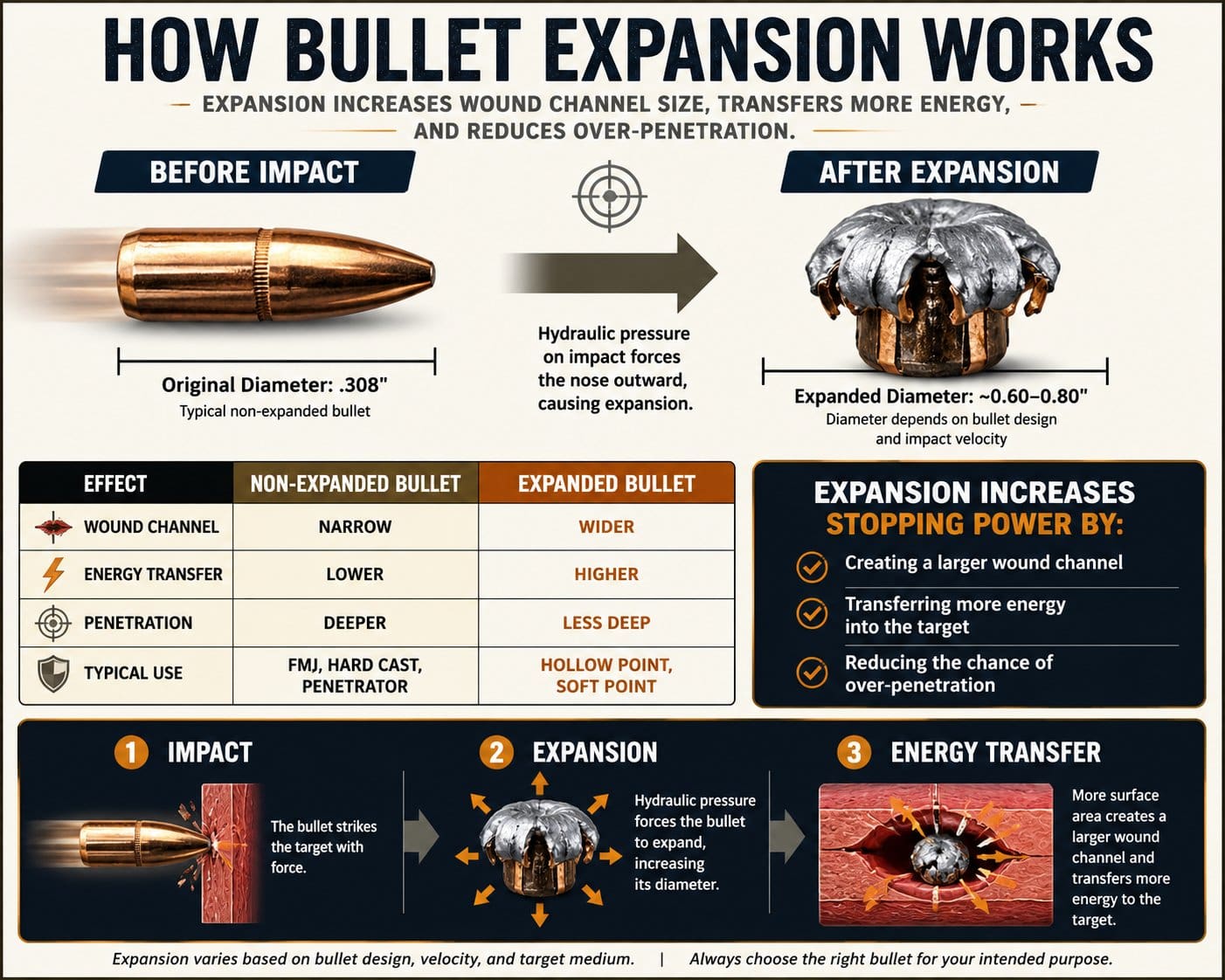
Bullet expansion is how much the bullet widens out (or expands) as it impacts a target. As the nose or front of the bullet impacts the target, it pushes backward, pushing out the sides of the bullet.
This has two effects.
First, the widening of the bullet causes a larger wound channel. Because there is increased resistance to the bullet, it slows, transferring energy from the bullet into the target.
Second, the increased resistance and greater energy transfer reduce penetration.
The more a bullet expands, the greater the energy loss and the less penetration the bullet achieves. There’s a balance between a bullet expanding too much and achieving sufficient penetration.
The required penetration depends on the specific use of the bullet. For hunting, maximum penetration and pass-throughs with wide wound channels are typically best.
However, for defensive shooting against two-legged targets, maximum expansion and less penetration are often best so that innocent bystanders are not hit by a pass-through bullet.
You can read our article on How to Avoid Over-Penetration in Home Defense Scenarios if you are researching defensive ammo.
In contrast, for defense against dangerous game, it’s best to maximize penetration to get through a hard bear skull, or a thick hide, meat, fat, and bones, so the bullet can reach the vitals or central nervous system to stop the threat as quickly as possible.
How is Bullet Expansion Related to Terminal Ballistics?
Bullet expansion is a part of terminal ballistics. Terminal ballistics refers to the ballistics of a bullet as it impacts its target. A bullet’s expansion directly affects how it behaves once it strikes something.
If you want to know more about the relationship between bullet design and ballistics, read this article: Internal External & Terminal Ballistics [What Truly Matters]
The terminal ballistics of a bullet includes expansion, fragmentation, penetration, energy transfer, wound channel, and tracking.
In general, the faster a bullet expands or fragments, the more energy it transfers to the target and the less penetration it achieves. Engineers carefully balance this when designing a bullet, and this is a big reason why it is so important to select the correct bullet for the job.
For example, some varmint bullets rapidly expand and are perfect for shooting thin-skinned or small game. However, that same bullet may not work well on, say, a deer or black bear.
Of course, there are nuances and caveats to all of this, but in general, for big game, a bullet that stays intact longer and doesn’t fragment is best.
Bullet Expansion vs Fragmentation
Bullet expansion and fragmentation are both part of a bullet’s terminal ballistics. Some bullets are designed to expand while others are designed to fragment. Fragmentation occurs when a bullet breaks into little pieces.
These pieces generally spread quickly and can cause significant damage. However, the smaller the fragment, the quicker it will lose momentum and the less penetration it will achieve.
Bullets purposefully designed to fragment are common for pistol self-defense and for varmint hunting. The Hornady V-Max bullet is a good example of a fragmentation bullet for predator hunting, and the Federal Syntech Defense is a good example of a frangible self-defense bullet for handguns.
While there are specialized fragmenting bullets for big game, they aren’t common. Generally, most hunters prefer expanding rather than fragmenting bullets for big game, so they can achieve sufficient penetration while creating a large wound channel.
Why is Bullet Expansion Important?
Bullet expansion is important because it significantly influences a bullet’s stopping power and should always be considered when selecting bullets for specific purposes.
Bullet Expansion for Self-Defense: Two-Legged Predators
For self-defense, most people want a bullet, like a hollow point, that will expand quickly, dump all of its energy into the target, and achieve at least 12 inches of penetration so it can reach vital organs from any angle while also limiting damage from pass-through or missed shots.
If you aren’t that familiar with hollow points, this article here is a must: Do Hollow Points Actually Make a Difference in Self-Defense?
This is important because errant shots or pass-throughs can potentially injure or kill an innocent bystander or even go through a wall in your home and hit a loved one you are trying to protect.
A minimum of 12 inches of penetration is the FBI’s standard and is sufficient to ensure a bullet will reach vital organs from all angles while also lowering the risk of injuring bystanders from pass-throughs.
Bullet Expansion for Self-Defense: Four-Legged Predators
Bullet selection for self-defense from animals like bears or mountain lions is quite a bit different than selection for self-defense from people.
For animals, it’s best to have a bullet that will penetrate deeply so that it has the potential to reach the central nervous system.
When animals are shot in the lungs, it often takes a minute or two for the animal to expire.
That’s why it’s important to incapacitate a charging bear or other wild animal immediately by hitting the central nervous system.
This highlights the importance of choosing ammunition loaded with bullets capable of penetrating thick bones.
Many people choose 10mm or larger cartridges, like the .500 S&W, .460 Rowland, or .44 Magnum, with hard-cast bullets designed for maximum penetration and to track straight when facing bears.
You are most likely to run into these types of predators out in a large mountainous area, maybe a forest, ect, but probably not an apartment complex so we don’t usually have to worry about over-penetration as much.
For cases like this you want to make sure you get a hard bullet that isn’t going to expand too much and that will make it all the way through a large predator. Copper monolith bullets are very popular for this.
Bullet Expansion for Hunting
Bullet expansion is extremely important for hunting as well. For big game, especially for elk or moose, you need much more penetration than you do something like a white-tailed deer. A bull elk’s chest is typically more than 30 inches wide, and their shoulders can stop more bullets than you may think.
That means if a hunter wants a pass-through shot, which often leaves the best blood trails, they need a bullet that will travel at a minimum of 30 inches through hide, bone, meat, and organs.
Luckily, there are plenty of manufacturers that design bullets specifically for this. The Hornady ELD-X loaded for a 30-06 is a great example and provides fantastic penetration and bullet expansion that will create a sufficient wound channel to quickly kill any animal in North America.
The weight of your bullet will have a big influence on how far it penetrates as well. A lighter bullet will not penetrate as far as a heavier bullet even if they have the exact same bullet design and expansion statistics.
If you’d like to read more about how to select a good bullet for hunting, read our article on The Best Bullet Design for Whitetail Hunting; much of the information is transferable to other big game species.
How Does Bullet Construction Affect Expansion?
When selecting ammunition loaded with different types of bullets, it’s important to consider the material the bullets are made from and how they are engineered. There are many bullet designs, and only two metals are commonly used to make hunting and self-defense bullets.
Metals Used to Cast Bullets
The two metals are copper and lead. Most bullets use a combination of the two, but monolithic bullets, those made from only one type of metal, are also available and popular.
Copper bullets have become more popular in recent years, and they are my personal preference.
Copper bullets expand readily when impacting a target at sufficient velocities, often 1,800 feet per second or faster. Although they hold together much more than lead bullets.
Additionally, it eliminates the risk of lead entering your food or being left at the carcass, killing scavengers later. That said, bullets made from both copper and lead are far more common.
Where you can get into different types of metals is usually in shotgun shells. The pellets can be made from a variety of different metals and alloys. Every now and then you’ll find a rifle bullet made from an alloy but it’s mostly copper and lead.
Bullet Construction
Most people have heard of the following common bullet types: hollow points, soft points, full metal jackets, ballistic tips, boat tails, wad cutters, semi-wad cutters, and frangible. These are names for general bullet styles, but the names for how the bullets are actually constructed are usually less well known.
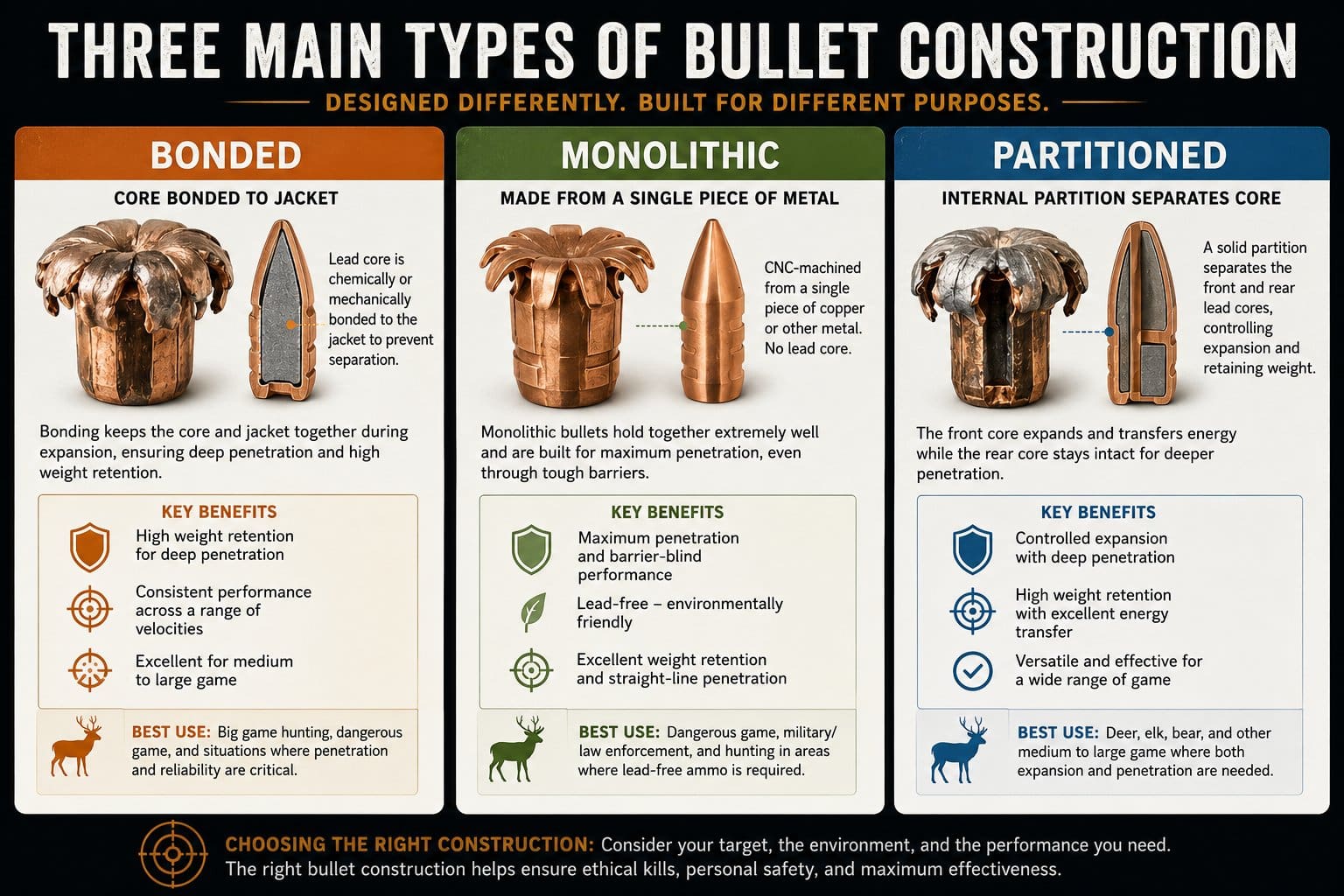
The three general types of construction are bonded, monolithic, and partitioned.
Bonded bullets have a jacket, commonly copper, bonded to the lead core. Bonded bullets often expand in a classic mushroom shape.
Monolithic bullets are made from a single metal, typically lead or copper.
Copper is the most common monolithic bullet used for hunting with rifles; however, there are good examples of monolithic lead bullets used more often in lower-velocity firearms like muzzleloaders or .22 LR.
Monolithic copper bullets often expand to a classic mushroom shape similar to bonded bullets, but they must impact the target at higher speeds to achieve reliable expansion, which is one of their major drawbacks.
Last is the partitioned bullet. Partitioned bullets often come apart into two or more pieces.
One of the pieces, typically the copper jacket, will come apart and expand, creating a devastating wound channel while the core, often lead, stays together and penetrates deeply into the animal.
What’s important to understand is that all of these bullet types have different methods of expanding and imparting energy on target. Your typical bullet is bonded. You’ll want to use a monolith for deeper penetration and you’ll want to use a partitioned bullet when you need a mix of both.
How Does Bullet Velocity Affect Expansion?
I alluded to this earlier, when discussing minimum velocities for bullet expansion with copper bullets. Below is a good example of what happens when a copper bullet doesn’t have sufficient energy to fully expand.
The bullet below was fired from a 6.5 Creedmoor into a whitetail buck at 310 yards. Typically, the bullet should have enough energy to expand properly at this distance from this cartridge, but apparently, this one did not.
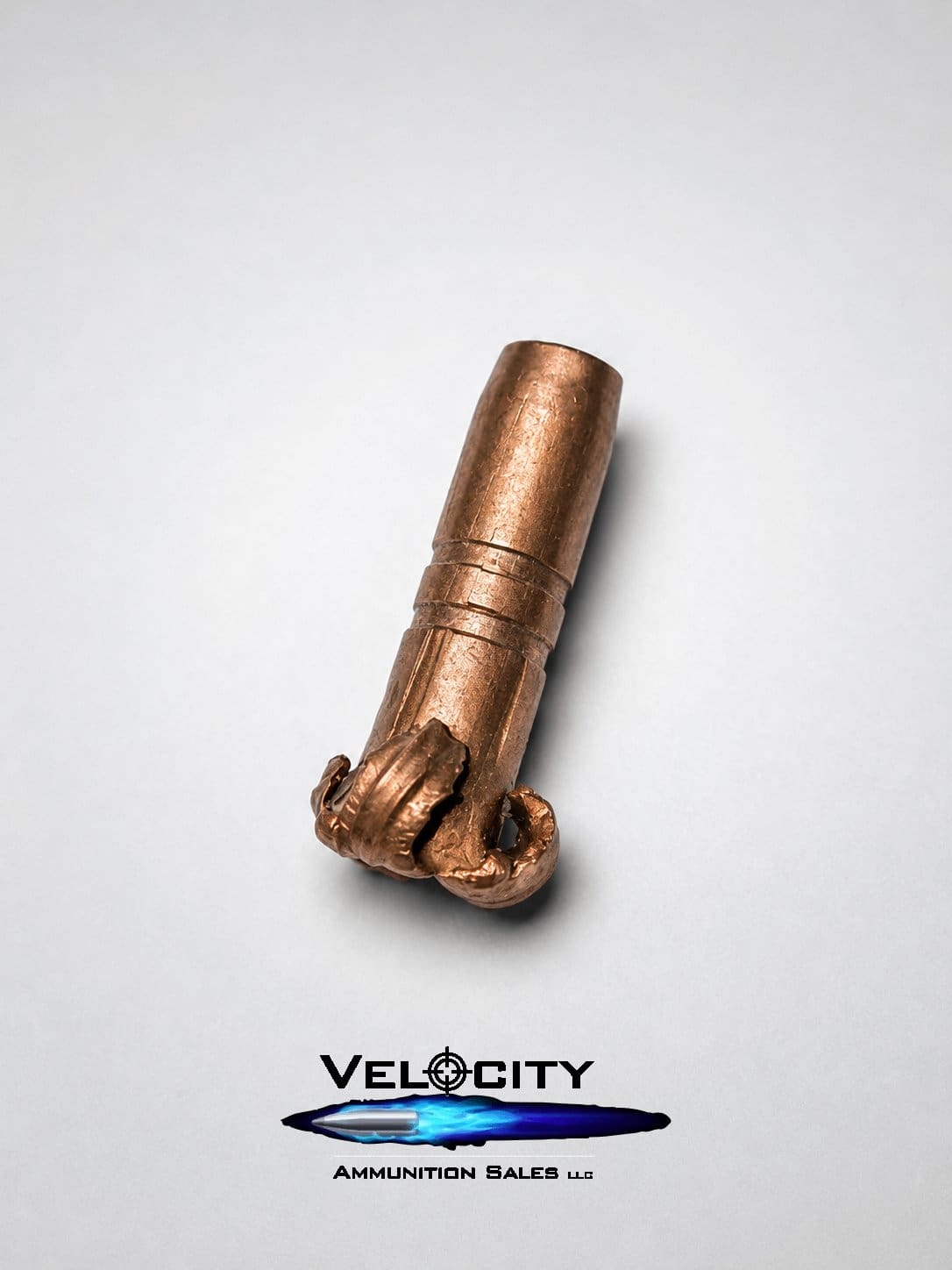
The next photo is of the same bullet, a 127-grain Barnes LRX that was shot into a mortally wounded running black bear at 70 yards. The bullet entered the left hind hip of the bear, passed through its entire abdomen, chest cavity, and broke the bear’s offside shoulder, passing through it and coming to rest beneath the hide on the offside.
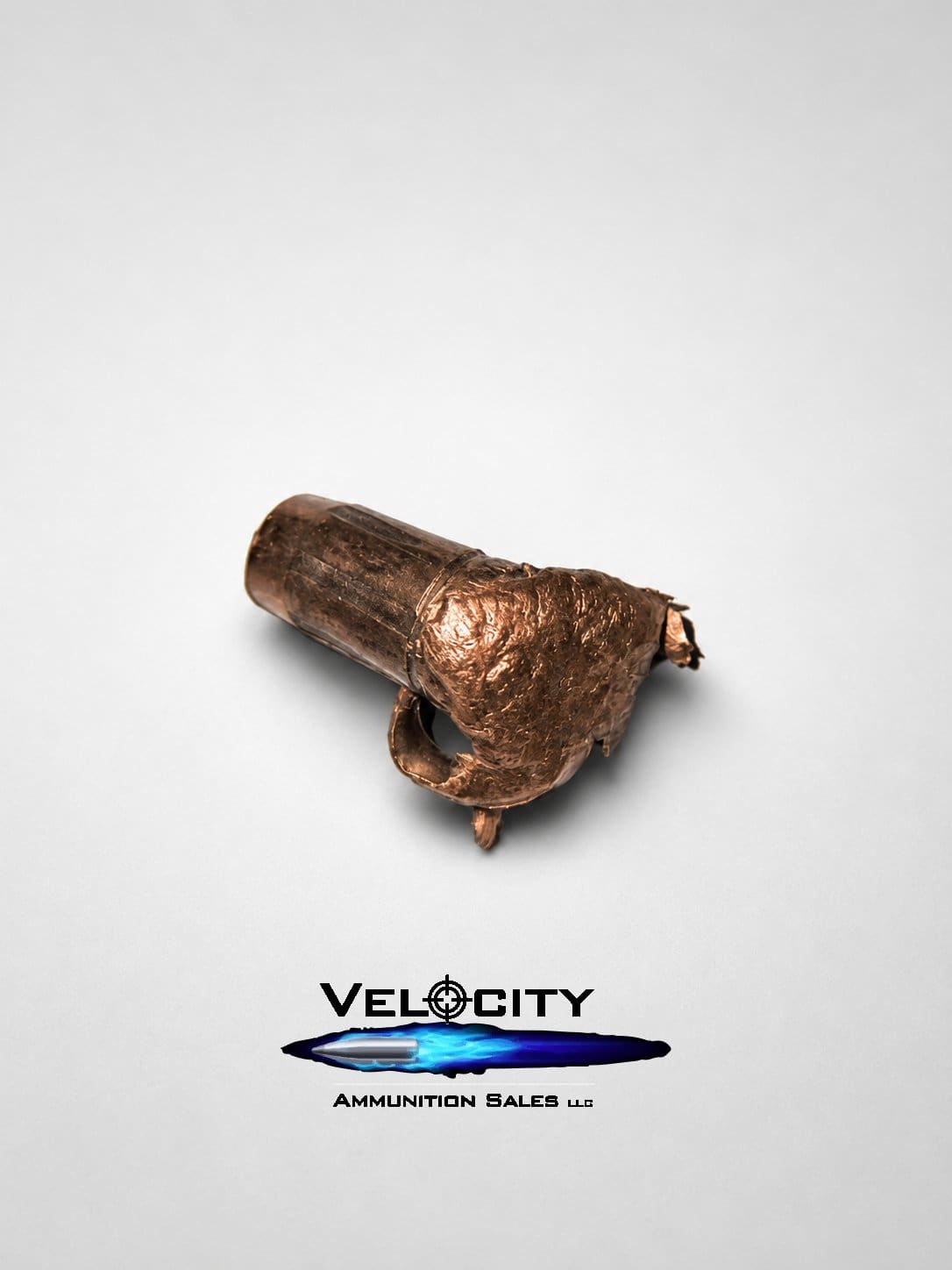
I was certainly impressed, and the bullet held together very well. When comparing the photos, you can see the difference in how well each bullet expanded.
Both did their job and killed the animals they hit, but one did a much better job of expanding than the other, primarily because of the velocity at which it impacted.
In short, greater velocities equate to greater expansion and greater stopping power. This holds true with all types of bullet constructions.
Factoring in Bullet Expansion With Cartridge Selection
When selecting a bullet for a specific use case, it’s extremely important to consider its terminal ballistics, which includes bullet expansion. Further, the way a bullet expands will impact its stopping power. Both of which need to be considered when selecting a bullet.
All of this can be summarized in one general statement:
For hunting, it’s best to select a bullet that strikes a balance between expansion and penetration, and for self-defense, it’s best to select a bullet that rapidly expands and quickly releases its energy into a target.
Bullet Expansion FAQs
What Is Bullet Expansion and Why Does It Matter?
Bullet expansion refers to how a projectile widens or mushrooms upon impact. This process increases resistance, transfers more energy into the target, and creates a larger wound channel, making it a key factor in determining effectiveness for hunting or self-defense situations.
How Does Bullet Expansion Affect Stopping Power?
When a bullet expands, it slows down more quickly and releases more of its energy into the target. This increased energy transfer improves stopping power, but excessive expansion can reduce penetration, so a balance between the two is important.
What Is the Difference Between Bullet Expansion and Fragmentation?
Expansion occurs when a bullet mushrooms outward, while fragmentation happens when it breaks into smaller pieces. Expanding bullets usually penetrate deeper with controlled damage, whereas fragmenting bullets spread energy quickly but often sacrifice penetration depth.
How Does Bullet Construction Influence Expansion?
Bullet design and materials play a major role in expansion. Bonded, monolithic, and partitioned bullets all expand differently based on how they are built, with factors like metal type and internal structure affecting how reliably and widely they deform on impact.
Why Is Bullet Expansion Important for Hunting and Self-Defense?
For hunting, proper expansion helps create effective wound channels while still allowing enough penetration to reach vital organs. In self-defense, faster expansion helps limit over-penetration and reduces the risk of harming unintended targets beyond the initial impact.