Prefer audio over written content? Listen to the article here:
If you have ever wondered why some ammo whispers while others crack like thunder, you have come to the right place. Subsonic and supersonic ammunition behave quite differently in the real world, even if they look similar on the shelf.
We will be breaking down the actual differences between the two and how they perform so that you can pick the right ammo for your needs.
Subsonic ammo travels below the speed of sound for dramatically quieter operation with a suppressor. Supersonic ammo breaks the barrier for flatter trajectories, higher energy, and better long range performance.
The choice is based on your priorities: stealth and low recoil versus speed and power.
So whether you are looking for quiet backyard plinking, home defense, long range target shooting, or just the best bulk deal for your next range day, you are in good company.
Let’s take a look at the real differences between subsonic and supersonic ammo.
What Does “Subsonic” and “Supersonic” Really Mean
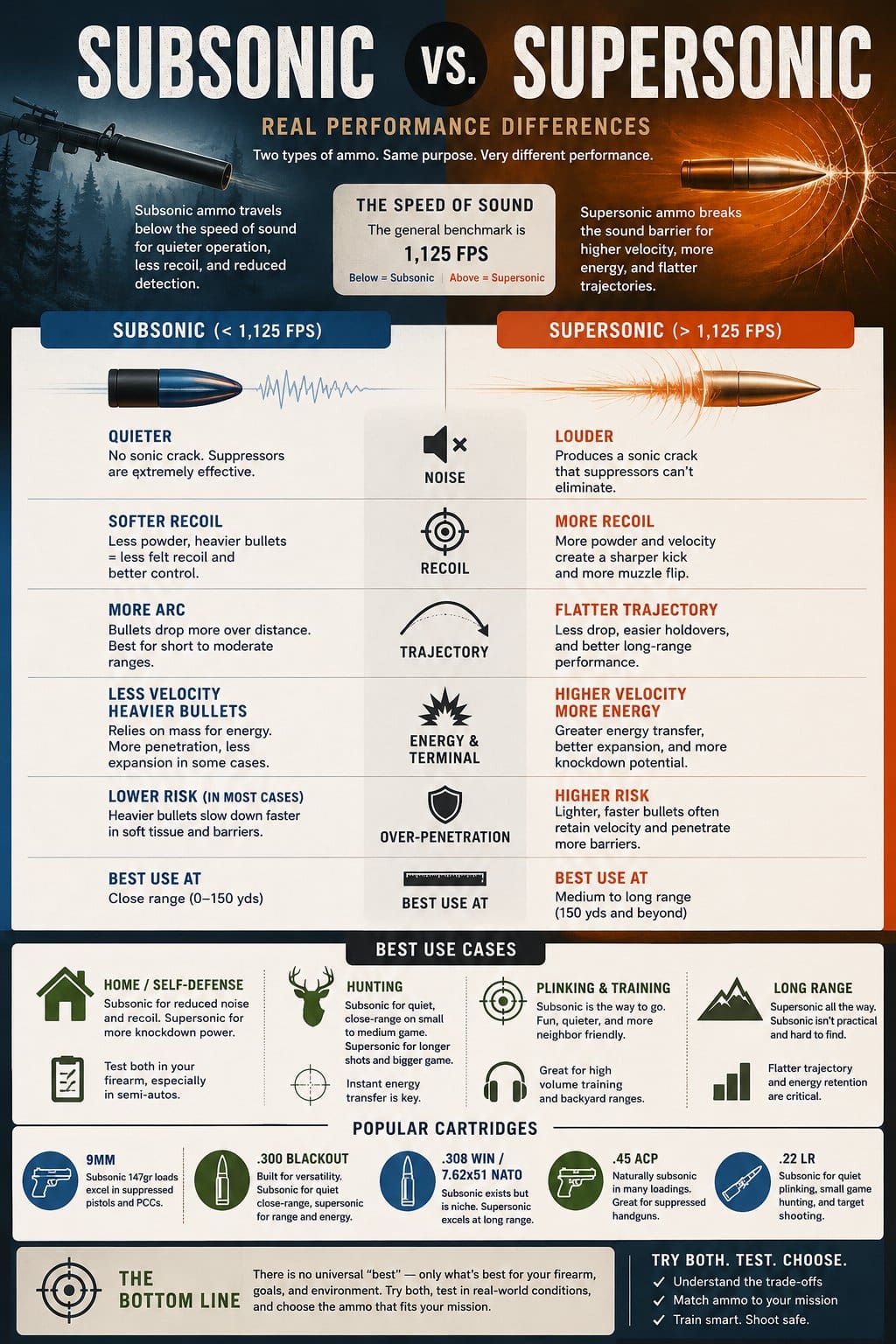
When dealing with subsonic and supersonic, we are talking about speed, specifically the speed of sound. While the speed of sound isn’t a fixed number alone, as it changes with altitude, temperature, and humidity, the number that is generally used is 1,125 feet per second (fps).
This is the simple benchmark for the difference between subsonic and supersonic ammo.
Anything slower than the speed of sound stays subsonic. Anything faster than the speed of sound goes supersonic and creates that telltale sonic crack most gun lovers are familiar with.
Subsonic ammo usually gets paired with heavier bullets with less powder. This keeps the velocity low while trying to maintain good, usable energy.
Supersonic ammo does the exact opposite. Lighter bullets get fired at a higher rate of speed for more zip and retain their energy.
The difference isn’t just noise. It can affect everything from how the gun feels when you fire it to trajectory to what happens when the bullet lands on its intended target.
Noise: the Most Obvious Real-World Difference
Subsonic ammo’s largest benefit is how much quieter it is as it flies through the air. Without the sonic crack, a good suppressor can turn a subsonic setup into Hollywood-like silenced rifles or pistols.
You can often shoot without ear protection in controlled environments, however we always recommend that you err on the side of caution, especially with something as important as your hearing.
Supersonic ammo can still be quieted down with a can, but that sonic boom will still remain. It is noticeably louder, can spook wild game, or draw unwanted attention.
If stealth matters to you, for such things like suburban hog control, predator hunting at night, or just being a good neighbor, subsonic is hard to beat in the noise category.
You can hear the difference between them in this short 9mm video,
Recoil & Shootability
Subsonic rounds generally produce softer recoil due to the lower amount of powder in the cartridge. The slower, heavier bullets also means less muzzle flip, which leads to easier follow up shots.
New shooters and anyone sensitive to recoil will love subsonic ammo for those longer training sessions or heavy volume shooting days at the range.
Supersonic loads tend to hit harder coming back at you on the trigger pull. The extra powder and velocity translate to a heavier kick.
Many experienced shooters tend to prefer that recoil push back for feel and for faster cycling in semi-auto firearms. It is a trade off that you will definitely have to feel out for yourself at the range, as preference is king in this department.
Trajectory & Practical Accuracy
Here is where supersonic ammo usually pulls ahead and wins. Faster bullets drop less over distance, which makes holdovers simple and also extends the effective range of the bullet.
A flatter trajectory helps significantly with hunting and/or longer-range target shooting.
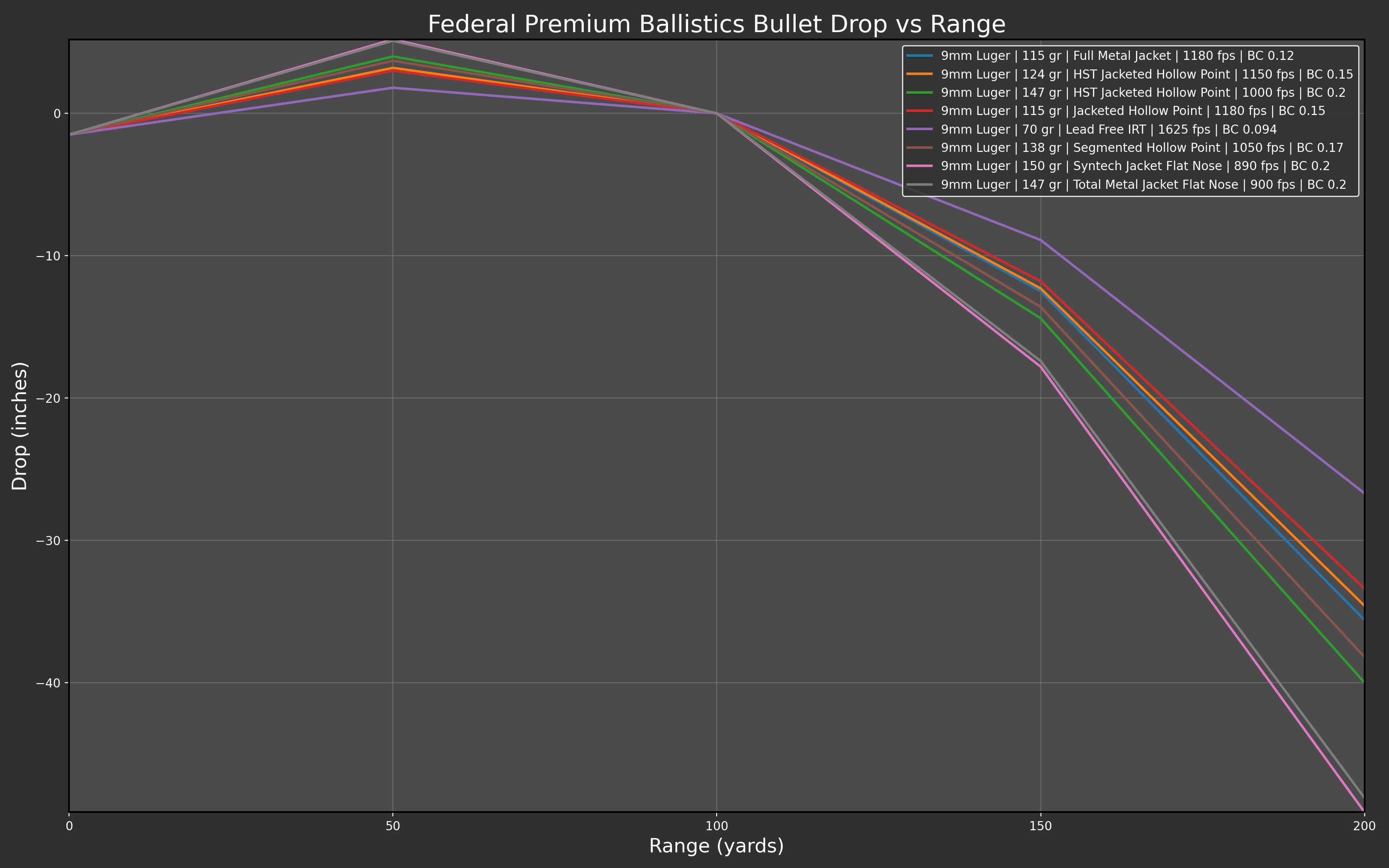
Subsonic ammo has a more arched trajectory due to the lack of speed over longer distances. Shooters need to account for the extra drop of the bullet out beyond 100 to 150 yards in many cases.
At closer ranges, like those used in home defense or short-range plinking, the difference is very minor and not as noticeable. Many subsonic loads also have tighter groupings on target at moderate distances because they avoid transonic instability issues.
You can see from this graph that subsonic loads tend to have more bullet drop as expected.
If you want to learn more about this, check out our guide on How Ballistic Coefficients Effect Long Range Shooters for more on how bullet shape plays into this aspect.
Energy, Penetration, & Terminal Performance
Kinetic energy, or transferred energy, depends on both mass and velocity. Supersonic ammo often delivers more punch downrange, especially at further differences because of the relationship of speed and weight of the bullet being fired.
This can mean better expansion and a faster energy dump on game or threats.
Subsonic ammo relies on heavier bullets to make up for the lack of speed that they produce. In calibers like .300 Blackout or 9mm, the energy difference is not always huge at close range.
A heavy subsonic bullet can still create solid wound channels, but it may penetrate deeper with less expansion in some cases.
If you want to get deeper down the rabbit hole on energy, penetration, and terminal performance, we highly suggest that you check out our articles on Internal External & Terminal Ballistics [What Truly Matters] and How Does Bullet Weight Actually Affect Performance? These will show how both subsonic and supersonic ammo create energy and damage on impact.
Over-Penetration Concerns
Over-penetration concerns come to light in self-defense or home-defense scenarios, and is a big deal.
Subsonic loads with heavier bullets often slow down faster in soft tissue or barriers due to the lack of speed. This potentially reduces the risk of shooting through walls with innocent bystanders on the other side.
Supersonic ammo tends to zip through more materials thanks to higher speeds, which is great for penetration and taking out a threat. However, it can cause unwanted damage to those we are seeking to protect.
Choose carefully based on your environment and situation of use.
For more on over-penetration, check out our article How to Avoid Over-Penetration in Home Defense Scenarios.
Popular Calibers & Real Use Cases
Let’s take a look at some popular calibers that can be found in subsonic. Anything not labeled subsonic is usually supersonic, or your typical, everyday ammunition.
9mm Subsonic
9mm subsonic loads are usually found in heavier 147 grain bullets, though some specialty loads go even heavier. These rounds are extremely popular in suppressed pistols and pistol caliber carbines because they stay below the speed of sound while still delivering solid close-range performance.
The softer recoil and reduced noise make them excellent for training, range use, and home defense setups where sound reduction matters. Many shooters also find them more comfortable during long shooting sessions.
See our Best 9mm Subsonic Ammo: Top Picks & Uses article for recommendations.
.300 Blackout
The .300 Blackout was practically built around the idea of swapping between subsonic and supersonic loads. Supersonic .300 BLK loads provide strong performance with solid energy and effective range beyond 300 yards, while subsonic loads shine in suppressed short-barreled rifles and close-range applications.
It is one of the most versatile modern cartridges because shooters can easily tailor the round to their specific use case simply by changing ammunition types.
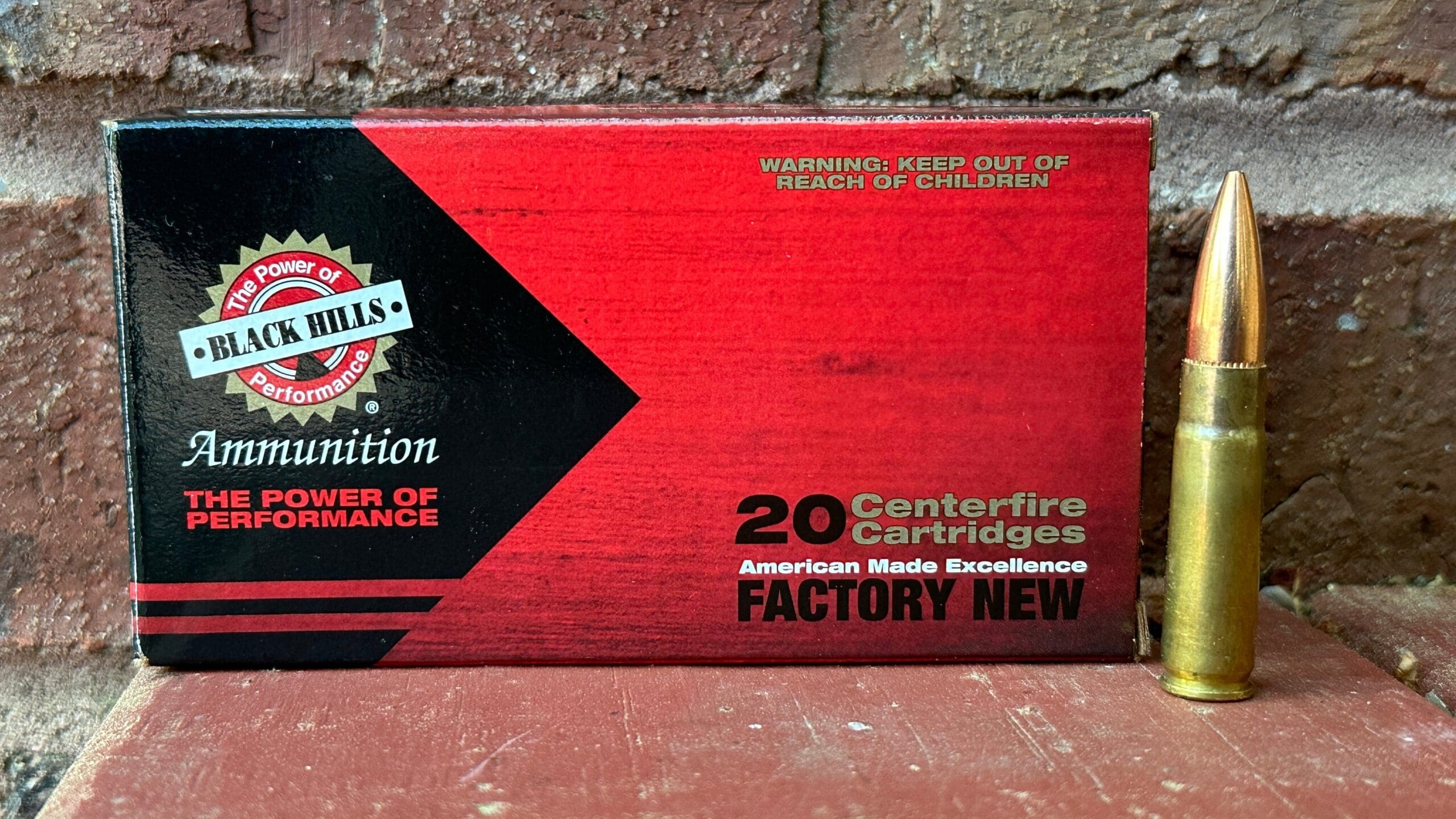
Our .300 Blackout vs 5.56 NATO for Home Defense [Backed By Data] goes into detail about the .300 BLK for defense and when you would want to use it with subsonic loads.
.308 Winchester & 7.62×51 NATO
Subsonic versions of .308 Winchester and 7.62×51 NATO do exist, usually using very heavy bullets to keep velocities below the sound barrier. However, they are far more niche compared to standard supersonic loads.
Most shooters choose these calibers specifically for their long-range capability, energy retention, and terminal performance, which are all strengths of supersonic ammunition. Subsonic loads can still be useful in specialized suppressed bolt-action setups, but they are much less common and may require careful tuning.
Supersonic dominates for long-range power, so finding subsonics for what you want in these calibers may be a bit tougher. Check out our article Best .308 Bullet Grain for Your Use [Full Guide] to find what you are looking for.
.45 ACP
The .45 ACP is naturally subsonic in many standard factory loadings, which is one reason it has remained so popular for suppressed handguns over the years. The heavier bullet and moderate velocities create a deep, controllable recoil impulse that many shooters enjoy.
While it may not match the velocity of modern high-speed handgun rounds, it performs well at defensive distances and remains a favorite for quieter shooting setups.
.22 Long Rifle
You can’t forget about everyone’s favorite plinking round. Subsonic .22 LR loads are extremely popular for small game hunting, backyard range setups where legal, and quiet target shooting with suppressors.
Because standard .22 LR ammunition often hovers around the speed of sound, dedicated subsonic loads can also help avoid inconsistent transonic performance while keeping noise levels impressively low. They are affordable, fun to shoot, and incredibly easy on recoil.
Reliability & Firearm Function
Most semi-auto firearms are tuned for supersonic pressures and velocities when it comes to functionality. Subsonic ammo can cause failures to eject or feed in some platforms unless the firearm is optimized or adjusted properly to make up for the differences.
Do your homework when it comes to your specific firearm and the type of ammunition you are looking to use, especially if it is subsonic. Know what to expect and where issues might arise so that you are not surprised by them when they happen.
We highly recommend that you test subsonic ammo thoroughly to know how it might affect your firearm.
If you are running a bolt gun or single shot firearms, they don’t care. They will run anything reliably.
Cost & Bulk Buying Considerations
Subsonic ammo often costs a bit more per round because of the heavier bullets and specific loading, while supersonics are usually cheaper and easier to find in bulk because they are the industry norm.
Focus on reliable bulk options so that you can stock up on your ammunition of choice with breaking the bank. Whether you are looking for cases of 9mm subsonic for training, .300 BLK mixed loads, or .22 LR for plinking days, buying in volume will save you money and keep your shooting a lot more.
Match Grade & Handloads
Factory subsonic ammo that is match grade has definitely come a long way with the help of technology, but handloaders can fine-tune ammo for the exact rifle it was intended to be used in.
If you are into handloading or reloading your own ammunition, trying out subsonic ammo might be an easy trial with just some differences in powder and bullet weight.
If you do reload, you don’t have to feel left out when it comes to the popular push of subsonic rounds in today’s shooting world.
Check out our article on How Match Graded Factory Ammo Stacks Up Against Handloads which covers the pros and cons.
Choosing the Cartridge That’s Right for You
Now that you are more familiar with the ins and outs of subsonic and supersonic ammo and their performance differences, it is time to choose what is right for you.
We definitely suggest trying both in your firearm and then deciding what fits your needs and preferences the best.
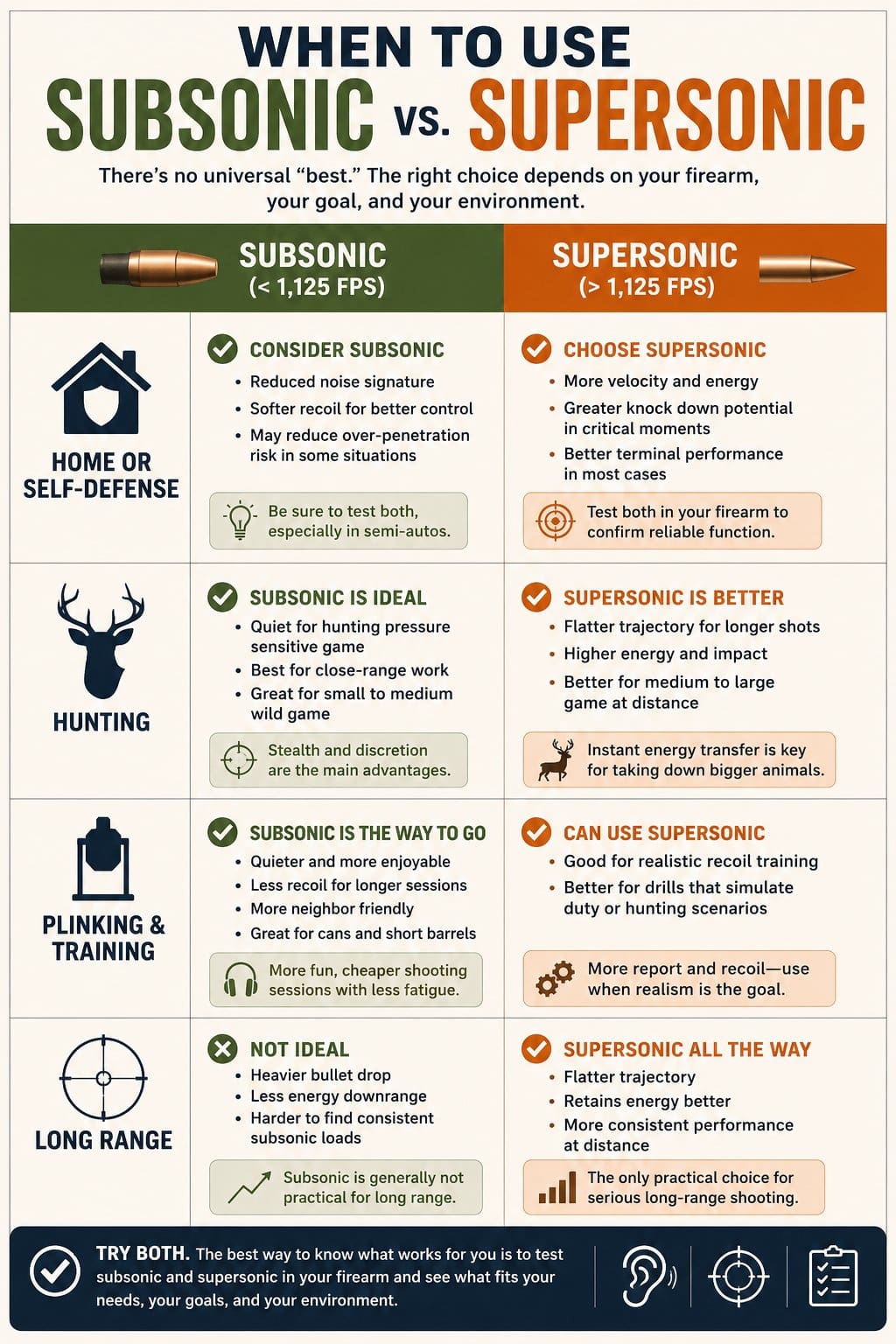
Home or Self-Defense: Consider subsonic ammo for reduced noise and recoil. Choose supersonic if you are looking for more knock down power in critical moments. Be sure to test both, especially in semi-autos.
Hunting: Subsonic for quiet, close-range work on small to medium wild game. Supersonic for those longer shots that require instant energy transfer to take down bigger animals.
Plinking and Training: Subsonic is the way to go. It is fun, quieter, and more neighbor friendly for those at home ranges some of you might have.
Long Range: Supersonic all the way. Wouldn’t even consider subsonic and would be hard to find.
There is no universal “best” when it comes to subsonic versus supersonic. It all depends on your firearm setup, preferences, goals, and environment.
Pick Your Priority
Subsonic and supersonic ammo each bring real strengths to the table. They just happen to be on opposite ends of the table with their key performance indicators.
Subsonic wins for quiet operation, lower recoil, and close range control. Supersonic delivers speed, energy, and reach when you need to stretch for that hit.
Understanding the differences between the two helps you buy smarter and shoot better for your own personal needs and the need of the firearm. Be sure to test your choice thoroughly to ensure that it operates how you want it to and for its intended purpose.
Once you are comfortable with your choice, stock up and enjoy your shooting time.
Subsonic Vs Supersonic Ammo FAQs
What Is the Difference Between Subsonic and Supersonic Ammo?
The main difference is velocity relative to the speed of sound. Subsonic ammo travels below roughly 1,125 fps, avoiding a sonic crack, while supersonic ammo exceeds it, producing louder shots along with higher speed, flatter trajectory, and greater downrange energy.
Is Subsonic or Supersonic Ammo Better for Noise Reduction?
Subsonic ammo is significantly quieter, especially when paired with a suppressor, because it avoids the sonic crack. Supersonic rounds can still be suppressed, but the noise from breaking the sound barrier remains noticeable and cannot be eliminated.
How Do Subsonic and Supersonic Ammo Compare in Range and Accuracy?
Supersonic ammo generally performs better at longer distances due to its flatter trajectory and reduced bullet drop. Subsonic ammo has a more arched path and is better suited for close to moderate ranges, where its accuracy can still be very consistent.
Does Subsonic Ammo Have Less Recoil Than Supersonic Ammo?
Yes, subsonic ammo typically produces less recoil because it uses less powder and lower velocity. This results in a softer shooting experience with reduced muzzle flip, making it more comfortable for extended training sessions or recoil-sensitive shooters.
Which Ammo Type Is Better for Home Defense or Hunting?
Subsonic ammo can be useful for home defense due to reduced noise and potentially less over-penetration, while supersonic ammo offers higher energy and better performance for hunting, especially at longer ranges where power and expansion are critical.