Prefer audio over written content? Listen to the article here:
If you own a gun, you’ve probably considered stockpiling ammunition. Maybe you’ve already started stockpiling, or maybe you’re still hung up on how much you should stock and for what cartridges.
Maybe you’re also trying to figure out how much ammunition you should stockpile for hunting vs range or self-defense.
For a simple starting point, we suggest stockpiling a minimum of 1,000 rounds of ammunition for semi-automatic pistols and rifles, 250 rounds for bolt-action hunting rifles, and 500 rounds for shotguns. Roughly 20% of these numbers should be dedicated to self-defense and hunting ammo.
However, before starting your stockpile, you’ll need to decide which cartridges, the type of ammo, and how much of it you personally need.
In this article, we discuss the benefits of stockpiling, give suggestions on how much ammunition you may want to stockpile for different types of firearms, and provide tips on how to save money when creating a stockpile.
Benefits of Stockpiling Ammunition
To be honest, I used to keep just enough ammo for the hunting season, maybe a box or two for the range, and a couple of magazines’ worth of self-defense ammo.
An ammo shortage changed this for me. Soon it became difficult to get ammunition, and I became worried that I wouldn’t have ammo for hunting season. I bought what I could find, and I paid a premium for it.
This brings me to my point. If you have a good stockpile of ammunition, an ammunition shortage like the one during COVID wouldn’t be a big deal. I didn’t have one, and I was caught off guard.
Another benefit is that you can save money by buying ammunition in bulk and when it’s on sale. Like everything else, ammo prices are likely to continue to rise.
If stored properly, ammunition can last decades, so you don’t need to worry about it going bad. However, it’s not a bad idea to rotate it.
Our article Why You Should Be Rotating All of Your Ammo does a good job of explaining why this is important and the best way to do it.
One last benefit is that if you have a stockpile, you’ll always have ammunition for a last-minute trip to the range, a hunting trip, or even a defensive situation.
For me, it’s at least a half-hour round trip to purchase ammunition. If you’re busy, it’s nice just to have some on hand so you can make the most of your time rather than making last-minute ammo runs.
Does It Make Sense to Stockpile Ammunition?
We discussed the benefits of stockpiling ammo; now let’s dig a little deeper into why it makes sense to stockpile.
Market Disruptions
One of the biggest reasons I enjoy having a stockpile is knowing that I’m covered if there is ever a disruption to the ammunition market. This goes for both loaded ammo and components.
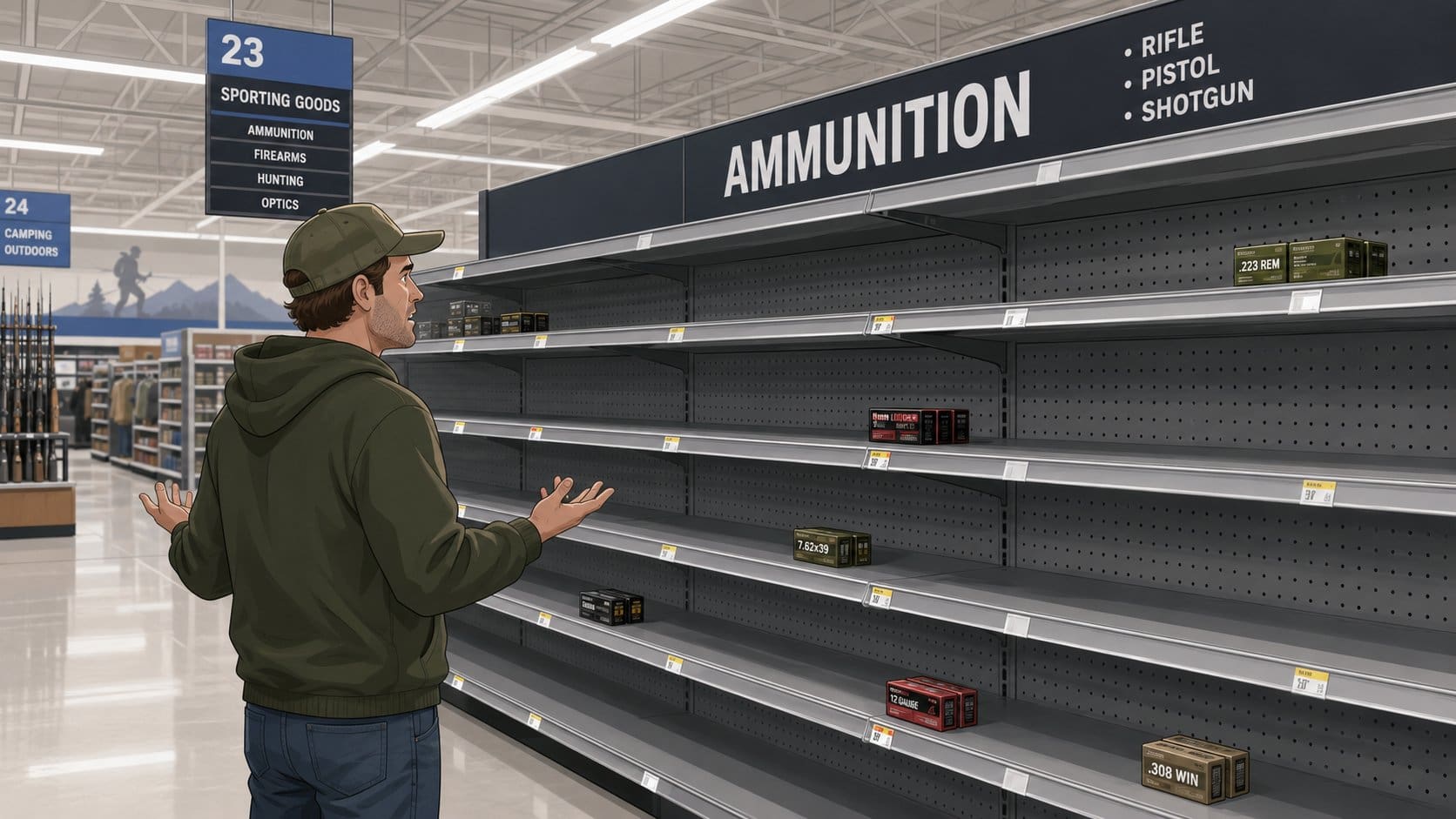
For example, during COVID, most ammo was difficult to obtain, and if you wanted something specific, good luck.
This was also true for reloading components. Primers and powder were extremely difficult to find. Both of these can also last for many years, so it doesn’t hurt to stockpile them if you reload as well.
COVID caused the last ammo market disruption, but in the past, they’ve also been caused by increased costs for specific metals like copper and lead, military conflicts, and simple supply and demand.
If you don’t currently have a stockpile, now is the best time to start. You never know when the next market disruption will begin.
As the saying goes, the best time to plant a tree was 30 years ago, the second best time is now.
Prepping
Prepping for disasters is also a great reason to have a stockpile, and really, stockpiling ammo is a form of prepping. Preppers will typically accumulate food, water, ammo, and other necessities in preparation for major natural or human-caused disasters.
If you’re prepping for disasters, it only makes sense to have a large stockpile that will last many years. If you have this in mind, you may want to stockpile defensive and hunting ammo along with some for the range to practice.
Long-Term Savings
The last reason is for long-term savings. Buying in bulk can save you hundreds of dollars over time, and it also ensures that the ammo is all from the same lot, which can be important for precision shooting.
If you’re only buying ammo on sale, then you will enjoy significant cost savings that can be realized long into the future.
For more information on buying ammo in bulk, check out our other article Is Buying Ammo in Bulk Worth It? [the Cold Hard Facts].
How Much Ammunition Should You Stock?
This is the million-dollar question, and there are a lot of opinions on this. However, the amount of ammunition you should stockpile is going to be closely tied to what you plan to do with it and why you are stockpiling ammo.
Are you worried about a societal collapse or a short-term ammo shortage? For a societal collapse, you’ll need a much larger stockpile than if your only concern is a short-term ammo shortage.
If you own firearms chambered in popular cartridges like 9mm, .223 Rem, .308 Win, or 12 gauge, you may want to focus on those rather than less common cartridges.
Once you have a good stockpile of ammunition, you should store it correctly.
Check out our article Buying & Storing Bulk Ammo Effectively [A Step-By-Step Guide] to learn how to do it right.
Semi-Automatic Rifles and Handguns
Semi-automatic rifles and handguns like the AR-15 and Glock 19 are prevalent and are chambered in common cartridges like the .223 Rem and 9mm Luger. Semi-automatic rifles and handguns can be used for self-defense, hunting, and target practice.
What you use yours for will determine the type of ammo you should stockpile.
Unlike bolt-action rifles, semi-automatic rifles make it easy to burn through a lot of rounds. The same can be said for semi-automatic handguns. Therefore, we suggest stockpiling a lot more ammunition for semi-automatic weapons than bolt-action rifles.
For semi-automatic firearms, we recommend stocking 1,000 rounds of range ammunition. If you plan to use them for hunting and self-defense, add an additional 500 rounds of each type of ammunition.
This will ensure you have enough ammo to still hit the range during a short-term shortage and have ammunition for hunting and self-defense in case of a major disruption.
Bolt-Action Rifles
Bolt-action rifles are commonly used by hunters, the military, and for precision shooting matches. In a societal collapse, a bolt-action rifle will likely be used primarily for hunting.
For hunting, you won’t use nearly as much ammunition as you would with a semi-automatic sport rifle.
However, you’ll still want to stockpile enough ammunition for target practice, sighting in a scope, and hunting. For a precision rifle, I prefer to shoot the same ammunition for practice that I use for hunting.
Once you’re dialed in with a quality setup, your scope shouldn’t move, but plan on stockpiling 100 rounds per year for practice, sighting in, and hunting.
Realistically, you may not use even that many. However, if you have to hunt for your food, you don’t want to run out. A good total number to keep on hand starts at 250 rounds, which should easily last a couple of years.
If you have the funds, 500 is even a safer bet and will ensure you won’t run out for many years.
Shotguns
Shotguns are extremely versatile and can be used for self-defense, upland game, waterfowl, and big game. Slugs are capable of taking a deer at distances up to 200 yards. Shotguns are also great for close-quarters self-defense.
For upland hunting, consider what animals you are most likely to hunt with it. For waterfowl, it’s pretty easy to go through a case (250 rounds) of ammo in a single season.
For upland hunting, hunters tend to use a lot less ammo. Additionally, for turkeys, it’s fairly rare to miss, and a single shot is generally all you need.
A good starting point would be 500 rounds of ammo for upland game and waterfowl combined. If turkeys are present in your area, you may want to keep 50 rounds of turkey loads on hand.
Additionally, I’d suggest 100 rounds of ammo loaded with slugs for hunting big game and another 100 rounds of 00 buckshot for either close-quarter self-defense or close-range hunting.
How to Make Stockpiling Ammunition More Affordable
One of the biggest obstacles to overcome when stockpiling ammo is cost. It’s no secret that ammo is expensive and prices continue to rise. The first way to make stockpiling ammo more affordable is to focus on common cartridges like 9mm Luger and .223 Rem.
If you own firearms chambered in these cartridges, it’s a good place to start. These cartridges are mass-produced, and it’s usually easy to find them in bulk or on sale.
Additionally, lead shotgun ammo like birdshot for upland game is typically very affordable and easy to find.
Reloading
One of the easiest ways to save money while stockpiling ammo is to reload. If you’re looking at acquiring thousands of rounds of ammunition, the reloading equipment will pay for itself. Personally, I purchased all of my reloading equipment used, except my cartridge-specific dies.
I found a pawn shop with a large stock of reloading equipment and was able to get set up for $200.
If you’re frugal when purchasing your reloading equipment and components, saving $1 or more per round for large-caliber hunting rifle ammo, it doesn’t take long to break even.
If you want to learn more about reloading, you’d probably be interested in this article: Is The Time & Money Spent Reloading Actually Worth it?
Be Patient & Wait for Sales or Buy in Bulk
If you’d rather not learn how to reload or invest in reloading equipment, your next best option is to wait for sales or purchase ammo in bulk. Both of these will save you money.
If you can find bulk ammo on sale, that’s even better.
Shotgun ammo can frequently be found on sale throughout the year. Target ammo for rifles and pistols also often goes on sale. You’ll need to be routinely searching the internet or visiting stores to find the best sales.
When you find a sale, buy as much as you can. While ammo isn’t a true financial investment, it will save you money in the long run if you buy in bulk.
Ammo prices are continuing to rise, so finding good deals now will save you money in the future.
Final Round
When stockpiling ammo, unless you have unlimited funds, it’s important to be practical. You need to consider how much you normally shoot and the length of time you want to prepare for.
For short market disruptions, several hundred rounds, up to 1,000, may be all you need. For longer-term, more disastrous scenarios, you may need thousands.
In the end, how much you stockpile is very dependent on your personal needs and plans.
A good starting point is 1,000 rounds of ammo for semi-automatic rifles and pistols, 250 rounds for bolt-action hunting rifles, and 500 rounds for shotguns, including ammo for upland bird and waterfowl hunting and for self-defense.
One easy way to not be caught unprepared is to start stockpiling ammo today and don’t forget to practice. You’ll be more prepared if you are proficient with your weapons before you need your stockpiled ammunition.
Ammo Stockpile FAQs
How Many Rounds of Ammo Should You Stockpile?
A practical baseline is 1,000 rounds for each semi-automatic pistol or rifle, 250 rounds for a bolt-action hunting rifle, and 500 rounds for a shotgun. Adjust upward if you shoot often, hunt heavily, or want long-term emergency reserves.
What Types of Ammo Should Be in a Stockpile?
Split your supply between practice ammunition and purpose-specific loads. Range ammo keeps skills sharp, while hunting and defensive loads should match the firearm’s intended use. For a general plan, dedicate about 20% of your stockpile to hunting or defensive ammunition.
Is 500 Rounds of 9mm Enough?
Five hundred rounds of 9mm can cover a minimal emergency reserve, but it disappears quickly with regular practice. If 9mm is your main defensive or training cartridge, building toward 1,000 rounds or more is a more practical goal.
How Should You Prioritize Cartridges for an Ammo Stockpile?
Start with the calibers you use most and that are easiest to replace, such as 9mm, .223 Remington, or 12 gauge. Common cartridges are usually cheaper, widely stocked, and easier to buy in bulk during normal market conditions.
How Can You Make Stockpiling Ammo More Affordable?
Buy slowly, watch for sales, and purchase bulk cases when prices are favorable. Reloading can also reduce costs, especially for expensive hunting rifle rounds. Focusing on common calibers helps because they are produced in larger quantities and often discounted.