Prefer audio over written content? Listen to the article here:
If you are serious about self defense, you have probably spent a decent amount of time staring at boxes of Federal HST and Speer Gold Dot ammo, wondering which one deserves a spot in your everyday carry magazine.
Both are considered top tier hollow points that are trusted by both law enforcement and civilians.
They are not just another type of ammo. They are engineered for real world stopping power while keeping situations responsible and manageable.
Head to head, both Federal HST and Speer Gold Dot shine as elite defensive rounds with excellent expansion and penetration.
HST often edges out in consistency and expansion, while Gold Dot Excels in barrier performance and reliability. The best choice depends on your gun, carry style, and scenario.
Let’s take a deeper dive into the head to head match up between the Federal HST and the Speer Gold Dot so that you can pick which of these defensive ammo golden childs that you want for your everyday carry setup. Let’s jump in!
A Quick Intro to These Defensive Powerhouses
Let’s start with some easy basics about these two defensive rounds. Federal’s HST and Speer’s Gold Dot are both jacketed hollow point (JHP) designs made for one thing and one thing only: performing when it matters the most.
Federal has been around since 1916 and Speer (under CCI) since the 1940s. Both companies have poured decades of experience into these two ammunition lines.
They are popular because they meet or exceed FBI ballistic protocols for penetration (ideally 12-18 inches) and expansion, which create big wound channels without excessive over penetration.
If you are newer to defensive ammo, check out our article on FMJ vs Hollow Point: Which Should You Actually Carry? for the foundational differences.
Hollow points like these two lines are game changers for self defense compared to FMJ rounds that are more suited for target practice.
Design and Engineering Breakdown
The magic in these two rounds happens in the bullet design department. Both use bonded jackets to keep the core and the jacket together during expansion, which reduces the chanse of separation on impact.
The Federal HST features a unique hollow point with skiving (cuts in the jacket) that promotes reliable, consistent petal expansion even through clothing or barriers. It often shows a very uniformed mushrooming in gel tests.
The Speer Gold Dot uses a bonded core with a distinctive “Gold Dot” process where the jacket is electrochemically bonded to the lead core.
This gives it a legendary toughness through heavy clothing, auto glass, and other barriers. This is a toughness that law enforcement personnel love.
Both come in various grain weights (124gr and 147gr are popular in 9mm) and both have +P options. For short barrel pistols, there are even specialized versions.
Dive deep into the realm of expansion in our article What Is Bullet Expansion? [How It Affects Stopping Power] to see why it matters.
Ballistics Gel Tests: the Real Data
Ballistics gel is the gold standard for testing. Independent tests from Lucky Gunner Labs and others provide solid numbers that show how effective these two rounds can be when hitting a target.
In Lucky Gunner’s extensive testing:
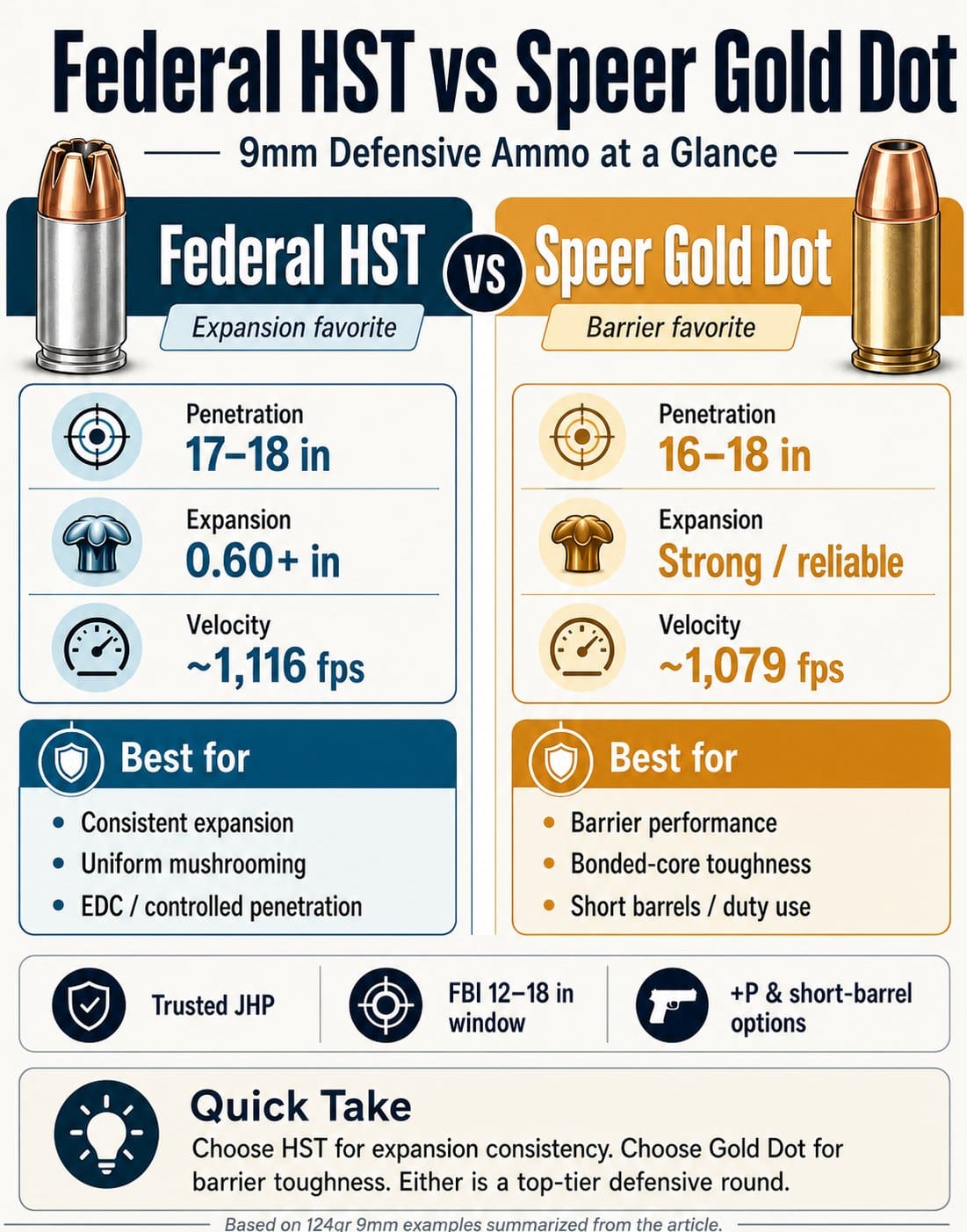
- Federal HST 124gr 9mm: Averages around 18 inches of penetration with 0.60+ inches of expansion.
- Speer Gold Dot 124gr 9mm: Averages 16-18 inches with solid penetration just under that of the Federal HST.
Widener’s comparison (using a Glock 45, 4 inch barrel, and a heavy clothing barrier) showed the following results:
- Federal HST 124gr: ~17.2 inches of average penetration from 1,116 fps.
- Speer Gold Dot 124gr: -16.1 inches of average penetration from 1,079 fps.
- Both expanded very well and captured fabric on the way in. The fabric barrier had very little effect on either of the rounds and their penetration compared to the Lucky Gunner test with no clothing barrier.
The Federal HST frequently gets praised for more uniform expansion, while the Speer Gold Dot tends to hold up better in some barrier heavy tests.
Neither is necessarily bad, as the both perform well in tests and hold the FBI ballistics protocol.
If you want to dive deeper into these ballistic gel tests and want comparisons to other calibers and ammo types, we highly suggest that you visit Lucky Gunner Lab’s website.
It is an excellent resource for penetration data, 5-shot average depth, expansion diameters, and average velocity. It also contains some great visuals of what the bullets look like after ballistic gel shots.
Watch this video for ballistic gel test visuals of the two rounds by Tools & Targets. It gives a great visual of both rounds performing during a ballistic gel test with a heavy clothing barrier.
Performance in Different Scenarios
Every scenario is different and could benefit from one cartridge more than another. Let’s talk about different scenarios and performance that you might be looking for out of each.
Everyday Carry (EDC): For compact or subcompact firearms, 124gr +P versions work great. HST is often a favorite for its balance, expansion, and creating bigger wound channels quickly in typical self-defense ranges (under 10 to 15 yards).
If you’re here trying to pick out a cartridge for EDC, this article is a must: What is the Best 9mm Self Defense Cartridge for EDC?
Short Barrel Firearms: Both types of ammo have options that are optimized for compact pistols. Gold Dot Short Barrel loads are designed to expand reliably from 3 inch barrels compared to the HST Short Barrel Loads.
The biggest issue with short barrel firearms is that the bullet just doesn’t have enough time in the barrel to create velocity. The Speer Gold Dot short barrel loads specifically counteract this issue and perform similar to standard loads.
Check out our article on Best Ammo for Short-Barrel Pistols if you are rocking a subcompact.
Home Defense: If concern about over-penetration in a home or apartment is a hot topic for you, both of these JHPs help reduce that risk compared to FMJs.
These jacketed hollow points expand quickly and dump energy well, which is great for soft barriers like clothing and doing damage in soft body tissue.
The Federal HST is often praised for its controlled penetration that stays within safe limits while still reaching vital areas.
The Speer Gold Dot’s bonding makes it tough against common home barriers like doors, windows, and drywall, which may lead to a little more over-penetration.
The choice for home defense might come down to what is more important and how your house is set up.
Be wary of wall pass-through and possible innocent bystanders on the other side of barriers where stray shots may end up.
For a deep dive into over-penetration, read How to Avoid Over-Penetration in Home Defense Scenarios.
+P Loads: These loads add velocity for better expansion, but also increase recoil as well. The Federal HST +P load often delivers impressive expansion with manageable recoil for most shooters.
Suppressor Use: If you are running a can on your pistol, heavier 147 grain subsonic-friendly loads of HST or Gold Dot can pair nicely.
They keep things quiet while maintaining defensive performance. Even though they will shoot at lower velocities, they still allow for good expansion in these designs.
Both the Federal HST and Speer Gold Dot have rounds that are specialized for each of these scenarios, which is nice because of their reliability and dependability, allowing you to get the best of the best ammo for any firearm scenario you might be looking for.
Reliability, Recoil, and Practical Factors
The Federal HST and the Speer Gold Dot both cycle very reliably in quality pistols. Their nickel-plated cases resist corrosion, which is perfect for everyday carriers who will have their rounds out and about, ready to use, instead of in storage.
The Federal HST tends to feel a bit snappier in the +P loads, compared to the Speer Gold Dot, but it is very manageable with practice, like any other round.
The standard rounds are very comparable to one another, giving no edge to one or the other.
Accuracy is also very comparable between the two rounds. Both shoot very flat, close groups at a high rate.
As always, be sure to test different rounds in your firearm, as every pistol is a bit different and may react differently to different ammo.
Price wise, these defensive rounds fluctuate from time to time, which is why it is extremely recommended that once you figure out which round you want to use, that you buy in bulk to ensure you have enough in stock and that your stock is consistent for the long haul.
Consistency can go a very long way when it comes to defensive rounds.
Potential Drawbacks
No ammo is completely perfect, but the important part is finding which ammo checks off the most needs for you individually.
For the Federal HST and the Speer Gold Dot defensive rounds, the differences between the two are very different in very light clothing or bare gel ballistics tests.
Some tests show that the Federal HST does petal a little more consistently, while the Speer Gold Dot might penetrate a hair deeper in certain barriers.
Cost is always going to be higher for defensive rounds, especially for Federal HST and Speer Gold Dot, but that is the price you pay for premium grade ammo that comes with the background, reliability, and holds the standard that these two rounds come with.
It is like the old adage says, you get what you pay for. And wouldn’t you want to know you are paying for the best?
Not every ammo is going to agree with your firearm, so be sure to test different ammo and find what shoots best for you. It takes time and practice, but that is the name of the game.
Don’t be the everyday carrier that doesn’t practice enough and carry the expected standard of everyday carriers. You have a duty to uphold that standard and finding the right ammo is part of that.
Which One Should You Choose?
This comparison is so close that it is hard to absolutely pinpoint one clear winner, but many do lean towards the Federal HST for its consistency and its popularity with law enforcement.
The Speed Gold Dot wins for its performance against barriers and for having a few more options.
The Federal HST and the Speer Gold Dot are both outstanding defensive ammo rounds that outperform most alternatives in gel tests and real world use.
For most folks, it is going to come down to which round feels better to them and how it performs with their individual firearm. You can’t go wrong with either one. It just comes down to individual preference.
Whether you pick the Federal HST for its expansion king status or the Speer Gold Dot for its bonded toughness, you are making a responsible choice that balances stopping power with safety.
Do your homework, which if you have read this far, you have already done a majority of that homework. Then pick up a few boxes of each ammo and see which one you and your firearm truly prefer.
Once you determine which one fits you best, bulk buy some of that choice and keep a good stock on hand. Then be sure to practice often to stay sharp and ready for any situation you might encounter.
Federal HST vs. Speer Gold Dot FAQs
Is Federal HST Better Than Speer Gold Dot?
Neither round is universally better. Federal HST often has a slight edge in consistent expansion, while Speer Gold Dot is known for bonded-core toughness through barriers. The better choice is the one that feeds reliably, shoots accurately, and feels controllable in your handgun.
How Do Federal HST and Speer Gold Dot Perform in Ballistic Gel?
Both loads typically meet the FBI’s preferred 12-to-18-inch penetration window in common 9mm tests. HST commonly shows wider, more uniform expansion, while Gold Dot generally penetrates solidly and stays intact well when fired through clothing or harder intermediate barriers.
Which Ammo Is Better for Short-Barrel Pistols?
For compact pistols, both can work well, but Speer’s Short Barrel Gold Dot line is specifically built to expand at lower velocities from shorter barrels. Federal HST also offers short-barrel options, so testing your exact pistol remains important.
Are Federal HST and Speer Gold Dot Good for Home Defense?
Yes. As jacketed hollow points, both are generally better suited to home defense than FMJ because they expand and reduce some over-penetration risk. Gold Dot may hold together better through barriers, while HST is often favored for controlled penetration.
Should You Choose +P Loads for Defensive Carry?
+P loads can add velocity and help expansion, but they also increase recoil, muzzle rise, and wear compared with standard-pressure ammunition. They make sense only if your handgun is rated for them and you can shoot them accurately under pressure.