Prefer audio over written content? Listen to the article here:
Two of the most widely used handgun cartridges for self-defense are the 9mm Luger and .45 ACP. If you’re thinking of purchasing a new handgun, these two cartridges may be at the top of your list.
The hard-hitting .45 ACP vs the lower recoil and higher capacity 9mm Luger handguns are two of the best cartridges available for self-defense.
Choosing a handgun for self-defense in 2026 can be difficult because of all the options available. Ammunition has also come a long way, and you can’t go wrong with a gun chambered in either the 9mm Luger or the .45 ACP.
However, if we had to pick just one, it’d be a handgun chambered in 9mm Luger.
That said, there are a lot of caveats to which handgun cartridge is best in 2026. It largely depends on what you want out of the cartridge.
Below, we provide information on both cartridges and why we believe the 9mm Luger is the best choice for most people.
9mm Luger Vs .45 ACP Ballistics
One of the things that makes these cartridges so interesting to compare is that they have very different ballistics. These differences actually support the pros of both cartridges.
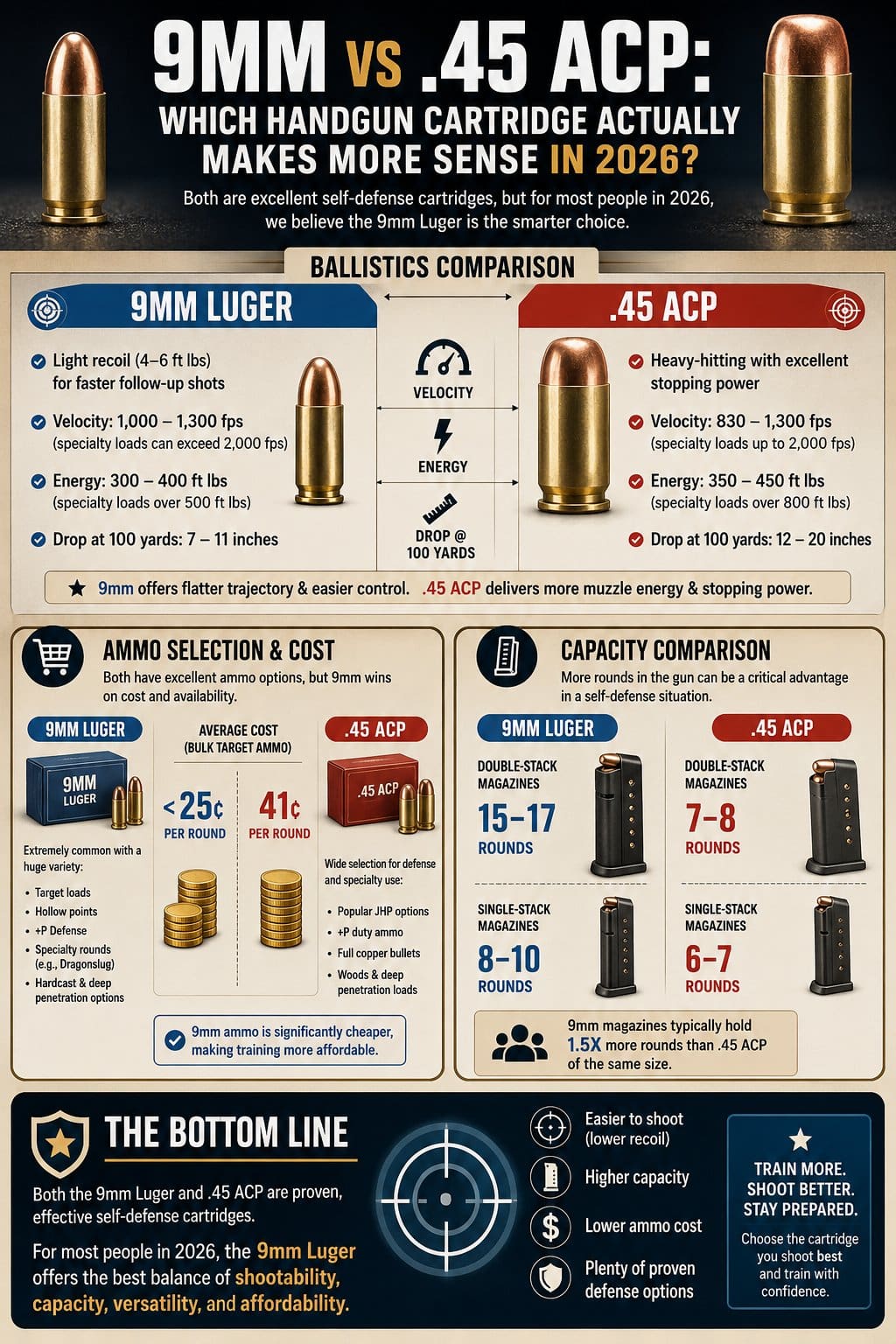
The 9mm Luger is a light-recoiling handgun that is easy to make quick follow-up shots with, and the .45 ACP is a heavy-hitting round with great stopping power.
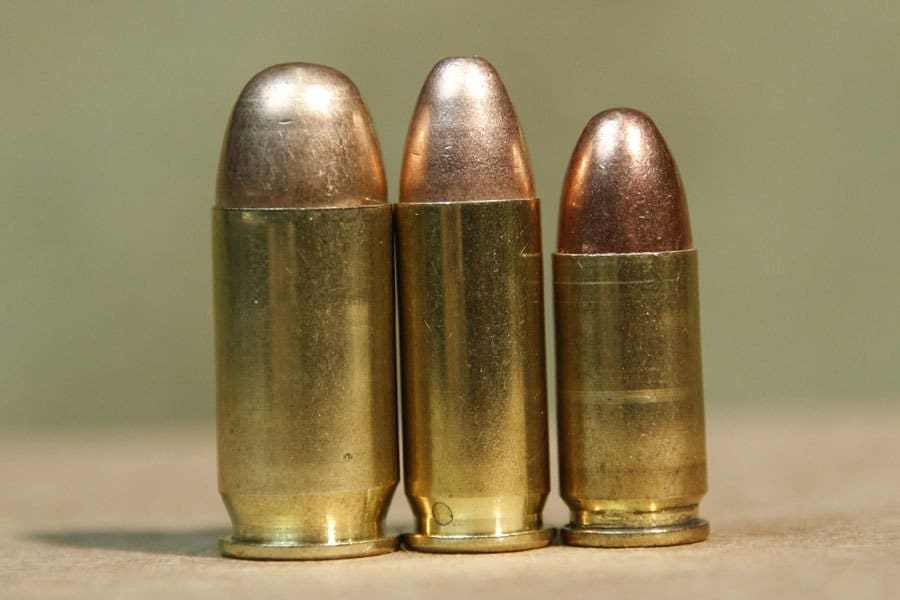
The biggest difference between these cartridges is the bullet weight and, of course, the diameter.
For an in-depth look at how bullet weight affects terminal performance, check out our article How Does Bullet Weight Actually Affect Performance?
9mm Luger Ballistics
The 9mm Luger is extremely popular for a reason. It produces only 4 to 6 ft lbs of recoil, depending on the ammunition and the gun it’s shot out of.
This is manageable for basically anyone who should be firing a handgun and makes it easier to follow up. Additionally, it produces 300 to 400 ft lbs of energy that can be increased to over 500 ft lbs with specialty loads. More than enough to stop a person.
Typical 9mm Luger velocities range from 1000 fps to 1300 fps, but some specialty ammunition can even exceed 2,000 fps. Granted, these velocities are only achieved with very light 50-grain bullets and in +P ammunition.
If shooting longer range with a handgun, 9mm ammunition typically drops 7 to 11 inches at 100 yards.
If you’re thinking of running 9mm in a Glock, this article is a must-read: Best 9mm Ammo for Glock 19 Pistols [Defense, Range & Bulk Buying]
.45 ACP Ballistics
As with the 9mm Luger, a wide variety of ammunition has been developed for this cartridge. The .45 ACP can achieve velocities of 2,000 fps with lightweight 90-grain bullets.
With more standard loads, typical velocities range from 830 on the low end to 1300 fps.
That said, the .45 ACP isn’t known for its speed but for its stopping power. The biggest difference between the 9mm Luger and .45 ACP is muzzle energy, and this is where the .45 ACP shines.
With specialty ammunition, the .45 ACP can produce over 800 ft lbs of energy. Standard off-the-shelf loads typically produce around 350 to 450 ft lbs of energy.
Longer-range ballistics are highly dependent on the ammunition and barrel length being used. Bullet drop at 100 yards will range from approximately 12 to 20 inches.
Ammo Selection and Cost
If you’re planning on target shooting with your handgun, ammo cost and selection should play into your decision-making process. Fortunately, both cartridges are popular, and there is a suite of ammunition available for each.
However, there is a big difference in cost. Target ammunition for the .45 ACP can be found for approximately 41 cents a round when purchased in bulk, while 9mm Luger ammo can easily be found for under 25 cents a round.
9mm Luger Ammo Selection
The 9mm Luger is one of the most common cartridges used around the world. Because of this, there is a plethora of ammunition available, ranging from light target loads like the Venom 115 Grain Full Metal Jacket target ammo to the hard-hitting CorBon 100 Grain +P Urban Response Hollow Points.
If you’re interested in specialty rounds that make range time a little more interesting checkout the Paraklese 124 Grain Dragonslug.
Wood’s defense rounds are also made for the 9mm Luger. These are often made with hardcast bullets or lighter specialty slugs designed for deep penetration and minimal expansion.
For more information on the best +P 9mm ammunition available today check out our article The 5 Best +P 9MM Cartridges for Defense & EDC.
.45 ACP Ammo Selection
Similar to the 9mm Luger, the .45 ACP is an extremely popular cartridge used around the world. Because the .45 ACP is a popular self-defense cartridge, there is a plethora of self-defense ammunition available.
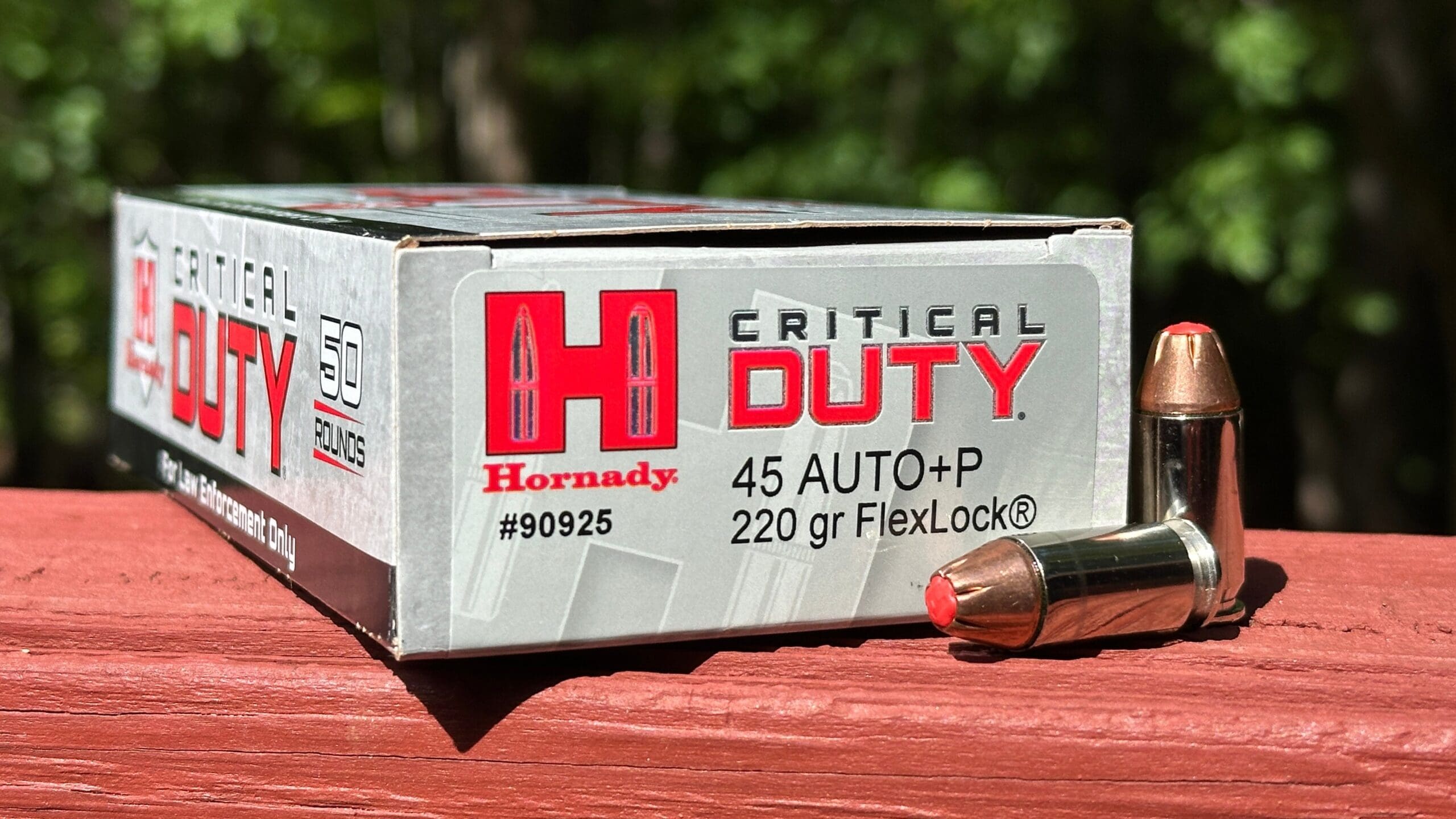
The Hornady American Gunner 185 Grain XTP is a popular hollow point round commonly used for self-defense. Another popular self-defense option for those looking for +P ammo is the Hornady Critical Duty 220 Grain +P Flex Lock JHP, which is loaded with a 220 Grain jacketed hollow point bullet.
Specialty self-defense ammunition like the Black Hills Honey Badger 135 Grain is also available. This ammo is loaded with a 135 grain full copper bullet. If you also need a woods load for defense against four-legged animals, the G9 Defense 165 Grain +P Woodsman is a good option.
9mm Luger Vs. .45 ACP Capacity
When selecting a handgun, there are two common types of magazines: single-stack and double-stack.
In single-stack magazines, the bullets sit one on top of the other. Single-stack magazines are great for concealed-carry weapons, where the handgun’s width is extremely important for reducing printing and increasing comfort.
Double-stack magazines are wider than single-stack magazines; however, they often hold 1.5 times as many rounds of ammunition as a single-stack magazine of the same length.
The catch to most double-stack magazines is that they are thicker than single-stacks.
Something else to consider is that the larger the cartridge, the larger the magazine has to be to hold the same amount of ammo; of course, the handgun will also need to be slightly larger. This is one of the downsides to the .45 ACP.
To make a .45 ACP handgun the same size as a 9mm Luger handgun, something has to give, and that’s the capacity of the firearm.
Some subcompact .45 ACP handguns only hold 5 or 6 rounds in their magazines compared to 10 rounds of 9mm in similar-sized guns.
9mm Luger Vs. .45 ACP Ease of Carrying
If you’re looking for a concealed carry gun, you should consider the size. The smaller the gun, the easier it will be to conceal.
However, the smaller the gun, the more difficult it will be to shoot accurately. There’s a fine line between too small and too big to carry every day.
Everyone is different, so to pick out the best-sized gun for you, I’d suggest going to a range where you can rent guns and try a few of them to see which works best for you.
Next, let’s compare the M&P 45 Shield M2.0 to the M&P 9 Shield Plus. Both handguns are currently being produced by Smith and Wesson, and both are considered micro compacts.
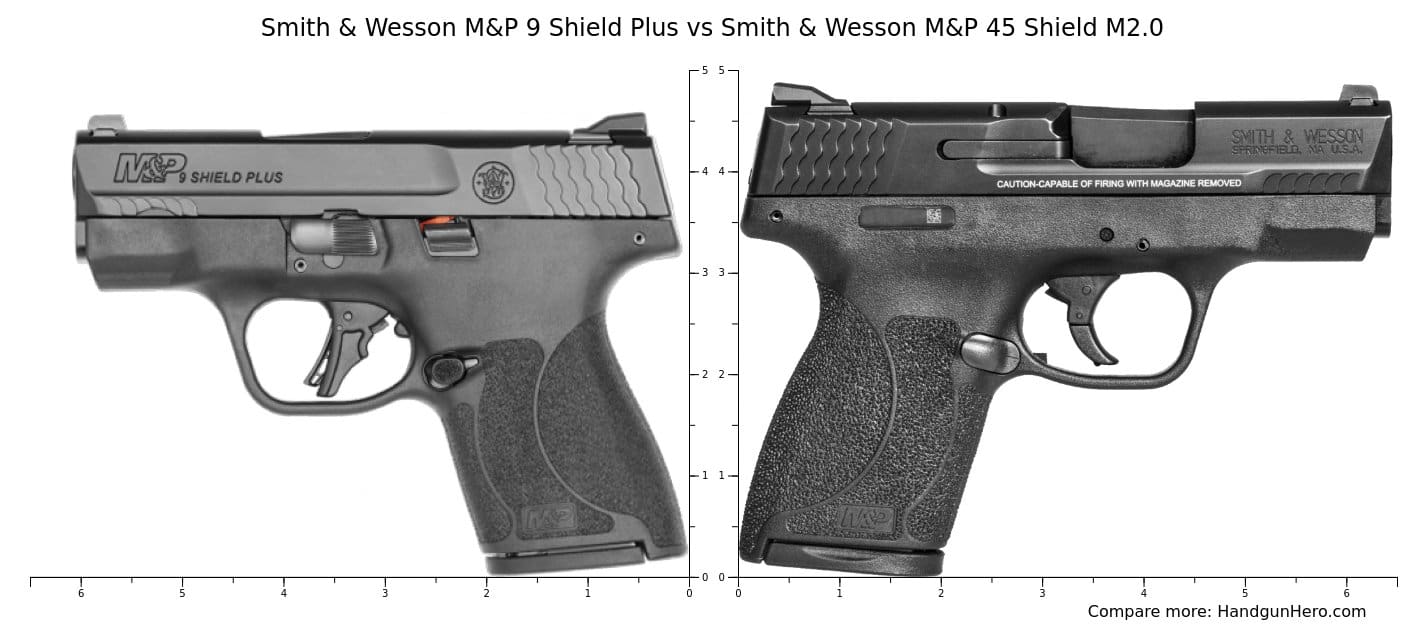
The M&P 45 Shield M2.0 is chambered in .45 ACP, has a 3.3-inch barrel length, is 1.05 inches wide with a thumb safety, 5 inches tall, 6.45 inches long, and weighs 20.5 oz. This gun also comes with a 7-round single-stack magazine.
The M&P 9 Shield Plus is chambered in 9mm Luger, sports a 3.1-inch barrel, is 1.1 inches wide with a thumb safety, is 4.6 inches tall, 6.1 inches long, and weighs 17.9oz. It is also sold with 10- and 13-round double-stack magazines.
Depending on the carrier’s body size and shape, both of these guns would probably carry about the same. However, the capacity and weight are different enough to make a difference.
The M&P 45 Shield M2.0 is taller and longer than the M&P 9 Shield Plus. If you’re a fairly small person, the 9mm will likely carry better.
Home Defense Vs. Concealed Carry
Many people, myself included, use the same handgun they carry concealed as their home defense gun.
While this has the obvious cost savings of not having to purchase another handgun, a home defense handgun can be much larger than a concealed carry handgun.
For home defense, the sky’s the limit on size. Some people use shotguns and rifles, while others prefer to stick with handguns.
For example, a 1911 .45 ACP would make a fantastic home defense gun, even though it would be very difficult for most to conceal.
If you would like to purchase a separate handgun for home defense, you should consider getting a larger-framed handgun that will have a higher capacity, be easier to shoot accurately, and be easier to hold. A larger gun will also recoil less and be easier to shoot.
For concealed carry, it’s best to stick with compact or micro-compact handguns that are slim so they don’t print.
However, the smaller and lighter the gun, the more difficult the recoil will be to control, and the shorter the sight radius, the distance between the front and rear sights, the harder it is to shoot accurately.
If you decide on a handgun chambered in 9mm Luger for self-defense and are interested in learning about the best self-defense ammunition, our article What is the Best 9mm Self Defense Cartridge for EDC? goes into detail about the best ammo.
Woods Defense
Outdoorsmen and women often carry a handgun for self-defense against four-legged animals like bears, mountain lions, and wild hogs.
While many choose the 10mm Auto or a larger caliber revolver, there is an argument to be made for the 9mm Luger and 45 ACP.
As we’ve mentioned before, the 9mm Luger and .45 ACP are extremely common. There’s a good chance that if you are considering buying a woods defense gun, you may already own a firearm chambered in one of these cartridges.
While there are better options, both of these cartridges can work with the right ammunition. While the .45 ACP typically delivers more energy due to the heavier bullets it fires, the 9mm Luger typically offers better penetration and capacity.
For woods defense, penetration beats energy. To stop a bear or wild hog quickly, hitting the central nervous system is a must. To do this, the bullet needs to be capable of penetrating through thick bone and muscle.
There are anecdotal stories of hunters harvesting bears and later finding a .45 ACP bullet resting against the skull of the bear.
It’s clear that at least in one or two cases, the .45 ACP failed to penetrate a black bear skull, not what you want in a life-and-death situation.
The 9mm Luger, loaded with hard casts or other bullets designed for maximum penetration, would be the best choice of these two cartridges.
If you own a .45 ACP handgun and don’t want to purchase another one for woods defense, use ammunition that is designed for maximum penetration.
This ammunition will likely be loaded with hard casts, and if safe in your firearm, consider using +P ammunition, which will increase the velocity of the heavy bullets, maximizing penetration.
If you find yourself in bear country and you want a handgun to match, read this article: The 8 Best Bear Defense Handgun Cartridges in 2026
Why Is the 9mm Luger Our Top Pick in 2026?
The 9mm Luger and the .45 ACP have a rich history of use throughout many wars across the world and for self-defense. However, if you have to choose between just one of them, the 9mm Luger would be our choice.
With appropriate ammo selection, for all practical purposes, the 9mm Luger can do everything that the .45 ACP can do.
Additionally, the 9mm Luger can be chambered in smaller guns that are easier to carry for smaller individuals, recoil is more manageable in large and small-framed handguns, and capacity is higher.
Additionally, the 9mm Luger is extremely versatile. It can be loaded with high-velocity 50-grain bullets and up to 185-grain subsonic bullets. Its ballistic capabilities make it a highly capable round for self-defense and target shooting.
Which brings us to our next point. To become proficient with a handgun, you must practice a lot. Shooting hundreds and even thousands of rounds of handgun ammunition is expensive.
However, target ammo for the 9mm Luger is approximately half the cost of the .45 ACP.
Short History of the 9mm Luger and .45 ACP
To fully understand a cartridge, you need to understand its history. Below, we give a short history of both cartridges and cover what they were initially designed for.
History of the 9mm Luger
The 9mm Luger is the most popular and common handgun cartridge ever developed, and can be found throughout the world.
The 9mm Luger, otherwise known as the 9x19mm and 9mm Parabellum, was designed in 1901 by an Austrian named Georg Luger. Georg served as an instructor at a military firearms school in Austria.
Afterward, he bounced around jobs before landing a design consultant position with a weapons engineering company in Germany.
Before creating the 9mm Luger, Georg worked on developing magazines, presented firearms to various militaries, including the US military, and helped develop the 7.65x21mm Parabellum and the Luger Parabellum pistol, which became popular in America, Europe, and even Brazil.
However, they needed more power, so the bullet diameter was increased to 9mm. Additionally, the cartridge’s length was shortened to 19mm. The 9mm Luger was born and released to the public in 1902,
Since then, the cartridge has been used in dozens of wars, including World War I and II, for self-defense against people and animals, and even for hunting.
The cartridge has also been chambered in many types of firearms, ranging from full-sized handguns to micro compacts, rifles, and even submachineguns.
History of the .45 ACP
The .45 ACP also has a rich history and was developed shortly after the 9mm Luger. The .45 ACP was also initially designed for combat. In 1899, the US military was involved in the Moro Rebellion.
During the rebellion, the Moro fighters were known to have taken drugs, and the US soldiers had a hard time stopping them with their military-issued .38 Long Colt revolvers.
Because of this, the military did some additional testing in 1904. The testing showed that the .38 Long Colt lacked the energy needed for military use.
They also tested the .45 Colt, and it did much better during the testing. However, the military was interested in developing a round that would function in a semi-automatic pistol.
This is where Colt and John Browning come into the picture. With guidance from the US military, they designed a .45 caliber cartridge and a Model 1905 pistol to fire it.
After multiple revisions and modifications, the pistol eventually became the famous Model 1911 that fires the .45 ACP.
Parting Shot
While the 9mm Luger is our pick between the two cartridges, this doesn’t mean that we think the .45 ACP is a bad cartridge. Quite the opposite, rather.
The .45 ACP is a proven cartridge that is fun to target shoot with and is highly capable of stopping threats.
However, the 9mm is more versatile and much cheaper to practice with, and for most people, this means that they will shoot more, which will lead to increased proficiency.
Both cartridges are very capable, and in the end, it really comes down to personal preference and use case.
9mm Vs .45 ACP FAQs
Is 9mm Better Than .45 ACP for Self-Defense?
For most shooters, 9mm makes more practical sense for self-defense because it offers lower recoil, faster follow-up shots, higher capacity, and cheaper practice ammunition. With quality defensive loads, it provides enough performance for typical defensive scenarios while being easier to shoot well.
Does .45 ACP Have More Stopping Power Than 9mm?
.45 ACP generally fires wider, heavier bullets and can produce strong muzzle energy, especially with specialty loads. Its advantage is not automatic, though. Shot placement, bullet design, recoil control, and the ability to make quick accurate hits matter more than caliber alone.
Why Is 9mm Often Easier to Carry Than .45 ACP?
Because 9mm cartridges are smaller, manufacturers can build compact pistols that hold more rounds without becoming bulky. Comparable .45 ACP handguns often carry fewer rounds, weigh more, or have larger dimensions, which can matter for concealed carry comfort and concealment.
Which Cartridge Is Cheaper to Practice With?
9mm is usually much cheaper for range use. Bulk target loads commonly cost far less than .45 ACP, making regular practice more affordable. Since handgun skill depends heavily on repetition, lower ammunition cost is a major advantage for many shooters.
Is 9mm or .45 ACP Better for Woods Defense?
Neither is ideal compared with cartridges like 10mm Auto, but 9mm can be a practical choice with deep-penetrating hard-cast or specialty loads. For animals with heavy bone and muscle, penetration and accurate placement are more important than bullet diameter alone.