The 10mm and .45 ACP are two of the most popular big-bore pistol cartridges around, carried by hunters, sport shooters, and anyone who wants serious stopping power in a semi-auto.
In the 10mm vs .45 ACP matchup, the 10mm hits harder, shoots flatter, and holds a round or two more, while the .45 ACP kicks less and costs less to feed. We’ll cover the ballistics first, then what matters in the real world: felt recoil, magazine capacity, and what you can realistically accomplish with each cartridge.
TL;DR: The Best Pick for Defense, the Woods & the Range
Need to pick a cartridge but don’t have time to dig through every detail? Here are our quick picks.
Best for Home Defense & Concealed Carry: .45 ACP. Its milder recoil makes fast, accurate follow-up shots easier, and proven 230-grain hollow points meet FBI penetration standards. Shop Federal HST 230 Grain JHP.
Best for Bear Country & Handgun Hunting: 10mm. Hard-cast and solid copper loads drive deep through heavy muscle and bone with far more energy than standard .45 ACP. Shop full-power 10mm ammo.
Best for High-Volume Practice: .45 ACP. Practice ammo is easier to find and usually cheaper per round, so you can afford more time on the range. Shop Speer Lawman 230 Grain TMJ.
10mm Vs .45 ACP Ballistics: Velocity, Energy & Penetration
The 10mm runs far hotter than the .45 ACP. SAAMI specs allow the 10mm up to 37,500 psi, while a standard .45 ACP load is capped at 21,000 psi.
| Spec | 10mm Auto | .45 ACP |
|---|---|---|
| Bullet diameter | .400 in | .451 in |
| Case length | 0.992 in | 0.898 in |
| Max overall length | 1.260 in | 1.275 in |
| SAAMI max pressure | 37,500 psi | 21,000 psi (23,000 psi +P) |
| Common bullet weights | 155 to 220 gr | 185 to 230 gr |
| Typical muzzle energy (5-in. barrel) | 500 to 700 ft-lbs | 350 to 415 ft-lbs |
| Glock magazine capacity | 15 rounds (Glock 20) | 13 rounds (Glock 21) |
Typical 10mm loadings might propel a 180-grain bullet from a 5-inch barrel at a muzzle velocity of 1,150 to 1,300 fps, producing 500 to 700 ft-lbs of energy.
Many 200-grain hard-cast or defensive bullets will still land in the 550 to 650 ft-lbs range, and some special loads will exceed those numbers.
A typical .45 ACP load with a 230-grain bullet will generate between 350 and 415 ft-lbs of energy from a 5-inch barrel, with muzzle velocity in the neighborhood of 830 to 900 feet per second.
+P loads are available in .45 ACP, but even these special loads do not generate as much power as full-power 10mm ammunition. Lighter 185-grain hollow points in +P loads can approach 1,000 fps and 400 to 450 ft-lbs of energy.
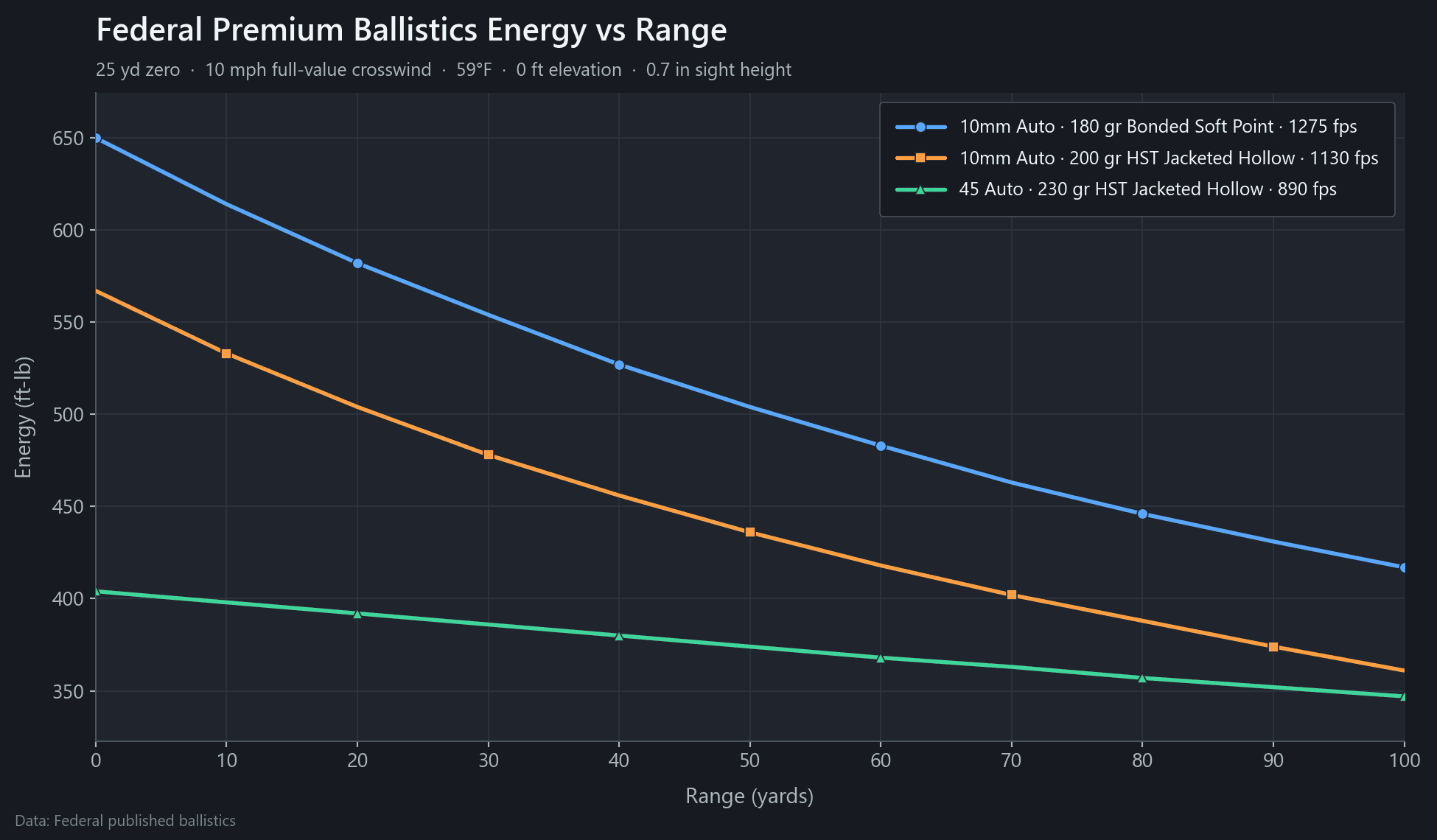
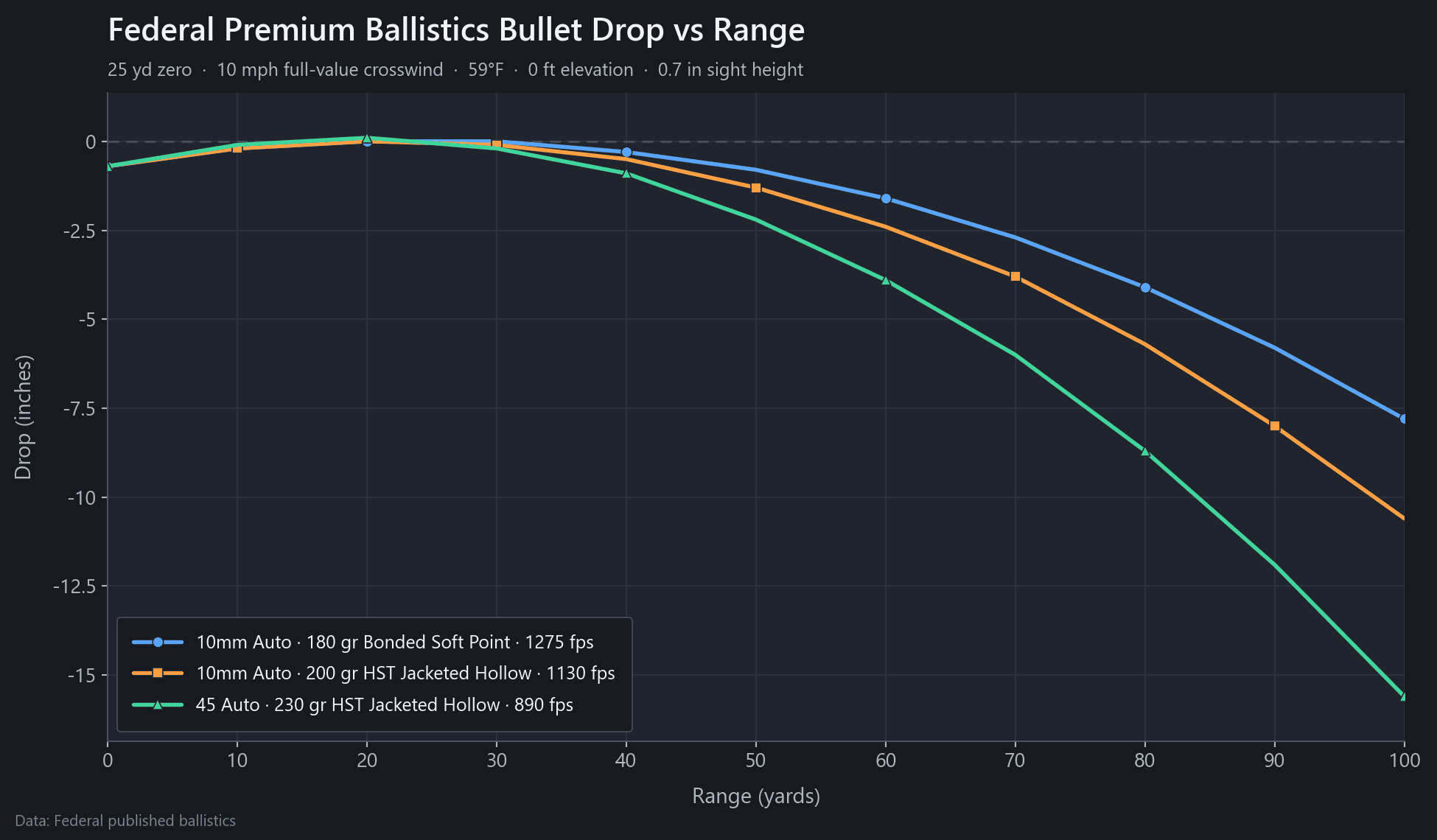
When it comes to raw energy and velocity, the 10mm wins in a landslide. The .45 ACP does counter with a larger diameter bullet that can create a bigger wound channel once it expands.
Quality 10mm hollow points generally expand well and penetrate from 14 to 18 inches in ballistic gel tests. Comparable .45 ACP bullets will penetrate 12 to 16 inches and, due to size, will have slightly larger expansion diameters.
The extra energy from the 10mm tends to help with barrier performance and deeper penetration when needed.
To get a deeper dive into how energy numbers are calculated and why they matter, see our article on What Is Firearm Muzzle Energy? [Why It Actually Matters].
Bullet weight also affects performance in either cartridge. Lighter bullets generally fly faster and may expand more easily at shorter ranges, while heavier bullets usually penetrate deeper thanks to their higher momentum.
Popular defensive loads like the Federal HST 200-grain 10mm (or a comparable Speer Gold Dot) should exhibit good penetration and expansion.
For a lighter 10mm option, the CorBon 155 Grain DPX Hollow Point uses a solid copper bullet, so there’s no jacket to separate at 10mm velocities.
On the .45 ACP side, the Federal HST 230-grain and Speer Gold Dot 230 have long track records of reliable performance in both tests and real-world applications.
Recoil & Shootability: The Difference You Feel First
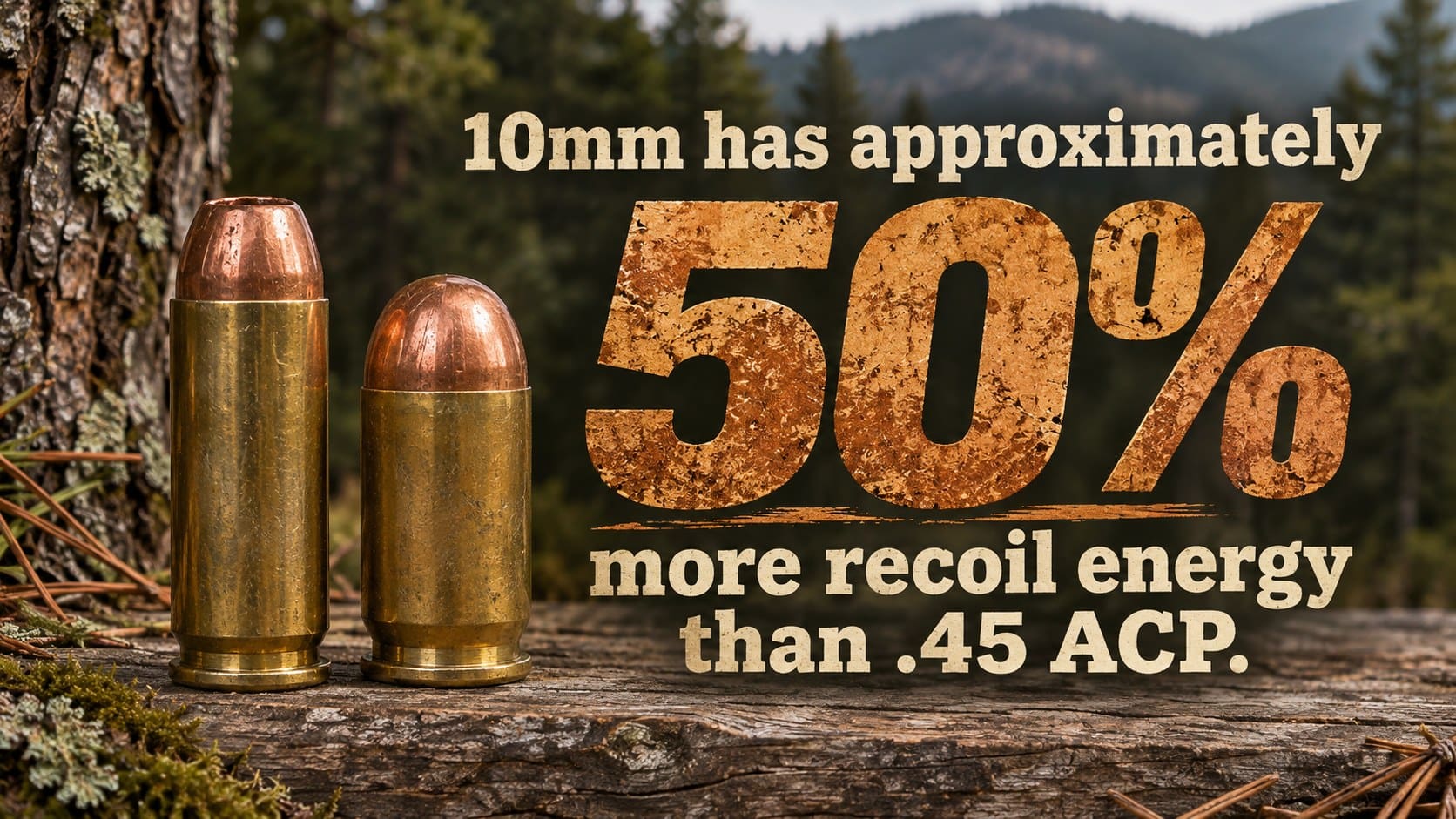
In a similar-sized pistol, a full-power 10mm will generally put out about 50% more recoil energy than the .45 ACP. That’s a big deal!
The .45 ACP has a slower, rolling push that many shooters find easier to manage than the 10mm. The 10mm snaps harder and has more muzzle rise, particularly out of guns with lighter frames.
Heavier firearms will help to soften the recoil in both of these cartridges, but the gap still remains. You can find some 10mm factory loads that are down-loaded closer to .40 S&W levels, but that reduction in recoil also cuts well into the ballistic performance.
Shootability matters most under stress. It’s much more important to place consistent groups on target with a cartridge than to use one that performs exceptionally well ballistically but you struggle to shoot accurately.
If you tend to be a bit recoil-sensitive or are a newer shooter to larger-caliber handguns, starting with the .45 ACP will let you build confidence and skill before jumping to the hand cannon that the 10mm can become.
Shooters who already have experience with magnum revolvers or hotter loads can often adapt to the 10mm without much trouble.
Of course, practice and proper technique go a long way with either cartridge. A firm grip with locked wrists and a consistent stance will help to reduce muzzle rise.
Compensators and ported barrels can tame the 10mm a little more, and both show up more often on competition and hunting pistols than on dedicated defensive guns.
Many shooters also notice that the 10mm recoil feels sharper in the hands than the free recoil energy numbers alone would suggest. This is due to the faster pressure curve that the 10mm cartridge has.
See the recoil difference for yourself in this side-by-side from Hickok45, who runs a Glock 20 against a Glock 21 and a pair of Colt 1911s.
How Capacity & Pistol Options Compare
The narrower 10mm case often allows one or two more rounds in a magazine of the same length compared to the larger .45 ACP.
A Glock 20 in 10mm commonly holds 15 rounds while the similar sized Glock 21 in .45 ACP only holds 13 rounds. To some, that is a big difference.
Both cartridges are available in a wide range of different platforms, from the classic 1911s to more modern polymer double-stacks like the Glock.
The .45 ACP has a longer history and more options overall, including the popular single-stack 1911s due to their feel and reliability.
Capacity differences become more noticeable in double-stack designs. The extra rounds in a 10mm magazine can matter more for some shooters who want the extra capacity, but shot placement and the ability to reload quickly usually matter more than having one or two extra cartridges in a defensive situation.
Both calibers work in modern, optic-ready pistols. Red-dot sights can help manage the recoil of the 10mm by letting you track and use the dot to reacquire the target after muzzle rise.
If you are weighing the idea of a steel 1911 against a polymer-framed pistol in .45 ACP, check out our article on Choosing a .45 ACP 1911 Pistol Vs Polymer Pistol [Cost & More] that covers the trade-offs in weight, cost, and maintenance.
The double-stack 10mm pistols tend to be larger and heavier, which helps control recoil but can make everyday carry and concealment a little more challenging and burdensome.
Best Cartridge for Home Defense & Concealed Carry
For most urban or home defense situations, the .45 ACP is the more practical choice between the two. With quality expanding hollow points in the 185 to 230 grain range, they meet the FBI penetration standards while remaining more controllable than the 10mm.
If you want to try the lighter end of that range, Hornady American Gunner 185 Grain XTP is an affordable hollow point to run through your pistol before you trust it for defense.
The .45 ACP’s recoil is manageable enough for most people in the family to use in a defensive role.
Everyday concealed carry definitely favors the .45 ACP for most people because of the recoil and a wider selection of compact and subcompact pistols available.
Full-sized 10mm pistols are less common in concealment roles, though some carriers find success with them in the right holster and clothing types.
When it comes down to it, for the best self-defense option at home or in public, go with the .45 ACP.
To see how 10mm and .45 ACP defensive hollow points hold up in gel and through a simulated barrier, this test from Gun Sam Revolver Ballistics runs Sig V-Crown loads in both.
Best Cartridge for Bear Country & Handgun Hunting
The 10mm shines when you need deeper penetration against larger threats or barriers. Full powered loads with hard cast or controlled expansion bullets perform well for hunters that want to carry and defend against predator animals.
For use in the field or woods, the 10mm’s higher velocity helps it maintain energy and penetrate heavy bone or muscle better than standard .45 ACP loads.
Hard-cast or solid copper penetrator bullets in 10mm are popular choices when the intended target is a large animal rather than a human threat.
Woods loads like these come and go on the shelf, so check the current full-power 10mm ammo selection before your next trip into the backcountry.
Hunters that use handguns to take medium-sized game often prefer the 10mm because it can be loaded to match the capabilities of some of the milder magnum revolver cartridges while still offering semi-automatic capacity and faster follow-up shots.
Beyond extremely short ranges, the .45 ACP isn’t often used for hunting.
Our roundup of The 8 Best Bear Defense Handgun Cartridges in 2026 places the 10mm near the top of the list for those who want a very practical semi-auto pistol option for protection against bears.
What It Costs to Feed a 10mm Vs a .45 ACP
The .45 ACP has a clear edge in ammo availability and cost. Practice ammunition is easier to find and usually costs less per round.
Defensive loads from manufacturers are widely available in both calibers, but buying in bulk for range sessions is easier and more affordable with .45 ACP.
The 10mm has improved in availability in the last 10 years and more options have become available. Still expect to pay a premium price for quality 10mm, especially for specialized hunting and bear loads.
The lower cost of .45 ACP FMJ or training loads means that you can afford to send more rounds downrange, which pays off in real-world situations when you need it most.
Hollow points remain the popular choice for defensive use in both the .45 ACP and the 10mm. See our article on FMJ Vs Hollow Point: Which Should You Actually Carry? for the key differences between the two bullet options.
Bulk cases usually carry the best per-round pricing for both calibers, so check our bulk .45 ACP ammo selection to keep your range sessions affordable.
For .45 ACP, a case of Speer Lawman 230 Grain TMJ is an easy way to stock up on range ammo. On the 10mm side, CCI Blazer Brass 180 Grain FMJ is a solid practice round that won’t eat your whole budget.
10mm or .45 ACP: Match the Cartridge to the Job
Match the cartridge to your intended use, your platform, and the amount of practice time you have. Both make excellent choices for serious handgun work.
.45 ACP or 10mm? Both are fine choices. In the end, practice makes perfect, and the caliber you choose won’t make nearly as much difference as the amount of quality practice you do.
Keep an ample supply of bulk practice ammunition, and always have an adequate supply of your proven defensive ammunition on hand so you’ll be prepared when it counts.
If you get the opportunity, take them both to the range and shoot them side by side with the loads you would actually use.
The numbers on paper only go so far; what counts most is how these cartridges feel when you fire them and how accurately you can place shots, and that’s how you’ll figure out which one belongs in your holster or nightstand.
10mm Vs .45 ACP FAQs
Is 10mm More Powerful Than .45 ACP?
Yes. In almost all cases, a full-power 10mm will outperform standard .45 ACP loads in velocity, pressure, and muzzle energy. That generally translates to better penetration and barrier performance, although it also means more recoil and, potentially, more challenging handling.
Which Is Better for Self-Defense, 10mm or .45 ACP?
For most home or personal defense roles, the lower recoil of .45 ACP makes for easier handling and, for many shooters, quicker, more accurate follow-up shots in a stressful situation. Quality hollow points also have a track record of good penetration and expansion.
Why Do Outdoorsmen Often Choose 10mm?
Outdoorsmen often choose 10mm because most full-power loads will push hard-cast or controlled-expansion bullets deep enough to get through the heavy muscle and bone of large animals. It also gives the shooter a powerful semi-auto with more energy than standard .45 ACP loads.
Does .45 ACP Have Less Recoil Than 10mm?
Yes. In similar-sized handguns, .45 ACP usually has less recoil and is easier to control and shoot accurately. The 10mm kicks harder and sharper and tends to have more muzzle rise, which makes .45 ACP easier for high-volume practice and defensive shooting.
Is 10mm or .45 ACP Cheaper to Shoot?
.45 ACP is generally cheaper and easier to find, especially for practice ammunition bought in bulk. The 10mm has become more available, but full-power defensive, hunting, and bear loads usually cost more per round.