Revolvers have a long track record as a dependable home defense firearm. Their simple design creates consistency and dependability that some prefer over semi-automatic firearms for home defense. Modern loads are turning classic revolver cartridges into effective home defense stoppers.
You get reliable functionality, controllable recoil, and the option to load specialized defensive ammunition.
That combination makes sense for many homeowners who just want a straightforward nightstand firearm that they don’t have to worry about.
Top Home Defense Revolver Ammo Picks
Defensive loads for all five cartridges, from recoil-sensitive shooters to big-bore fans and six-shot small frames.
-
Best for Newer & Recoil-Sensitive Shooters
-
Best All-Around Home Defense Load
-
Best for .44 Magnum Revolver Owners
-
Best for Big-Bore Stopping Power
-
Best for Six-Shot Small-Frame Revolvers
Why a Revolver Works Well Indoors
A double-action revolver is ready to go with minimal movement outside of a long, consistent trigger pull. There is no slide to rack and no magazine to worry about if the gun sits loaded for months without use.
Most defensive revolvers hold five or six rounds, which is usually enough for short ranges typical of self-defense and home defense encounters. Follow-up shots are straightforward once you learn the trigger, and speedloaders or moon clips can make fast reloading possible with practice.
That flexibility is especially useful with bigger, heavier cartridges like the .357 Magnum and the .44 Magnum that also accept lighter rounds for better and longer practice sessions.
Lucky Gunner’s Chris Baker walks through where revolvers fall short and why they still make sense for a gun that mostly sits in a drawer:
Why Hollow Points Are the Default Choice
Expanding hollow point bullets will transfer energy more efficiently while creating a larger wound channel compared to regular ball ammo.
Hollow points also reduce the chance of pass-through shots that go through the target and then continue through walls into other rooms where bystanders can also be hit.
This really matters inside of homes and apartments where innocent people can be close to your home defense situation.
Quality modern hollow points are designed to expand reliably, even at slightly slower velocities that can be found in shorter-barreled revolvers.
For a side-by-side look at how the two bullet types behave, see our guide on FMJ Vs Hollow Point: Which Should You Actually Carry.
1 | .38 Special +P: The Controllable Workhorse
Standard pressure .38 Special loads are mild, but the +P versions of this cartridge push the velocity and energy into a more useful range for defensive shooting.
Typical +P loads in the 110- to 158-grain range create roughly 200-290 ft-lbs of energy from a standard 4-inch barrel. Many short-barrel-optimized rounds will deliver reliable bullet expansion.
The recoil stays manageable in medium-frame revolvers. This helps with accurate follow-up shots in high stress situations. That recoil is what really helps the .38 Special +P make this short list of home defense revolver cartridges.
Popular ammo choices in the .38 Special +P include the Speer Gold Dot Short Barrel 135gr +P and the Hornady Critical Defense 110gr FTX +P.
Both of these are engineered for the lower velocity that is common in snub-nosed and mid-sized revolvers. They expand well and penetrate in the deadly 12 to 16 inch range during testing without over-penetrating for safety.
The .38 Special is widely available and quite affordable, so stockpiling ammunition is possible. Also keep in mind that a .357 Magnum revolver can safely fire .38 Special, giving you an easy path to milder practice rounds if you later upgrade. A bulk case like the Speer Lawman 125 Grain TMJ (1,000 rounds) covers a lot of that range time.
For a full comparison of power and recoil, check out our article on .357 Magnum vs .38 Special: Ballistics, Recoil & Best Uses.
2 | .357 Magnum: Maximum Versatility in One Gun
Any .357-chambered revolver will also shoot the .38 Special, so you can train with the milder round and keep the full-powered Magnum loads for home defense situations. Plain range ammo like CCI Blazer Brass 125 Grain FMJ in .38 Special keeps those training sessions affordable.
A 125-grain hollow point often leaves a standard 4-inch revolver barrel around 1,300 to 1,450 feet per second and produces 450-650 ft-lbs of energy.
That roughly doubles the energy of many .38 Special loads. Heavier 158-grain bullets trade some velocity for deeper penetration and are popular for more barrier performance.
The downside to the .357 Magnum is that recoil and muzzle blast increase noticeably compared to the .38 Special. This is especially true in smaller-frame and short-barreled revolvers.
A medium-frame steel revolver with a 3- or 4-inch barrel keeps the .357 Magnum controllable for most shooters while still packing a big punch.
The 125- and 135-grain hollow point options expand reliably and stay in reasonable penetration depths. Avoid the hot hunting loads for indoor use and stick with purpose-built home defense ammunition to keep these hot rounds from over-penetrating.
Also keep in mind the barrel length affects velocity more than most people expect. Our article on How Barrel Length Affects Bullet Velocity and Performance explains the specifics.
3 | .44 Special: Big Bore Without Magnum Recoil
The .44 Special shoots a .429-caliber bullet, second in diameter only to the .45 Colt on this list, but with a twist. Even though it is bigger, it comes with a moderate recoil with a sensible load.
It sits between the .38 Special and the hard-kicking .44 Magnum in power, which makes it popular with shooters who want a bigger bullet than a .357 without the full Magnum blast and recoil.
Put on one chart with a common defensive load for each, the .44 Special lands just above the .38 Special +P and well below both Magnums.
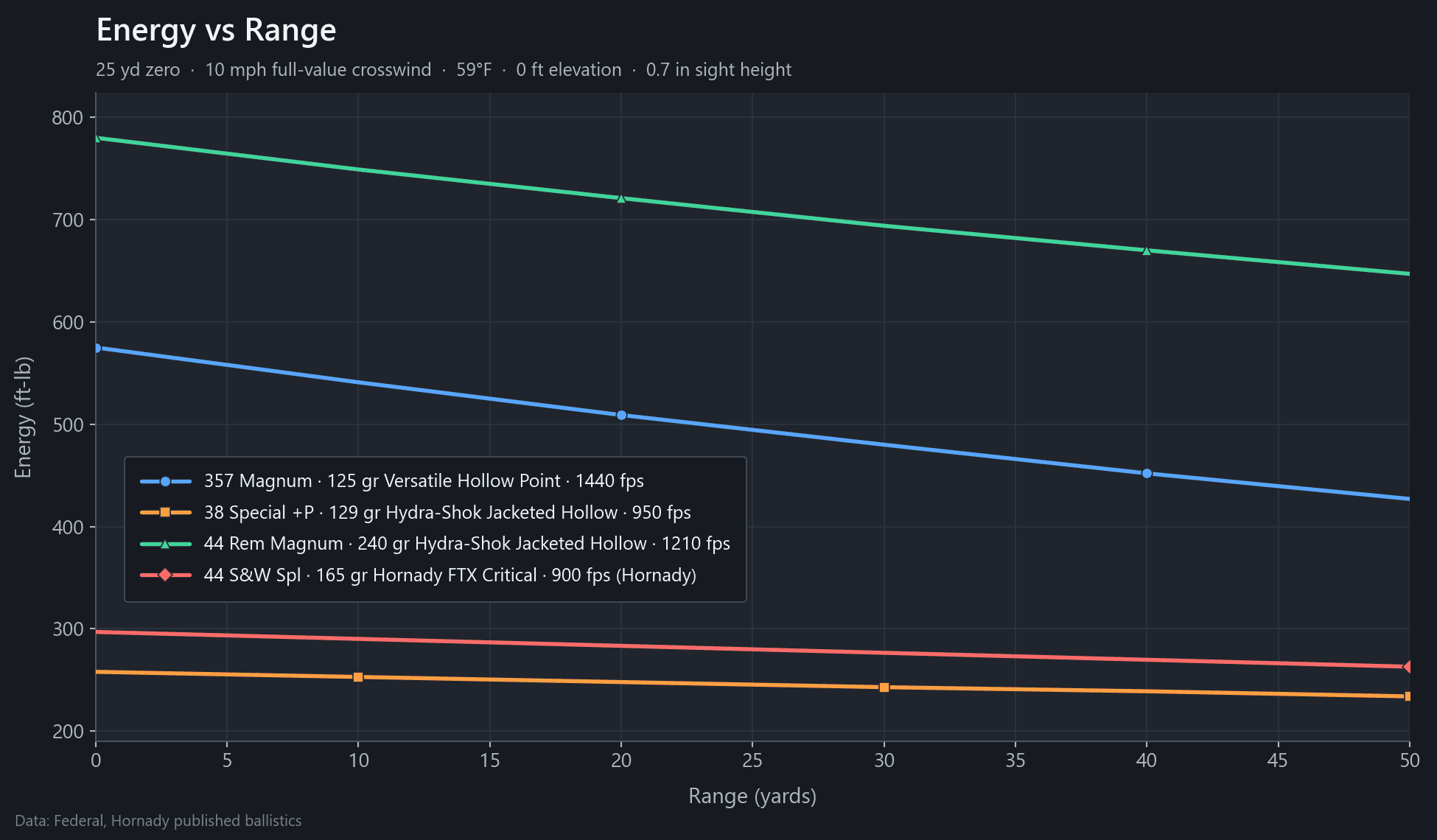
A typical defensive load uses a 165- to 200-grain hollow point at velocities in the 800 to 1,000 feet per second range from a standard 4-inch barrel.
Energy usually lands between 300 and 350 ft-lbs. That is enough performance with today’s modern expanding bullets.
The .44 Special is less common than .38 or .357. The ammunition selection is lower and prices are higher, and revolvers chambered in .44 Special are harder to find, too.
The upside is that any .44 Magnum revolver can also safely fire .44 Special. That gives owners of Magnum revolvers a milder option for home defense use. For range time, a soft-shooting lead load like the HSM Cowboy Action 240 Grain Lead Semi-Wadcutter keeps practice comfortable.
Hornady Critical Defense 165gr FTX and Speer Gold Dot 200gr loads are among the better defensive choices for the .44 Special.
They expand well at the velocities the cartridge produces while keeping the recoil manageable in medium- to large-frame revolvers.
4 | .45 Colt: Proven Big Bore Stopping Power
The .45 Colt has been a defensive cartridge for more than 150 years now. Modern loads improve on the original black-powder designs while retaining the mild recoil that makes this round easy to handle in a properly sized revolver.
Defensive hollow points in the 185- to 250-grain range usually fire 750 to 950 feet per second from a 4- to 5.5-inch barrel while producing roughly 300-400 ft-lbs of energy.
The large bullet diameter creates a large wound channel once expansion occurs.
We break down why that expansion matters in our guide on How Bullet Expansion Affects Stopping Power.
Recoil is easier to manage in steel-frame revolvers with 4-inch or longer barrels. Lightweight or short-barreled revolvers will increase recoil, so be sure to choose the platform carefully to handle this bigger cartridge.
There are numerous single- and double-action revolvers that are chambered for the .45 Colt. It remains very popular with shooters who want a big-bore option without the Magnum recoil. When you stock up for range days, start with our .45 Colt bulk ammo.
Popular .45 Colt loads like the SIG V-Crown, Hornady Critical Defense, and other similar modern loads expand reliably and stay inside of the useful penetration limits.
To avoid over-penetration, be sure to avoid heavy, high-velocity hunting loads. Stick with rounds that are designed for home defense.
5 | .327 Federal Magnum: Capacity & Manageable Power
The .327 Federal Magnum offers six rounds in small-frame revolvers that normally hold only five rounds of .38 Special or .357 Magnum. That extra round can bring peace of mind to many home defense revolver owners.
In a standard 3- to 4-inch barrel, a 100-grain hollow point will create 400 to 500 ft-lbs of energy. The recoil is milder than full-powered .357 Magnum in similar guns.
This helps with control and faster follow-up shots. The cartridge’s pressure peaks at 45,000 psi by SAAMI standards, well above the 9mm’s 35,000 psi maximum, so only load it in a revolver built for .327 Federal Magnum.
This is probably the least popular cartridge on the list, so ammunition and firearm options are a bit more limited than the more popular cartridges.
When you can find ammunition for it, buy in bulk and stockpile for practice range days while keeping the higher-performance rounds for home defense use. Keep an eye on our .327 Federal Magnum ammo, and grab a few extra boxes when your load is in stock.
Look for Speer Gold Dot and other similar expanding loads that perform well. This is definitely a cartridge for those shooters that want to prioritize round capacity and controllability over having a wide ranging choice of ammunition.
Discreet Defense Ranch put Hornady Critical Defense .327 Federal Magnum through a chronograph and ballistic gel from a Ruger LCRx:
How the 5 Revolver Cartridges Stack Up Side by Side
| .38 Special +P | .357 Magnum | .44 Special | .45 Colt | .327 Federal Magnum | |
|---|---|---|---|---|---|
| Typical Grain | 110-158 Grain | 125-158 Grain | 165-200 Grain | 185-250 Grain | 85-115 Grain |
| Muzzle Velocity | 850-1,000 fps | 1,200-1,450 fps | 800-1,000 fps | 750-950 fps | 1,300-1,500 fps |
| Muzzle Energy | 200-290 ft-lbs | 450-650+ ft-lbs | 290-350 ft-lbs | 300-400 ft-lbs | 350-500 ft-lbs |
| Recoil | Mild to Moderate | Moderate to Heavy | Moderate | Moderate | Mild to Moderate |
| Common Capacity | 5-6 Rounds | 5-6 Rounds | 5-6 Rounds | 5-6 Rounds | 6 Rounds |
| Ammo Availability | Excellent | Excellent | Fair | Good | Limited |
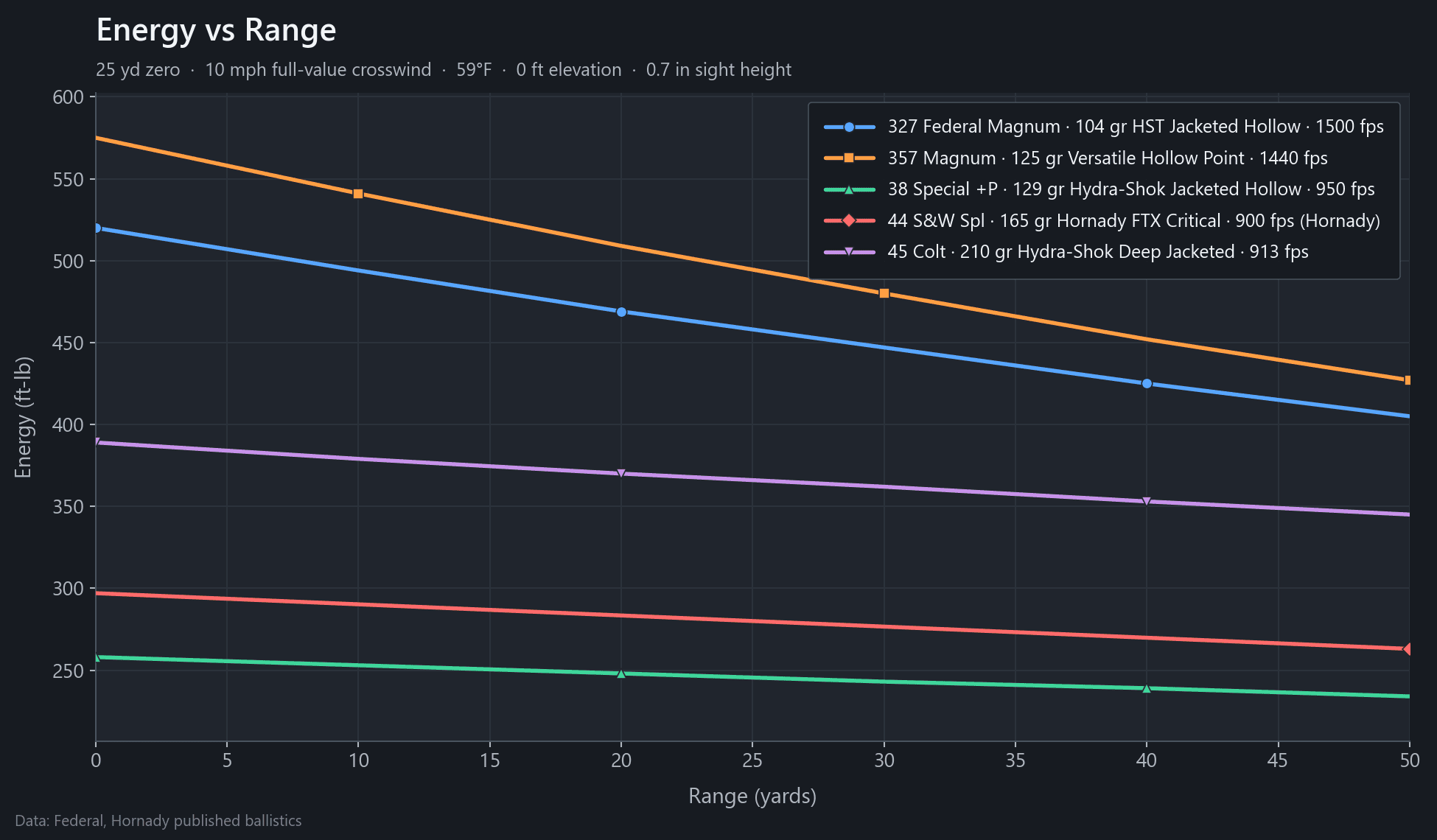
The chart below plots one defensive load per cartridge from the muzzle to 50 yards, and the order holds anywhere in your house: the .357 Magnum and .327 Federal Magnum lead, the .45 Colt sits in the middle, and the .44 Special and .38 Special +P trail.
Match the Cartridge to Your Setup
In home defense situations, the best cartridge choice is always going to be the one you can shoot accurately and quickly in stressful situations.
A mild .38 Special +P in a medium-frame revolver is often more effective for a newer shooter than the hard-kicking .357 Magnum that they can’t control the recoil of.
Consider the revolver’s weight, barrel length, and the type of grip. They will all have an effect on how well you shoot the chosen cartridge. Comfort and trust in your chosen revolver goes a long way.
Remember that shorter barrels reduce velocity and can make expansion less consistent in some loads. So be sure to choose ammunition designed for use in shorter barrels if that’s what you choose. Be sure to practice with your exact defensive load of choice.
Over-penetration also remains an important factor with any handgun round that meets the FBI 12- to 18-inch gelatin standard.
Hollow point cartridges help reduce that risk compared to full metal jacket ammunition, but it doesn’t totally eliminate that risk either. Know what is beyond your target and prioritize accurate shot placement.
If you share walls with neighbors or family, see our guide on Best Home Defense Ammo for Apartment Living: Reducing Over-Penetration Risks before you settle on a load.
Training and having a plan to be prepared for any situation is a must. Regardless of any cartridge choice, having a plan and being well prepared will make any cartridge choice the right choice.
Load It, Prove It & Keep It by the Bed
The .38 Special +P and the .357 Magnum cover most home defense needs with excellent ammunition availability and proven performance. The .44 Special and the .45 Colt add big-bore options that have manageable recoil in the right revolver frames.
The .327 Federal Magnum provides extra capacity for those who want an option with an extra round.
Choose a quality hollow point in a cartridge that will match your intended barrel length and the setup of your revolver frame.
Be sure to practice regularly and keep spare ammunition on hand for those practice days as well as to have on hand for any home defense situation that might arise.
Revolvers paired with the right cartridges remain simple, reliable tools for protecting your home.
Home Defense Revolver Cartridges FAQs
What Is the Best Revolver Cartridge for Home Defense?
For many shooters, .38 Special +P is the most practical choice because it balances manageable recoil, good hollow point performance, and broad ammo availability. More experienced shooters may prefer .357 Magnum, while big-bore fans may choose .44 Special or .45 Colt.
Is .357 Magnum Too Powerful for Indoor Defense?
.357 Magnum can be effective, but it produces more recoil, flash, and noise than .38 Special +P. In a medium-frame steel revolver with a 3- or 4-inch barrel, defensive 125- or 135-grain hollow points are usually more controllable.
Why Are Hollow Points Recommended for Home Defense Revolvers?
Hollow points are preferred because they expand in soft tissue, increase the effective wound channel, and reduce the likelihood of a bullet continuing through the target. They do not make walls safe, so shot placement and target awareness still matter.
Can a .357 Magnum Revolver Shoot .38 Special?
Yes. A revolver chambered for .357 Magnum can safely fire .38 Special and .38 Special +P ammunition. This makes training cheaper and more comfortable, while still allowing the owner to load full-power .357 defensive ammunition if desired.
Does Barrel Length Matter for Revolver Defense Ammo?
Barrel length affects velocity, recoil feel, and hollow point expansion. Short barrels are easier to store and maneuver, but they can reduce bullet speed. If using a snub-nose or compact revolver, choose ammunition designed for short-barrel performance.