Prefer audio over written content? Listen to the article here:
If you spend any amount of time around revolvers, you have probably heard about the debate between the .357 Magnum and the .38 Special.
They look similar, share the same bullet diameter, and one can even feed the other in the right gun. Yet they feel and perform very differently. One is mild and easy to shoot all day. The other hits harder, reaches farther, and asks more of the shooter. So which one of the two is the best option?
The .357 Magnum and .38 Special use the same .357 inch bullet, but the Magnum runs at roughly double the pressure for much higher velocity, energy, and recoil.
Any .357 Magnum revolver can also fire .38 Special, making the pair one of the most flexible combinations available on the market. This expanded guide will break down the real difference in history, ballistics, recoil, practical uses, and how to choose the right ammo and firearm for you.
A Closer Look at These Cartridges
The .38 Special was developed by Smith & Wesson in 1898 as an upgrade over earlier black powder cartridges like the .38 Long colt.
It quickly became popular because of its accuracy, reliability, and manageable recoil in the revolvers of the day and age. For decades, it earned a great reputation as the standard self defense and law enforcement cartridge.
By the early 1930s, shooters wanted more power than the .38 Special had to offer. Law enforcement started facing threats that the .38 Special couldn’t handle effectively, especially penetrating car doors of lawless criminals.
Experimenters started working with the .38 Special to improve it, resulting in lengthening the case by about one-eighth of an inch and loaded it with more powder at a much higher pressure.
The result was the .357 Magnum being born in 1935.
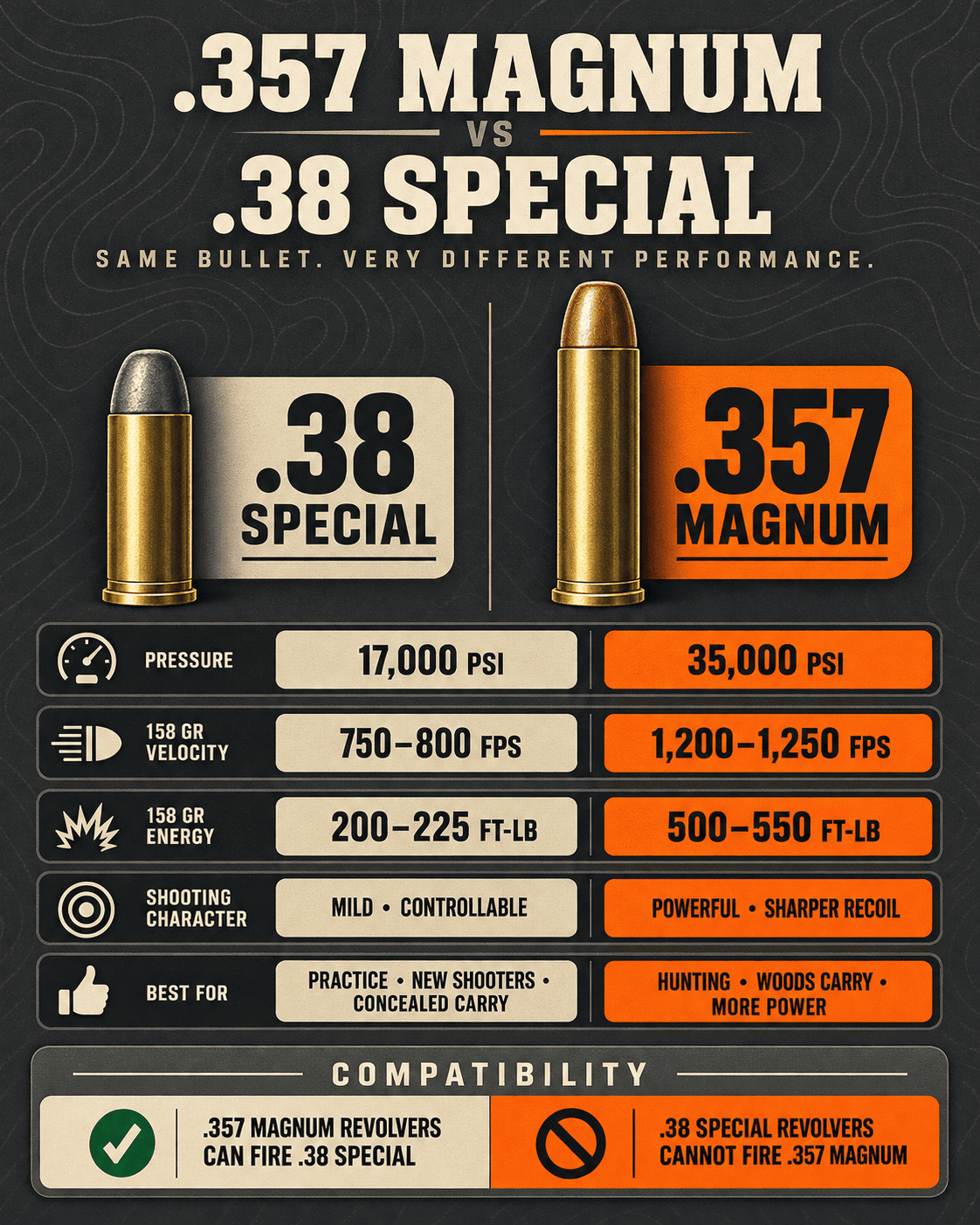
The extra case length was intentional. It prevents the hotter Magnum cartridge from chambering in a revolver designed for the lower pressure .38 Special. A .357 Magnum revolver, however, can safely fire both cartridges.
This one way compatibility remains one of the smartest design features in modern handgun cartridges. It gives owners built-in flexibility.
Both rounds are rimmed and work best in revolvers, though some lever action rifles also chamber them.
Check out our article Best Cartridges for Lever-Action Rifles: Ballistics & Use for more on lever action ammo.
The bullet diameter is identical at .35 inches on both rounds and common weights overlap between 110 and 158 grains. The .357 Magnum also comes in heavier bullets up to 180 grains or more for hunting or deep penetration.
This shared bullet size is why the names can throw people off when comparing them.
The “.38” label comes from a time when cartridges were measured by the size of the casing instead of the diameter of the bullet like it is today. Which explains why the two cartridges are so close together, yet deliver such different results upon trigger pull.
One was built for everyday reliability and comfort while the other was designed for maximum performance within a handgun sized package.
For a quick visual side-by-side of the two rounds, here’s a short comparison:
Ballistics: Pressure, Velocity, & Energy
Pressure is the real difference maker between these two cartridges. According to SAAMI standards, the standard .38 Special runs around 17,000 psi. Any +P versions sit between 18,500 to 20,000 psi.
The .357 Magnum is rated at 35,000 psi, which is essentially double! That extra pressure drives the same diameter bullet much faster and with far more energy.
A common 158 grain .38 Special load fired from a four inch barrel leaves the muzzle between 750 and 800 feet per second while producing about 200 to 225 foot-pounds of energy.
The same grain in a .357 Magnum often reaches 1,200 to 1,250 feet per second and lands in the 500 to 550 foot-pound range.
We carry the PMC Bronze 158 Grain Jacketed Soft Point if you want to see those exact numbers for yourself. It’s one of our most reviewed .357 Magnum loads.
A 125 grain .357 Magnum round pushes 1,400 to 1,5000 feet per second and can create 550 to 700 foot-pounds of energy even with a much lighter bullet.
Check out our article What Is Firearm Muzzle Energy? [Why It Actually Matters] to find out more information on muzzle energy.
The comparison shows how these two cartridges perform, but velocity also depends on barrel length, the powder charge, bullet design, and temperature. The .357 Magnum often delivers two to three times the amount of muzzle energy as a .38 Special.
The extra energy shows up as a flatter trajectory at longer handgun distances and expands better to penetrate barriers.
Barrel length plays a bigger role than most realize. Longer barrels give the powder more time to burn and increase the velocity of the bullet. Snub-nose barrels allow for pressure to escape quickly, resulting in lower velocities and are a poor use of the extra pressure.
A 4 to 6 inch barrel allows the .357 Magnum to maximize the extra pressure and really stretch its legs.
Check out our guide How Barrel Length Affects Bullet Velocity and Performance for more on how barrel lengths can affect bullet velocity.
The weight of the bullet also matters. Lighter bullets will leave the barrel at faster speeds and expand better on impact with more pressure behind them. A heavier bullet can carry more energy and can get deeper penetration on barriers or have more energy to kill larger animals.
If you’re loading up for a hunting trip, the CorBon Hunter 200 Grain Hard Cast Lead is a popular choice in that heavier bullet range, built for the deep, straight-line penetration you want on bigger game.
Knowing the relationship between bullet weight, speed, and resulting knockdown power can really help you understand which ammo you should use for specific uses.
For more on How Bullet Weight Actually Affects Performance, check our other article.
At longer ranges the .357 Magnum’s advantage grows. With a higher starting velocity, it keeps its energy better past 50 yards. For most defensive encounters this difference is less critical because distances are shorter. For hunting or carrying in the woods, that extra reach and power can become more relevant.
Recoil, Blast, & What You Feel
Power always comes with a cost. With the .357 Magnum that cost is felt in recoil, muzzle blast, and flash. On the other hand, the .38 Special produces a mild, controllable push that most new shooters handle comfortably from the first trigger pull.
The Magnum is sharper, louder, and more abrupt. In full-sized steel revolvers the difference is manageable for experienced shooters. In lightweight snub-nose recoil is harsh and makes follow up shots a lot tougher.
The recoil can be influenced by a number of different factors, including gun weight, grip, barrel length, the specific load of the round, as well as the shooter’s stance, grip strength, and experience.
In a general comparison between 125 grain bullets in a medium sized revolver, the .357 Magnum generates several times the amount of recoil energy compared to the standard .38 Special.
Many shooters describe the .38 Special as a smooth, controllable recoil and the .357 Magnum as a sharper, harsher recoil with more muzzle rise.
This is why many .357 Magnum owners train with .38 Special or .38 Special +P loads. The milder rounds cost less, produce less fatigue, but still allow for realistic practice with the same firearm. Then when it is time for carrying, they switch back to the .357 Magnum.
The Speer Lawman 125 Grain Total Metal Jacket is a good pick for exactly this kind of practice ammo. It’s affordable enough to shoot in bulk without beating up your wrist.
The ability to do both in the same firearm is a major practical advantage that few other cartridges have.
The .38 Special +P sits as a very useful middle ground between the two cartridges. It is a step up in velocity and energy compared to the standard .38 Special without the full kick of the .357 Magnum.
Many defensive loads fall into this category and perform well in short barrel revolvers.
For more on +P ammo, check out Should You Everyday Carry +P or +P+ Ammo? [A Break Down].
The CorBon 125 Grain +P Jacketed Hollow Point is a well-reviewed option in that category, giving you more speed than standard pressure loads without stepping all the way up to Magnum recoil.
Recoil management will improve with practice and the right setup. Heavier firearms soak up a lot more energy on recoil along with softer rubber grips. Good form and the proper stance can also go a long way in helping with recoil management, leading to faster follow up shots.
Many shooters report that the .357 Magnum becomes comfortable and manageable after a few trips to the shooting range.
For a side-by-side look at recoil and blast between the two calibers fired from the same revolver, see this comparison from Paul Harrell:
Best Uses for the .38 Special
The .38 Special shines where controllability, comfort, and high volume shooting matter the most. It is an excellent choice for new shooters learning the fundamentals of shooting a revolver.
The mild recoil allows them to focus on their form and making good shots instead of flinching from recoil. It is also ideal for those high volume range days due to the ammo being cheaper and causing less fatigue in the shooter.
The .38 Special remains extremely popular for small framed revolvers used for concealed carry. Many smaller framed and polymer framed snub nose revolvers are chambered only for .38 Special.
The reduced blast and recoil make them easier to shoot in these smaller firearms.
Standard and +P hollow point loads have a long track record for personal defense use. Modern expanding bullets designed for short barrels perform reliably and reduce the risk of over penetration in home and public settings if the need for use arises.
The Hornady Critical Defense 110 Grain FTX is built specifically for this. Its FTX bullet is designed to expand reliably even out of the short barrels common on carry revolvers.
Home Defense is another strong fit for the cartridge. The mild report and flash can be less disorienting in close quarter situations and the right hollow point balances penetrations with bullet expansion.
For range practice or casual plinking, the .38 Special is simply more fun for most people because of the lower recoil. If your priority is shootability, lower cost of practice, or a small, lightweight carry firearm, the .38 Special is hard to beat.
Best Use for the .357 Magnum
The .357 Magnum steps up when more power is needed. It has earned a strong reputation for defensive use against human threats and is frequently recommended for carrying in the woods where larger animals may appear.
Heavier loads with careful selected expanding loads give it real capability on larger game like deer from a handgun or lever action rifle. Higher velocity helps with better shooting at longer handgun ranges.
Many experienced shooters prefer the .357 Magnum for defense situations. The extra power and velocity of the .357 Magnum increase the odds for between bullet penetration and expansion, especially through barriers.
The CorBon 125 Grain DPX Hollow Point is built around that idea. It’s a solid copper hollow point designed to hold together and expand consistently after punching through denim, drywall, or a car door.
The recoil is very manageable in medium to large frame revolvers, but practice is needed to ensure good follow up shots.
Revolvers chambered in .357 Magnum also have the ability to use the .38 Special for training with less recoil or should the time come to take a step back from those bigger rounds.
Hunting and backcountry can also make use of the .357 Magnum’s strengths. In a revolver or shorter lever action rifles, it can take down medium sized game with the proper bullet selection.
Heavier loads are popular for knockdown power on tougher animals, while controlled expansion designs work well for deer and similar game. The cartridge has great versatility between both handgun and rifle platforms.
Many shooters choose to buy a .357 Magnum revolver but keep both types of ammo on hand. For practice and casual shooting days, stay comfortable with the .38 Special. When the situation calls for maximum performance, the .357 Magnum is the go to.
This approach maximizes versatility without the need for multiple firearms. It is one of the smartest ways to own a revolver today.
Putting the Pieces Together
The .357 Magnum versus the .38 Special decision is less about declaring a single winner and more about matching the tool to the job and shooter.
The .38 Special offers a more mild recoil, lower cost, and proven defensive performance in a cartridge that is easy to shoot. The .357 Magnum delivers way more velocity and energy for situations that demand it while also allowing you to use the .38 Special whenever you want.
For most revolver owners, the smartest choice will be a quality .357 Magnum firearm. It will give you the flexibility to train comfortably, carry or hunt with, and adapt to different needs with only one gun.
Whether you are stocking up for the range, building a defensive load out, or looking for a woods companion, understanding these two classic cartridges helps you choose the right ammo for the job.
The shared design, the compatibility, and the clear performance steps from standard .38 Special, to .38 +P, to the .357 Magnum creates a system that is both simple and highly adaptable.
Learn the differences, practice with the loads that match your goals and shooting styles, and you will get the most out of whatever revolver you choose to carry or keep at home.
.357 Magnum vs .38 Special FAQs
Can a .357 Magnum Revolver Shoot .38 Special?
Yes. A revolver chambered for .357 Magnum can safely fire .38 Special because both use the same bullet diameter, and the .38 case is shorter. The reverse is unsafe because .357 Magnum operates at much higher pressure.
Why Is .357 Magnum More Powerful Than .38 Special?
The .357 Magnum uses a slightly longer case and is loaded to roughly double the pressure of standard .38 Special. That higher pressure produces much greater velocity and muzzle energy, especially from longer barrels where powder has more time to burn.
Which Cartridge Has Less Recoil?
.38 Special has noticeably less recoil, blast, and muzzle flash than .357 Magnum. That makes it easier for new shooters, small revolvers, and longer practice sessions. .357 Magnum can be manageable, but it usually requires more grip strength and training.
Is .38 Special or .357 Magnum Better for Self-Defense?
Both can work for self-defense with quality hollow points. .38 Special +P is easier to control, particularly in compact revolvers, while .357 Magnum offers more penetration and expansion. The better choice is the load you can shoot accurately under stress.
What Barrel Length Works Best for .357 Magnum?
A four- to six-inch barrel generally lets .357 Magnum use its extra pressure more efficiently, increasing velocity and reducing some harshness compared with tiny snub-nose guns. Short barrels still work, but they amplify blast and give up some ballistic advantage.