Prefer audio over written content? Listen to the article here:
When looking for the right concealed carry cartridge, the decision can be tough with all the options out there. Two popular options keep coming to the forefront for those who want something that is easy to conceal but also super reliable when it counts the most.
Those two options: the .380 ACP and the 9mm. Both have loyal fans and both come in modern compact pistols, but which one is better for concealment?
The popular choice is going to be the 9mm for concealed carry. It offers more power, and better ammo availability, and proven knock down power while still fitting into plenty of small, concealable firearms.
The .380 ACP wins on smaller size and soft recoil for deep concealment.
With pros and cons of both of these cartridges, let’s take a deeper dive into each one and see which round might be better for you to conceal carry.
Top .380 ACP and 9mm Concealed Carry Ammo Picks
Recommended defensive and range loads for compact carry, deep concealment, and consistent practice.
-
Best for Everyday 9mm Defense
-
Best for Deep-Concealment .380 Defense
-
Best for Affordable 9mm Range Practice
-
Best for Higher-Performance 9mm Defense
-
Best for .380 Range Practice
A Quick Look at the Two Cartridges
The 9mm (also called the 9x19mm or 9mm Luger) has been around since the early 1900s. It became the standard for many police and military forces.
Today the 9mm is one of the most common handgun rounds in the United States. You can find it in full size duty pistols, compact everyday carry guns, and even some subcompacts for deep concealment.
The .380 ACP (also known as 9mm short or 9x17mm) is a shorter, lower pressure cartridge. John Browning designed it more than a century ago for early pocket pistols.
Modern versions of it still show up in very small, lightweight guns that slip into a pocket or ankle holster with almost no imprinting visible to most onlookers.
Both rounds use a .335 inch diameter bullet. The biggest differences show up in case length, powder charge, velocity, and the energy they deliver in target.
Size, Weight, & How Easy They Are to Carry
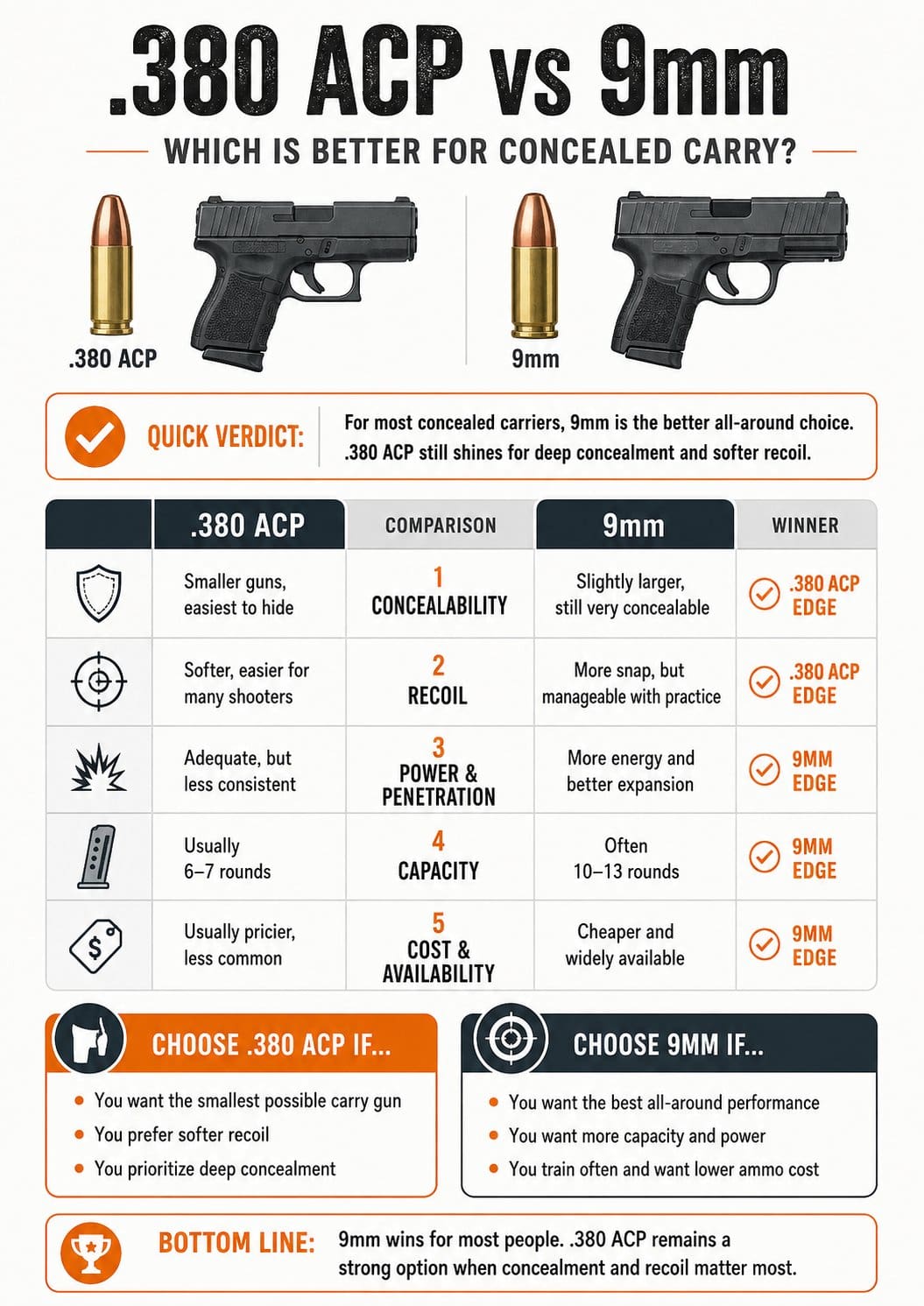
Concealability is the whole of having an everyday carry firearm. Here the .380 ACP has a clear edge in the smaller frame firearms that are chambered in it. Many .380 pistols are thinner, lighter, and shorter than their 9mm counterparts.
Models like the Ruger LCP or Smith & Wesson Bodyguard can disappear quite easily in a front pocket on your jeans.
Most modern 9mm carry firearms are only a little larger than the .380 ACP firearms. Firearms such as the Glock 43, Sig P365, or Springfield Hellcat still fit under a T-shirt or in an appendix holster without much trouble.
The extra size often brings higher capacity magazines that range from 10 to 13 rounds versus the 6 to 7 rounds that many .380s hold.
That extra ammo can matter if a confrontation lasts longer than expected. Sometimes more is better.
If your priority is to have the absolute smallest footprint and you already shoot well with a .380, that cartridge still makes sense. The common stat you see online quotes the FBI saying the average defensive encounter only contains 2-3 gunshots. So the .380 has more than enough capacity on average.
For most carriers who can handle a slightly larger pistol, the 9mm’s capacity advantage can give you a bit more reassurance though.
Recoil & Shootability
The recoil factor is often a very personal aspect that each shooter can only answer for themselves. The .380 ACP is definitely milder in recoil compared to the 9mm.
In a lightweight, polymer pistol it still snaps, but most shooters find it much easier to control for faster follow up shots. That softer push can help newer shooters or people with smaller hands stay on target better.
The 9mm generates more felt recoil, especially in smaller compact firearm setups. Modern designs with good grips, ports, or compensators can help tame the 9mm down even more.
Plenty of people shoot a 9mm compact faster and more accurately than a tiny .380 once they put in the range time to practice.
Practicing with the exact gun and ammo that you plan to carry is far more important than the type of firearm or the name on the side of the ammo box.
Familiarity with your firearm will go much further quibbling over having the perfect round for the situation. Preparation over perfection.
If you struggle with heavy recoil or have wrist or hand issues, the .380 may keep you practicing more often and keep you more consistent in the moment that it matters most.
Consistency and shot placement usually beats theoretical power that isn’t as accurate.
Stopping Power & Real World Performance
This is usually where the debate gets heated between .380 ACP and 9mm. The 9mm generally delivers higher velocity and more energy. Typical 9mm defense loads push a 115 or 124 grain bullet at around 1,100 to 1,200 feet per second from a short barrel.
That extra speed helps hollow point bullets expand more reliably and create larger wound channels on impact.
The .380 ACP usually launches a 90 to 95 grain bullet at 900 to 1,000 feet per second from the same short barrels. Modern premium hollow points have helped close the gap with the 9mm, but they still start with less energy.
This can create lower expansion reliability and create smaller, shorter wound channels, essentially creating less damage on the target.
FBI and independent gel tests show many quality 9mm loads expand and penetrate in the preferred 12 to 18 inch range more consistently than most .380 loads.
This means that the 9mm has more knock down power and inflicts more stopping power compared to the .380 ACP.
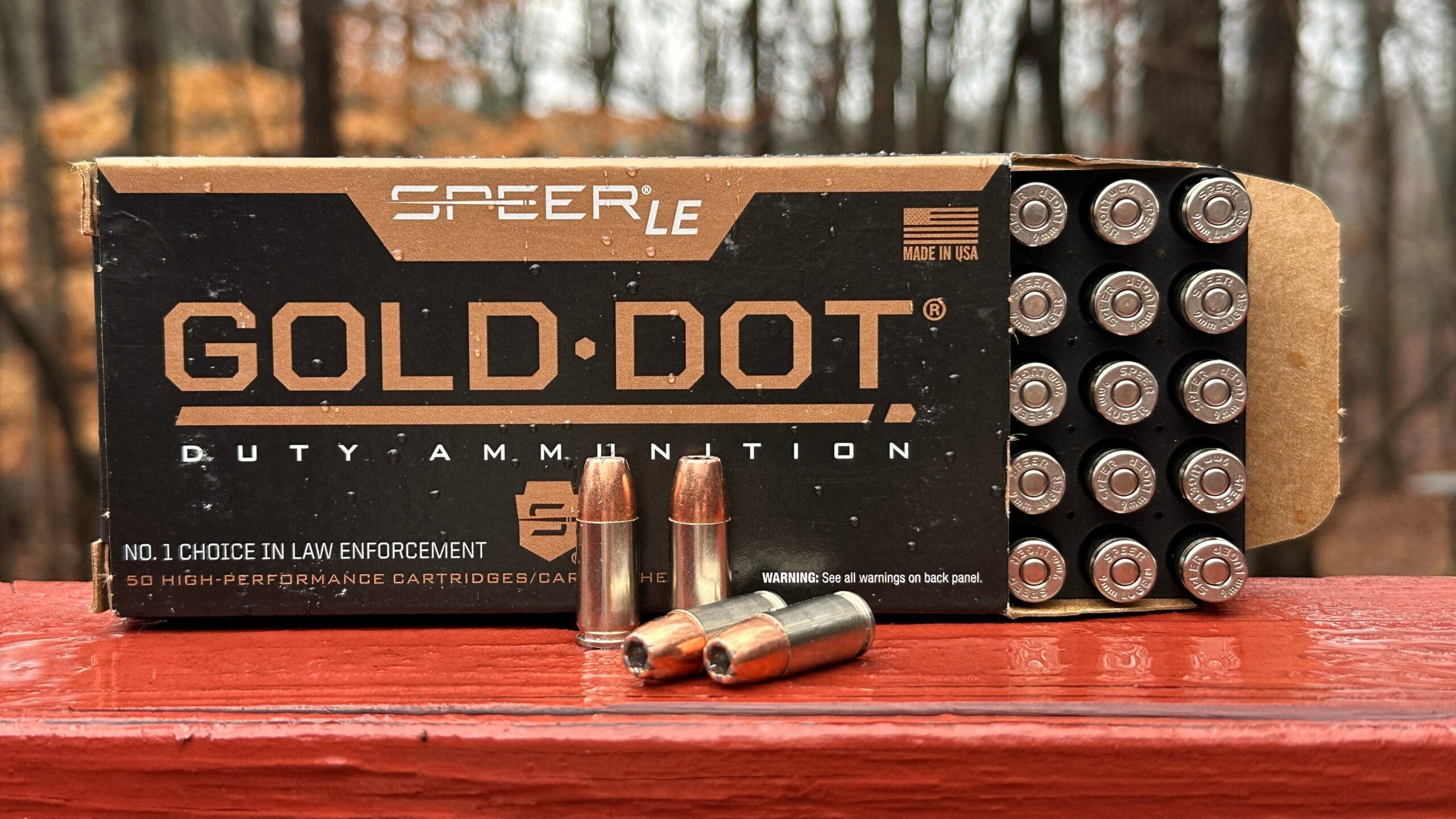
If you want a defensive 9mm load built around that exact expansion profile, the Speer Gold Dot 124 Grain +P JHP is one of the most trusted choices for compact carry guns and has built up a loyal following among our customers.
Neither round is a magic “one shot stop.” Shot placement and the ability to fire multiple rounds accurately matters more than the cartridge itself. Still, the 9mm gives you a wider margin of error if the first hit is not perfect.
For a deeper look into what works best in shorter, compact barrels, see our guide on Best Ammo for Short-Barrel Pistols (Compact & Subcompact).
Ammunition Availability & Cost
The 9mm is available everywhere. You can buy it at almost any sporting goods store, big box retailer, or online shop. Bulk options are readily available and prices stay lower because of the huge production volume in the ammo industry.
That matters for training with your everyday carry firearm. You need to shoot regularly with the same type of ammo that you carry.
Stock up on affordable range ammo like the CCI Blazer 124 Grain FMJ; it’s one of our most reviewed practice loads and keeps cost per round low enough to train as often as you should.
The .380 ACP is less common than the 9mm. This leads to a higher cost per round and the selection of ammo can shrink during times of high demand.
You can still find good defensive loads, but bulk buying practice ammo for the .380 ACP is a little harder.
Good news, bulk .380 practice ammo is still out there. The Fiocchi Range Dynamics 95 Grain FMJ is a reliable, affordable option to keep in rotation for range days.
If you want to train often without spending a small fortune, the 9mm wins again over the .380 ACP.
When you are ready to stock up for both the range and everyday carry, check out options for reliable defensive rounds in our article on What is the Best 9mm Self Defense Cartridge for EDC?
Capacity & Magazine Differences
Most .380 pocket pistols hold 6 or 7 rounds, while a few stretch to 8 to 10 rounds with extended magazines that stick out a bit further.
The 9mm micro-compacts routinely offer 10 to 13 rounds in a very similar overall size. That extra capacity can be the difference between having rounds left over and running dry during a high stress event.
Higher capacity also means you can practice more before reloading at the range. Combined with cheaper ammo, it encourages training that actually improves performance under pressure.
Once again, the 9mm wins if you are looking to have more rounds ready in your everyday carry.
Reliability in Compact Guns
Both cartridges can be extremely reliable in quality pistols. The 9mm has a slight edge because more manufacturers design around it and test it heavily.
Modern .380 pistols have improved a lot, but some older or very small designs still prefer hotter loads or specific bullet shapes to help cycle rounds more efficiently.
Always, always test your chosen defensive ammo in your exact firearm. A few hundred rounds of the same load you plan to carry will tell you everything you need to know about your firearm and what to expect out of your chosen ammo.
Who Should Choose .380 ACP?
The .380 ACP still definitely has a place and is recently becoming more popular again.
Choose it if:
- You need the absolute smallest and lightest gun possible for deep concealment or clothing restrictions.
- Recoil from a 9mm makes accurate follow up shots difficult for you.
- You already own a reliable .380 and shoot it well.
- Your carry environment is low threat and you prioritize comfort and accuracy over power.
For the .380 ACP, pair it with a modern hollow point load designed for short barrels. Avoid FMJ practice rounds for defensive uses.
A great place to start is the Hornady Critical Defense 90 Grain FTX JHP. It’s purpose-built for short-barrel .380 pistols and one of our best-reviewed defensive loads in this caliber.
See our comparison of FMJ vs Hollow Point: Which Should You Actually Carry if you want to know more.
Who Should Choose 9mm?
The most popular choice and the group most probably fall in is the 9mm.
Pick 9mm if:
- You can comfortably conceal a modern subcompact or compact pistol.
- You want higher magazine capacity and more energy on target.
- You plan to train regularly and want affordable practice ammo.
- You prefer the wider selection of proven defensive loads, including +P options.
If you fall into this group, take a look at the Federal LE 115 Grain +P+ Jacketed Hollow Point; a proven +P+ defensive load that’s earned strong reviews from carriers who want extra performance in a compact platform.
Many of the same guns that once only came in .380 now have 9mm versions that are only slightly larger than their .380 counterparts. The performance jump is usually worth the small size increase.
For more on higher pressure defensive loads, read Should You Everyday Carry +P or +P+ Ammo? [A Break Down].
Practical Carry Considerations
Holster choice, clothing, and body type can matter just as much as the cartridge choice. A well designed appendix or strong-side holster can hide a 9mm compact almost as easily as a .380 pocket gun for many people.
Try both setups if possible. Comfort in carrying leads to more consistent carry, and consistent carry is more important than the theoretical edge of either round. The best ability is availability.
Also, think about your environment. If you live in a place with higher violent crime rates or work late nights, the extra power and capacity of 9mm provides a larger safety margin.
Training Tips of Either Cartridge
No matter which cartridge you pick, dry fire practice and life fire sessions with your carry ammo are essential to stay at peak performance.
Focus on drawing from concealment, getting hits on a silhouette target at 3-8 yards, and controlling the firearm under stress. Both cartridges will stop a threat when you put the bullets where they need to go.
If you choose 9mm, you can also explore the wider range of proven defensive loads.
Our piece on Federal HST vs Speer Gold Dot: Which Defensive Ammo Performs Better? breaks down two of the most tested ammo options for 9mm.
Your Best Concealed Carry Cartridge
The .380 ACP remains a solid option for deep concealment and softer recoil. For the majority of everyday carriers, though, the 9mm offers a better overall package.
It offers more power, higher magazine capacity, cheaper and more available ammo, and a huge selection of reliable firearms and loads.
Modern compact 9mm pistols have closed the size gap enough that the performance advantage is hard to ignore in exchange for a slightly larger size of the firearm.
Test both in the gun you can actually conceal, practice with the ammo you will carry, and choose the combination that lets you hit what you aim at under stress. That decision will serve you better than any online argument.
When you are ready to stock quality defensive or practice rounds, look for bulk options that keep training affordable and consistent.
The Federated Ordnance 124 Grain FMJ is a solid place to start; budget-friendly, well-reviewed, and available in bulk so you can put in the range time your carry gun deserves.
.380 ACP vs 9mm FAQs
Is .380 ACP or 9mm Better for Concealed Carry?
For most carriers, 9mm is the stronger all-around choice because it offers more energy, higher capacity, cheaper practice ammo, and broader defensive-load selection. .380 ACP still makes sense when the smallest possible pistol or softer recoil matters most.
Is .380 ACP Enough for Self-Defense?
.380 ACP can be adequate when paired with a reliable pistol, quality defensive ammunition, and accurate shot placement. Its main tradeoff is reduced velocity and penetration consistency compared with 9mm, so testing your chosen load in your carry gun is important.
Which Has Less Recoil, .380 ACP or 9mm?
.380 ACP usually produces less felt recoil, especially in small carry guns, which can help with faster follow-up shots. However, very tiny .380 pistols can still feel snappy, and many shooters manage compact 9mm pistols well with practice.
Does 9mm Have Better Capacity Than .380 ACP?
In many modern carry pistols, yes. Pocket-size .380 pistols commonly hold six or seven rounds, while micro-compact 9mm pistols often carry 10 to 13 rounds in a slightly larger package, giving carriers more margin in a stressful encounter.
Is 9mm Cheaper to Practice With Than .380 ACP?
Generally, 9mm is easier to find and costs less per round because it is produced in much higher volume. That lower cost can make regular training more realistic, which matters more than cartridge choice if it improves accuracy and confidence.