Are you standing at the handgun counter, or holding an ammo cart on your phone? There is one question that is probably holding up the purchase. 9mm or .40 S&W?
Three things settle it. How much recoil you can manage, how many rounds you want in the gun, and what the bullet does once it gets where you sent it.
Price belongs there too, especially if you buy practice ammo by the case.
I carry one of these every day and keep the other one in my truck, so you’re not getting a shrug and a draw.
TL;DR: 9mm or .40 S&W by Use Case
Short on time? Or maybe you’re already at the counter? Here’s what we recommend for each job, plus one box to add to your order.
Best for New Shooters: 9mm. Lighter recoil and cheaper practice let you build fundamentals with more rounds in the gun. Shop CCI Blazer 124 Grain FMJ.
Best for Everyday Concealed Carry: 9mm. The slimmer pistol that disappears under a shirt is the one you will actually carry every day. Shop Federal P9HST3 LE 124 Grain +P JHP.
Best for Home Defense: .40 S&W. More energy than a 9mm without the heavier push of a .45, and a nightstand gun does not need to be light. Shop Federal P40HST1 LE 180 Grain JHP.
Best for a Truck Gun or Hunting Sidearm: .40 S&W. When you have room for a full-size pistol and a chest holster, take the extra capability. Shop Underwood 140 Grain Xtreme Penetrator.
Best for High-Volume Training: 9mm. Practice is where the ammo budget goes, and 9mm costs less per round by the case. Shop bulk 9mm FMJ ammo.
Why 9mm Is the Default & When the .40 S&W Earns Its Spot
For most people, 9mm is the right default. It’s cheaper, it holds more, it recoils less, and modern defensive loads have closed most of the performance gap that used to justify going bigger.
I carry a Bersa BP9CC every day, not because of ballistics, but because it’s slim enough to ride on my body all day without me thinking about it.
The .40 S&W earns its spot when the pistol doesn’t have to disappear under a shirt.
It gives you real energy per round, it stays manageable in a duty-size gun, and it sits between 9mm and .45 ACP, with less of that sluggish .45 push.
That is why my truck gun is a Glock 23, and why it goes in a chest holster when I hunt.
If you are weighing the bigger bores too, see our guide on 9mm Vs .45 ACP: Which Cartridge Makes More Sense in 2026? before you settle on a cartridge.
Here is how the two compare on paper, with capacity shown in the same pistols.
| Specification | 9mm Luger | .40 S&W |
|---|---|---|
| Bullet diameter | 0.355 in | 0.400 in |
| Common bullet weights | 115, 124, 147 gr | 155, 165, 180 gr |
| Case length | 0.754 in | 0.850 in |
| SAAMI max pressure | 35,000 psi (38,500 psi +P) | 35,000 psi |
| Full-size Glock capacity | 17 rounds (G17) | 15 rounds (G22) |
| Compact Glock capacity | 15 rounds (G19) | 13 rounds (G23) |
How the .40 S&W Was Born & Why the FBI Walked Away
The .40 S&W came about after an FBI shootout in Miami on April 11, 1986. Two bank robbers killed two agents and wounded five more, and the Bureau went looking for a semi-automatic to replace its revolvers.
Firearms Training Unit chief John Hall added the 10mm Auto to the evaluation, and a reduced-velocity load, roughly a 170- to 180-grain hollow point at 900 to 1,000 fps, gave the FBI the penetration it wanted without full-power 10mm recoil.
The cartridge worked. The pistol did not. The Smith & Wesson Model 1076 built around that load was large and heavy, so Smith & Wesson and Winchester shortened the 10mm case to fit the same performance into a 9mm-sized frame. The .40 S&W debuted January 17, 1990.
What Changed the FBI’s Mind
In a May 6, 2014 memo, the FBI Training Division laid out why it was going back to 9mm: higher magazine capacity in a similar-sized pistol, less recoil and faster follow-up shots, lower ammunition and maintenance costs, and better qualification scores among agents.
What you won’t find in that memo is any claim that the .40 S&W stopped working. It says agents shoot 9mm better and cheaper, and that good 9mm ammunition caught up.
Paul Harrell retraces the Miami shooting and the road to the .40 S&W, and his own hands-on testing of 9mm and .40 duty loads leads him to a different conclusion than the FBI’s.
Cartridge Specs & Ballistics: Velocity, Energy & Trajectory
Cartridge comparisons only work if the loads are comparable. Same maker, same bullet line, same test barrel.
A figure drawn from a 5-inch barrel set beside one from a 3-inch carry piece isn’t a comparison, it’s a sales pitch. Here are two Speer Gold Dot loads, both from a 4-inch barrel.
| Speer Gold Dot, 4-inch test barrel | 9mm Luger 124 gr | .40 S&W 180 gr |
|---|---|---|
| Muzzle velocity | 1,150 fps | 1,025 fps |
| Muzzle energy | 364 ft-lbs | 420 ft-lbs |
| Velocity at 50 yards | 1,044 fps | 956 fps |
| Energy at 50 yards | 300 ft-lbs | 365 ft-lbs |
| Drop at 50 yards (25-yard zero) | 0.9 in | 1.3 in |
Energy on Paper Vs Energy That Matters
At the muzzle, the .40 S&W is carrying 56 more foot-pounds, or about 15 percent. That difference is valid, and it doesn’t change the class of the cartridge.
Both of these are still handgun cartridges at less than 450 foot-pounds, while a normal 55-grain 5.56 rifle round leaves the muzzle at roughly three times that much.
The FBI’s 2014 memo says what matters is penetration depth and shot placement. A 56 foot-pound delta at the muzzle changes neither. Treat the energy edge as a minor tiebreaker, not a reason to carry a handgun you can’t shoot well.
For what that number actually represents and where it stops predicting performance, see our guide on What Is Firearm Muzzle Energy? [Why It Actually Matters].
Trajectory Inside Defensive Distances
Drop is not a factor inside defensive distances. Zeroed at 25 yards, Speer’s charts put the 124-grain 9mm about 0.9 inch low at 50 yards and the 180-grain .40 about 1.3 inches low, less than half an inch apart.
If you’re inside 15 yards, you’re holding the same point of aim with either one.
Recoil & Controllability: What You Feel & What It Costs You
The .40 S&W impulse is sharper, and there’s a good reason why. That 180-grain bullet at 1,025 fps carries about 30 percent more momentum than the 124-grain 9mm at 1,150 fps, and the pistol has to handle the difference.
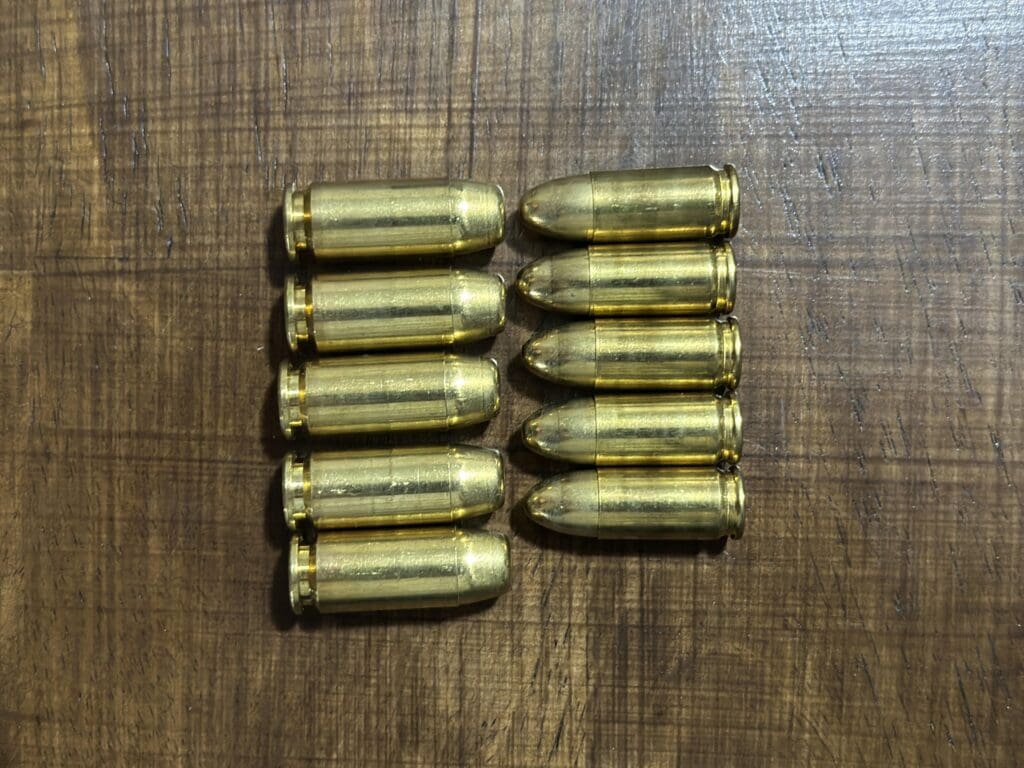
You feel it as muzzle flip and a slower reset back to the sights, which costs you time on follow-up shots.
It’s not nearly the monster it’s made out to be online, though. My Glock 23 is pleasant to shoot. Compared to a 9mm it is clearly working harder, and it’s still well short of overpowering.
Why the Same Cartridge Feels Different in Two Pistols
The specific gun matters more than most caliber debates let on. The all-stainless Smith & Wesson Model 4006 weighs about 37 ounces, while Glock lists the current G23 Gen5 at 24.23 ounces without a magazine.
Same cartridge, and the steel gun absorbs recoil the polymer gun passes into your palm.
My Glock 23 in .40 is easier for me to shoot than my Bersa BP9CC in 9mm, because the Glock gives me a full grip, a 4.02-inch barrel, and more weight in hand. Shoot the exact pistol before you decide a cartridge is too much.
Recoil & Practice Volume
Recoil adds up over a range trip. A harder kick fatigues your hands sooner, and tired hands are where a flinch begins.
If 100 rounds of .40 leaves you done while 200 rounds of 9mm doesn’t, the 9mm shooter practiced twice as much that week.
If recoil is what cuts your sessions short, a case of 115-grain 9mm FMJ is a softer-shooting way to buy volume.
To see the recoil difference for yourself, Hickok45 shoots a Glock 19 and a Glock 23 back to back and talks through what he feels.
Magazine Capacity: The Rounds You Give Up for a Wider Bullet
The capacity gap is small and remarkably consistent. Moving from 9mm to .40 S&W costs you two rounds in a duty-size pistol, and the same two in a compact.
Glock lists 17 rounds for the G17 and 15 for the G22. Smith & Wesson lists exactly the same 17 and 15 for the M&P9 M2.0 and the M&P40 M2.0.
Drop to the compacts and both makers land on 15 rounds of 9mm against 13 of .40.
Two companies arrive at the same gap because it isn’t a design decision, it’s the width of the bullet. Exact counts still move around by model and magazine, so check the specific pistol.
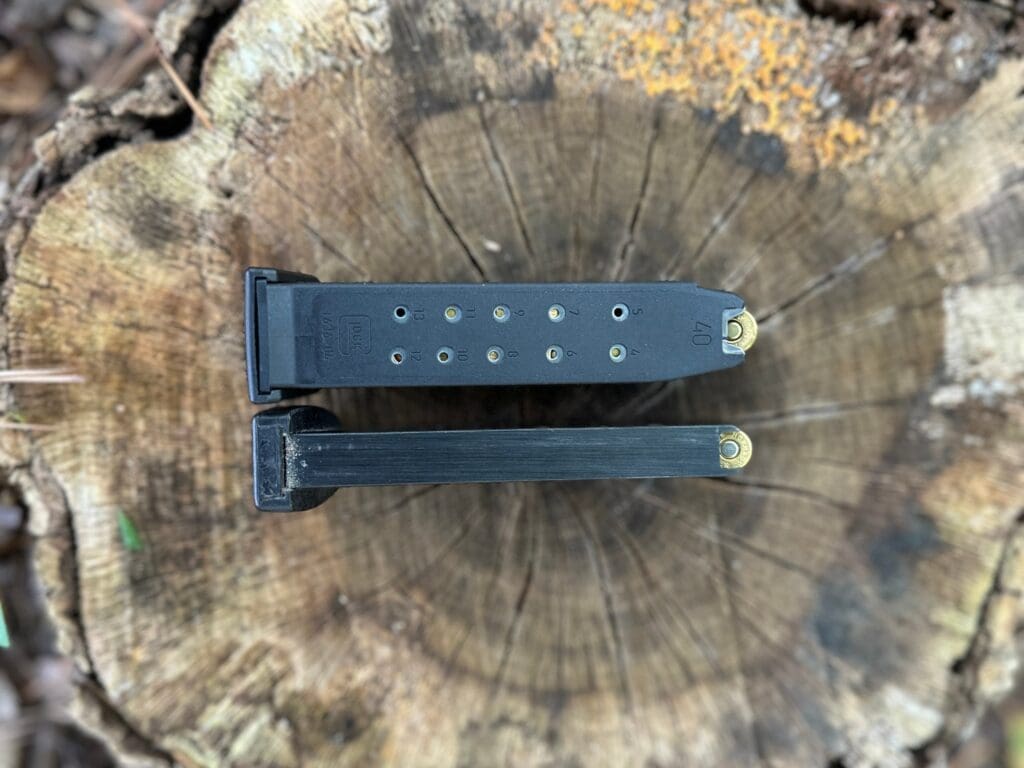
Whether two rounds matter is your call. For most defensive use the answer is probably no.
Self-Defense Performance: Stopping Power, Penetration & Modern Loads
Here is where the argument usually goes wrong. The gap between quality defensive loads narrowed, and people read that as proof the .40 S&W is pointless. It’s overlooked, not obsolete.
The gap narrowed because both cartridges are engineered against the same yardstick. The FBI protocol fires each load into 10 percent ordnance gelatin through six events: bare gel, heavy clothing, steel, wallboard, plywood, and automobile glass.
The requirement is 12 to 18 inches of penetration in every one.
If you want a proven one off the shelf, Federal P9HST3 LE 124 Grain +P JHP is a law-enforcement load built for that kind of barrier testing.
What Stopping Power Actually Describes
Stopping power is a folk term, and the FBI’s own memo called it a myth. The things you can measure are how deep the bullet penetrates, how much it expands, and where it comes to rest.
Both depend on the load and the barrel it left, so a number from a 4-inch test barrel does not transfer to your 3-inch carry gun.
Penetration & Over-Penetration
Because bullets can and do pass through walls, the wallboard event is part of the FBI protocol. There are two layers of half-inch gypsum set 3.5 inches apart, and the 12 to 18 inch requirement still applies after that.
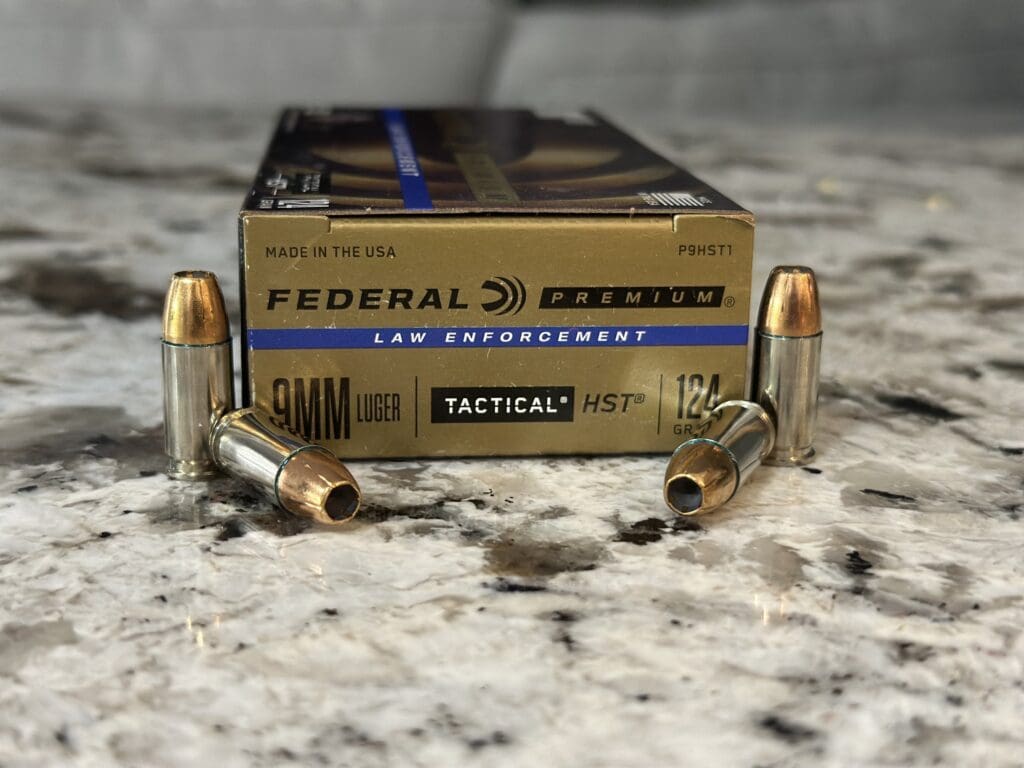
Any defensive round that penetrates enough to work will also pass through interior walls. Same thing with the 9mm or the .40, so knowing what’s behind your target is important.
For practical steps on reducing that risk inside a home, see our guide on How to Avoid Over-Penetration in Home Defense Scenarios.
Placement Beats Caliber
The same FBI memo notes that officers hit with only 20 to 30 percent of the rounds they fire in real incidents, and that placement is the deciding factor.
The round you can put where it needs to go, under stress, is the one that performs.
Ammo Cost, Availability & Buying in Bulk
Cost favors the 9mm, though by less than its reputation suggests. As of late October 2026, our listed case prices start around $245 per 1,000 for 9mm FMJ and $290 for .40 S&W FMJ, a gap of roughly 4.5 cents a round.
.40 S&W is less about cost than supply. Bulk practice ammunition generally comes in smaller batches and sells out quickly, so the question is often whether a case is available at all, not what it costs.
Check to see if it is in stock before buying a cartridge that you are going to shoot a lot.
Defensive .40 is the exception. Loads like the CorBon 140 Grain DPX Hollow Point stay on the shelf even when the practice ammo does not, so stocking carry rounds is rarely the problem.
Range Ammo Vs Carry Ammo Budgets
Treat these as two separate budgets. Carry ammo is a small, infrequent purchase in either chambering, and Speer Gold Dot 124-grain runs about 55 cents a round in a case of 1,000, while Federal HST 180-grain in .40 S&W comes in a little cheaper at about 50 cents. You need enough to confirm your pistol cycles it and to keep your magazines topped off.
Practice ammunition is the volume spend, and where buying by the case pays. A dime a pop over 1,000 rounds is $100. That’s a lot of time at the range.
For real numbers on where case quantities stop paying off, see our guide on Is Buying Ammo in Bulk Worth It? [the Cold Hard Facts].
Pick the Caliber You’ll Actually Shoot Well
New shooter or first defensive pistol: 9mm. Less recoil, cheaper practice, and more rounds in the gun while you build fundamentals.
Everyday concealed carry: 9mm. The pistol that disappears under a shirt is the one you will actually carry.
Home defense: .40 S&W, if you want a handgun for it. More energy than a 9mm without the slower, heavier push of a .45, and a nightstand gun does not need to be light.
Truck gun or hunting sidearm: .40 S&W. When you have room for a full-size pistol and a chest holster, take the capability.
High-volume training: 9mm, on cost alone.
The one that overrides all of it: if you shoot the .40 better, carry the .40.
Do not settle this from a spec sheet. Borrow comparable pistols in both chamberings, ideally a Glock 19 next to a Glock 23, and bring a shot timer.
Shoot a five-round string at 7 yards with each, then run it again after 50 rounds when your hands are tired. Whichever one gives you the tighter group and the faster second shot is your answer.
9mm Vs .40 S&W FAQs
Is 9mm or .40 S&W Better for Everyday Carry?
The vast majority of people will do better with 9mm as their carry round, due to reduced recoil, cheaper ammunition for training, and the fact that comparable pistols hold two extra rounds. Even so, modern defensive ammunition has closed much of the gap, which means shot placement matters more.
Does .40 S&W Recoil More Than 9mm?
The .40 S&W usually has a harder kick as it’s launching a larger bullet with greater mass behind it. In smaller and lighter pistols, this may lead to more muzzle rise, less rapid recovery for follow-up shots, faster shooting fatigue, and more likelihood of developing a flinch.
How Much Magazine Capacity Do You Lose With .40 S&W?
If you compare pistols offered in both .40 S&W and 9mm, they usually run about two rounds apart. Examples include full-size and compact Glock and M&P models. The exact number can vary by magazine and gun, but the pattern holds.
Does .40 S&W Have More Stopping Power Than 9mm?
The .40 S&W generally has more energy at the muzzle than 9mm, but that isn’t the question that matters for a defensive caliber. What matters is the most dependable bullet, one that penetrates adequately, expands properly, and can be placed accurately in a high-stress situation with a handgun you can shoot well.
Is 9mm Cheaper to Shoot Than .40 S&W?
Bulk 9mm is typically more accessible and less expensive than .40 S&W. Defensive .40 loads are usually easy to find, but bulk range ammunition can be harder to come by. For those who shoot frequently, the savings from 9mm add up.