Prefer audio over written content? Listen to the article here:
If you are in the market for an intermediate-sized cartridge, especially for an AR or AK setup, you may have come across both the .300 Blackout and the 7.62×39mm.
The comparison comes up a lot, and it gets fiercely debated on both sides. Both deliver solid .30 caliber performance inside a couple hundred yards, and neither one beats you up in a properly set up rifle.
Neither cartridge is universally better though.
The .300 Blackout wins in the AR-15 platforms, short barrels, suppressed use, and home defense versatility. The 7.62×39 wins on raw energy, lower cost, and AK platform reliability. Your rifle, the intended use, and your budget decide the true winner.
Both the .300 Blackout and the 7.62×39 have their passionate fans alongside the AR and AK rifle platform enthusiasts who will argue which is better until they are blue in the face.
This guide breaks down each cartridge so you can pick which one is better for your setup, without the fanboy noise.
TLDR; The Short Answer by Use Case
Both rounds are capable .30 caliber performers inside 200 yards, and if you already own an AR or an AK, that decision is mostly made for you. Here is who wins what.
- Home defense: .300 Blackout, especially subsonic behind a suppressor.
- Suppressed shooting: .300 Blackout. It was designed for exactly this.
- Range time and high-volume practice: 7.62×39, on cost alone.
- Deer and hogs inside 200 yards: Either one. The 7.62×39 hits harder, the .300 Blackout gives you more bullet choices.
- Availability today: 7.62×39, by a wide margin.
- Short-barrel and AR pistol builds: .300 Blackout.
Cartridge Specs: A Side-by-Side Look
The 7.62×39 is the cartridge that powers the SKS and the AK-47, and it has been in production since the mid-1940s. The .300 Blackout is the modern answer to it, developed by Advanced Armament Corporation in concert with Remington around 2010 to deliver similar performance from a short barrel on an AR-15.
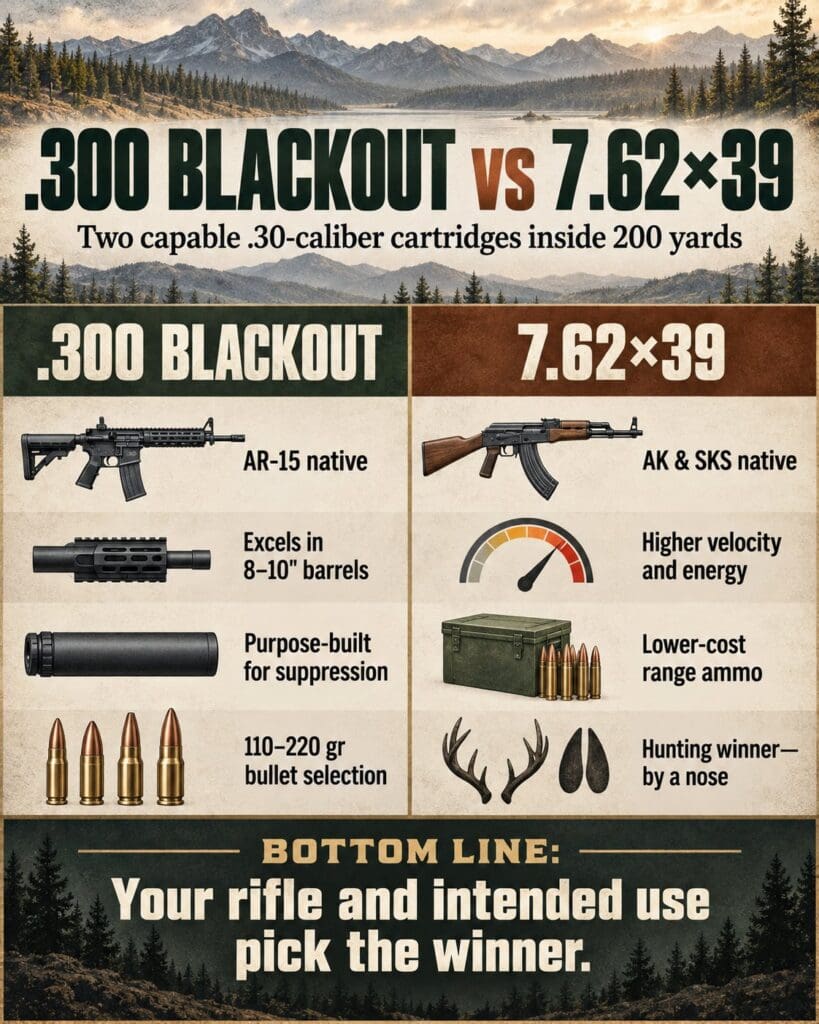
Both are intermediate cartridges firing .30 caliber bullets, but each one gets there differently.
When it comes to bullet diameter, the .300 Blackout uses a true .308-inch bullet, whereas the 7.62×39 uses a .310- to .311-inch bullet. A small difference, but a difference nonetheless.
Typical bullets for the 7.62×39 run in the 122- to 125-grain range and don’t vary much from that weight.
The .300 Blackout, on the other hand, offers a much wider range of options, from 110- and 125-grain supersonic loads all the way up to 190- and 220-grain subsonic loads.
The two cases run slightly different lengths, with the 7.62×39 holding more case capacity for powder.
The .300 Blackout offsets that with a higher SAAMI pressure ceiling, 55,000 psi against 45,000 psi for the 7.62×39, which lets it get close on performance out of a much smaller case.
The 7.62×39 also runs a heavily tapered, obviously necked-down case, while the .300 Blackout has a much subtler shoulder.
While the .300 Blackout can look like a straight-wall cartridge at first glance, it is not one, which matters if you hunt in a state that restricts you to straight-wall rounds.
These specification differences explain why the .300 Blackout runs in a standard AR-15 lower with nothing more than a barrel change, while the 7.62×39 needs a dedicated upper or an AK-pattern rifle to work well.
If you’re trying to run subsonic, 300 Blackout typically wins, but if you want to see how much of a difference that speed can make, you should read this article: Subsonic Vs Supersonic Ammo: Real Performance Differences
Ballistics: Velocity, Energy, & Trajectory
On paper these two look nearly identical at matched bullet weights. The 7.62×39 does hold a slight edge in muzzle velocity and energy.
A common 123-grain 7.62×39 leaves a 16-inch barrel between 2,300 and 2,365 fps and produces roughly 1,450 to 1,530 ft-lbs of energy. A 125-grain .300 Blackout sits lower at 2,150 to 2,220 fps and 1,300 to 1,350 ft-lbs from the same barrel length.
At 100 yards, the energy gap shows up noticeably, but it is not as dramatic as the numbers suggest.
The trajectory is close enough that neither one earns a real advantage, and neither is a long-range cartridge. Both start dropping hard past 200 to 250 yards.
The 7.62×39 stays slightly flatter in common loads, but the .300 Blackout can close that gap with optimized bullets that carry better ballistic coefficients.
All of that applies to common supersonic rounds. Go subsonic, and the .300 Blackout pulls way ahead of the 7.62×39.
With heavy 200- to 220-grain bullets at around 1,000 to 1,050 fps, these subsonic rounds are widely available, cycle well in a properly tuned AR, and they pair naturally with a suppressor.
Subsonic 7.62×39 rounds do exist, but they are less common, have more cycling issues, and are rarely optimized the way Blackout subsonics are.
If you want to get into the fine details of ballistics, check out our guide on What Is Firearm Muzzle Energy? [Why It Actually Matters].
Platforms & Practical Handling
Platform and handling are the biggest real-world difference between these two cartridges.
The .300 Blackout was clearly built for the AR-15. It uses the same bolt face, magazines, and lower receiver as 5.56 NATO. Change the barrel, sometimes the buffer, and you are good to go.
That compatibility cuts both ways. A .300 Blackout will chamber in a 5.56 barrel and it will fire, and it’ll wreck uppers and bolt carriers when it does. Keep these two in different, clearly marked magazines, and don’t put them in the same range bag.
Short-barreled rifles and AR pistols have become so popular in the .300 Blackout because it holds velocity in an 8- to 10-inch barrel.
Barrel length moves these numbers more than most shooters expect. Our guide on How Barrel Length Affects Bullet Velocity and Performance shows exactly what you give up as you get shorter.
The gas systems of these platforms can also be tuned for reliable cycling with both supersonic and subsonic ammo.
The 7.62×39 was designed for the AK platform and shines there. This platform’s heavy steel construction and curved magazines handle the cartridge’s geometry and dirtier-burning ammo without complaint.
You could run a 7.62×39 in an AR, but it requires a specific bolt, dedicated magazines or adapters, and can have reliability issues.
Most shooters find it is just less of a headache to use an AK platform with the 7.62×39.
Recoil is mild with both of these platforms and cartridges. The .300 Blackout tends to be slightly softer in recoil, which has made it popular for home defense and newer shooters.
Neither of these cartridges will beat you up like their bigger counterparts in .308 Winchester and 7.62×51 NATO.
Home Defense: Which One Belongs by the Bed
Both of these cartridges are highly capable of stopping a threat inside your home. The choice, as with most home defense setups, comes down to handling, overpenetration risk, and whether you plan to suppress it.
Subsonic .300 Blackout home defense rounds use expanding or controlled-fracture bullets that stop a threat while cutting overpenetration risk compared to other rifle rounds.
Pair those rounds with a suppressor and you get a quieter shot that still hits harder than most handgun cartridges. This is the main reason that the .300 Blackout has become so popular in modern AR builds for home defense.
The 7.62×39 will deliver more stopping power and has a long track record in defense roles, but that energy comes with deeper penetration and a greater risk of punching through interior walls.
Soft point or modern defensive 7.62×39 rounds expand reliably and can help cut that risk.
The bigger issue with the 7.62×39 is the AK platform itself in a home setting. Most AKs are longer, heavier, and louder than the compact ARs people build for this job.
If I were building an AR specifically for home defense, the .300 Blackout is what I would choose.
Worth knowing before you commit: when we ran the numbers in .300 Blackout Vs 5.56 NATO for Home Defense [Backed by Data], 5.56 came out ahead for most setups. Read that one if 5.56 is still on your list.
Winner for home defense: .300 Blackout. A subsonic expanding load like Hornady’s Sub-X 190 Grain Subsonic leaves the muzzle around 1,050 fps, opens up reliably, and stays quiet behind a can. The 7.62×39 has no equivalent.
Hunting Deer & Hogs Inside 200 Yards
Both of these cartridges have also become popular for hunting deer, hogs, and similar-sized game at intermediate ranges inside 150 to 200 yards.
The 7.62×39’s slightly higher velocity and energy give it a small advantage over the .300 Blackout. Many hunters have started treating the 7.62×39 like a modern .30-30 and like its performance.
The .300 Blackout has the upper hand when it comes to bullet options. Light, fast polymer-tipped or monolithic copper bullets open up quickly and put game down cleanly.
Heavier subsonic loads work for quiet hunting, but they lose reliability past 100 yards or so. Newer, high-quality hunting loads have made the Blackout a more popular deer and hog round than most people expect.
Bullet weight and construction matter a lot in the hunting world. Heavier bullets usually penetrate deeper, while lighter ones can expand faster.
Again, the .300 Blackout tends to have more ammo options that give hunters different choices based on what they prefer for hunting their intended target.
Our article How Bullet Weight Actually Affects Performance can walk you through the trade-offs between heavier and lighter bullets.
Winner for hunting: 7.62×39, by a nose. A soft point like the Wolf Polyformance 125 Grain SP gives you the energy edge at deer and hog distances for steel-case money. Go .300 Blackout instead when you want premium bullet construction or a quiet shot.
Range Time, Cost, & Availability
The 7.62×39 usually wins for high-volume shooters. Decades of global mass production keep it plentiful and cheap by the case.
On a per-round basis, the 7.62×39 is usually cheaper than the .300 Blackout. Steel-cased surplus, brass-cased ammo, and modern commercial loads all sit at relatively low cost.
As the .300 Blackout has become more popular over the last 15 years, it has also come down in price as production has increased. Good bulk deals do exist, especially on training and defensive loads.
The more specialized subsonic and hunting loads still carry much higher prices. If you shoot a lot, the cost difference can add up fast.
If case-quantity pricing is what you are after, start with our 7.62×39 bulk collection, where the steel-cased 500- and 1,000-round options live.
If you are looking at the 7.62×39 and trying to decide between cheaper steel cased options and premium brass, our comparison Steel Case Vs Brass Case Ammo: Is Cheaper Better?. is worth the read.
Winner for range time: 7.62×39, and it is not particularly close. Cheaper per round, easier to find, and steel-case bulk is what keeps a high-round-count day affordable.
Pros & Cons at a Glance
The table below lines up the pros and cons of each cartridge on the same set of factors, along with what each one does best.
| Factor | .300 Blackout | 7.62×39 |
|---|---|---|
| Best platform | AR-15, barrel swap on a standard lower | AK pattern & SKS |
| Muzzle energy, common load | Roughly 1,300 to 1,350 ft-lbs (125 gr) | Roughly 1,450 to 1,530 ft-lbs (123 gr) |
| Short barrels | Holds velocity in 8 to 10 inches | Loses more velocity, louder, more flash |
| Subsonic & suppressed | Purpose-built, wide selection | Few loads, cycling problems |
| Bullet selection | 110 to 220 gr, many designs | 122 to 125 gr, few specialty designs |
| Recoil | Slightly milder | Mild, slightly sharper |
| Cost per round | Higher, falling as production grows | Lower, especially by the case |
| Availability | US commercial market | Global, decades of surplus |
| Best uses | Home defense, suppressed builds, deer & hogs inside 200 yards | High-volume range time, deer & hogs inside 200 yards, AK builds |
Which One Should You Choose?
Choose the .300 Blackout if you already have ARs, want a suppressed, short-barrel setup, or want to prioritize home defense. It gives you the widest ammo selection of the two, whatever the job turns out to be.
Ammo might cost you a little more, but the rise in popularity of the .300 Blackout will continue to see those costs come down with time.
Choose the 7.62×39 if you prefer the AK platform, shoot high volume, and want the lowest bulk ammo cost. A good AK will train and hunt reliably for years.
If you want that little extra energy and a slightly flatter trajectory while keeping your ammo costs down, the 7.62×39 is a great choice.
The platforms are different enough that they don’t really compete for the same role. What matters most is matching the cartridge to your specific rifle and to what you actually plan to do with it.
Your Rifle Already Picked the Winner
The .300 Blackout and the 7.62×39 are two excellent intermediate cartridges that solve similar problems in different ways. One is engineered for modern AR versatility and suppression, while the other has decades of real-world performance in tough conditions.
Both cartridges reward good shot placement at intermediate ranges far more than the tiny differences that separate them on a ballistics chart.
Figure out which platform you want, whether short barrels and suppression are part of the plan, how much you plan to shoot, and what the rifle will actually be used for.
.300 Blackout Vs 7.62×39 FAQs
Is .300 Blackout or 7.62×39 More Powerful?
With common supersonic loads, 7.62×39 usually has a small edge in muzzle velocity and energy. The gap is noticeable but not huge inside typical intermediate ranges, and bullet design, barrel length, and shot placement still matter more.
Which Cartridge Is Better for an AR-15?
The .300 Blackout is generally better for AR-15 builds because it works with standard lowers, bolts, and magazines when paired with the correct barrel. A 7.62×39 AR can work, but it often needs dedicated parts and careful tuning.
Which Cartridge Is Better for Suppressed Shooting?
.300 Blackout is the stronger choice for suppressed shooting, especially with heavy subsonic ammunition. It was designed around short AR barrels and suppressor use, while subsonic 7.62×39 loads are less common and can be harder to cycle reliably.
Is .300 Blackout or 7.62×39 Better for Home Defense?
For home defense, .300 Blackout often has the advantage because it performs well in compact ARs and offers effective defensive loads, including subsonics. The 7.62×39 is capable, but it is usually louder, heavier-recoiling, and more prone to wall penetration.
Which Cartridge Costs Less to Shoot?
The 7.62×39 is usually cheaper, particularly for bulk practice ammunition, because it has been produced globally for decades. .300 Blackout prices have improved, but specialized hunting, defensive, and subsonic loads still tend to cost more per round.